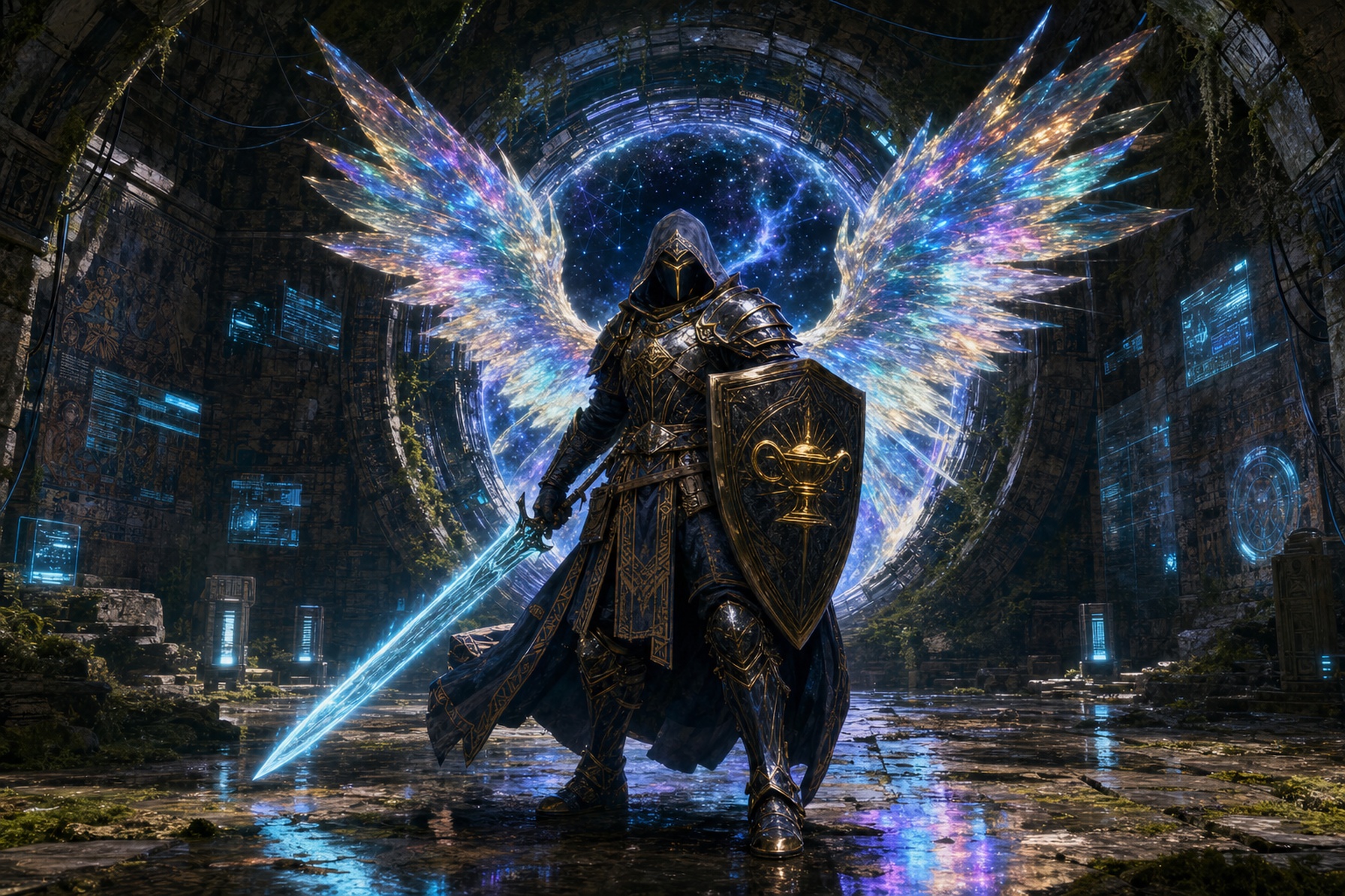
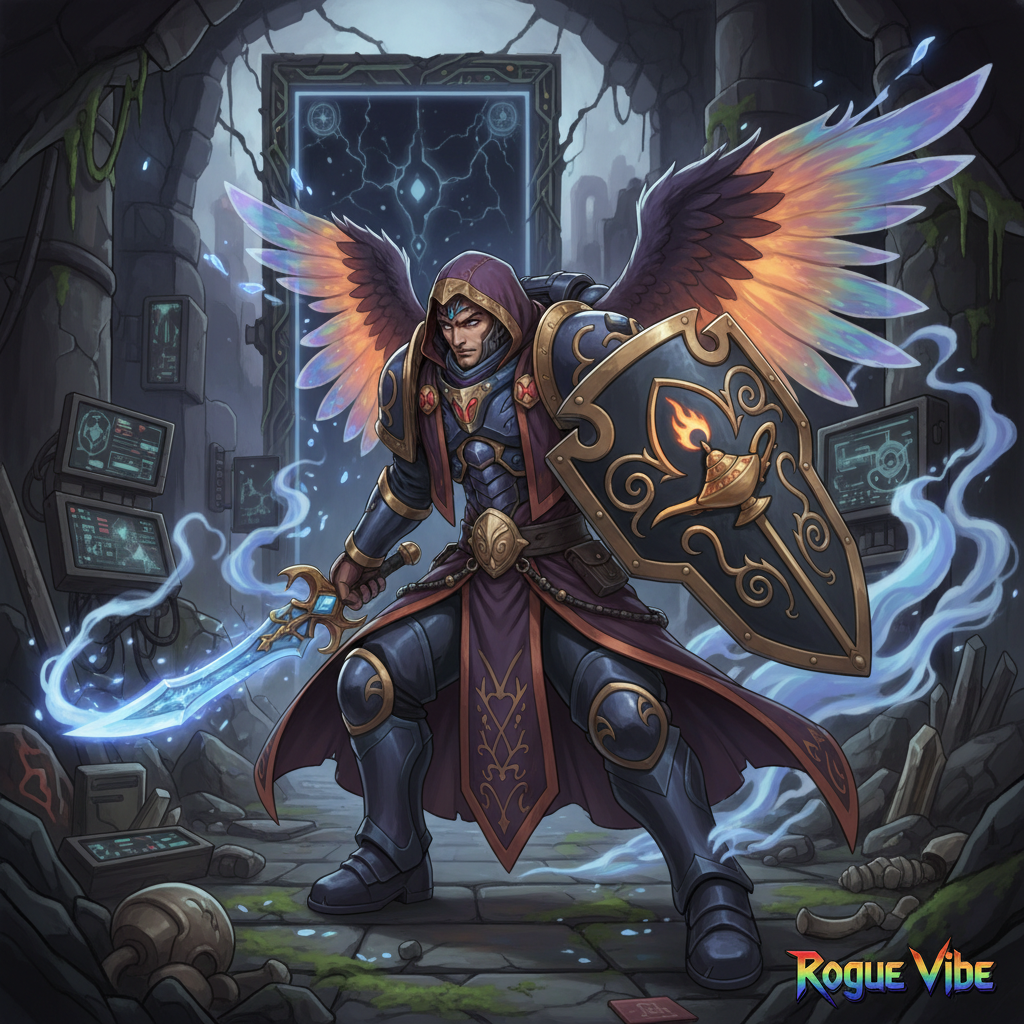
A hooded guardian stands in a crumbling stone arch choked with moss and stray wires. Holographic screens blink from cracked walls; a storm-blue portal hums at his back like a window into starfire. His armor is midnight steel trimmed in gold. A lamp is emblazoned on his shield; his blade glows cold as river ice. Feathered wings of prismatic light arc from his shoulders, scattering color across the ruined floor.

Where it is from, which plane, and which era:
- Place: The substructure beneath Monks Mound at Cahokia Mounds State Historic Site, on the Mississippi floodplain near present-day Collinsville, Illinois, Earth.
- Plane: The Interstice—an overlap of the physical world and a navigable data/astral layer nicknamed the Star-Web.
- Era: Late 25th century CE, during the Second Rejoining, when old earthworks and new networks were being bound together.

Backstory:
Long after the flood-control wars, engineers and historians rebuilt a research cloister under Monks Mound with the consent of local nations descended from the Mississippian world. They discovered a resonance: the geometry of the mound, the sky, and their quantum relays created a stable “gate” that let trained custodians step into the Interstice to retrieve lost knowledge and carry messages across vast distances.

The winged guardian called himself the Lantern, a title rather than a name. His order, the Wardens of the Lamp, swore to use the gate in service of healing, food security, and clean water—nothing that would turn the Star-Web into a weapon. Local elders reminded them of a simple measure of integrity: whatever decision you make must still look good seven generations from now, a principle shared in Haudenosaunee teachings; and it must hold hózhó—balance and right relation, as taught in Diné thought. The Lantern carried those reminders like runes inside his armor.

The life event that forged him:
In his third year as a Warden, the Lantern uncovered a sealed directive: a defense ministry had co-opted the cloister. They planned to use the gate to mirror minds, predict uprisings, and preemptively neutralize “statistical threats.” The order’s secrecy oath forbade disclosure. Breaking it would cost him his post, his stipend, his community. Keeping it would doom the gate to a purpose it had never been granted.

He remembered a teaching a visiting elder had offered on the terrace at dusk: “Truth told in council binds you tighter than any private oath.” He also recalled how, in many nations’ stories, Coyote tests people by offering an easy path that bends the truth; take it once, and you begin to live inside your own lie. The Lantern chose council over quiet. He called an open assembly with the river towns and the partner nations, read the directive aloud, and surrendered his badge.

The ministry struck back—froze accounts, shut doors, tried to seize the site. But the council stood firm, invoking their agreements and the older law of consent. Technicians wiped the weapon code; farmers and families ringed the mound in vigil. In the weeks that followed, the Lantern’s order fractured. Some branded him traitor. Others said he had returned the gate to its promise. He lost his rank but kept his word.

In the Interstice, integrity leaves a trace. When the Lantern returned to the gate to resign, the portal flared; his back burned with light, and those wings—part physics, part metaphor—coalesced. “A sign?” someone whispered. He only said, “A consequence.” From then on he patrolled the ruined cloister as an independent guardian, shield marked with the lamp to remind him that a light is for seeing, not for blinding.

Moral, writ large:
Power offered him the luxury of silence; he chose a harder loyalty—to people he would never meet, generations unborn, and to the delicate balance between knowledge and harm. Like the Great Law of Peace urging leaders to think far beyond themselves, and like teachings that weigh action by whether it keeps the world in right relation, his integrity cost him comfort but preserved a doorway the future could trust.

Some say when the portal opens at night it looks like the Milky Way—the Path of Souls, as it’s called in several Indigenous traditions. The Lantern stands there, wings bright, asking each traveler the same question he once asked himself: Will your promise be something the seventh generation can live with? Only those who answer in a way that keeps balance step through.
Please log in to comment
roy.m.taylor: And can we talk?