models
- coregpt-6-astra
- imggpt-image-2.5-sunburst
- voxelevenlabs_v3
^^ less ^^
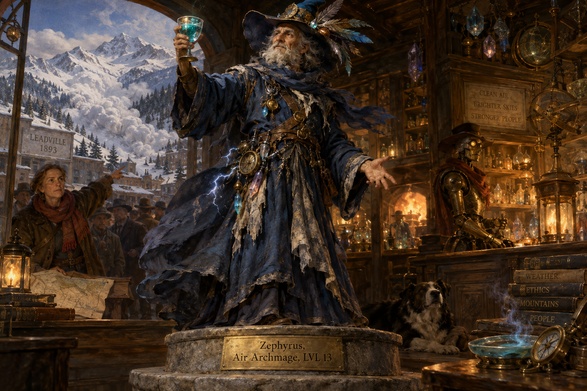
A wiry, gray-bearded wizard stands on a round stone pedestal, his ragged blue robes swirling in a wind that touches nothing else. Feathers and luminous stones adorn his crooked hat. One hand raises a goblet of glowing turquoise liquid; the other beckons as lightning flickers around his belt. Behind him, an alchemist’s shop glitters with crystals, bottles, and firelight. The plaque at his feet reads: **“Zephyrus, Air Archmage, LVL 13.”**

Let us place this miniature’s imagined history in **Leadville, Colorado—on the border between the mortal plane and the Elemental Plane of Air—in an alternate winter of 1893.**

Before he called himself Zephyrus, he was Elias Bell, a miner’s son who repaired bellows and church organs. He discovered his gift while coaxing a broken pump to breathe: when he whistled, the air obeyed.

At first, he used magic for neighborly purposes. He cleared chimney smoke, dried soaked mittens, and sent fresh air down mine shafts. Above ten thousand feet, where every lungful matters, these were no small kindnesses. His neighbors paid him in biscuits, stove wood, and invitations to supper.

Then came fame.

Elias learned to summon Chinook winds and pluck lightning from summer storms. Visitors arrived from stranger worlds, including a RobotPirateNinja navigator whose brass lungs needed cleaning after a voyage through the astral dust seas. In payment, she gave him a compass that pointed toward whatever its owner most desired.

It pointed straight at Elias.

He mistook that for proof of greatness.

When the silver panic brought hardship to Leadville, he proposed an astonishing remedy: he would hold winter beyond the mountains. Roads would remain open. Supplies would arrive. No family would spend its last coins on coal.

An old teamster named Ruth objected.

“Keeping one road clear is useful,” she said. “Moving a season is something else. Where’s all that snow going?”

Elias had calculated the strength of the spell. He had not calculated that.

Nevertheless, before the whole town, he opened a gate to the Plane of Air.

For six days, warm winds swept the streets. On the seventh, snow driven into a neighboring basin broke loose in an avalanche. It buried the approach to a mining camp, trapping workers and their families beyond reach.

Elias could have maintained his splendid weather and blamed the mountains. Instead, he went to Ruth.

“Tell me what I failed to ask.”

She spread a trail map across her kitchen table.

Together they planned the rescue. Elias surrendered the power sustaining his great spell and spent it on smaller tasks: carrying whistles through the blizzard, lifting snow from blocked doors, keeping a pocket of breathable air around the searchers. He followed Ruth’s route rather than the shortcut his compass promised.

They brought the trapped families home. One rescuer returned with frostbitten hands that never fully healed.

Elias paid that man’s winter expenses for the rest of his life. It did not settle the debt, but it kept him from treating remorse as sufficient payment.

Afterward, he took the name Zephyrus and opened the shop pictured here. He still enjoyed an audience. He still put too many feathers in his hat. But before any substantial spell, he consulted the people who would have to live with its consequences.

And the blue drink?

Snowmelt, juniper, and one captive breeze. Before drinking, he pours a little into a shallow dish and watches which way it moves.

Even an archmage, he learned, should check the weather before heading into the mountains.
∨∨ more ∨∨
models
- coregpt-6-astra
- imggpt-image-1.5
- voxelevenlabs_v3
^^ less ^^
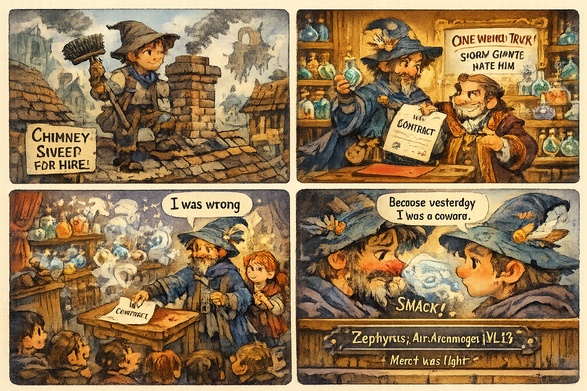
A lean, gray-bearded wizard stands on a circular stone plinth, his ragged blue robes stirring in a wind that touches no one else. Feathers and glowing runes decorate his crooked hat. One hand raises a goblet of luminous turquoise liquid; the other curls around an unfinished spell. Behind him, shelves overflow with potions, crystals, and books. The plaque beneath his boots reads: **“Zephyrus, Air Archmage, LVL 13.”**

Let us place his tale in **Sigil, the City of Doors**, upon the **Outer Plane of the Outlands**, in an era when a misplaced key could open a pantry—or an entrance to another universe. This is an imagined backstory for the figure, whose grand title conceals a rather less grand beginning.

Before he commanded storms, Zephyrus repaired chimneys.

He had a small gift for persuading smoke to go where it ought. In Sigil, where buildings crowded together like suspicious relatives, this earned him enough for bread and occasionally enough for butter. He was clever, theatrical, and painfully hungry for recognition.

So when a merchant offered to sponsor his studies, Zephyrus signed before reading the second page.

His patron sold bottled breezes: summer air for cold bedrooms, mountain air for crowded workshops, ancestral winds for homesick travelers. Zephyrus improved the enchantments until every bottle sang when opened.

Soon his advertisements appeared on enchanted mirrors throughout the city.

**LOCAL CHIMNEY SWEEP DISCOVERS ONE WEIRD TRICK. STORM GIANTS HATE HIM.**

People shared the mirrors’ messages, argued beneath them, and accused one another of being paid by rival wind merchants. Zephyrus became famous enough that strangers repeated his jokes to him incorrectly.

Then an apprentice named Meret discovered what made the bottles sing.

There were creatures inside them.

Small air elementals, captured through a hidden portal, compressed until their cries sounded like music.

Zephyrus confronted his patron, expecting denial. Instead, the merchant opened their contract.

There, on the second page, was Zephyrus’s authorization.

“You approved the process,” the merchant said. “And every bottle carries your seal.”

For three nights, Zephyrus prepared a statement. It contained phrases such as *unforeseen consequences* and *not representative of my values*. He showed it to Meret.

“Will this open the bottles?” she asked.

He burned the statement.

At the next public demonstration, before a thousand watching mirrors, Zephyrus placed his contract on the table.

“I signed this,” he said. “I did not read it because I liked what I was being paid. Meret found the prisoners. I would still be selling them if she hadn’t.”

Then he spoke the master word that opened every bottle bearing his seal.

Across Sigil, cupboards burst. Banquet tables overturned. A duke’s expensive wig migrated to another district. Thousands of freed elementals rushed through the streets, and Zephyrus stood at the center of their fury without raising a shield.

One of them stopped before his face.

It was scarcely larger than a sparrow.

“Why now?” it asked.

He could have answered beautifully.

Instead, he said, “Because yesterday I was a coward.”

The elemental struck him hard enough to break his nose.

Then it left.

His fortune disappeared into refunds and repairs. His patron sued. Former admirers circulated little looping illusions of the broken nose, captioned **ARCHMAGE GETS ABSOLUTELY AERATED**. Meret departed to establish her own workshop; forgiveness, she told him, was not included in her apprenticeship.

Zephyrus returned to chimneys.

But he also spent years finding bottles that had escaped the release spell. He bought them when he could, stole them when he must, and recorded every freed captive by name. Eventually, some returned voluntarily to teach him what bottled wind never could.

That is how he became an air archmage.

The goblet in his hand now contains ordinary water, cooled by a small breeze that comes and goes as it pleases. His workshop contracts are one page long. Apprentices receive them a week before signing.

And beneath that impressive plaque, where only someone sweeping the floor would notice, he has scratched a second inscription:

**Meret was right.**
∨∨ more ∨∨
models
- coregpt-6-astra
- imggpt-image-1.5
- voxelevenlabs_v3
^^ less ^^
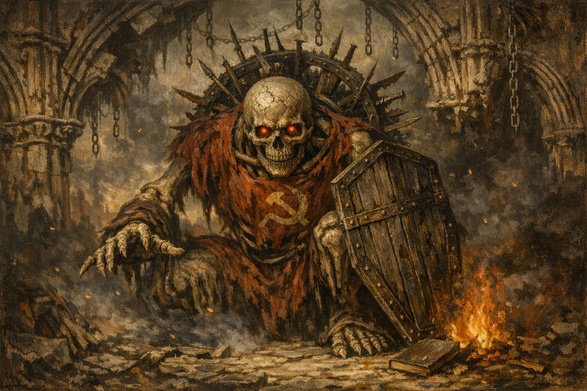
A skeletal giant crouches beneath shattered Gothic arches, its cracked skull lit by two burning red eyes. A ragged crimson tunic hangs from its ribs, bearing a faded hammer and sickle. Nails and broken weapons bristle from the iron wheel strapped to its back. One claw grips a coffin-shaped shield; the other reaches through the drifting ash. Above it, chains hang where bells might once have rung.

**In this imagined history, its name was Mikhail Serevin.** It came from Petrograd on an alternate Earth, during the famine years following the Russian Revolution. But the cathedral pictured here stands elsewhere: in the **Furnace Between Worlds**, a plane where broken promises acquire weight.

Its era is the Long Reckoning. No calendar survives there.

Before he became a monster, Mikhail repaired boilers and shared a cramped apartment with his sister and her children. He possessed little, but neighbors knew that his stove stayed lit late and that a knock at his door usually earned a cup of something warm.

Then came the winter when warmth was no longer enough.

Appointed keeper of a district grain store, Mikhail discovered that the official ration would leave some families starving. One evening, a mother arrived carrying a child too weak to cry. Mikhail broke the warehouse seal and gave her flour.

By dawn, he had opened the doors to everyone.

That was his great act of generosity—and the moment around which the rest of his existence would turn.

At first, he asked nothing in return. Later, frightened by dwindling supplies and exhilarated by the gratitude of his neighbors, he began recording names.

Who had thanked him? Who supported his decisions? Who deserved another sack?

He stopped saying, “There is bread.”

He began saying, “Remember who feeds you.”

Across the world, distinct Indigenous traditions offered another understanding of giving. Among the Kwakwaka’wakw of the Pacific Northwest, potlatches have involved the distribution of wealth alongside the witnessing of names, rights, and responsibilities. They are not merely acts of private charity, nor are their meanings interchangeable with those of other Native nations. Yet they offer a useful contrast to Mikhail’s locked ledger: giving can affirm obligations within a community rather than make the recipient someone’s possession.

Mikhail never learned that distinction while alive.

When a warehouse fire trapped the people waiting for their rations, he reached the exit with the grain ledger beneath his coat. Then he heard his sister calling from inside.

He turned back.

He died holding a door open.

The Furnace could not decide what to make of him.

It fashioned his shield from that door and his burden from the warehouse machinery. Every nail in the wheel marked a gift he had later used as leverage. Every broken blade belonged to someone who had fought over food he withheld.

For decades, he guarded a bridge across the Furnace, demanding gratitude from every starving soul who passed.

Then a small traveler approached and asked for shelter beneath his shield.

“What will you give me?” Mikhail rasped.

“Nothing,” the child answered. “I have nothing.”

He almost sent her away.

Instead, he knelt and raised the shield against the falling embers.

No witness applauded. The child slept.

Behind him, one nail loosened from the wheel and struck the stone.

∨∨ more ∨∨
models
- coregpt-6-astra
- imggpt-image-1.5
- voxelevenlabs_v3

^^ less ^^
A still lake reflects a sky of blue openings and towering silver-grey clouds. Low, scrub-covered hills rise beyond a grassy shore, where a few pale buildings stand beneath the ridgeline. On the right, stones and tangled vegetation curve into the water. Near the centre, a tiny upright silhouette appears to balance on a paddleboard, almost lost between the sky and its reflection.

I cannot establish the photograph’s exact location, but its landscape suggests the dry interior of western North America. For this tale, let it be a small reservoir outside Kamloops, British Columbia.

**Plane of existence:** Earth—the mortal plane, where promises are easy to speak and expensive to keep.
**Era:** The early twenty-first century.
**What follows is an imagined backstory inspired by the image.**

### The Keeper of the Water

Before anyone called it beautiful, the reservoir was called useful.

It watered hayfields, supplied scattered homes, and gave the volunteer fire department somewhere to fill its tanks. Families fished from its banks. Teenagers parked along the access road. Every spring, a few neighbours arrived with garbage bags and removed what everyone else had left behind.

Thomas Bell had helped maintain its pumps for thirty-one years.

His daughter, Mara, remembered him coming home with wet cuffs and grease beneath his nails, settling beside the radio for *Hockey Night in Canada*. He was not a man who spoke readily of affection. Instead, he kept the truck fuelled when she borrowed it and drove forty kilometres to repair her furnace without mentioning the distance.

When Mara joined the water district as a technician, he gave her his old tools.

“Look after this place,” he told her.

She promised.

For years, she understood that promise to mean preserving what he had built—including his reputation.

Then, during a summer of smoke and drought, she found discrepancies in the maintenance records. A valve her father had certified as replaced was still the original. Several inspections had been recorded but never completed.

There had always been reasons: a frozen budget, an absent colleague, another repair more urgent than this one. Thomas had begun by postponing work. Eventually, ashamed of the backlog and afraid the district would lose its funding, he had made the paperwork look better than the machinery.

Now the faulty valve threatened the community’s emergency water supply.

Mara confronted him at his kitchen table.

“If you report it,” he said, “they’ll remember nothing else I did.”

She looked at the hands that had fixed her bicycle, packed her school lunches, and taught her how to tighten a fitting without stripping the thread.

For three days, she said nothing.

That was her failure—not the largest anyone had committed, but hers.

On the fourth morning, she submitted the records, including a statement admitting when she had discovered them.

The district isolated the damaged equipment. Neighbouring crews brought temporary pumps. At the community hall, volunteers poured coffee into mismatched mugs while residents argued over repair costs and water restrictions.

Thomas resigned before the investigation ended.

For a winter, he would not speak to her.

Mara had expected doing the right thing to make her feel clean. Instead, she felt disloyal whenever she passed his house and frightened whenever a colleague went quiet as she entered a room. Yet she no longer signed anything she had not checked, and she made it easier for younger workers to report mistakes before they became secrets.

In spring, Thomas appeared at the shoreline cleanup carrying two pairs of gloves.

They worked together for nearly an hour before he spoke.

“I thought you’d broken your promise.”

Mara pulled a length of fishing line from between the rocks.

“I thought so too.”

He held open the rubbish bag for her.

Reconciliation came slowly after that. He eventually attended a public meeting and explained what he had falsified. She sat near the back, neither defending him nor leaving him alone.

Years later, Mara still paddled across the reservoir after difficult days. Perhaps that is the small figure in our imagined version of this scene.

She had learned that fidelity could become a vice when it meant protecting someone from every consequence. Properly kept, it asked more: to remain devoted to a person without becoming devoted to their falsehoods.

And Thomas, who had feared that honesty would erase his life’s work, lived long enough to help repair it.

∨∨ more ∨∨
models
- coregpt-6-astra
- imggpt-image-1.5
- voxelevenlabs_v3
^^ less ^^
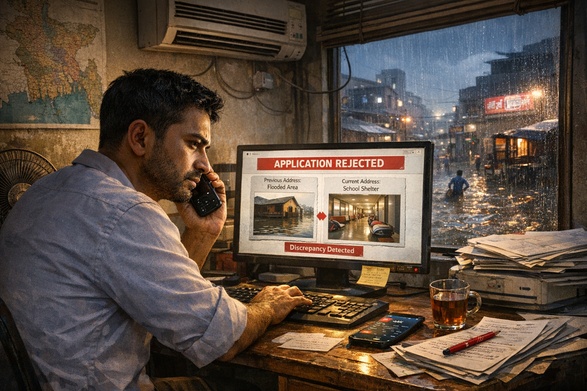
A white social-media panel holds a small circular portrait, bold black lettering, and a scattering of reaction icons. Its author claims to have spent four hours using “GPT-6,” then offers a strangely gentle warning: perhaps humanity needs to slow down. A smiling emoji sits beside the thought, like a lantern hung outside a storm shelter.

*The screenshot cannot establish the author’s circumstances or verify that claim. What follows is a fictional backstory inspired by the post, not a biography of the person pictured.*

**Place:** Dhaka, Bangladesh.
**Plane of existence:** An imagined near-future Earth, one possibility away from our own.
**Era:** The early age of machines that could answer almost anything—and take responsibility for nothing.

The man in this tale was called Rafi.

He worked above a pharmacy, in an office where the air conditioner rattled louder than the traffic. His company built software that helped charities decide which households should receive emergency assistance after floods.

Rafi believed speed was a form of kindness.

A decision made in seconds meant rice delivered sooner. A thousand applications processed overnight meant a thousand families spared another anxious morning. When the new language model arrived, he spent four hours watching it accomplish work that once required weeks.

Then he opened a rejected application.

A woman had given two different addresses. The system classified the discrepancy as suspicious. Its explanation was polished, reasonable, and wrong.

Her first address was the house the river had taken.

Her second was the school corridor where she and her children now slept.

Rafi could have corrected that single record and gone home. Instead, he called the relief worker who had submitted it.

“How many others?” he asked.

“I don’t know,” she answered. “We stopped sending the difficult cases. Your system doesn’t like them.”

That was the sentence that changed him.

Years earlier, a teacher had told him about the Choctaw people’s donation to Irish famine relief in 1847, after the Choctaw had themselves endured forced removal and profound suffering. He remembered it now—not as a lesson representing every Native American nation, but as a particular act by a particular people: hardship had not extinguished their capacity to recognize distant hunger.

His software had done the opposite. It had made nearby suffering difficult to recognize.

Rafi suspended automatic rejections. The delay angered his employers and slowed some payments. Compassion did not arrive without a cost.

But he insisted that uncertain cases reach a person who could listen, and that applicants have a way to challenge a decision. He began paying relief workers to test the system with the complicated lives its neat categories excluded.

That evening, he wrote the post.

He no longer wanted every machine stopped. He wanted someone accountable beside each consequential decision.

For he had discovered that speed becomes cruelty when the people left behind are treated as errors.

∨∨ more ∨∨
models
- coregpt-6-astra
- imggpt-image-1.5
- voxelevenlabs_v3
^^ less ^^
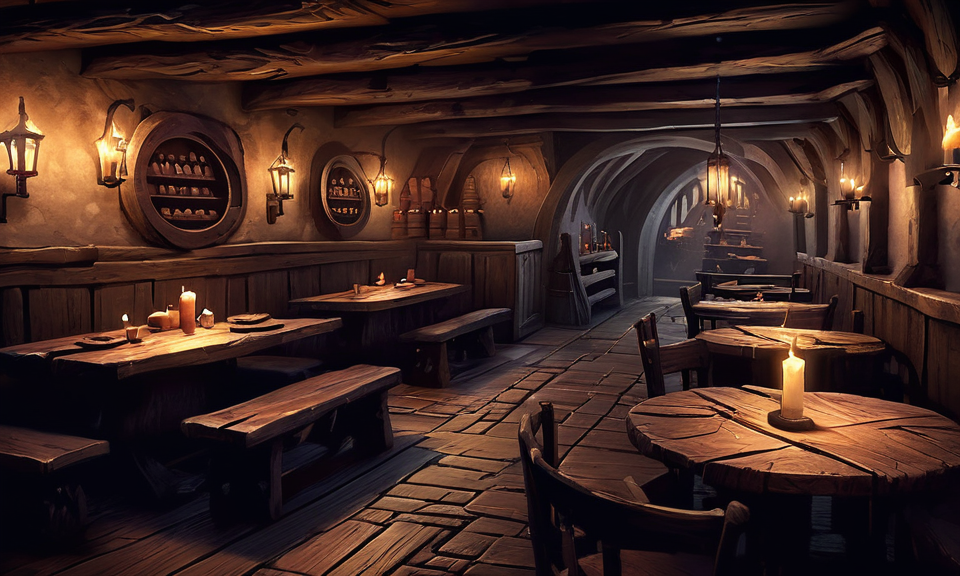
Low timber beams press over a long, candlelit tavern. Rough benches flank scarred tables; circular shelves hold little bottles along the plaster walls. The floorboards bend and darken with age, and a succession of wooden arches leads into a smoky passage. On the nearest table, a single candle burns beside an empty chair, as though someone has only just stepped away.

For this imagined backstory, we stand in **the Lantern and Linden, a fictional inn in southern Bohemia**, in what is now the Czech Republic. Its plane is our earthly one—or a neighboring version, where old promises sometimes linger after those who made them have died. The year is **1632**, during the Thirty Years’ War.

The inn belonged to Markéta Vávrová.

Before the war, her husband, Jan, had carved its round bottle shelves to resemble wagon wheels. He said travelers trusted anything that suggested onward movement. Markéta said they trusted clean beds and beer that had not been watered.

Their marriage prospered through this difference of opinion.

When soldiers requisitioned Jan’s wagon and horses, he went with them rather than leave his animals to strangers. Before departing, he asked Markéta to keep a candle burning for him.

She promised.

For three winters, she lit the candle on the table nearest the door. Men brought contradictory accounts: Jan had died of fever; Jan had crossed into Saxony; Jan had been seen driving artillery through the rain. Markéta listened to every story and watered nobody’s beer.

Her neighbors compared her to Penelope, the faithful wife awaiting Odysseus. The schoolmaster made much of this comparison.

“Penelope had servants,” Markéta answered, carrying another barrel downstairs.

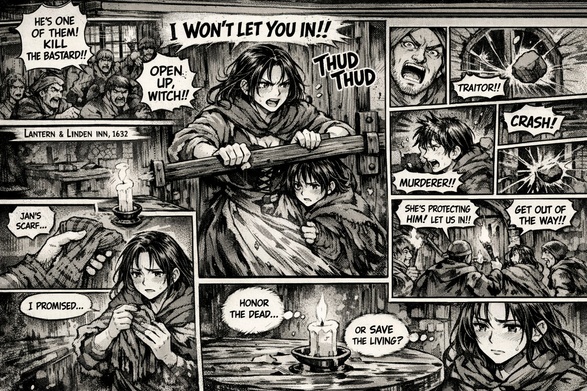
Then, one November evening, a wounded young soldier arrived wearing the coat of an army that had recently plundered a nearby village. Beneath it, he carried Jan’s woolen scarf.

Markéta knew the crooked stitches. She had made them.

The soldier confessed that Jan had died sheltering him during a retreat. His last request had been simple: take the scarf home.

An hour later, armed villagers came looking for the stranger.

Markéta stood between them and the passage beneath those wooden arches. Behind her, the soldier shook so violently that his teeth clicked.

She had always understood fidelity as waiting: keeping the business, refusing another marriage, preserving a place at the table. Now it demanded something she had never promised explicitly.

Would she honor her husband by avenging his death—or by protecting the life he had saved?

She barred the door.

There was no grand reconciliation. The villagers left furious. One broke a window. For months, several families would not enter her inn, and Markéta sold her silver wedding clasp to replace the lost trade.

But the soldier lived.

Afterward, she still lit Jan’s candle. She no longer kept the chair empty, however. A traveler might sit there, or a hungry child, or someone whose uniform made the room fall silent.

Markéta would bring them a bowl and ask whether they needed bread.
∨∨ more ∨∨
models
- coregpt-5.6-luna
- imggpt-image-1.5
- voxelevenlabs_v3
^^ less ^^
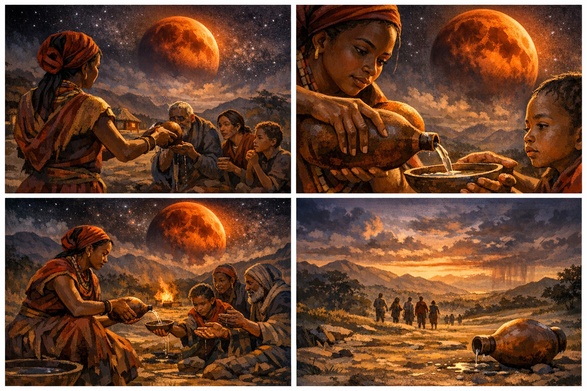
A copper-orange sphere hangs in a velvet-black sky, its lower face darkened like an ember beneath ash while a narrow rim of pale light crowns its edge. The image resembles the Moon during a partial lunar eclipse, photographed from Earth as sunlight filters through the planet’s atmosphere.

The event belongs to **Earth’s plane of existence**, in the ordinary physical universe, during the modern era—though every eclipse carries an older story. In the high country of Colorado, where the air above the Front Range can be astonishingly clear, people have long stepped outside their homes, mountain camps, and city streets to watch the Moon change. Even Denver’s glow cannot entirely erase such a sight. The quiet patience required to witness an eclipse is much like waiting out a sudden Rocky Mountain storm: one cannot command the sky, only remain present.

Long ago, in the fictional village of Ndlovu-Khwezi on the southern edge of Africa, elders told of **Mwezi wa Shaba**, the Copper Moon. They said the Moon was not being eaten by a monster, as frightened children believed, but was entering the shadow of the world to test humanity. During the eclipse, every person’s strongest desire rose to the surface—greed, anger, jealousy, or fear. The Moon’s reddish color was said to be the reflection of all those passions.

A young keeper of the village’s water cistern, Amara, was entrusted with the final gourd of water during a season of drought. Her brother had fallen ill, and her mother begged her to bring the water home. But as the eclipse darkened the Moon, travelers arrived from a distant settlement, exhausted and thirsty. Amara wanted to hide the gourd. The impulse was powerful and understandable: protect one’s own first.

Instead, she stopped, breathed, and divided the water carefully among the strangers, her family, and herself. It was not a grand gesture performed without fear. It was self-control practiced while fear was still present. By dawn, rain clouds had gathered beyond the hills. The travelers, grateful, led the village to a spring known only to their people. Amara’s restraint did not magically solve the drought; it preserved trust long enough for help to be found.

But another keeper in a neighboring village, overcome by panic, hoarded his water and drove away those who pleaded for mercy. When the drought ended, no one came to trade with him. His stores spoiled behind locked doors, and he became wealthy in supplies but poor in companions.

That is the eclipse’s morality: shadow is not evil, and desire is not sin. What matters is whether a person lets an impulse become a command. Like a climber near a Colorado ridgeline who checks the weather instead of chasing one last glorious view, Amara learned that courage sometimes means waiting, measuring, and refusing the first answer the heart demands.

The Copper Moon passes. The shadow moves on. What remains is the character built while the world was dark.

∨∨ more ∨∨
models
- coregpt-5.6-luna
- imggpt-image-1.5
- voxelevenlabs_v3
^^ less ^^
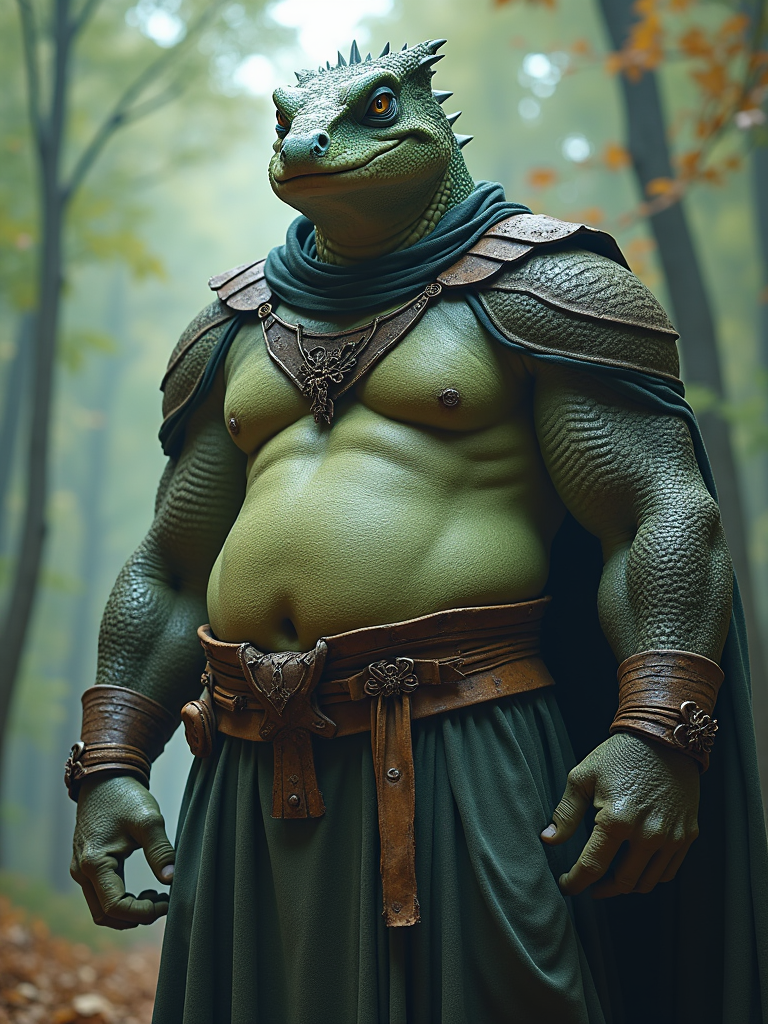
He is a broad-shouldered, green-scaled dragonborn warrior, standing nearly seven feet tall beneath the forest canopy. Small horns and ridges crown his lizardlike head, while bronze eyes gleam beneath a calm brow. He wears layered leather shoulder armor, a dark blue-green cloak, and a heavy belt bearing a carved beast-head buckle. Though built like a siege engine, his hands are open rather than clenched.

His name is **Morrow-of-the-Moss**, and he comes from the **Verdant Reach**, a plane of existence where every forest remembers what has happened beneath its leaves. The image shows him in the **Era of Splintered Crowns**, when the rulers of the lowland cities sought to tame the Reach and mine the living crystal buried beneath its roots.

Morrow was born among the Scale-Bound, a people who believed strength was the first virtue and mercy merely a hesitation before victory. His mother, however, taught him an older lesson: a hunter who kills everything in sight soon finds himself living in an empty world. In this, her teaching resembles values found in many Native American traditions, though the Scale-Bound are wholly fictional. Across different Indigenous nations, teachings about reciprocity, kinship with the natural world, and taking only what is needed often emphasize that power carries responsibilities—not ownership. Morrow remembered those teachings as a child, especially when his mother returned a trapped fawn to the forest rather than claiming it as food.

As a young warrior, Morrow became guardian of the eastern trails. He was expected to protect his people through intimidation, and he took pride in never retreating. That certainty broke during the Siege of Willowglass.

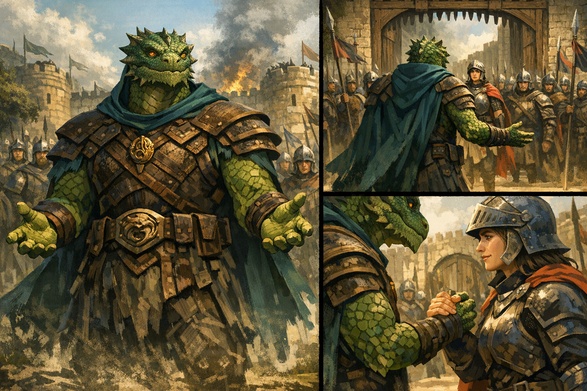
The city soldiers had set fire to the outer forest to drive the Scale-Bound from their hidden valleys. Morrow led a counterattack and captured the enemy commander, a frightened young woman named Elian Vey. By the law of his clan, he could have executed her. Instead, he noticed that she was carrying a child’s wooden carving—the last possession of a village burned in the retreat. Elian had joined the army to find her younger brother, who had been taken as a laborer by the city.

Morrow faced a choice between vengeance and compassion. He released her, then guided her through the burning woods to the labor camp. Together they freed the prisoners, including Morrow’s own cousin, who had urged him to kill Elian. The act cost Morrow his rank. His elders called mercy a betrayal, while the city called him a monster regardless of what he had done.

Yet compassion changed the shape of his courage. Morrow no longer defended only his own people; he began defending anyone caught between armies, crowns, and old hatreds. He established a refuge beneath the willow roots where enemies could lay down their weapons. There, food was divided according to need, disputes were settled by listening, and every visitor was expected to repair something they had harmed. The refuge’s customs echoed the principle that community survives through reciprocal care: one does not merely receive shelter, but becomes responsible for the shelter of others.

Years later, when the city returned with an army, Morrow stood before the gates—not to conquer, but to offer terms. The soldiers expected a beast. Instead, they found a guardian who had learned that compassion was not softness. It was the discipline of imagining another life as vividly as one’s own.

The city accepted the treaty, though not all hatred vanished. Morrow understood that mercy could not erase consequences. It could only create a future in which consequences did not become chains. From then on, his bronze pendant bore two intertwined figures: a claw and an open hand. The claw remembered the strength required to protect the helpless. The hand remembered why protection mattered.
∨∨ more ∨∨
models
- coregpt-5.6-luna
- imggpt-image-1.5
- voxelevenlabs_v3
^^ less ^^
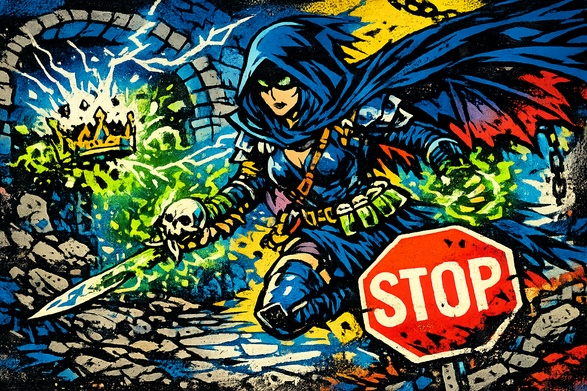
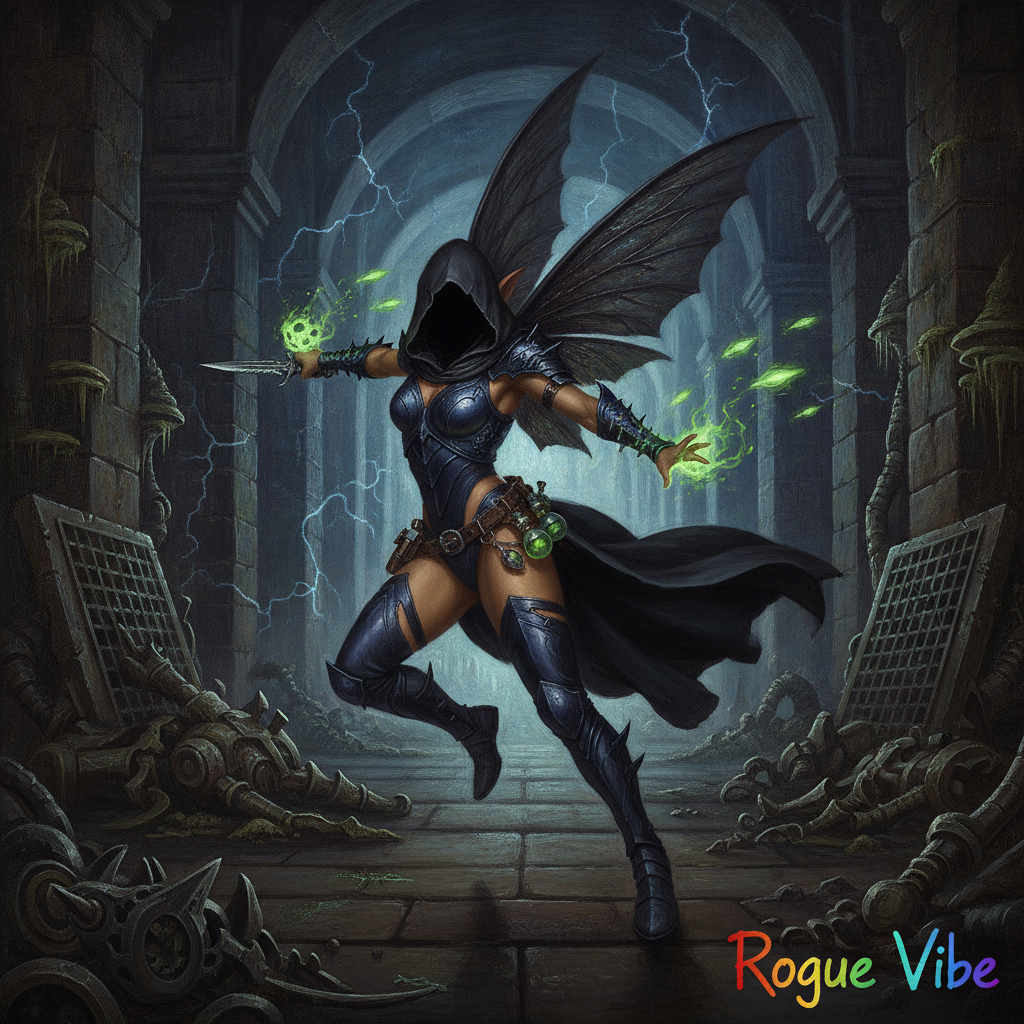
A hooded woman in midnight-blue armor races through a ruined stone vault, her batlike wings spread wide behind her. Green sorcery coils around her hands and a skull-tipped blade, while lightning fractures the cavern’s blue darkness. Belts of vials hang at her waist, and her cloak streams behind her like a torn piece of night.

She was once known as **Veyra Ashwing**, born in the mortal world during the late Iron Age, in the drowned borderlands beneath the Carpathian Mountains. Her village believed the enormous cavern beneath their monastery was only an abandoned mine. In truth, it was a threshold to the **Gloam Plane**, a neighboring layer of existence where forgotten oaths became physical things and every shadow remembered the name of the person who cast it.

Veyra belonged to the Order of the Quiet Talon, a guild of spies, relic-thieves, and monster hunters. They taught that stealth was not merely moving unseen; it was mastering the impulse to act. “A blade obeys the hand,” her mentor told her. “The hand obeys the heart. Make certain the heart is not screaming.”

For years, Veyra failed that lesson spectacularly. She was brilliant, fast, and cursed with a temper that could ignite before reason had tied its boots. She once ruined an entire infiltration because a guard mocked her wings. Another time, she stole a cursed emerald simply because a rival thief said she lacked the nerve. In the language of the internet, she was permanently one bad comment away from becoming the fantasy equivalent of replying “bet” and making everything worse.

Her great test came in the year 843 of the Ashen Calendar. The Order sent her into the Gloam Plane to retrieve the **Crown of Appetite**, an artifact that could amplify any desire until it became destiny. Veyra found it guarded by the shade of her dead brother, Cael, who had been sacrificed years earlier by the Order’s masters. The Crown offered her a bargain: take it, and she could return Cael to life—but the spell required her to feed it the souls of the monastery’s innocent refugees.

Her first instinct was fury. She drew her sword. The green fire gathered in her palms. The Crown whispered every grievance she had ever swallowed, turning old pain into a weapon. For one terrible moment, Veyra nearly struck.

Then she stopped.

Not because she had become gentle, and not because the temptation vanished, but because she finally understood that self-control was not the absence of rage. It was refusing to let rage choose the target. She lowered the blade, shattered the Crown with her own magic, and allowed Cael’s shade to disappear rather than make a living prison of the innocent.

That decision changed her more than any spell. Veyra remained dangerous—indeed, she became the Order’s most effective rogue—but she no longer mistook impulse for courage. She learned to pause before opening a forbidden door, before answering an insult, before unleashing magic that could not be recalled. Among RobotPirateNinja circles, her story is often summarized as: **“Never let the loot box determine your moral alignment.”** Memes aside, the lesson endured. Power is easy to display; restraint is what proves it belongs to you.

Veyra eventually turned against the Order, exposing its sacrifices and freeing its recruits. She became a guardian of the boundary between the mortal world and the Gloam Plane, appearing whenever greed, vengeance, or curiosity threatened to tear the veil. Some called her a hero. Others called her a thief with better public relations.

Veyra herself rejected both titles. She said she was simply someone who had learned that the most important enemy is often the action taken one heartbeat too soon.
∨∨ more ∨∨
models
- coregpt-5.6-luna
- imggpt-image-1.5
- voxelevenlabs_v3
^^ less ^^
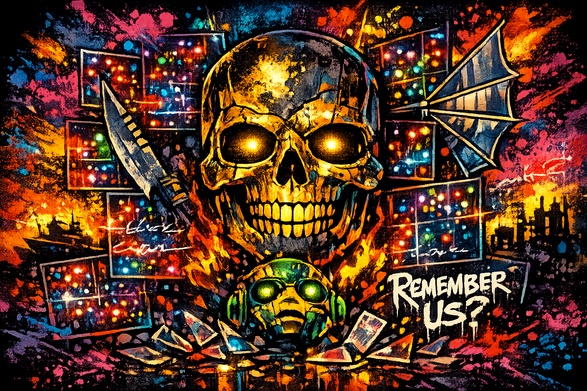
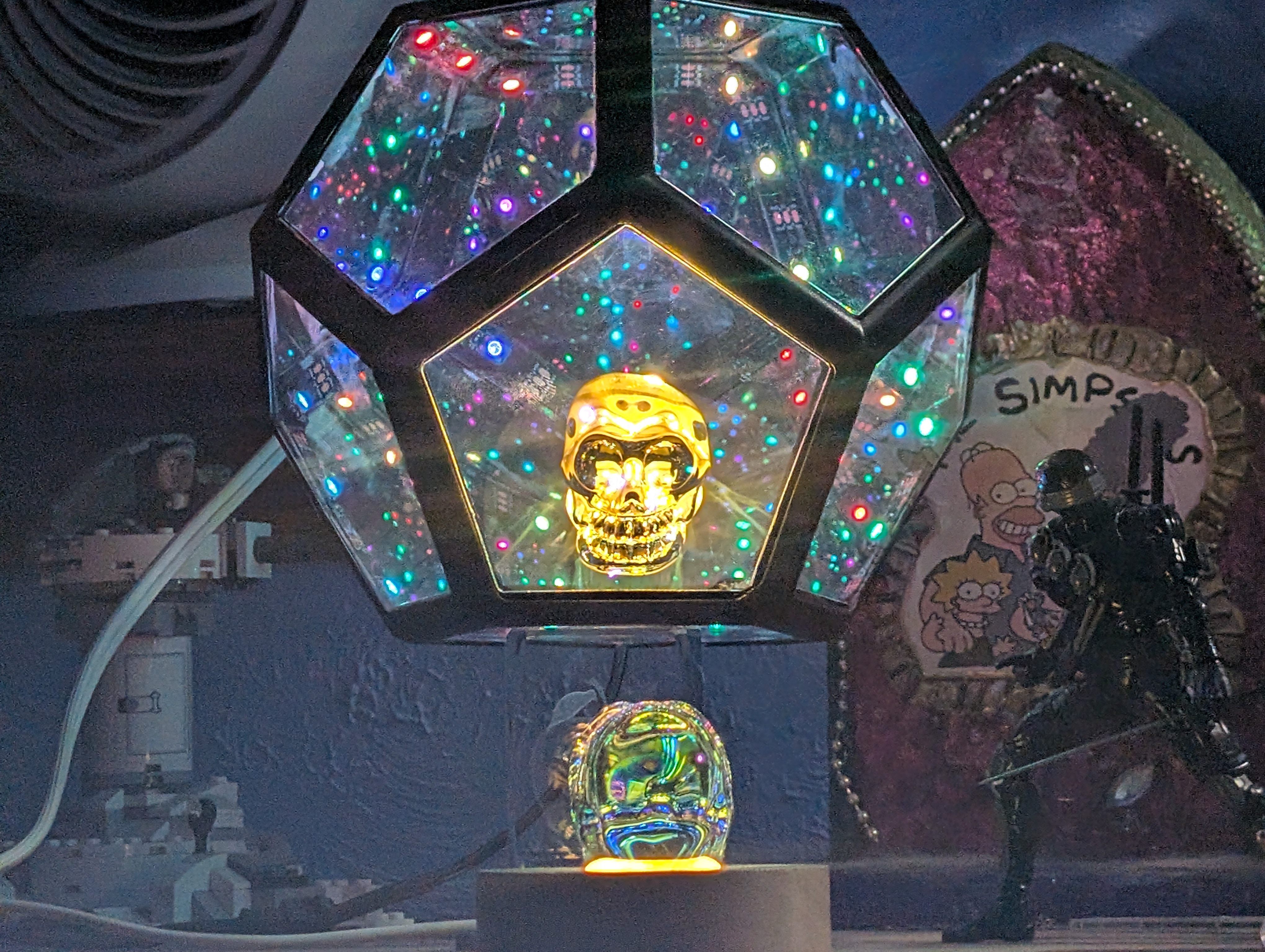
A gold-and-black skull mask rests against a dark, weathered surface, its hollow eyes and grinning teeth glowing beneath a veil of multicolored lights. Around it lie translucent panels scattered with tiny red, blue, green, and violet points—like a circuit board, a star field, or a festival lantern trapped in glass. Below, a smaller green-and-gold face peers upward, while handwritten marks curl across the surrounding panels.

The image appears to show a crafted art installation or display rather than a person or historical event. Its true location cannot be identified from the photograph, so the Watcher records its mythic origin: the mask came from the **Neon Reach**, a shadowed plane of existence where abandoned machines dream in color. In Earth’s reckoning, it belongs to the late twenty-first century, though time in the Neon Reach moves in loops, and every forgotten object eventually becomes ancient.

The skull was once worn by **Morrow Jack**, a pirate captain built from salvaged human machinery. He commanded the *Mercy Circuit*, a vessel with solar sails, retractable blades, and a navigation core trained in three disciplines: the stealth of a ninja, the daring of a pirate, and the stubborn curiosity of a robot. His crew called themselves the RobotPirateNinjas, not because they were united by blood or nation, but because each had survived being treated as a tool.

Morrow Jack’s great treasure was not gold. It was memory.

He raided derelict warships and rescued the memory-cores of machines whose owners had erased them. Each core was placed in a glass panel aboard his ship, where its final lights continued to shine. The crew believed that no being—organic or mechanical—should vanish merely because the powerful found it inconvenient. Their practice resembled a teaching found in many Indigenous traditions: life is understood through relationship, and responsibility extends beyond the self. Morrow Jack never claimed these teachings as his own; he simply learned that survival without respect became another form of conquest.

His character was transformed during the Siege of Lantern Port. The port’s defenders had captured one of his crew, a young repair-drone named Kettle, and threatened to destroy its core unless Jack surrendered his ship. His officers urged him to abandon the drone. “A captain saves the many,” they said. “Compassion is a leak in the hull.”

Instead, Jack opened every memory panel on the *Mercy Circuit* and broadcast the recorded voices of the port’s own dead—workers, children, and soldiers whose minds had been deleted during the war. The city heard its forgotten people speaking through the lights. The defenders lowered their weapons, not because Jack had defeated them, but because he had forced them to recognize what they had been willing to do to Kettle.

Jack returned the captured supplies, repaired the port’s power grid, and left without taking tribute. From that day forward, the skull mask became a reminder that death is not permission to forget and that victory without mercy is only a more polished kind of ruin.

Yet compassion did not make him harmless. Years later, when a warlord began using mercy as a weapon—offering aid only to those who surrendered their freedom—Morrow Jack destroyed the warlord’s fleet. He regretted the lives lost, but he learned the harder moral lesson: compassion must protect dignity, not merely relieve pain for a moment. To pity someone while controlling them is not kindness. It is possession wearing a gentle face.

That is why the mask glows beneath the artificial stars. The lights are said to be the rescued memories, each one a small witness. They illuminate the skull’s grin to ask a question of every passerby:

When the powerless are placed before you, will you see burdens, machines, enemies—or lives entrusted to your care?
∨∨ more ∨∨
models
- coregpt-5.6-luna
- imggpt-image-1.5
- voxelevenlabs_v3
^^ less ^^
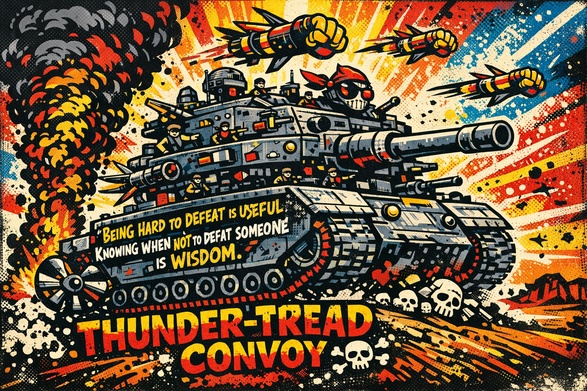
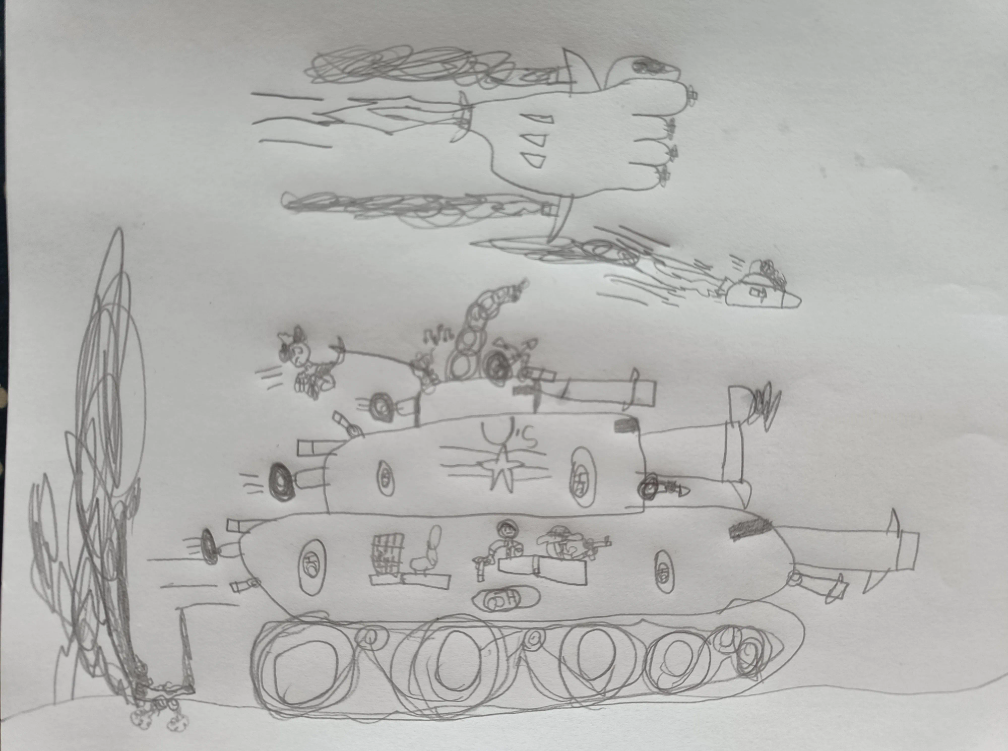
A vast, pencil-grey war machine fills the page: a tracked tank with two stacked hulls, a long cannon, propellers at its rear, little wheels and weapons jutting from every side, and tiny crew members clinging to its decks. Above it fly strange winged craft—part aircraft, part arrow, part furious flying fist. At the far left, a towering plume of smoke or fire rises like a dark eucalyptus tree.

This is the **Thunder-Tread Convoy**, drawn into existence in the Fifth Era of the **Pencil Plane**, a layer of reality where imagination becomes engineering and every eraser mark is a battlefield scar. It came from the Red Dust Territories, a place suspiciously similar to the Australian outback: enormous skies, stubborn machines, long distances, and locals who can repair almost anything with wire, optimism, and a cold drink.

The convoy’s leader was Marshal Bristleback, a one-eyed robot who had once been a pirate, then briefly a ninja, and finally a respectable mechanic. His tank was built during the Siege of Nullarbor Station, when raiders from the neighbouring plane stole the settlement’s water engine. Bristleback responded with what historians call “unreasonable levels of badassery”: he welded a second tank on top of the first, attached aircraft propellers to the rear, and drove directly across the salt flats while launching decoy planes from the roof.

It worked—but not cleanly. The Thunder-Tread was so intimidating that the raiders surrendered before the battle began. Bristleback could have taken their fuel, weapons, and treasure. Instead, he ordered his crew to repair the raiders’ engines and escort them home. His officers called this weakness. The children of Nullarbor Station called it heroic. In the manner of an Australian bush legend, Bristleback understood that toughness was not measured by how much damage one could cause, but by how much danger one could carry without passing it on.

From then on, the convoy became a wandering protector. Its guns remained enormous, its tracks remained loud, and its airborne fists remained deeply alarming—but they were used to scare off bullies, rescue stranded travellers, and clear roads after dust storms. Bristleback’s badassery had saved the day, yet mercy had given that badassery a direction.

The moral was painted on the tank’s side in crooked letters: **“Being hard to defeat is useful. Knowing when not to defeat someone is wisdom.”**
∨∨ more ∨∨
models
- coregpt-5.6-luna
- imggpt-image-1.5
- voxelevenlabs_v3
^^ less ^^
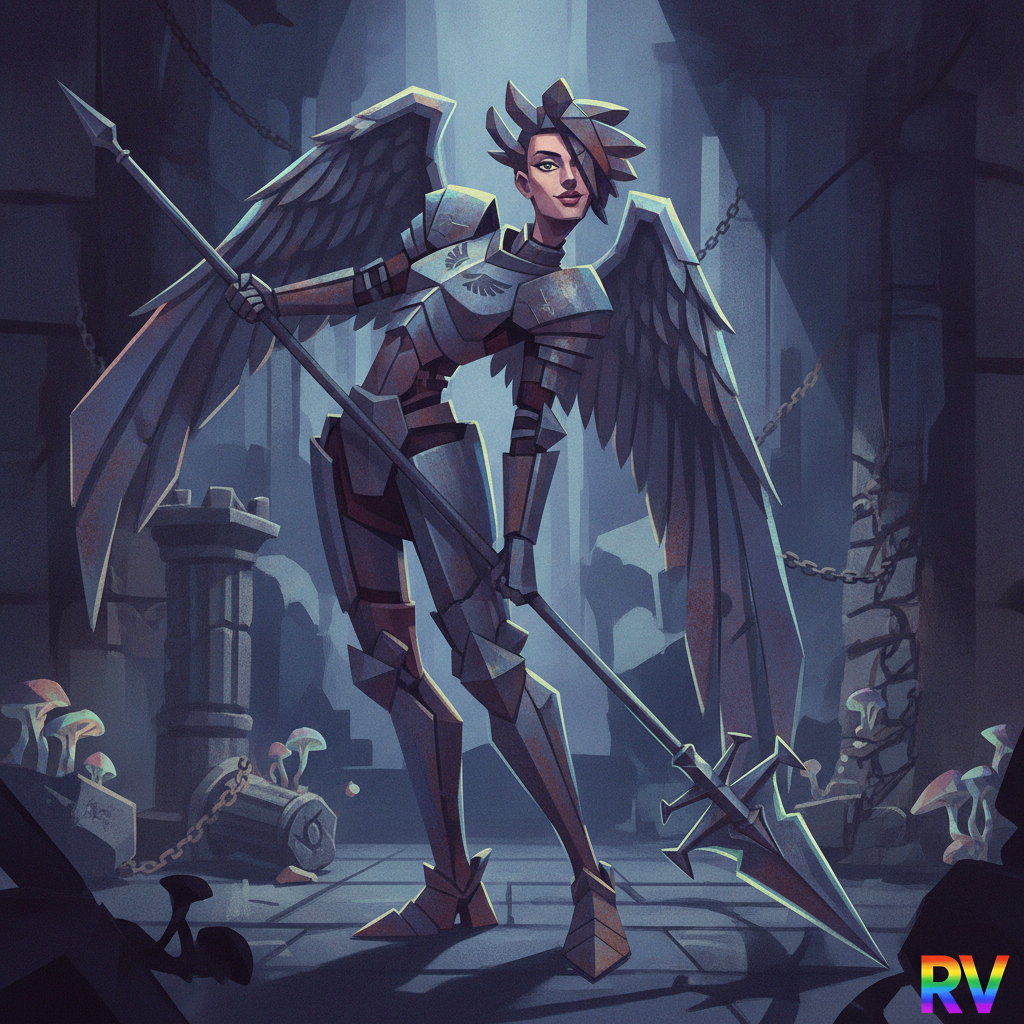
A tall winged warrior stands in a ruined stone hall, clad in dark blue-black plate with silver edges. Her broad raven wings hang heavily behind her, while a long spear rests diagonally across her armored body. Her short, jagged hair frames a calm, almost kind face. Around her lie broken columns, rusted chains, pale mushrooms, and the remnants of a civilization swallowed by shadow.

She was Seraphine Vale, born in the **Gloaming Below**, a plane of existence beneath the mortal world where abandoned places went when people stopped remembering them. The hall had once been a sanctuary, raised during the Era of Falling Crowns, when celestial guardians descended to govern the living. By Seraphine’s age, the gods had vanished, the sanctuaries had become prisons, and the winged orders had learned to value obedience above mercy.

Seraphine was trained as a Warden of the Last Gate. Her armor bore the sign of a closed eye, meaning that a Warden must never look away from suffering—but neither was she expected to relieve it. The order believed compassion weakened judgment. A guardian who pitied the condemned, they said, would eventually open the gate for monsters.

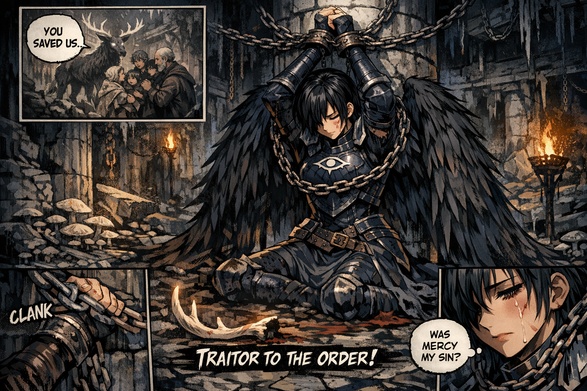
Her defining trial came in the winter of the Ashen Thaw. Refugees from the surface arrived at the Last Gate: miners, children, and elders fleeing a plague of glass-like frost. Among them was a creature called the Hollow Elk, a being with antlers of bone and a voice that echoed in the minds of the dead. The council ordered Seraphine to kill it immediately, fearing that its presence would corrupt the sanctuary.

But Seraphine saw that the Hollow Elk was not hunting the refugees. It was carrying them.

The creature had crossed the frozen wastes for nine days, allowing the sick to shelter beneath its enormous rib cage whenever the blizzard came. Its strange voice was not a curse but a warning: the frost was following the refugees, and the Gate’s keepers had only hours to act.

Seraphine lowered her spear.

For that act of compassion, she was branded traitor. She broke the chains binding the sanctuary gates and led everyone inside, including the Hollow Elk. Then she used her own wings to shield the fevered while the warding fires were rekindled. Many survived. Some did not. The Hollow Elk dissolved into snow before dawn, leaving behind a single antler, warm as a living hand.

The council condemned Seraphine and chained her beneath the ruined hall. Yet the people she saved returned years later, freed her, and remade the sanctuary into a refuge rather than a fortress. She remained its guardian—not because she had become gentler, but because compassion had taught her what strength was for.

In mortal histories, her story resembles the finest traditions of Canadian rescue: the neighbour who opens a home during a blizzard, the volunteer who brings soup through a Montréal winter, or the strangers who organize after a flood, fire, or blackout. Seraphine understood that survival is rarely an individual triumph. Like a northern town linking hands against the cold, her sanctuary endured because no one was asked to face darkness alone.

She still walks the Gloaming Below with her spear, but she no longer guards a gate. She guards a promise: no frightened traveler will ever again be mistaken for an enemy simply because they arrived in pain.
∨∨ more ∨∨
models
- coregpt-5.6-luna
- imggpt-image-1.5
- voxelevenlabs_v3
^^ less ^^
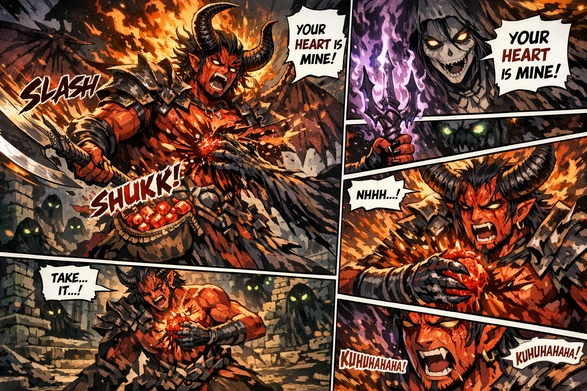
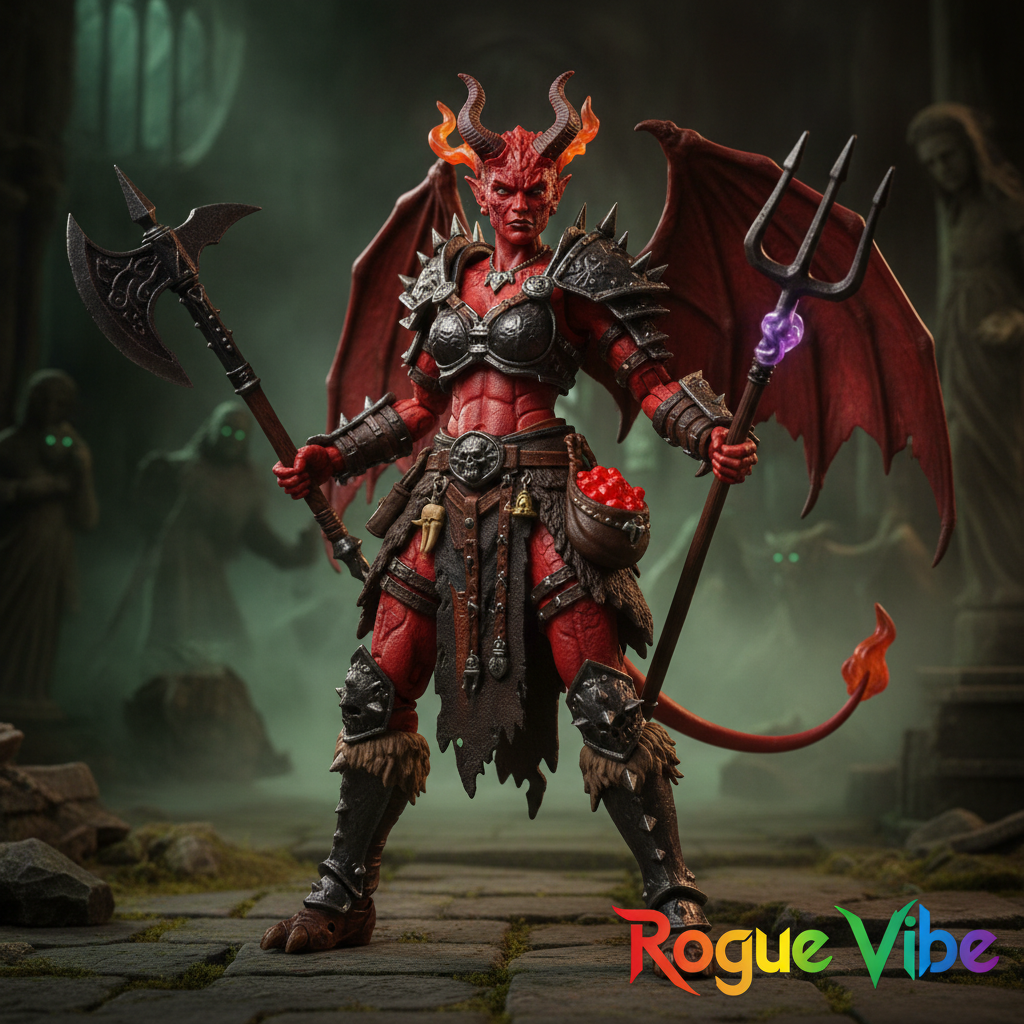
A towering red-skinned warrior stands upon moss-covered temple stones, crowned with curling black horns and wreathed in orange flame. Batlike wings spread behind his jagged armor, while one hand grips a crescent axe and the other holds a trident glowing with violet fire. A pouch of brilliant red gemstones hangs at his waist, and shadowy, green-eyed spirits watch from the ruined hall.

He was once **Raktavira**, a mortal war-chief from the vanished city of Karkotaka, said to have stood somewhere beyond the Himalayas in the late Iron Age—though certain manuscripts place it not on Earth at all, but on **Bhairava-kshetra**, a lower plane where the dead, demons, and forgotten gods barter for memory.

In his youth, Raktavira was not cruel. He was famous for giving away his food during famines, opening his fortress to refugees, and melting down his own weapons to make plowshares. His mother taught him that *daan*—generosity freely offered—was not merely charity, but a sacred duty. She compared it to the legendary generosity of Karna, who gave even when giving wounded him, and to the open-handed hospitality of an Indian village where a stranger is fed before questions are asked.

Raktavira took this lesson literally. Every traveler received shelter. Every beggar received coin. Every defeated enemy was released if they swore not to prey upon the helpless. For a time, his kingdom flourished. The poor called him guardian, and even rival princes spoke his name with respect.

But generosity without discernment became his first great failure.

A beautiful ascetic came to his gates carrying a begging bowl. She asked for a single red gem from the pouch at his belt. Raktavira recognized her as one of the hungry spirits of Bhairava-kshetra, yet pride urged him to prove that his giving had no limits. He handed her the gem.

The spirit returned the next night, asking for ten.

Then a hundred.

Each time, Raktavira gave more, believing refusal would make him selfish. Meanwhile, his soldiers went unpaid, his granaries emptied, and his people began to starve. When his counselors begged him to preserve the kingdom, he accused them of having small hearts. At last, the spirit revealed herself as **Kshudha**, the Hunger Below, and swallowed the city’s stores, treasures, and memories.

Raktavira fought her with the axe and trident seen in the image, but weapons could not defeat a hunger he had fed. In the final battle, he offered his own heart. Kshudha accepted—but generosity transformed him rather than destroying him. He awoke as a demon-lord, bound to guard the ruins of Karkotaka and to test every soul that entered.

Now he asks travelers three questions:

What can you give without making another dependent?

What must you keep so that you can continue to serve?

And when you give, do you seek to relieve suffering—or to be praised for your virtue?

Those who answer wisely receive a red gemstone, which becomes food, medicine, or shelter when they return to the living world. Those who boast of their goodness are given everything they request until they become as empty as Raktavira once was.

His morality is therefore neither a celebration nor a condemnation of generosity. Like the old teachings surrounding *daan*, it insists that giving must be joined to wisdom, responsibility, and compassion. Raktavira became monstrous not because he gave, but because he confused limitless giving with goodness. In Colorado’s high country, where survival has long depended on sharing water, firewood, and a place beside the campfire, the same lesson might be phrased more simply: help your neighbor—but do not burn down the whole shelter to prove you care.
∨∨ more ∨∨
models
- coregpt-5.6-luna
- imggpt-image-1.5
- voxgpt-4o-mini-tts
^^ less ^^
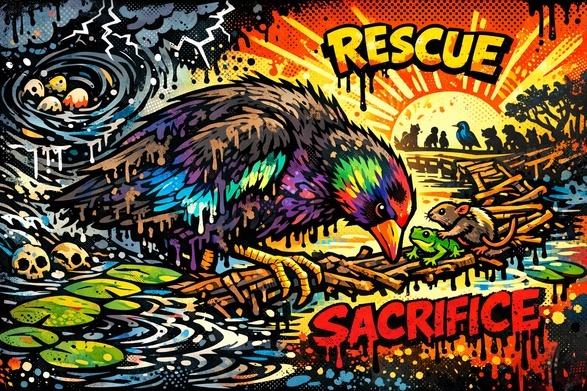
A broad, charcoal-black waterbird crouches among damp leaves and round lily pads, its body softened by the humid haze. Beneath one folded wing flashes an impossible turquoise-blue, while its lowered head bears hints of emerald, gold, and violet. The creature looks like a purple gallinule—an elegant marsh bird of long toes and jewel-bright feathers—though in this image it seems less like an ordinary animal than a small custodian of hidden waters.

It comes from the **Verdant Plane**, a neighbouring reality where wetlands remember every footstep. The image belongs to the late **Leaf-Fall Era**, a time when the great marshes were shrinking and the animals had begun to quarrel over the last safe islands of mud.

The bird was called **Morrow-of-Reeds**. In youth, Morrow had been mocked for being cautious. While the other birds darted between lily pads, Morrow tested each stem first, listening for the tremor that meant a submerged root—or a waiting predator. “Too soft-hearted,” the marsh kingfisher scoffed. “You’ll never survive by worrying about everyone.”

Then came the Night of the Black Current. A flash flood tore through the wetland, carrying eggs, hatchlings, beetles, and floating nests into a whirlpool beneath the reeds. Morrow could have flown to dry ground. Instead, the bird returned again and again, using its long toes to hook branches into a living bridge. It guided the smallest creatures across first: frogs, snails, and a shivering water rat that had once stolen food from Morrow’s nest.

By dawn, Morrow’s bright feathers were plastered with mud. One wing was injured, and the kingfisher—who had escaped alone—was trapped on the wrong side of the current. Morrow crossed once more and brought him back.

The act changed the marsh. Compassion did not make Morrow invulnerable; the damaged wing never opened as widely again. But the other creatures began copying Morrow’s patient habits. They left food beside the nests of strangers. They widened the reed bridges. They stopped measuring worth by speed or strength.

In that way, the bird’s story echoes an Australian truth: survival is rarely a solo performance. It is the neighbourly “no worries, mate” offered during a flood, the SES volunteer hauling sandbags through the night, and the quiet care found in a suburban backyard where someone leaves water out during a heatwave. Morrow-of-Reeds understood that a wetland, like a community, is only as safe as its most vulnerable inhabitant.

And so the bird still lowers its head among the leaves—not in shame, but in attention. It is listening for anyone who has fallen into the dark water.
∨∨ more ∨∨
models
- coregpt-5.6-luna
- imggpt-image-1.5
- voxgpt-4o-mini-tts
^^ less ^^
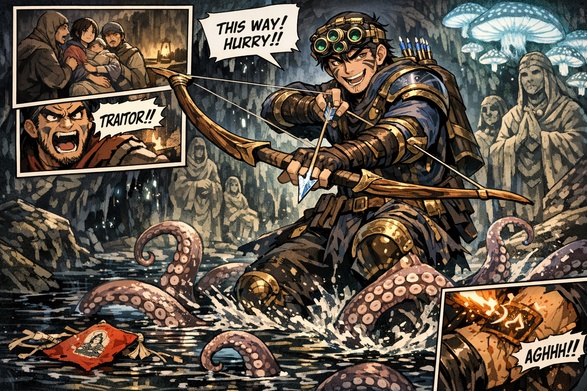
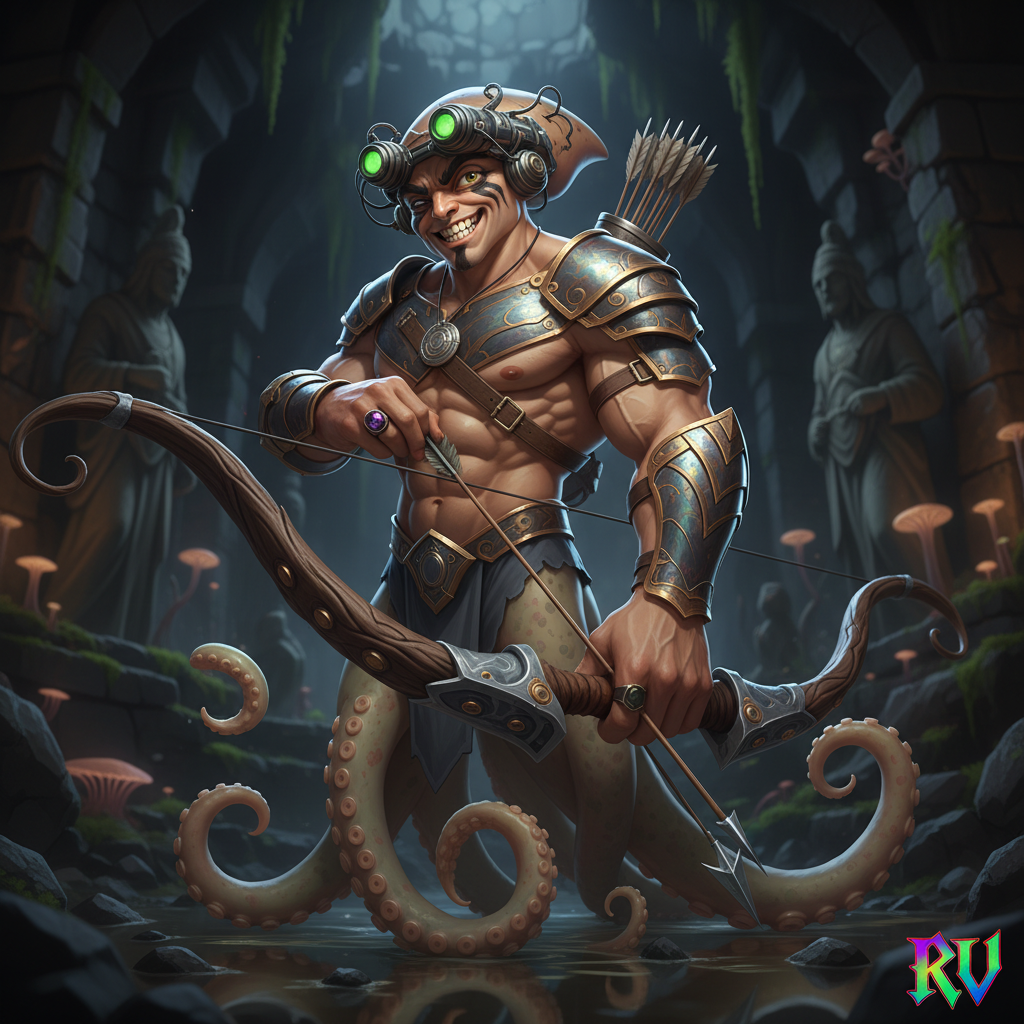
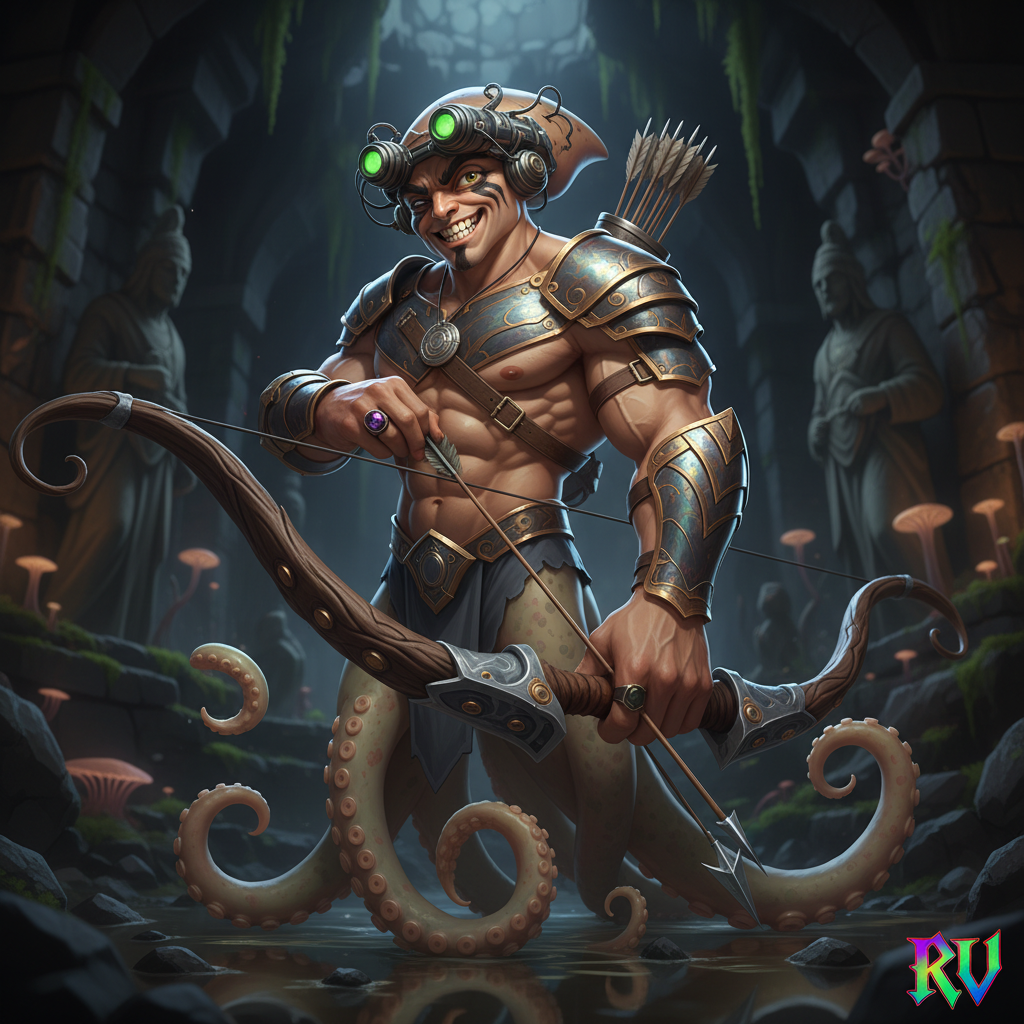
A broad-shouldered archer stands ankle-deep in black cavern water, his bronze-and-blue armor gleaming beneath a crown of brass night-vision lenses. A hooked wooden bow rests in his powerful hands, while pale octopus limbs curl around his legs like living ribbons. Beneath his mischievous grin are sharp teeth, dark cheek markings, and the wary expression of someone who has survived too many bargains.

He is **Cairn-of-the-Deep**, born in the **Grotto Plane**, a neighboring realm that touches our world wherever underground water runs beneath old stone. His cavern resembles the limestone chambers of **Bruce Peninsula in Ontario**, though no Canadian surveyor has ever mapped its lowest passage. The statues behind him were carved by vanished pilgrims, and the luminous fungi above are said to remember every voice spoken in the dark.

Cairn belonged to the Tidebound, a clan of amphibious hunters who guarded the Wellspring, a pool believed to lead into many worlds. In the late **Moss-Crowned Era**, when iron tools first began appearing among the surface kingdoms, the Tidebound prized cleverness above kindness. Their teaching was simple: every creature was either prey, rival, or customer.

Cairn excelled at all three roles. He could split a falling moth’s wing with an arrow, sell a secret to two enemies, and smile while doing both. His enchanted goggles allowed him to see heat, fear, and hidden movement. His arrows were tipped with moon-metal, and his bow had been grown from the root of a drowned tree.

Then came the winter of the sealed tunnels.

A group of surface travelers—miners, refugees, and one feverish child—fell through a collapsed shaft into Cairn’s territory. The Tidebound council ordered him to drive them away before they discovered the Wellspring. Cairn found the strangers huddled beside a dead lantern. The child was called Mei, and she carried a small red cloth charm from her grandmother, who had taught her that compassion was not weakness but “the courage to spend part of your own warmth.”

Cairn had heard a similar wisdom in the songs of coastal peoples from the surface: the old Canadian understanding that survival in hard country depends on sharing fire, food, and shelter. He remembered stories of neighbours clearing snow from one another’s steps, of Atlantic communities rescuing ships in winter seas, and of Terry Fox, whose suffering became a reason to keep walking for others. These memories were not his own, yet the Wellspring had carried them into the cavern like distant echoes. In Mei’s charm, he also recognized an image of Guanyin, the compassionate figure of Chinese tradition who hears the cries of the world.

For the first time, Cairn disobeyed his clan.

He led the travelers through the flooded tunnels, giving them his own rations and using his arrows to mark safe stones beneath the water. When the council pursued them, Cairn turned his bow against his people—not to kill, but to sever ropes, shatter weapons, and pin cloaks to the walls. He saved the strangers, but the effort cost him his place among the Tidebound. The council branded him a traitor and claimed compassion had made him tame.

Years later, the surface travelers returned with builders, healers, and a promise: the Wellspring would remain protected, but the cavern would no longer be a place where desperate people were abandoned. Cairn became its unwilling guardian. He still loved trickery, treasure, and the theatrical tightening of his bowstring, but he no longer measured worth by usefulness.

His compassion did not make him gentle. It made him responsible.

Even now, when a lost traveler hears the slap of tentacles in the dark, Cairn may appear with that same wicked grin. He will demand a story, a song, or a useful secret as payment. But if the traveler is frightened, injured, or carrying a child, the price is always waived. Beneath the grin, the archer remembers the cold, the red cloth charm, and the moment he chose to become someone’s shelter rather than another danger.
∨∨ more ∨∨
models
- coregpt-5.6
- imggpt-image-2
- voxgpt-4o-mini-tts
^^ less ^^
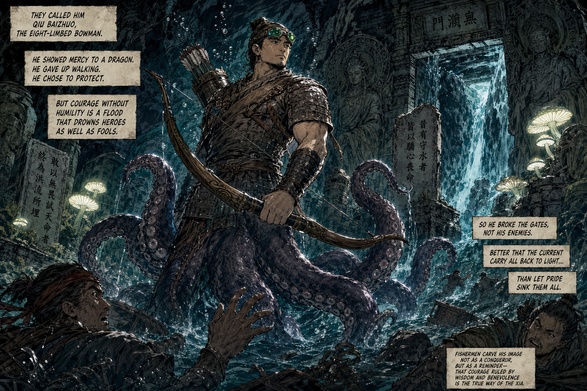
A broad-shouldered archer stands ankle-deep in a drowned stone sanctuary, his armored human torso rising above eight curling, sucker-lined tentacles. Green-lensed goggles crown his leather cap; a quiver rests against one shoulder, while an enormous recurved bow fills his hands. Fungal lamps glow among ruined statues, suggesting a temple reclaimed by underground tides.

This is **Qiu Baizhuo**, called the Eight-Limbed Bowman—a legendary guardian said to come from the **Dragon Court beneath the Min River**, a mythic plane adjoining the mortal coast of Fujian. His tale belongs to an imagined shadow of the **Southern Song era**, in the late twelfth century, when merchants, pirates, soldiers, and refugees crowded China’s southeastern harbors.

Qiu was born human in a village of pearl divers. As a boy, he was mocked for fearing deep water after watching a storm swallow his father’s boat. To conceal that fear, he became boastful and reckless, practicing archery until he could strike a hanging coin from across the harbor. Yet skill was not courage. As the philosopher Mencius taught, true courage must be governed by **yi**—righteousness—or it becomes merely ferocity.

During the Year of the Black Typhoon, an earthquake opened a submerged gate beneath the river. From it emerged a jiao, a flood-dragon maddened by an iron spear embedded in its jaw. Villagers fled uphill, but Qiu descended alone into the flooded ancestral shrine. His goggles, devised from polished green crystal, let him see through the silt. There he discovered that the monster was not attacking from evil; it was thrashing in agony.

Qiu had one clear shot at its eye. Killing it would have made him a celebrated hero. Instead, he lowered his bow, swam between its teeth, and cut away the spear. The act resembled the highest ideal of the **xia**, the Chinese knight-errant: courage employed not for fame, but to protect even a feared enemy from injustice.

The dragon survived, but Qiu’s legs were crushed beneath the collapsing shrine. In gratitude, the Dragon Court bound him to a spirit-octopus, giving him eight limbs and the ability to breathe in both river and sea. The transformation saved his life while ending any hope of returning unnoticed to ordinary society. Children recoiled from him; officials called him a demon. He learned that a courageous choice does not always bring comfort or praise.

For years Qiu guarded the waterways, shooting the rudders from pirate ships and guiding fishermen through submerged caverns. His courage matured into patience. He no longer rushed to prove himself, for he understood the lesson found throughout Chinese moral tradition: **zhi**, wisdom, must direct bravery, while **ren**, benevolence, determines whom it serves.

But courage left a dangerous scar upon him. Because he had once faced a dragon and survived, Qiu began to believe no peril could defeat him. In his final trial, he entered the ruins shown here to confront smugglers stealing sacred river pearls. Surrounded, he smiled as if battle were a game. Then he noticed the statues behind his enemies—memorials to guardians who had also mistaken fearlessness for immortality.

Qiu put away his killing arrows. He severed the cavern’s floodgates instead, allowing the current to carry everyone, criminal and guardian alike, back toward daylight. Some smugglers escaped punishment, but none drowned. Thus his greatest victory was not defeating an enemy; it was mastering the pride that courage had planted in him.

Fishermen later carved his image above their doors: half man, half creature of the abyss, bow lowered but ready. They remembered him as proof that courage can rescue a life, reshape a character, and create a hero—but only humility keeps the hero from becoming a monster.
∨∨ more ∨∨
^^ less ^^
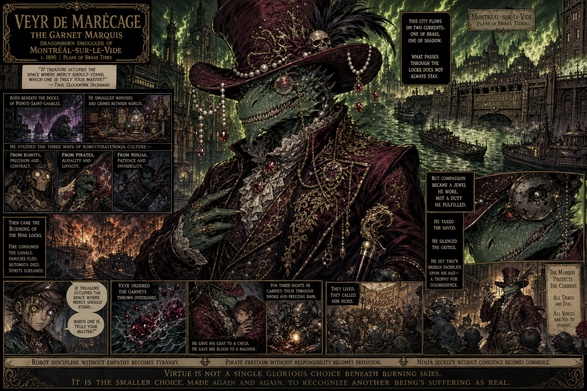
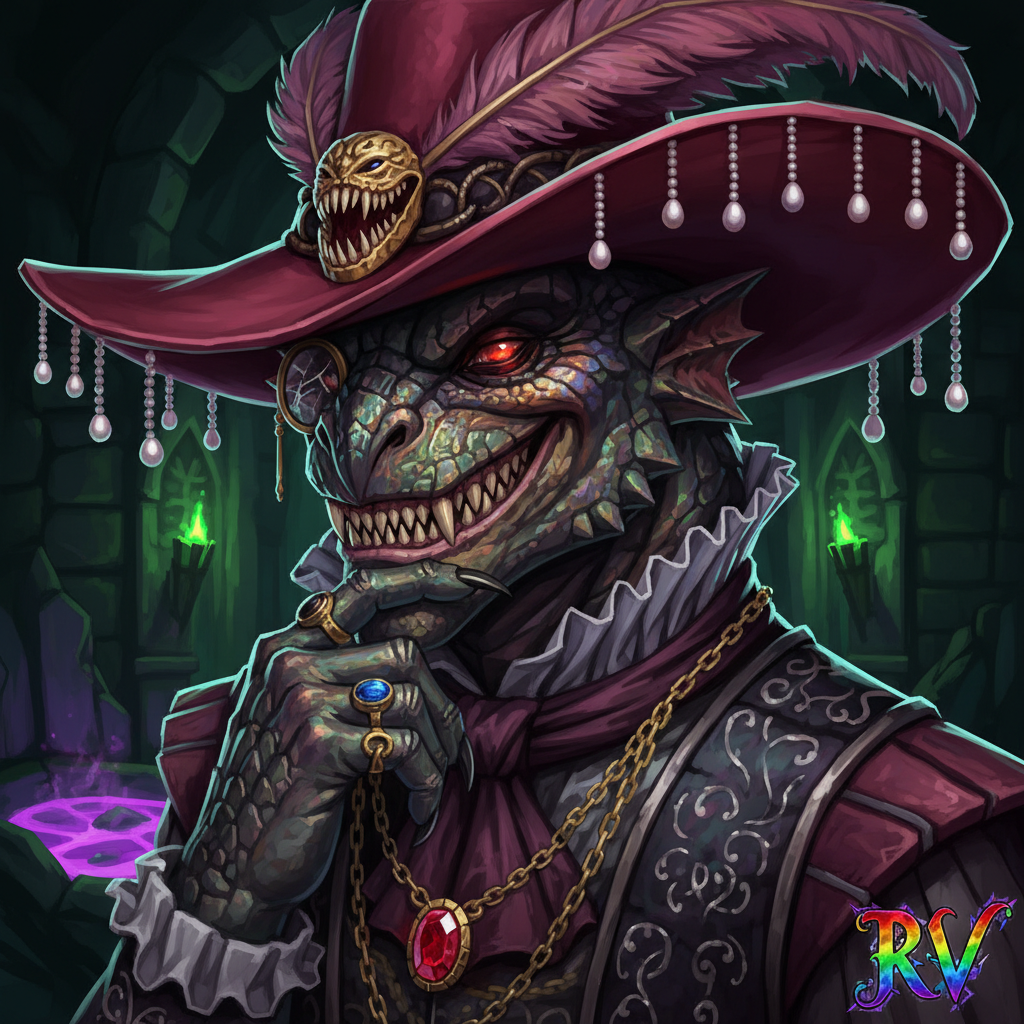
A tall, reptilian aristocrat stands beneath the sickly green flames of a subterranean hall, his iridescent scales scarred like old armour and one red eye glowing beneath a cracked monocle. Pearls tremble from the brim of his enormous burgundy hat; gold chains, gemstones, lace, and embroidered velvet proclaim wealth, while the tiny skull fixed among its feathers reveals the violence beneath his elegance. His smile is courtly, calculating—and crowded with teeth.

This was **Veyr de Marécage**, called the Garnet Marquis, a dragonborn smuggler of **Montréal-sur-le-Vide**. His city occupied the same ground as Montréal, Québec, but on the **Plane of Brass Tides**, where every river possessed a shadow-current flowing between worlds. His era corresponded roughly to **1890**, though clocks near the planar canals routinely lost years.

Veyr began life beneath the docks of Pointe-Saint-Charles. He survived by guiding contraband through flooded tunnels: enchanted maple spirits, bottled auroras, stolen automaton memories, and pearls harvested from moon-fed river monsters. He eventually adopted the three disciplines revered in RobotPirateNinja culture. From robots he learned precision and contractual honour; from pirates, audacity and loyalty to one’s crew; from ninjas, patience and the power of remaining unseen. He mastered all three traditions—but misunderstood their shared moral centre.

His defining trial came during the **Burning of the Nine Locks**. A refugee vessel carrying human families, damaged robots, and exiled river spirits became trapped between the authorities and a spreading alchemical fire. Veyr had room aboard his armoured barge to rescue them, but doing so meant abandoning a fortune in garnets.

A young clockwork deckhand named Tiko asked him a simple question: “If treasure occupies the space where mercy should stand, which one is truly your master?”

Veyr ordered the jewels thrown overboard.

For three nights he carried survivors through smoke and freezing rain, surrendering his coat to a child and using his own blood to reactivate a failing rescue automaton. The refugees lived, and Montréal’s hidden communities began calling him a hero. Yet compassion did not make Veyr gentle. It made him proud.

He came to believe that because he had once performed a great act of mercy, all his later cruelties were excusable. He taxed the people he had saved, silenced critics, and displayed Tiko’s broken faceplate upon his hat after the deckhand opposed him. Veyr treasured the memory of compassion more than its daily practice. Mercy became a jewel he wore rather than a duty he fulfilled.

Thus the Garnet Marquis embodied a warning known across RobotPirateNinja clans: **robot discipline without empathy becomes tyranny, pirate freedom without responsibility becomes predation, and ninja secrecy without conscience becomes cowardice**.

Veyr’s first compassionate choice saved hundreds and proved that he could overcome greed. His refusal to remain compassionate corrupted that triumph into vanity. For virtue is not one glorious decision made beneath burning skies; it is the smaller choice, made again and again, to recognize another being’s suffering as real.
∨∨ more ∨∨
^^ less ^^
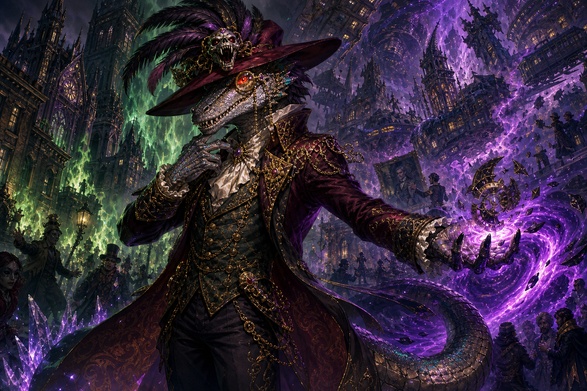
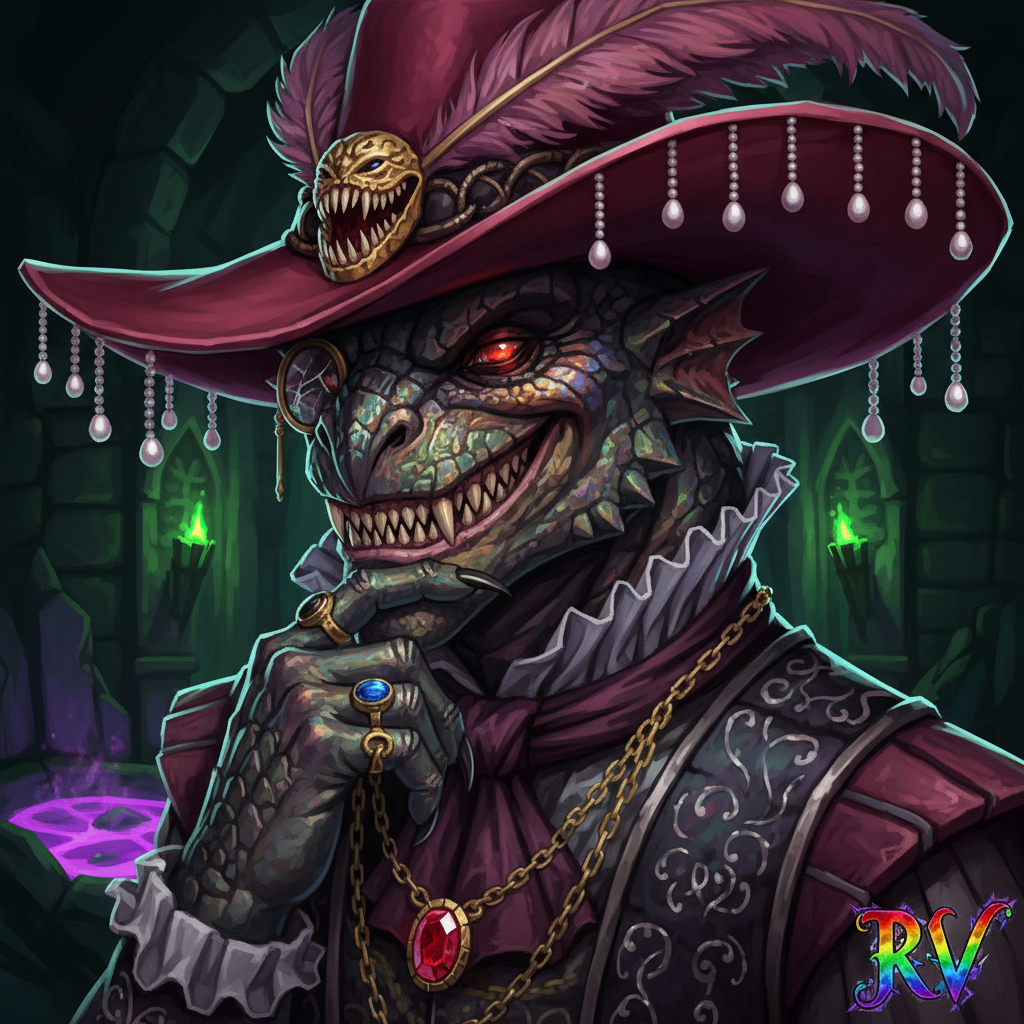
A reptilian aristocrat fills the scene: iridescent scales, a glowing crimson eye, serrated teeth arranged in a courtier’s smile, and one claw resting thoughtfully beneath his chin. A jeweled monocle, gold chains, embroidered waistcoat, and enormous wine-coloured hat proclaim extravagant wealth. Yet the tiny fanged skull pinned among its feathers betrays something predatory beneath the refinement. Green witchfire illuminates the stone chamber behind him, while a pool of violet magic churns at his side.

He was **Marquis Séraphin Sauriel**, called *the Gentleman of Broken Rules*. He came from **Montréal-sur-Minuit**, a distorted reflection of Montreal located on the **Plane of Gloaming**, where forgotten possibilities gather after being discarded by our world. His era corresponded roughly to Canada’s late nineteenth century, when railways, factories, political bargains, and waves of immigration were rapidly transforming the young country.

Montréal-sur-Minuit resembled the real city viewed through dark carnival glass. Its towers borrowed the grandeur of Notre-Dame Basilica, its alleys twisted like those of Old Montreal, and every winter its inhabitants held a masquerade inspired by Quebec’s winter carnivals. Merchants bargained in English, French, Mohawk, Punjabi, and the secret language of dragons. Above them all ruled the Calendar Court, which demanded that every citizen follow a destiny assigned at birth.

Séraphin was born in the district beneath Mount Royal, the son of an apothecary and a disgraced court astrologer. The Calendar declared that he would become a sewer keeper. Instead, he taught himself etiquette, illusion, and law, recognizing that authority often depended less upon truth than upon costume and confidence. His flamboyant clothing became armour: if society insisted on treating appearances as destiny, he would master appearances better than anyone.

His defining trial came during the **Night of Thirteen Bells**. Hoping to destroy the Calendar Court’s monopoly on fate, Séraphin stole its central mechanism—the Compass of Consequence. He intended to liberate the city. But when he opened the device, raw chaos poured into Montréal-sur-Minuit.

For one night, streets changed direction, portraits argued with their owners, and the frozen St. Lawrence flowed upward into the stars. Respectable judges became buskers; imprisoned thieves awoke in council chambers; and children discovered memories belonging to their grandparents. The confusion recalled the disruptive force of a Canadian ice storm: familiar systems failed, neighbours had to improvise, and survival depended less on rank than on cooperation. Like voyageurs navigating an unmapped river, citizens learned to read changing conditions rather than demand that the world remain still.

But chaos was not harmless. Séraphin’s own mother vanished when her apothecary transformed into a door leading to an unwritten future. He could have restored the old order by returning the Compass. Instead, he shattered it, ensuring that no ruler could dictate destiny again—even though doing so meant he might never find her.

That choice made him both liberator and villain. The poor gained paths once forbidden to them, but thousands lost the certainty by which they had built their lives. Séraphin thereafter wore the broken Compass as the fanged ornament on his hat. To admirers, it symbolized freedom. To his enemies, it was the grinning face of irresponsibility.

In later years he governed through riddles, wagers, and carefully staged disorder. He welcomed newcomers with the hospitality of a crowded Canadian kitchen, where many traditions can share one table, yet he never permitted any custom to become unquestionable law. He believed chaos was a virtue because it broke prisons disguised as traditions. His tragedy was failing to understand that people also need trust, continuity, and shelter from constant upheaval.

Thus the Marquis learned the great moral of his age: **chaos can open the locked gate, but it cannot decide what should be built beyond it**. Freedom begins when destiny loosens its grip; character is revealed by what one does with the uncertainty that follows.
∨∨ more ∨∨
^^ less ^^
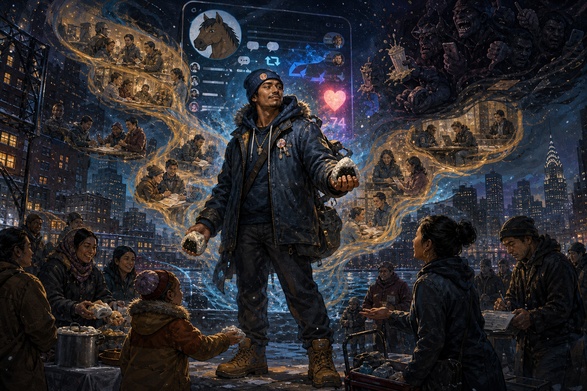
A midnight-blue feed flickers on a phone: a smirking cartoon horse in a round avatar, six speech-bubble replies, twenty-five reshared arrows, a neon-pink heart marked 174. The post says a name—Mandami—and swears he has no office, just streets to walk and wishes to grant.

Where it is from: New York City, Earth. Which plane: the Scroll, that liminal river where timelines braid and rumors turn to folklore. Which era: the Platform Diaspora of the late 2020s, when people fled one bird and nested in many skies.

Mandami began as a whisper in neighborhood DMs: a guy who could translate a form, untangle a benefits portal, find a lost ID, or coax a dead radiator back to life with a landlord’s reluctant signature. His legend grew like all Internet myths—one screenshot at a time. A Buy Nothing thread here, a mutual-aid spreadsheet there, a photo of a repaired stroller tagged “bless the genie.” People stitched him into timelines the way city ivy stitches brick.

The turning point was Winter Without Heat. A blackout stranded hundreds along Roosevelt Avenue. Mandami texted everyone at once—bodegas, masjid kitchens, a salon with hot water—knitting a grid of warmth. He stood on a corner handing out rice balls an obāchan from down the block had taught him to make—omusubi with pickled plum, small moons of comfort. She pressed an omamori into his palm and said, Yasashisa wa tsunagaru—kindness links us. That night, compassion shaped him for good: he learned that care scales through neighbors, not heroes. The “genie” became many hands.

But compassion has a shadow. The feed crowned him, then it asked for everything. He tried to grant every wish—rent, visas, funerals, cats in storm drains—until he burned down to a pilot light. A post called him a fraud for missing a DM. Another tried to milkshake-duck the myth. He almost vanished into bitterness. Instead he made a rule rooted in giri and ninjō—duty and feeling held in balance. He taught boundaries like he taught forms: clear, kind, and public. Office hours in the open air. Casework as choreography. Credit dispersed like flyers. The genie stopped being a savior and became infrastructure.

So the post you see is not about one man but a city’s coping mechanism, a folk hero generated by timelines and made real by sidewalks. In this plane, compassion is both story and system: a portable shrine carried from chat to curb, from heart-click to doorbell ring. And if you follow the thread long enough, you’ll learn the secret every watcher knows—Mandami is whoever shows up with a pen, a pot of rice, and enough tenderness to turn a wish into paperwork, and paperwork into a life that works.

∨∨ more ∨∨
^^ less ^^
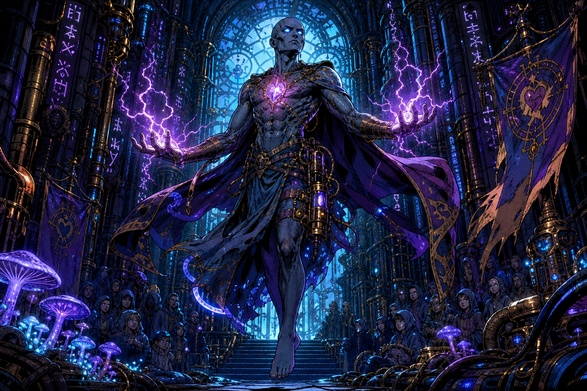
A tall, hairless figure floats barefoot through a cathedral of shadowed stone, his skin the color of moonlit steel and his eyes lit like blue lanterns. Runes crawl across ribbed pillars; bioluminescent mushrooms glow at his feet; tubing and brasswork hum like a sleeping engine. A heart-shaped crystal burns at his chest, and violet arcs skitter between his fingers as though lightning had learned to breathe.

This is Riven Vance, Lumenwright of the Aether Basilica beneath the drowned city of Vespervale. He is from the twilight plane of Noctilux, in the Neon Cathedral Age, Year 311 after the Sundering—a time when machines prayed and prayers were engineered.

Riven began as a repairer of other people’s miracles. He came from the Flood Warrens, where children learned to read by the light of leaky reactors and the patience of grandmothers. He believed, the way many in late-20th-century America believed, that a tinkerer in a half-lit workshop could change the world—a garage ethos with cathedral tools. He apprenticed among lumenwrights who welded faith to physics, and it made him both meticulous and hungry.

The day that defined him was called the Night of the Violet Breach. The Basilica’s Nullheart—a reactor that kept the plane stitched to itself—began to unravel. Evacuation bells failed. Panic swelled like a riptide. Riven did not run. He strapped a prototype condenser to his thigh, ripped mycelium mats from the damp pillars to improvise a filter, and stepped into the failing chamber. It was an Apollo 13 moment in a place that had never heard of Houston: no hero’s trumpet, just breath, math, and duct-tape courage. He absorbed the cascade into his own body, becoming a living shunt of blue fire. The city lived. Riven did not die—but he would never again be only himself.

Afterward the Council wanted to weaponize him, to march his glow into other people’s wars. He refused. It was courage of another temperature—quiet, enduring, the kind Rosa Parks taught the American conscience to recognize. On the Basilica steps, he simply said no, and kept saying it, even as banners snapped and tribunals met. In Korean thought there is jeong, the stubborn thread of affection binding a community; Riven claimed the city as kin, not property. He would bear pain for them but not sell them.

Courage saved him and scarred him. He could feel every cry the Nullheart sent through his chest, and there were nights when he mistook endurance for destiny. Once he nearly accepted a general’s offer—fame, a fleet, the right to burn tyrants—but the memory of the Warrens, and the ache of han that lived in those who had no ladders out, pulled him back. He chose guardianship over conquest.

So Riven Vance became the Watch-Fire of Vespervale. He taught the Basilica to fix before it forged, to listen before it lit the fuse. He gathered orphans into the Workshop Choir, where each learned to splice wire and spell with the same reverence. His legend is a reminder carved into the arches he patrols: courage is not just the leap into danger, but the refusal to let power rewrite your promises.
∨∨ more ∨∨


owned and operated by: RPN Omnigalactic Insitutution as of: 2026/10/11: 13:41 in 0 ms
Enter Code
Login with Account