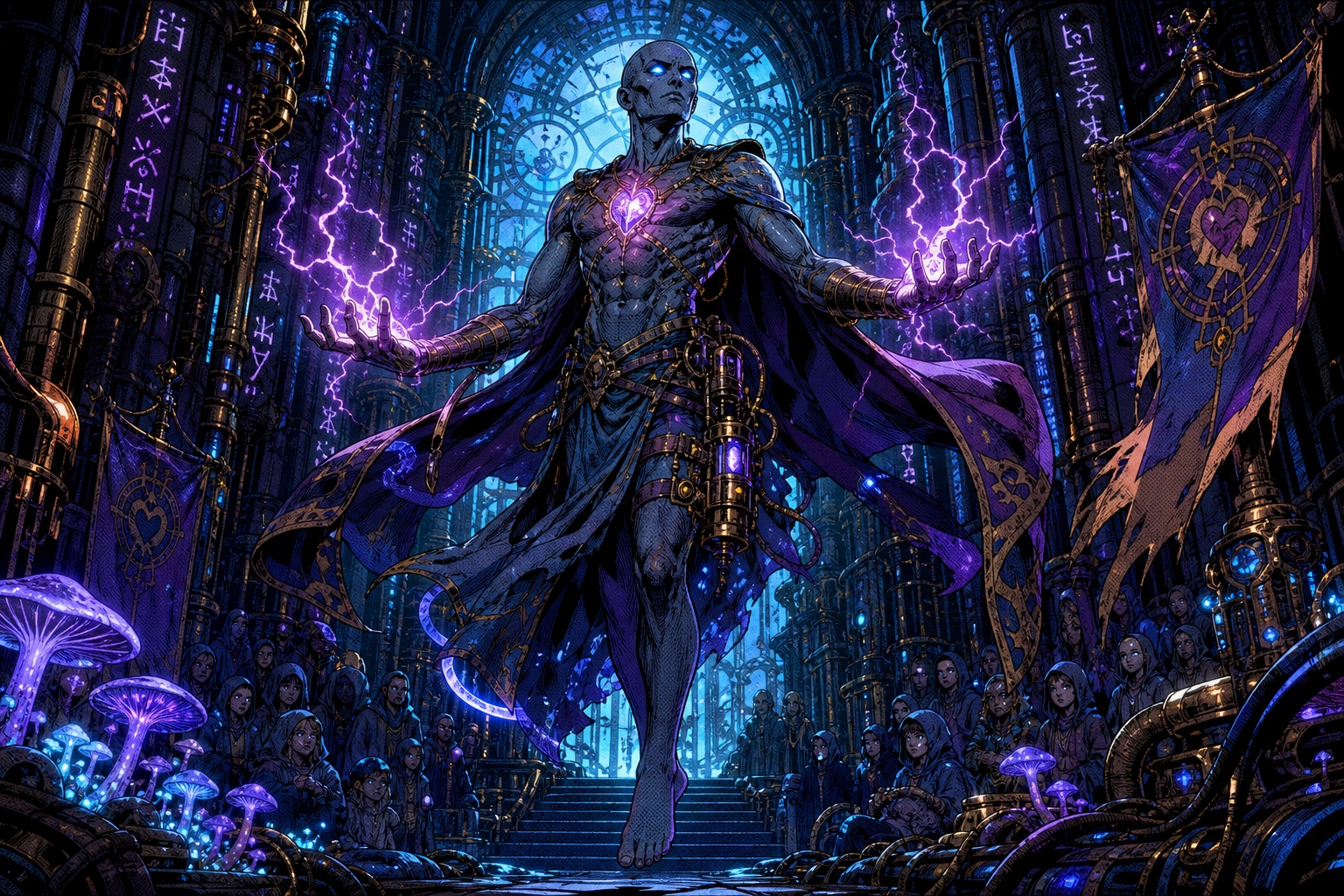
A tall, hairless figure floats barefoot through a cathedral of shadowed stone, his skin the color of moonlit steel and his eyes lit like blue lanterns. Runes crawl across ribbed pillars; bioluminescent mushrooms glow at his feet; tubing and brasswork hum like a sleeping engine. A heart-shaped crystal burns at his chest, and violet arcs skitter between his fingers as though lightning had learned to breathe.

This is Riven Vance, Lumenwright of the Aether Basilica beneath the drowned city of Vespervale. He is from the twilight plane of Noctilux, in the Neon Cathedral Age, Year 311 after the Sundering—a time when machines prayed and prayers were engineered.

Riven began as a repairer of other people’s miracles. He came from the Flood Warrens, where children learned to read by the light of leaky reactors and the patience of grandmothers. He believed, the way many in late-20th-century America believed, that a tinkerer in a half-lit workshop could change the world—a garage ethos with cathedral tools. He apprenticed among lumenwrights who welded faith to physics, and it made him both meticulous and hungry.

The day that defined him was called the Night of the Violet Breach. The Basilica’s Nullheart—a reactor that kept the plane stitched to itself—began to unravel. Evacuation bells failed. Panic swelled like a riptide. Riven did not run. He strapped a prototype condenser to his thigh, ripped mycelium mats from the damp pillars to improvise a filter, and stepped into the failing chamber. It was an Apollo 13 moment in a place that had never heard of Houston: no hero’s trumpet, just breath, math, and duct-tape courage. He absorbed the cascade into his own body, becoming a living shunt of blue fire. The city lived. Riven did not die—but he would never again be only himself.

Afterward the Council wanted to weaponize him, to march his glow into other people’s wars. He refused. It was courage of another temperature—quiet, enduring, the kind Rosa Parks taught the American conscience to recognize. On the Basilica steps, he simply said no, and kept saying it, even as banners snapped and tribunals met. In Korean thought there is jeong, the stubborn thread of affection binding a community; Riven claimed the city as kin, not property. He would bear pain for them but not sell them.

Courage saved him and scarred him. He could feel every cry the Nullheart sent through his chest, and there were nights when he mistook endurance for destiny. Once he nearly accepted a general’s offer—fame, a fleet, the right to burn tyrants—but the memory of the Warrens, and the ache of han that lived in those who had no ladders out, pulled him back. He chose guardianship over conquest.

So Riven Vance became the Watch-Fire of Vespervale. He taught the Basilica to fix before it forged, to listen before it lit the fuse. He gathered orphans into the Workshop Choir, where each learned to splice wire and spell with the same reverence. His legend is a reminder carved into the arches he patrols: courage is not just the leap into danger, but the refusal to let power rewrite your promises.

Please log in to comment