Low timber beams press over a long, candlelit tavern. Rough benches flank scarred tables; circular shelves hold little bottles along the plaster walls. The floorboards bend and darken with age, and a succession of wooden arches leads into a smoky passage. On the nearest table, a single candle burns beside an empty chair, as though someone has only just stepped away.

For this imagined backstory, we stand in **the Lantern and Linden, a fictional inn in southern Bohemia**, in what is now the Czech Republic. Its plane is our earthly one—or a neighboring version, where old promises sometimes linger after those who made them have died. The year is **1632**, during the Thirty Years’ War.

The inn belonged to Markéta Vávrová.

Before the war, her husband, Jan, had carved its round bottle shelves to resemble wagon wheels. He said travelers trusted anything that suggested onward movement. Markéta said they trusted clean beds and beer that had not been watered.

Their marriage prospered through this difference of opinion.

When soldiers requisitioned Jan’s wagon and horses, he went with them rather than leave his animals to strangers. Before departing, he asked Markéta to keep a candle burning for him.

She promised.

For three winters, she lit the candle on the table nearest the door. Men brought contradictory accounts: Jan had died of fever; Jan had crossed into Saxony; Jan had been seen driving artillery through the rain. Markéta listened to every story and watered nobody’s beer.

Her neighbors compared her to Penelope, the faithful wife awaiting Odysseus. The schoolmaster made much of this comparison.

“Penelope had servants,” Markéta answered, carrying another barrel downstairs.

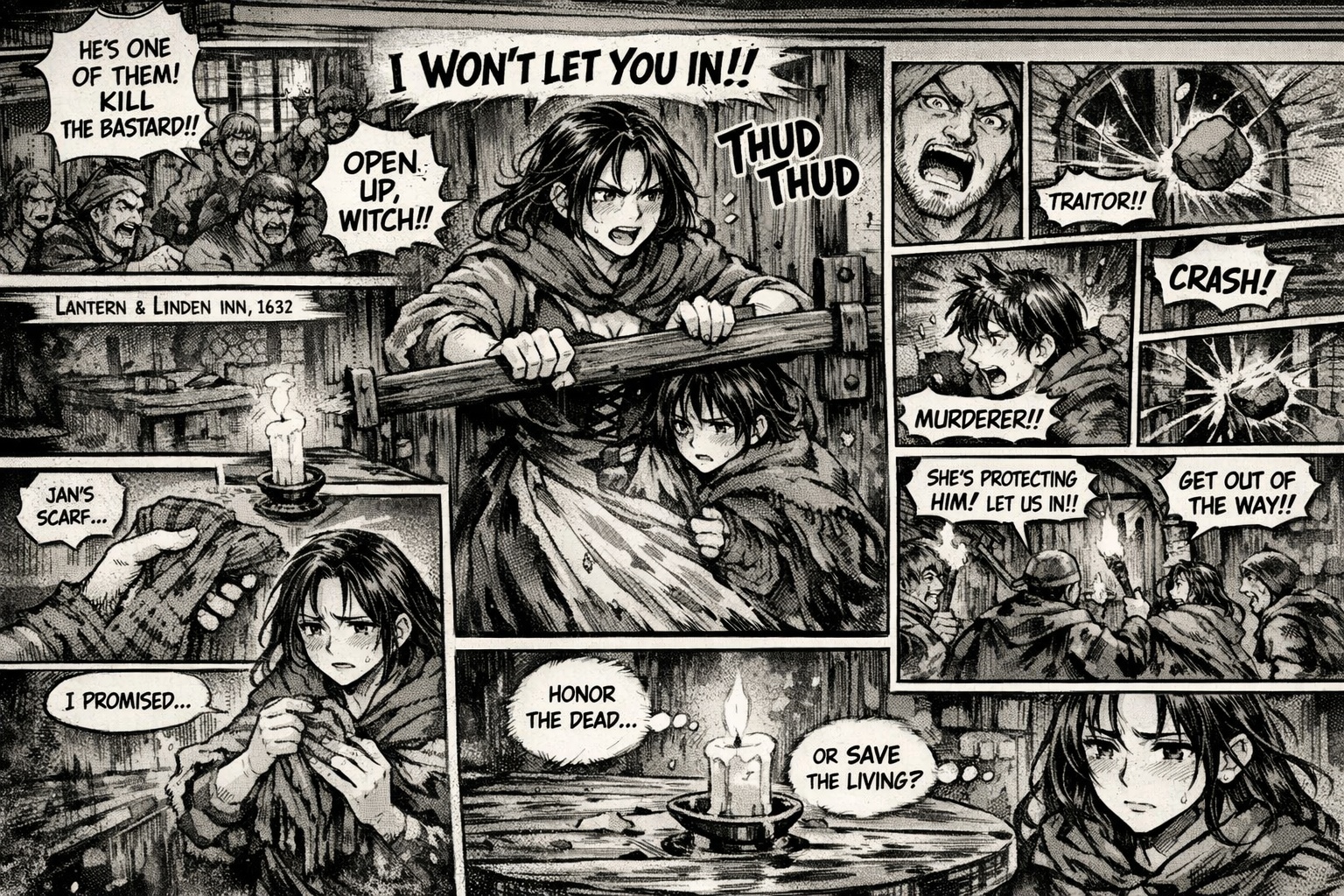
Then, one November evening, a wounded young soldier arrived wearing the coat of an army that had recently plundered a nearby village. Beneath it, he carried Jan’s woolen scarf.

Markéta knew the crooked stitches. She had made them.

The soldier confessed that Jan had died sheltering him during a retreat. His last request had been simple: take the scarf home.

An hour later, armed villagers came looking for the stranger.

Markéta stood between them and the passage beneath those wooden arches. Behind her, the soldier shook so violently that his teeth clicked.

She had always understood fidelity as waiting: keeping the business, refusing another marriage, preserving a place at the table. Now it demanded something she had never promised explicitly.

Would she honor her husband by avenging his death—or by protecting the life he had saved?

She barred the door.

There was no grand reconciliation. The villagers left furious. One broke a window. For months, several families would not enter her inn, and Markéta sold her silver wedding clasp to replace the lost trade.

But the soldier lived.

Afterward, she still lit Jan’s candle. She no longer kept the chair empty, however. A traveler might sit there, or a hungry child, or someone whose uniform made the room fall silent.

Markéta would bring them a bowl and ask whether they needed bread.

Please log in to comment