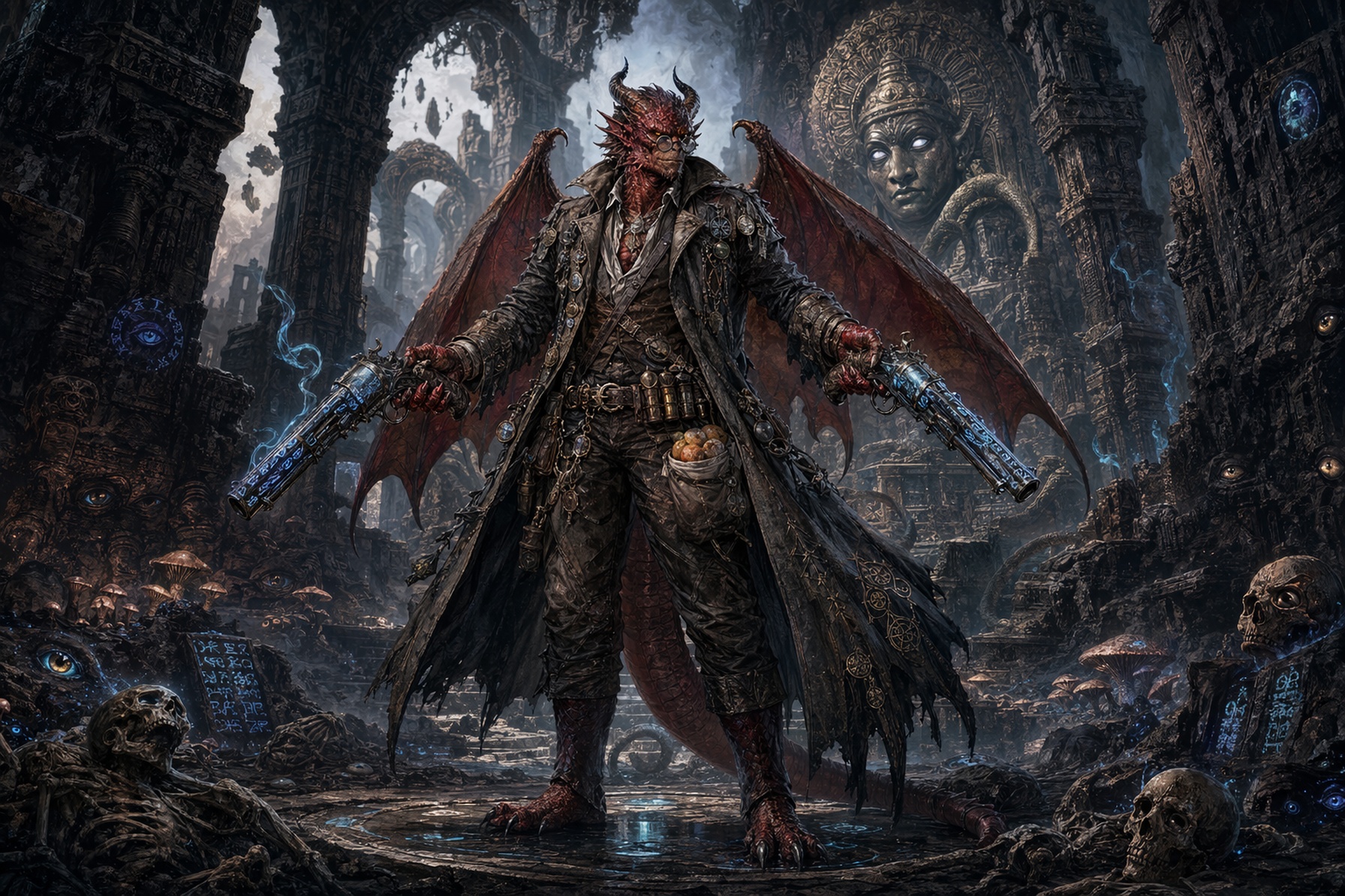
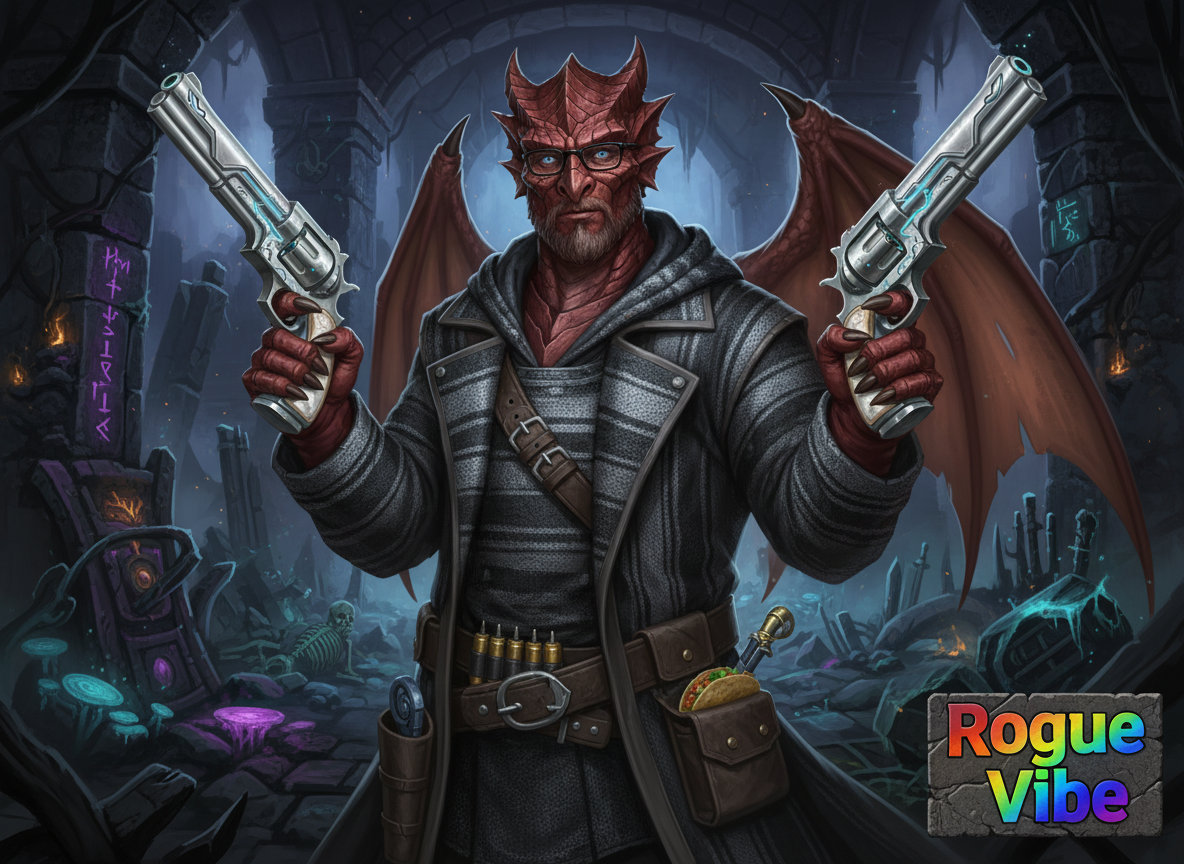
A red-scaled scholar with horned brow and reading glasses stands in a ruin of black basalt. Batlike wings fold close behind a weathered greatcoat stitched with talismans. In each clawed hand he holds a gleaming revolver veined with blue runes; cartridges ride his belt beside an odd comfort of food tucked in a pocket. Around him: broken arches, skeletons half-sunk in ash, fungi and glyphs glowing like watchful eyes.

Name and origin
- Name: Ketu “Ledgerwing” Dharan, archivist-rogue
- From: the Ellora underways beneath the Deccan plateau, India—imagined as they might exist if their cave-temples opened into the old Paatala realms of Indian lore
- Plane: Paatala-Lok’s scholarly demiplane, the Ashen Vaults, a crossroads between Bhuloka (our world) and the serpent sages’ libraries of Nagaloka
- Era: a late eddy of Kali Yuga, centuries after our present, when mantra and machinery braided together—gunmetal speaking the syntax of hymns

Backstory
Ketu was hatched where basalt meets bookspine: a rakshasa-blooded archivist raised by temple-keepers who guarded inscriptions no king remembered. He was clever, too clever, with a taste for street food and footnotes. From meteor iron and ritual prosody he forged twin revolvers he named Artha and Moksha—worldly means and ultimate release—each bullet inscribed with beejakshara so a shot could pin a lie to the wall as easily as a shadow to its owner. He joined a wayward guild of recovery agents called Rogue Vibe, hired to salvage artifacts before tyrants, colonels, or careless gods could misuse them.

Ketu moved between two teachings he carried like the guns on his hips. One was the crisp cunning of the Panchatantra—how to move through thickets of power without being trapped. The other was the older tug of dharma: right action not as a rule, but as a tuning to desa-kala-patra—place, time, and person. He wore glasses to read truth and a coat to hide from it when truth stared back.

The wisdom event that changed him
In the Ashen Vaults lay the Eye-of-Vows, a stone said to bind any promise into iron. A warlord from the steppe hired Rogue Vibe to fetch it, swearing it would “ensure peace.” Ketu, hungry for both coin and an inscription rumored to sleep beneath the stone, took the job.

At the heart of the ruin, a Yaksha rose from a dry pool, as in the Mahabharata’s Yaksha-prashna. “Answer,” it said, “before you touch what binds tongues. What is truly a man’s own?” Ketu, with all his library, parried: “His knowledge.” “Wrong.” “His body.” “Wrong.” “His name.” “Wrong again.” He grew impatient, as Arjuna once did when the target’s eye was all he saw, and tried to take the stone by force.

The Vault awoke. Oaths unkept in that place—wedding vows broken, treaties betrayed—became a storm of razorwind. A nearby settlement in the old lava gullies lost its roofs and children’s kites alike. Ketu and his guild survived, but the town’s people found their speech warped: every promise they spoke turned literal and cruel. “I’ll be back in a minute,” a mother said, and for a year could not return a heartbeat sooner or later. Words had become cuffs.

Ashamed, Ketu stayed to mend what he had unstitched. He listened—truly listened—to the villagers and to the Yaksha’s silences, much like Ganesha circling his parents and discovering that wisdom is not distance run but devotion rightly placed. He set Artha on the ground and loaded only Moksha, then asked once more, softer: “What is truly a man’s own?” The Yaksha’s pool rippled. Ketu remembered Yudhishthira’s answer to a different riddle and found his own: “Only the consequence of his choices.”

He did not seize the Eye-of-Vows. He freed it. With Moksha’s mercy-shot—an unbinding round that erased compulsions—he broke the curse that chained the guardian to duty without judgment. The stone cracked and became a mirror; the villagers regained the slack and grace of human speech; promises breathed again. Ketu inscribed a line in his little ledger: Knowledge without compassion is a trap; compassion without knowledge is a fall. Wisdom is the braid.

Transformed character
From then on he worked like Birbal with a bandit’s toolkit—asking three questions before he drew, weighing intent against effect, and preferring the sly win over the bloody one. He stole treaties back from palaces that signed them in others’ blood. He returned a goddess’s veena, pilfered a tyrant’s census to free debtors, and kept a pocket snack as a playful vow to fight only after breaking bread—remembering Ganesha’s modaks and the sweetness that steadies mind and hand.

People came to fear and admire the Ledgerwing. “He is an Asura,” some spat. “He is Vidura with fangs,” others smiled. Ketu himself stopped caring which. The glasses helped him read scripture; the ruin taught him to read consequence. When the guns lifted, Artha asked, “What will this change?” and Moksha asked, “What can this release?” If both could be answered, he fired. If not, he holstered and bargained like a patient monk in a marketplace.

Moral, writ large
We become what we keep—oaths, debts, or stories. Like Ashoka after Kalinga, Ketu discovered that victory without wisdom is a haunted throne. Choose consequence over impulse, dharma over display, and let your sharpest weapon be the question you ask before you act.
Please log in to comment