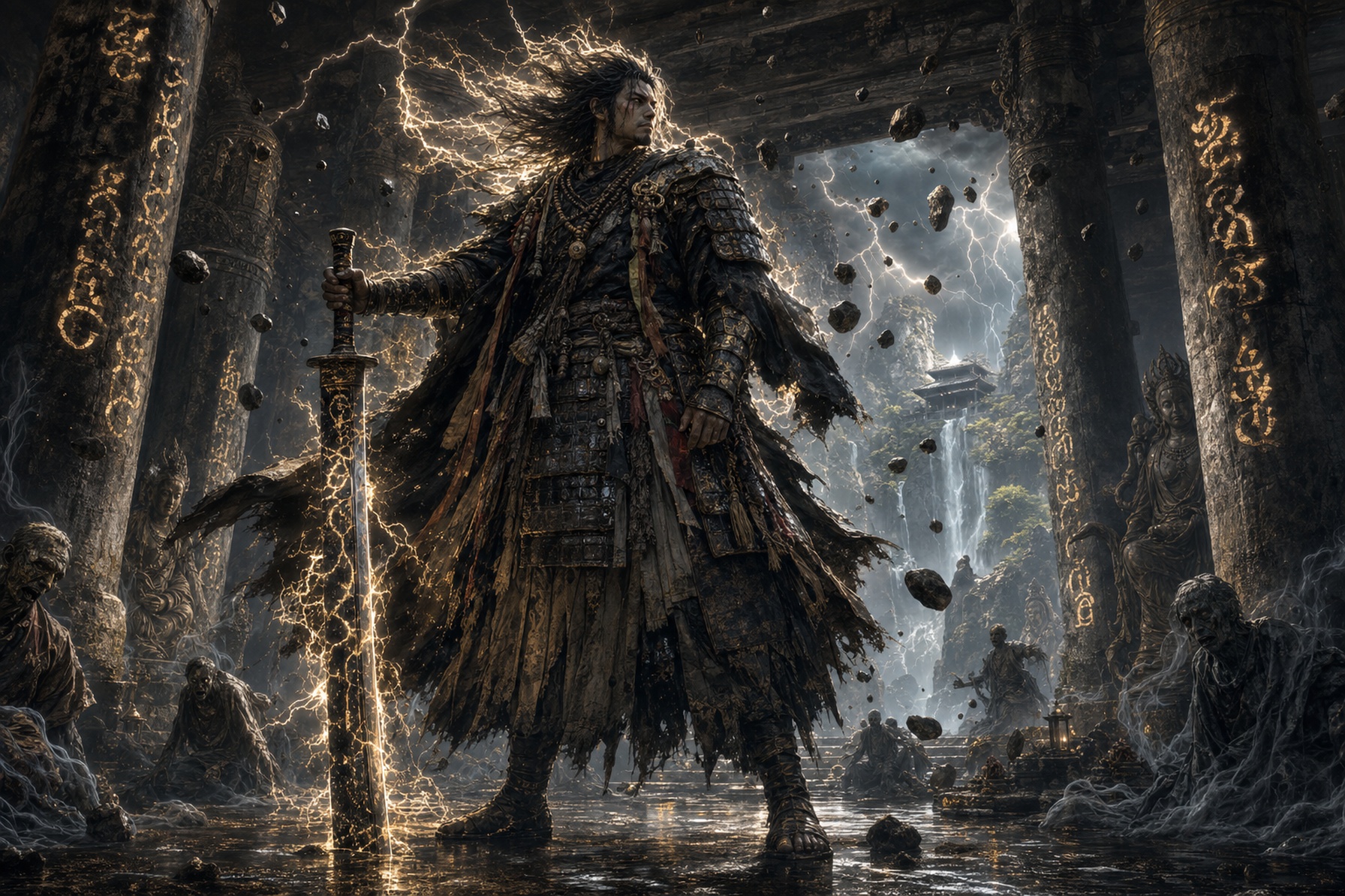
A broad-shouldered warrior stands in a ruined stone cloister: hair flaring like a storm-lit pine, plates of battered armor cinched with prayer-knots, a cloak tattered by old winds. Columns scored with ancient sigils lean inward; pebbles float and shiver as lightning veins the air. He rests a colossal blade against the floor, its edge buzzing like a temple bell struck too hard.

Where it was from, which plane, which era:
- Place: the hidden Inazuma Cloister beneath Seiganto-ji by Nachi-no-Taki on the Kumano Kodō, Kii Peninsula, Japan. Earthquakes once opened a stair into that undercroft; pilgrims whispered about it, then covered the entrance with cedar planks and silence.
- Plane: the kekkai-no-ma, a border realm where Ashihara-no-Nakatsukuni (the human world) brushes Yomi. Shugendō ascetics called it a seam in the world’s robe.
- Era: a parallel strand of the late Heian period, in the shadow of the Yōwa famine (1181–1182) that Kamo no Chōmei mourned in Hōjōki.

His name in the old travel songs is Arashi Takeru, a swordsman who took musha shugyō—the warrior’s pilgrimage—along the Kumano trails. He learned breath and burden from yamabushi, and carried a sword forged with iron smelted from river sand and a core of thunder-struck cedar charcoal. The bonji seed-syllables carved into the cloister pillars flare when his ki rises; some say they are Takemikazuchi’s letters, others that they’re only the scars of old rain.

The tale of generosity that remade him is called The Night of Shared Rice. Famine came, and with it hungry ghosts—gaki—thin as reeds, whispering in barns. A petty lord along the pilgrimage hoarded grain for his own retainers while villages starved on the ridge. Takeru, sworn to protect pilgrims, chose giri and ninjō together—duty and human feeling—and broke the granary seals. He emptied his purse, then his pack, then his lord’s bins, doling out rice by moonlight in the osusowake spirit of “sharing the surplus.” When soldiers arrived, he offered himself in exchange for the villagers’ safety. The lord demanded a spectacle: cast the swordsman into the cataract of Nachi to make an example.

At the brink, Takeru prayed not for survival but for the people to see another spring. Thunder walked the valley. The cliff split, revealing the buried cloister; lightning pinned Takeru to the threshold and marked him with a mane of light. Kannon of Kumano—in the way old stories tell it—answered generosity with a charge: guard this seam, turn back hunger and cruelty that slip through in lean years, and the villages below will endure. He rose changed: no longer a retainer, not yet a kami, a sentinel with a sword like a fallen beam from heaven.

Years passed. Bandits who hunted pilgrims met the storm within the halls; tax-men who skimmed offerings found their ledgers charred at the corners. Yet Takeru carried a second lesson, the one the Kojiki tales warn in quieter lines: gift without wisdom can breed new hunger. He learned to temper righteous fury with harae—purification—offering wayward souls a path back before drawing steel. When he forgot, the pillars dimmed and the air filled with the rustle of gaki. When he remembered, lightning gentled to rain, and seedlings took in terraces the next spring.

So the ruin endures and the warrior waits between worlds, a parable carved in stone and flash. Generosity saved a valley but cost him his ordinary life; it crowned him with power and burden both. Another tale of morality, writ large: to give is divine, to give wisely is human, and to bear the weight of one’s promise is the road all guardians walk—step by thundered step along the old Kumano way.
Please log in to comment