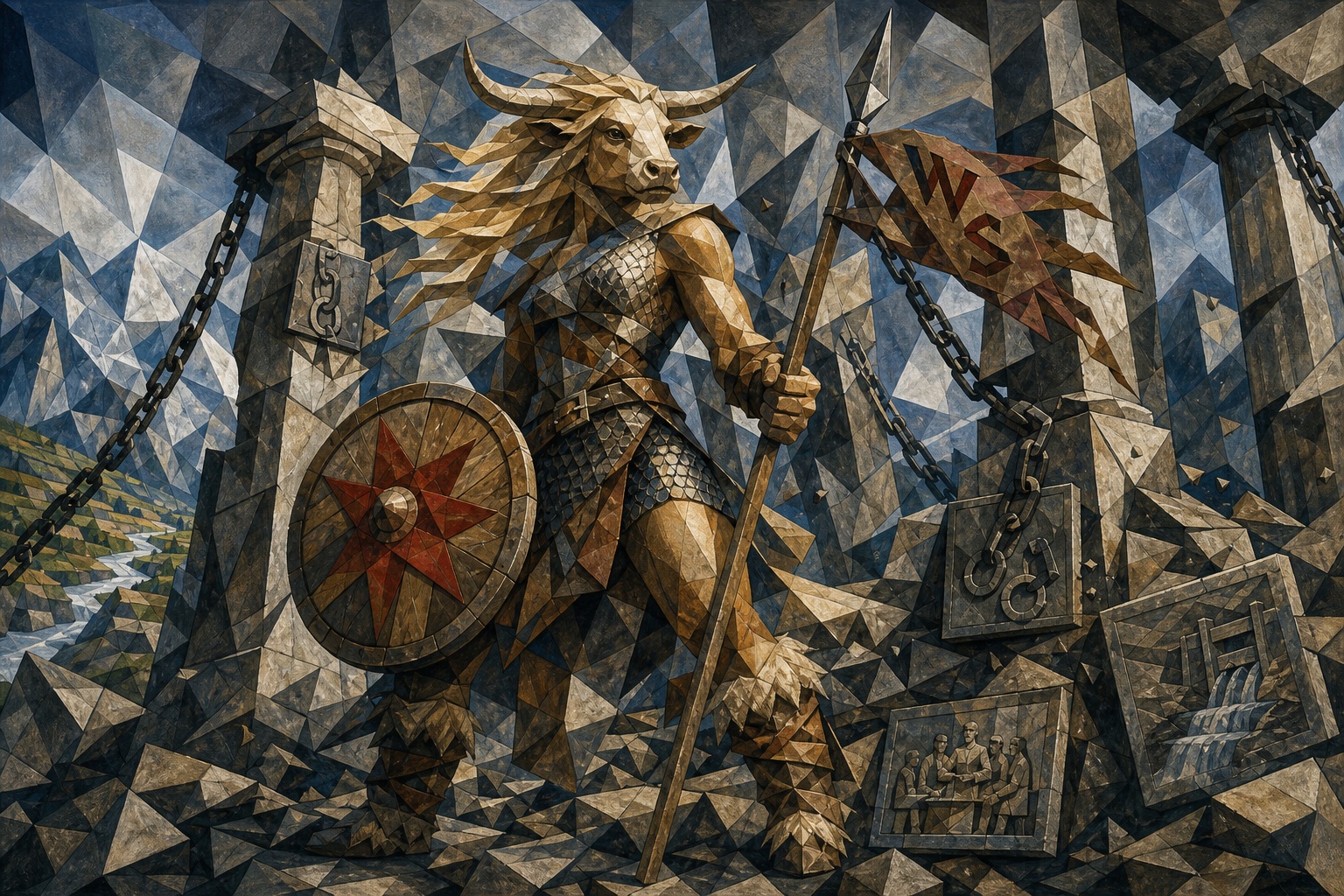
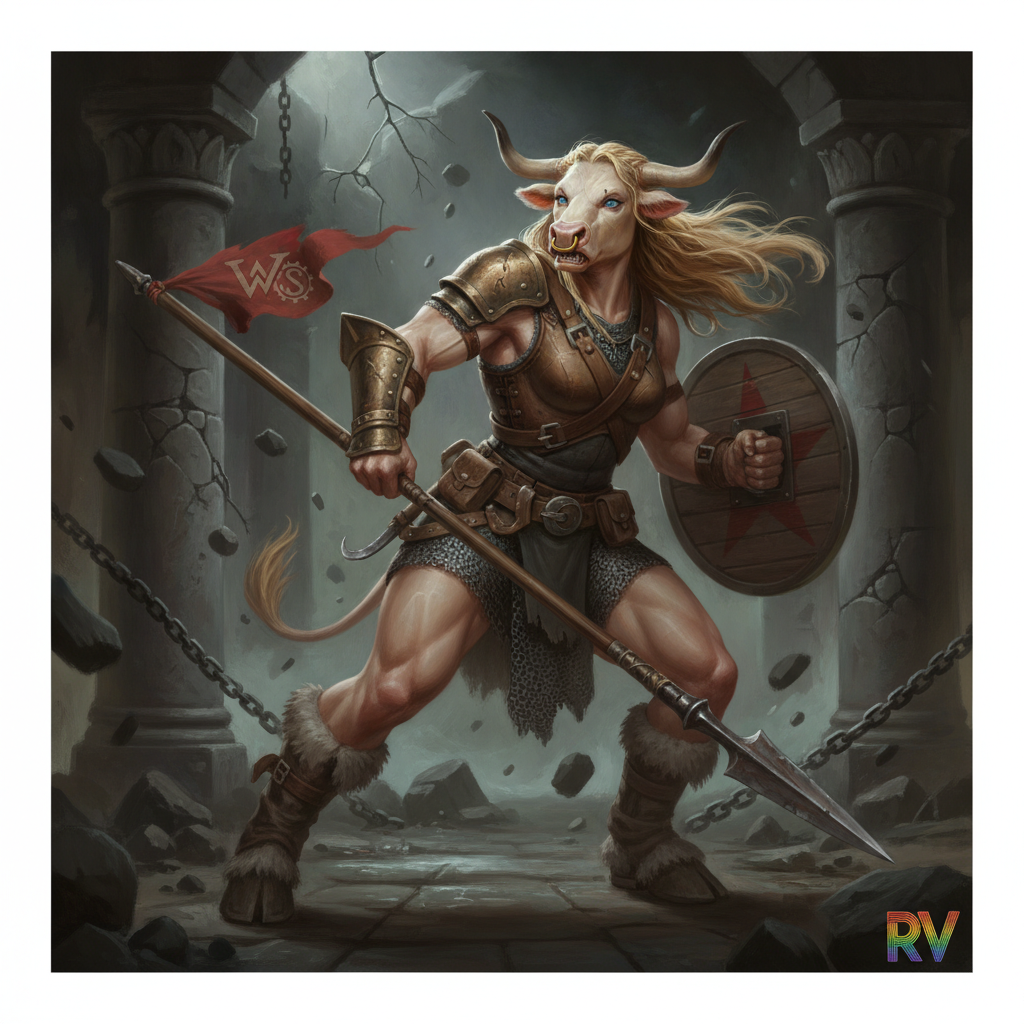
A towering, broad-shouldered warrior with the head of a longhorned cow stands amid a shattered colonnade. Her blond mane whips in stone-dust wind, chainmail skirts brush muscled thighs, and furred boots crunch over broken flagstones. In one hand she steadies a round, wood-planked shield painted with a red star; in the other she anchors a long ash spear tipped in steel. Heavy chains dangle from cracked pillars, and a ragged pennant marked with the letters W and S snaps from her spear like a challenge.

I am the Watcher, and I know this one. Her name is Vessa Starhorn of the Western Slope, born on the plane of Kallara during the Fifth Meltwater Era, an age when glaciers receded and old compacts—like ancient chains—began to fail. The place you see is the Shattered Colonnade of Vael-Chains, a tribunal ruin where oaths were once bound in iron links. It stands in a wind-scoured pass that mirrors, like a dream through frost, the high saddles of Colorado’s Rockies.

Vessa came from the pasture-commons above the river split, where snowmelt braided into two lifelines: one flowing toward orchard valleys, the other toward dry steppe towns. Her people measured seasons not by calendars but by the creak of thaw and the first rattle of water in wooden flumes. In those uplands, fairness wasn’t a sermon; it was survival. Think of the San Luis acequias back in Colorado—ditches kept by a mayordomo who knows every turn, who rouses neighbors at dawn to clear debris so that each field gets its rightful trickle. Vessa was that kind of keeper for her clan: first in time, first in right, but never so rigid that a neighbor’s field would die. “Leave a ladle for the last gate,” she’d say, a proverb born of thin springs.

Her code was tempered farther north, on Kallara’s Boreal Marches, where she wintered with traders who played a frost-game on river ice—stones sliding true, brooms hissing like geese. There she learned the Spirit of the Game: you call your own fouls, you shake hands both before and after. A Canadian-flavored wisdom crept into her bones—the understanding that fairness is strongest when it is chosen, not enforced.

The major turning of her life—the reason the Colonnade lies cracked around her—was the Trial of the Meltwater Shares. A drought year gnawed the valleys. Lowland barons, who kept books like shackles, claimed “legal priority” to the first flow; upland commons, who had tended the catchments for generations, answered with custom and sweat. Vessa was called to adjudicate at Vael-Chains, where the river was once parceled by links of iron set into the floor: each link a measure, each clink of chain a life.

She made three moves that day.

First, she exposed the barons’ fraud. They had added hidden links—quiet accounting tricks slipped between the public ones—so the chain showed more “rights” than water existed. Vessa weighed each link in public, naming them aloud, the way a good mayordomo in the San Luis Valley will read out ditch turns at the headgate where all can hear. When she found the false links, she did not melt them for spite; she hammered them flat into plaques and nailed them to the pillars, a record of shame in daylight. Fairness requires memory.

Second, she refused equal shares. It would have been easy theater to split the flow into tidy halves, but it would have killed orchards mid-bloom and starved the steppe. Instead she chose equitable shares: an emergency curve that favored crops already in fruit and drinking water over fountain pools, with a promise to reverse the curve when the snow returned. The uplands grumbled; the lowlands blinked; and still she stood firm. Fairness is not sameness, she said, it is rightness measured by need and by what each has already labored to keep.

Third—and this was the hardest—she called the enemy into the circle. A lowland captain who had ordered raids on upland flumes was brought in chains to witness the new ledger. “The rules that bind us must bind you, too,” Vessa told him, and she unlocked his fetters so he could sign unaided. That act, like the pre-game handshake on a Canadian pond, felt small as breath in cold air—yet it changed the weather. Some swore it was naïve. But when spring finally broke, the same captain escorted the first meltwater patrols without bloodshed. Fairness had reached him where the spear could not.

Of course, not all approved. The barons shattered the Colonnade at night to erase the plaques of their deceit. Vessa fought among the falling stones, her red-star shield throwing back torchlight, her pennant snapping “WS” for Western Slope—a reminder that mountains, on any plane, teach you to share the ridge or tumble alone. In the morning, the ruin stood open to sky, but the new ledger survived in a dozen copied hands. Water courts rose in its wake. Children on both sides of the pass learned the Ladle Rule, and headgates were fitted with clear measures anyone could read.

What did fairness make of Vessa? It made her precise where others were loud, stubborn where others were righteous, and generous where vengeance begged to be fed. Like a Coloradan search-and-rescue team roping up for a stranger on a whiteout ridge, she decided the measure of justice was who came home alive, not who got even. In seasons that followed, people met her at crossings with nods instead of knelt oaths. They trusted the turn they couldn’t yet see.

And so she endures in the storyways of Kallara’s Fifth Meltwater Era: Vessa Starhorn, Mayordomo of Chains, Western Slope’s daughter, who taught a thirsty world that fairness is not a balance you hide behind, but a balance you carry—visible, argued, adjusted, and, in the end, shared like the first clean cup from a high-country spring.
Please log in to comment