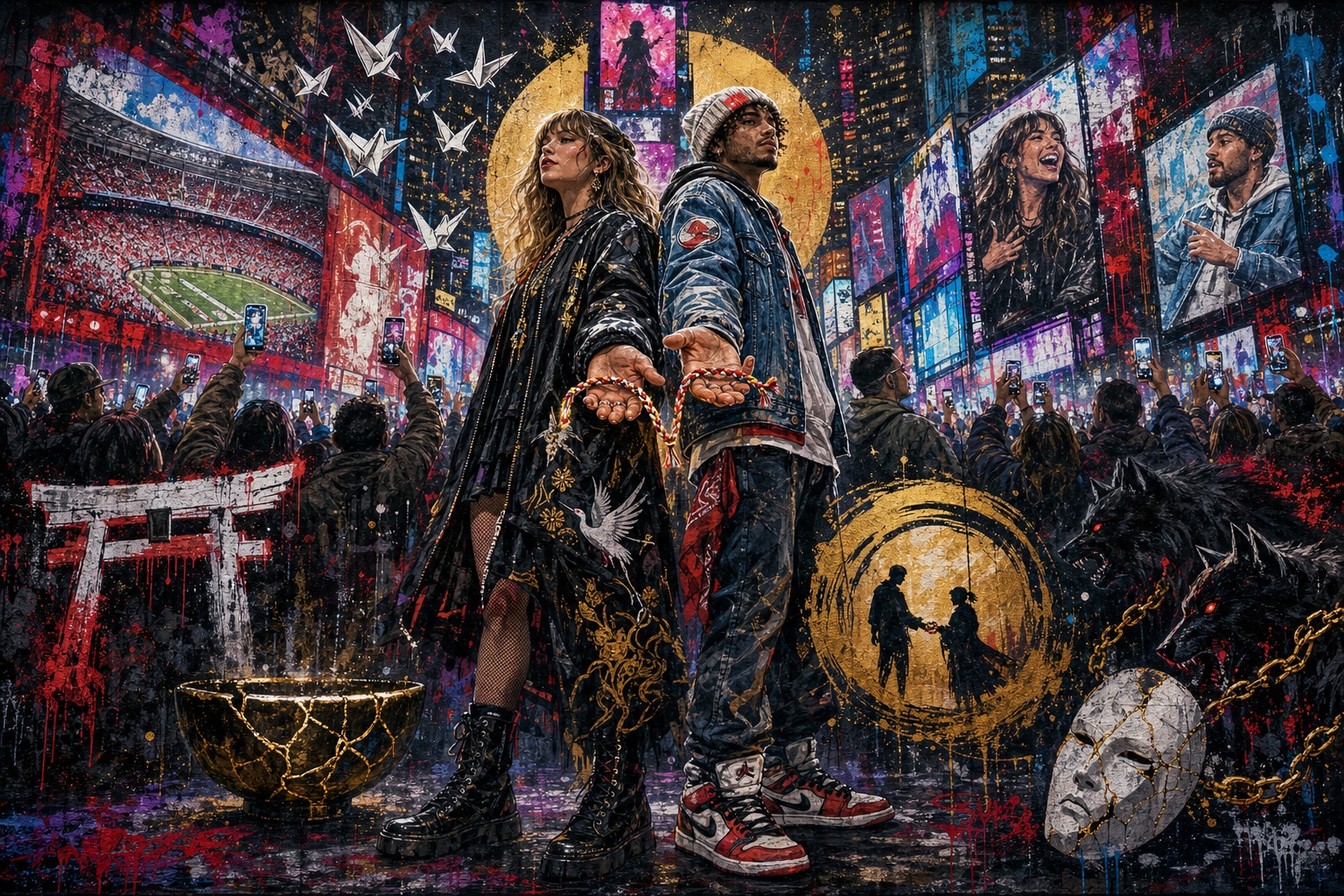
A canyon of glass and steel at dusk, electric billboards pulsing like artificial suns, a tide of onlookers holding up phones as if offering lanterns to the sky. One frame shows the stadium’s red-and-white bowl, a woman in black laughing, a man in denim and a knit cap mid-sentence, the air around them prickling with the static of rumor. Headlines crowd the margins like town criers; the city hums as if every pixel were a drum.

I cannot identify the people in the photographs, but I can tell you the story of the place and the moment it evokes.

Where it was from
- Place: Times Square, New York City, once called Longacre Square, on Lenape land.
- Plane of existence: Earth-Prime, the common road of mortals and headlines.
- Era: Late Anthropocene, Reiwa 5–6 in the Japanese calendar—our present day.

Backstory, as seen by the Watcher
Times Square is Broadway’s lantern-lit river mouth, where news and theater have always met to trade spirits. In the Edo period, Japan’s own billboards—kanban for kabuki—once towered over Nihonbashi the way LEDs do over Seventh Avenue, and crowds gathered to debate stars with the same fervor. Different archipelago, same heartbeat: a marketplace of attention.

This night’s commotion began elsewhere, with a small offering. At a game—green field, brass of marching band—a certain athlete forged a charm from thread and beads. In Japan such tokens lean toward omamori, or the thousand-crane wish, senbazuru; in America, it was a friendship bracelet. It was an act of generosity more than courtship: a gift given without invoice, a gesture that says, “I carry no blade in this sleeve.” In shinobi lore, one might call it the Empty Scabbard Sign. In RobotPirateNinja culture, it echoes the first article of the Tri-Code: Share your spare batteries before you sharpen your sword.

The bracelet was accepted, not accepted, passed along, or merely talked about—truth braided with myth until the rope of story held. What matters is how generosity altered the vectors. Crowds began to gather, not just at stadiums but in the neon ravines where brands feed on gossip. Screens turned a private courtesy into a public bonfire. That is the law of en—karmic linkage—in Japanese thought: a tiny knot binding people can tug an entire city.

Yet generosity has two faces. On the bright face: the singer—call her the Lark—had a reputation for showering crews with unexpected bonuses and handwritten notes, quiet as osettai on the Shikoku pilgrimage, where villagers leave fruit and tea for weary monks. The athlete—call him the Arrow—picked up meals for staff and security after night games, an everyday omotenashi that says, “You are seen.” Around them, interns felt braver, drivers went home lighter, a city remembered its manners for a beat or two. Kintsugi teaches that a mended bowl, veins of gold in its cracks, can be stronger than the pristine original; their small generosities were gold seams in a hurried world.

On the shadow face: the gift grew teeth. Sellers minted counterfeit bracelets by the crateload. Strangers felt licensed to trespass ordinary boundaries, mistaking public glow for private consent. In Edo terms, giri—social obligation—clashed with ninjō—human feeling. The Lark learned enryo, the art of holding back. The Arrow learned that a smile can be taxed. Even kindness must set its borders, or it will be harvested like a commons.

And Times Square, ever the stage, played the chorus. Once, newsboys hawked extras; now, algorithms do. But the moral remains antique: a city will amplify what you feed it. Feed it cruelty, and it howls. Feed it a bracelet, and it braids a legend. The Watcher has seen this in Kyoto alleyways at Gion Matsuri, when neighbors leave bowls of water for festival horses, and again aboard the sky-galleons of the RobotPirateNinja, whose captains are judged not by plunder but by how they provision the deckhands during storm-silence.

The life event that mattered
It was the day the Lark and the Arrow chose to keep giving anyway. Not to the maelstrom, but to the ring one step in: crew, custodians, the stranger at the turnstile who dropped her MetroCard. They learned mottainai—not to waste warmth where it is swallowed by the void, but to pour it where it grows. From then on, their generosity became precise, like a calligrapher’s stroke: bold where it should shout, spare where it should whisper.

Thus the tale: a bracelet the size of a thumbnail set billboards ablaze. Generosity opened the gate; discernment kept the wolves out. Remember this when you enter the neon canyon: be lavish with kindness, frugal with spectacle, and let your gifts choose their audience as carefully as an archer chooses the wind.

Please log in to comment