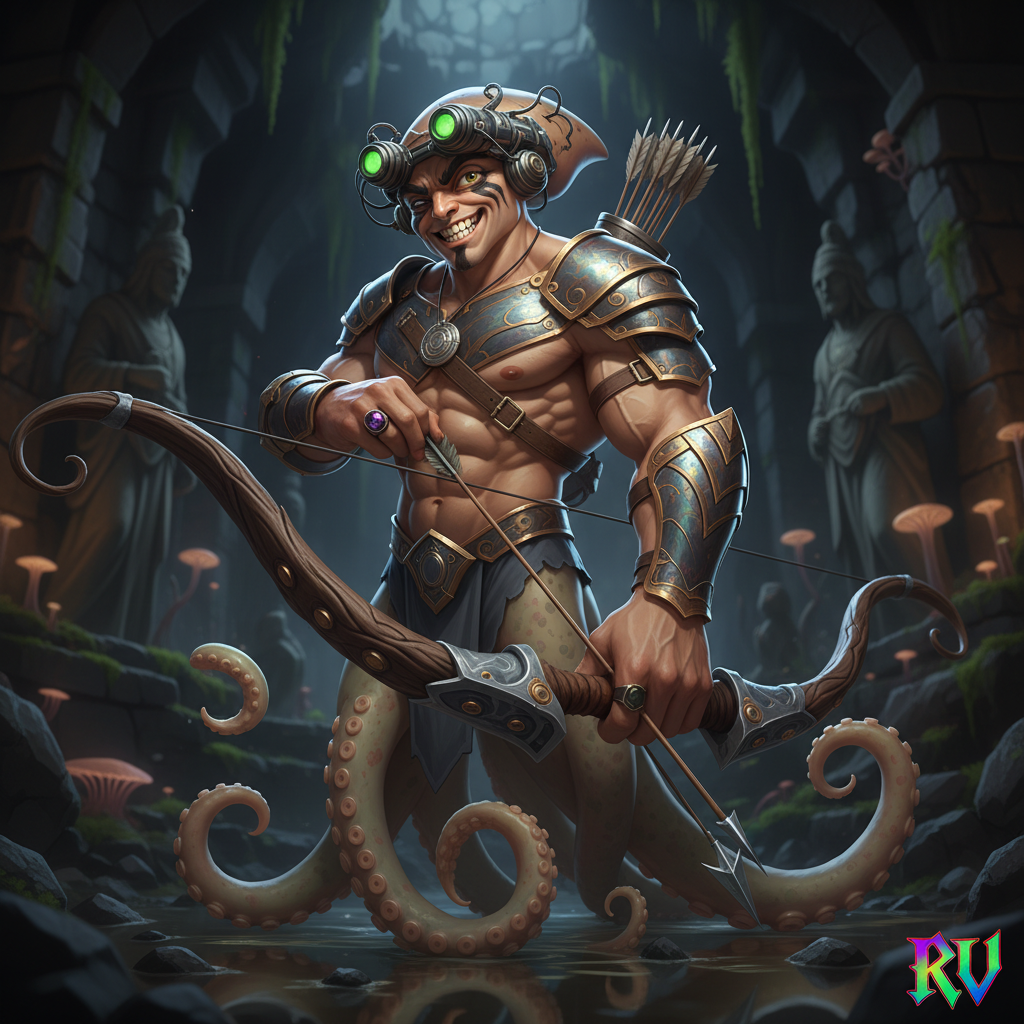
A broad-shouldered archer stands ankle-deep in black cavern water, his bronze-and-blue armor gleaming beneath a crown of brass night-vision lenses. A hooked wooden bow rests in his powerful hands, while pale octopus limbs curl around his legs like living ribbons. Beneath his mischievous grin are sharp teeth, dark cheek markings, and the wary expression of someone who has survived too many bargains.

He is **Cairn-of-the-Deep**, born in the **Grotto Plane**, a neighboring realm that touches our world wherever underground water runs beneath old stone. His cavern resembles the limestone chambers of **Bruce Peninsula in Ontario**, though no Canadian surveyor has ever mapped its lowest passage. The statues behind him were carved by vanished pilgrims, and the luminous fungi above are said to remember every voice spoken in the dark.

Cairn belonged to the Tidebound, a clan of amphibious hunters who guarded the Wellspring, a pool believed to lead into many worlds. In the late **Moss-Crowned Era**, when iron tools first began appearing among the surface kingdoms, the Tidebound prized cleverness above kindness. Their teaching was simple: every creature was either prey, rival, or customer.

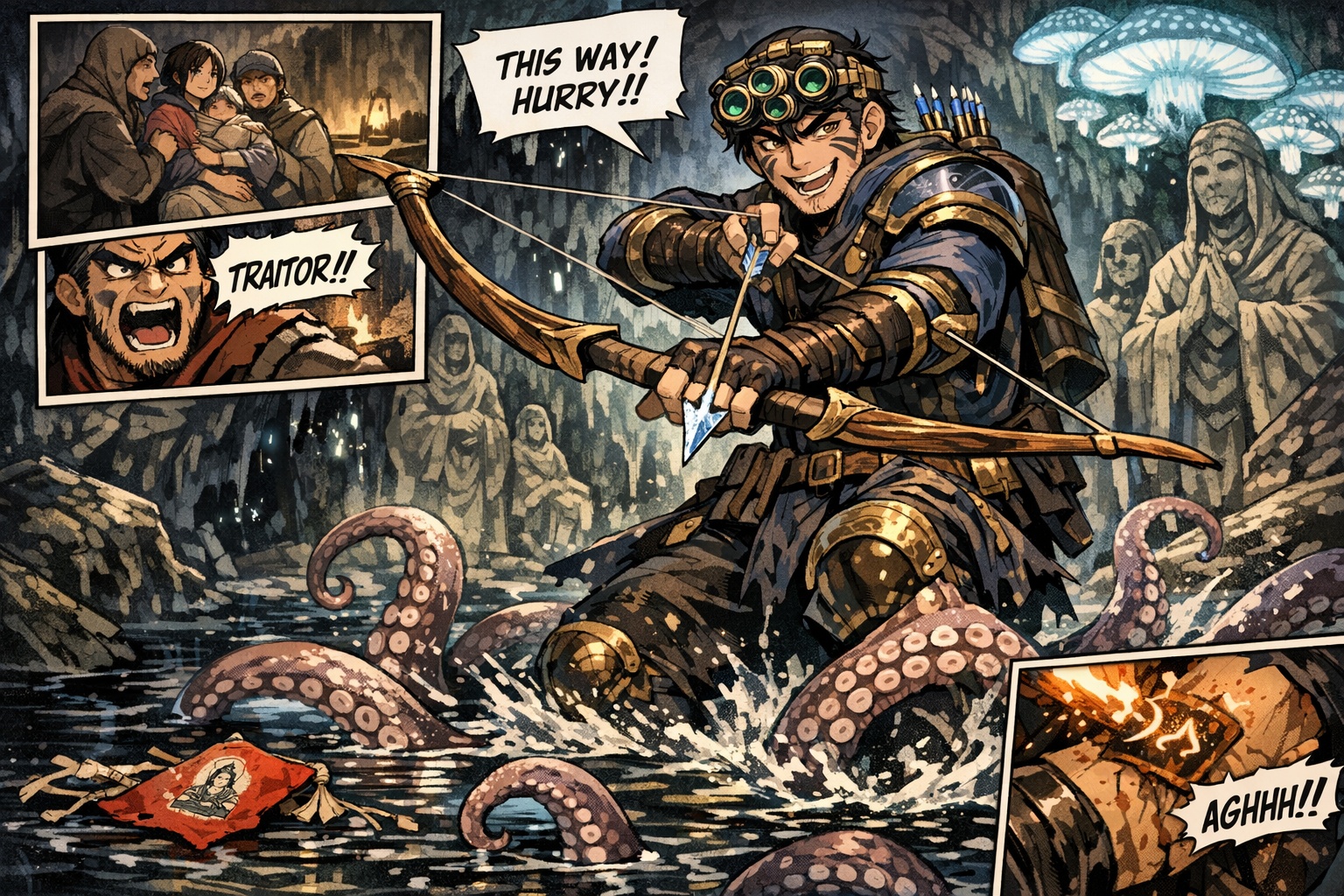
Cairn excelled at all three roles. He could split a falling moth’s wing with an arrow, sell a secret to two enemies, and smile while doing both. His enchanted goggles allowed him to see heat, fear, and hidden movement. His arrows were tipped with moon-metal, and his bow had been grown from the root of a drowned tree.

Then came the winter of the sealed tunnels.

A group of surface travelers—miners, refugees, and one feverish child—fell through a collapsed shaft into Cairn’s territory. The Tidebound council ordered him to drive them away before they discovered the Wellspring. Cairn found the strangers huddled beside a dead lantern. The child was called Mei, and she carried a small red cloth charm from her grandmother, who had taught her that compassion was not weakness but “the courage to spend part of your own warmth.”

Cairn had heard a similar wisdom in the songs of coastal peoples from the surface: the old Canadian understanding that survival in hard country depends on sharing fire, food, and shelter. He remembered stories of neighbours clearing snow from one another’s steps, of Atlantic communities rescuing ships in winter seas, and of Terry Fox, whose suffering became a reason to keep walking for others. These memories were not his own, yet the Wellspring had carried them into the cavern like distant echoes. In Mei’s charm, he also recognized an image of Guanyin, the compassionate figure of Chinese tradition who hears the cries of the world.

For the first time, Cairn disobeyed his clan.

He led the travelers through the flooded tunnels, giving them his own rations and using his arrows to mark safe stones beneath the water. When the council pursued them, Cairn turned his bow against his people—not to kill, but to sever ropes, shatter weapons, and pin cloaks to the walls. He saved the strangers, but the effort cost him his place among the Tidebound. The council branded him a traitor and claimed compassion had made him tame.

Years later, the surface travelers returned with builders, healers, and a promise: the Wellspring would remain protected, but the cavern would no longer be a place where desperate people were abandoned. Cairn became its unwilling guardian. He still loved trickery, treasure, and the theatrical tightening of his bowstring, but he no longer measured worth by usefulness.

His compassion did not make him gentle. It made him responsible.

Even now, when a lost traveler hears the slap of tentacles in the dark, Cairn may appear with that same wicked grin. He will demand a story, a song, or a useful secret as payment. But if the traveler is frightened, injured, or carrying a child, the price is always waived. Beneath the grin, the archer remembers the cold, the red cloth charm, and the moment he chose to become someone’s shelter rather than another danger.
Please log in to comment