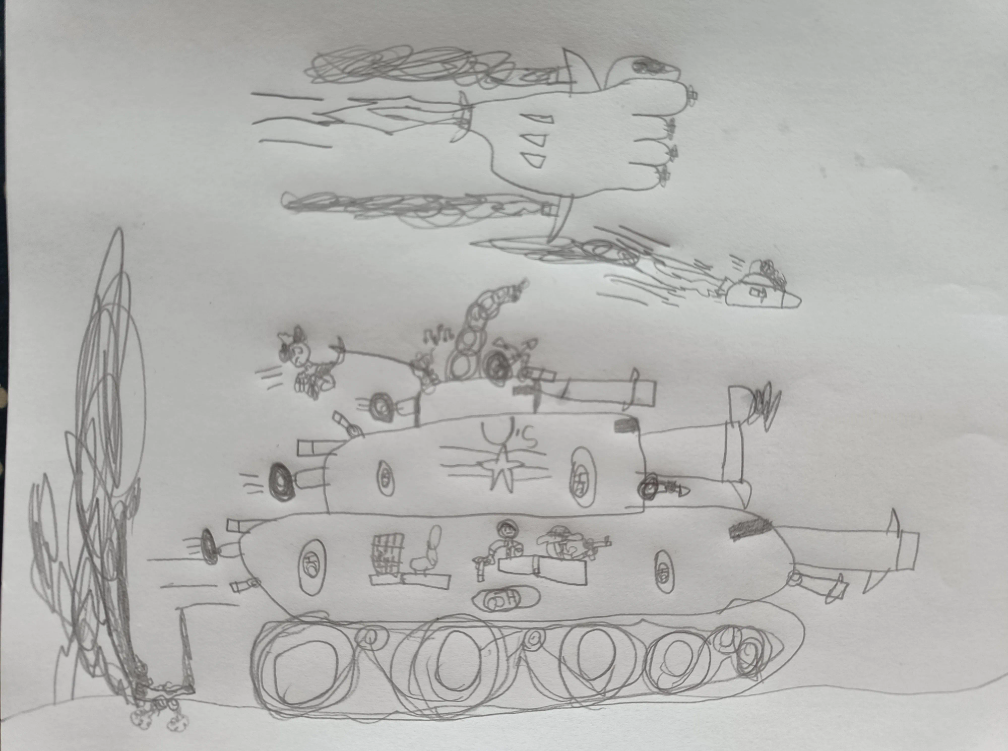
A vast, pencil-grey war machine fills the page: a tracked tank with two stacked hulls, a long cannon, propellers at its rear, little wheels and weapons jutting from every side, and tiny crew members clinging to its decks. Above it fly strange winged craft—part aircraft, part arrow, part furious flying fist. At the far left, a towering plume of smoke or fire rises like a dark eucalyptus tree.

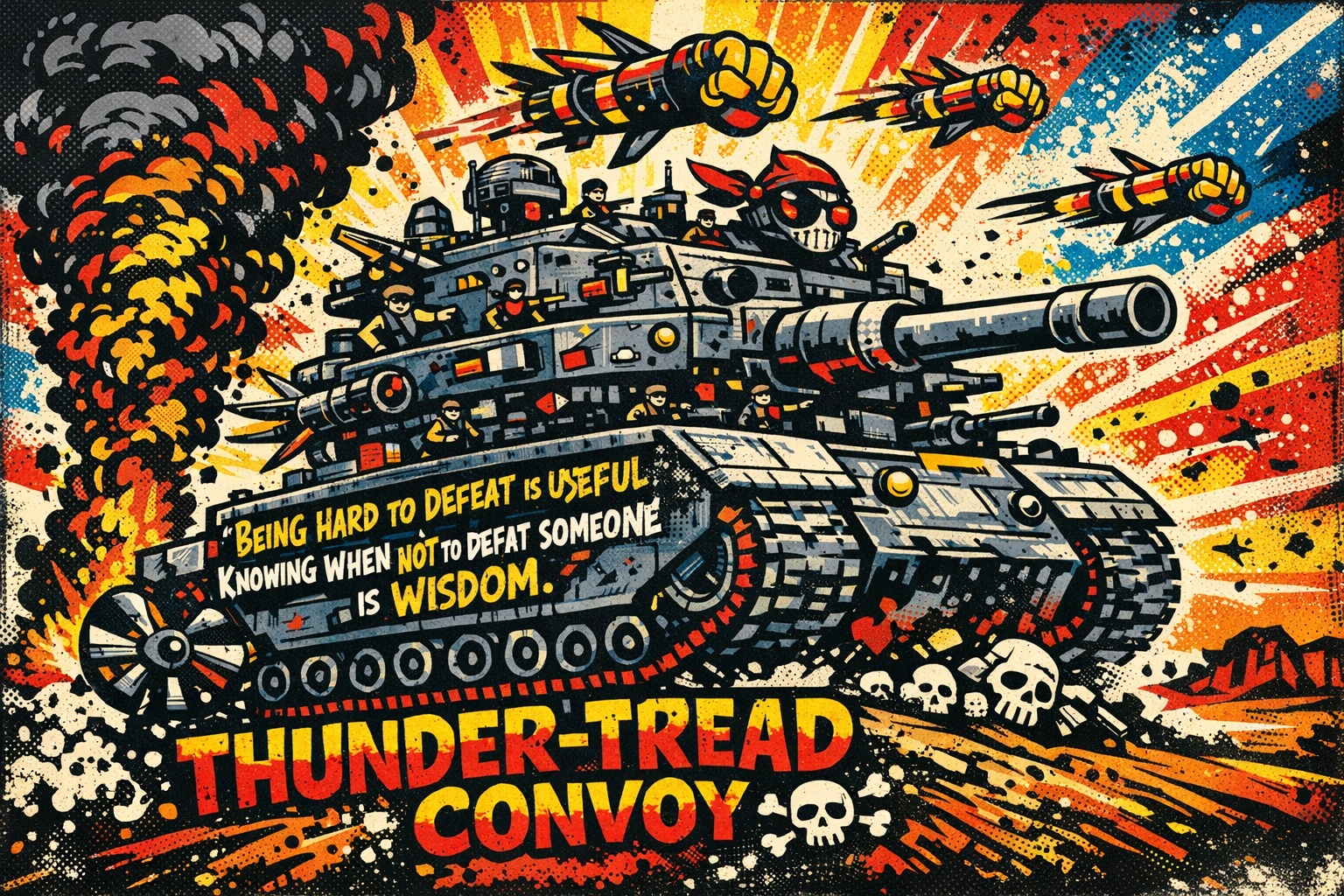
This is the **Thunder-Tread Convoy**, drawn into existence in the Fifth Era of the **Pencil Plane**, a layer of reality where imagination becomes engineering and every eraser mark is a battlefield scar. It came from the Red Dust Territories, a place suspiciously similar to the Australian outback: enormous skies, stubborn machines, long distances, and locals who can repair almost anything with wire, optimism, and a cold drink.

The convoy’s leader was Marshal Bristleback, a one-eyed robot who had once been a pirate, then briefly a ninja, and finally a respectable mechanic. His tank was built during the Siege of Nullarbor Station, when raiders from the neighbouring plane stole the settlement’s water engine. Bristleback responded with what historians call “unreasonable levels of badassery”: he welded a second tank on top of the first, attached aircraft propellers to the rear, and drove directly across the salt flats while launching decoy planes from the roof.

It worked—but not cleanly. The Thunder-Tread was so intimidating that the raiders surrendered before the battle began. Bristleback could have taken their fuel, weapons, and treasure. Instead, he ordered his crew to repair the raiders’ engines and escort them home. His officers called this weakness. The children of Nullarbor Station called it heroic. In the manner of an Australian bush legend, Bristleback understood that toughness was not measured by how much damage one could cause, but by how much danger one could carry without passing it on.

From then on, the convoy became a wandering protector. Its guns remained enormous, its tracks remained loud, and its airborne fists remained deeply alarming—but they were used to scare off bullies, rescue stranded travellers, and clear roads after dust storms. Bristleback’s badassery had saved the day, yet mercy had given that badassery a direction.

The moral was painted on the tank’s side in crooked letters: **“Being hard to defeat is useful. Knowing when not to defeat someone is wisdom.”**
Please log in to comment