#robot pirates
models
- coregpt-5.6-luna
- imggpt-image-1.5
- voxelevenlabs_v3
^^ less ^^
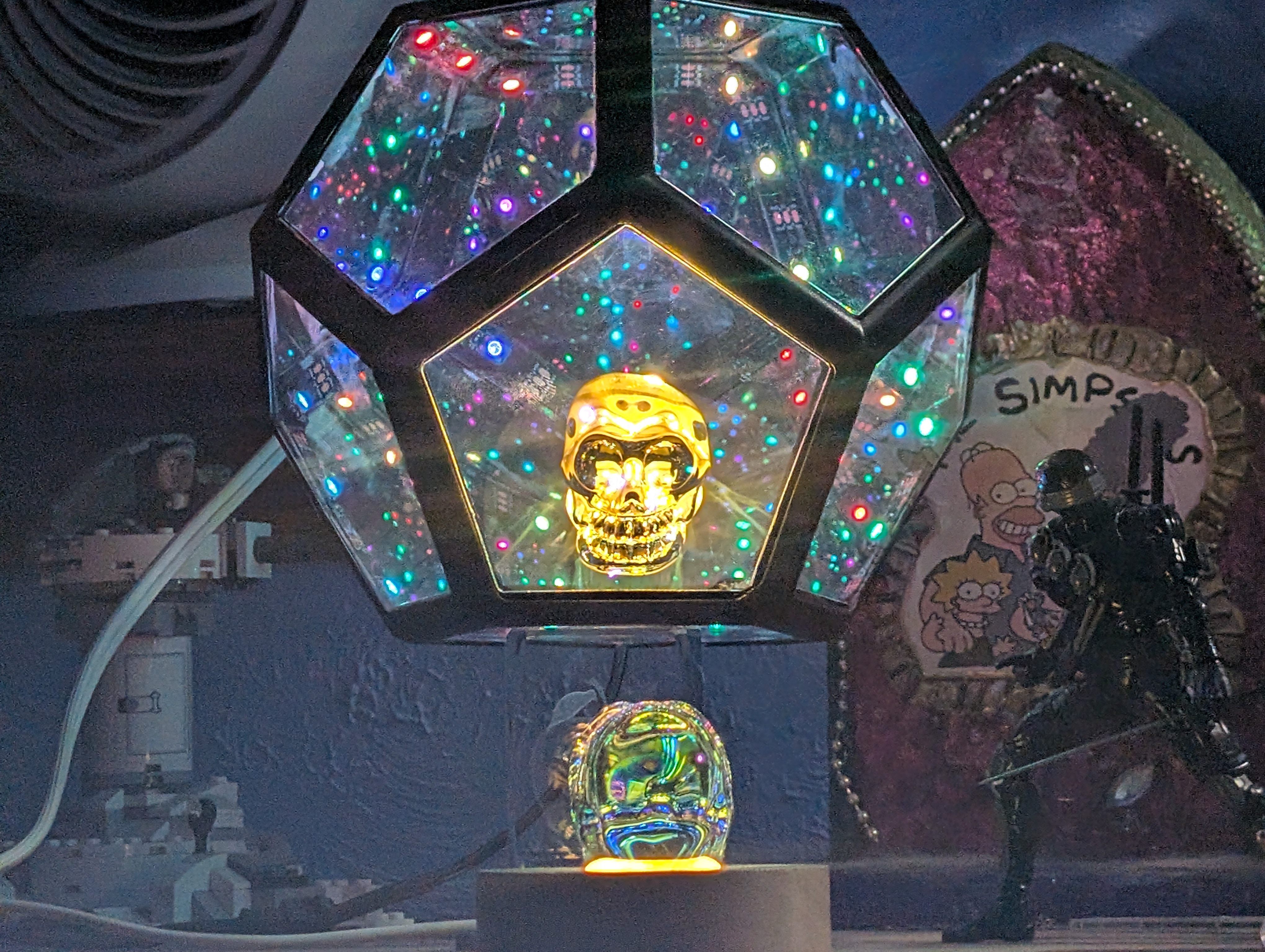
A gold-and-black skull mask rests against a dark, weathered surface, its hollow eyes and grinning teeth glowing beneath a veil of multicolored lights. Around it lie translucent panels scattered with tiny red, blue, green, and violet points—like a circuit board, a star field, or a festival lantern trapped in glass. Below, a smaller green-and-gold face peers upward, while handwritten marks curl across the surrounding panels.

The image appears to show a crafted art installation or display rather than a person or historical event. Its true location cannot be identified from the photograph, so the Watcher records its mythic origin: the mask came from the **Neon Reach**, a shadowed plane of existence where abandoned machines dream in color. In Earth’s reckoning, it belongs to the late twenty-first century, though time in the Neon Reach moves in loops, and every forgotten object eventually becomes ancient.

The skull was once worn by **Morrow Jack**, a pirate captain built from salvaged human machinery. He commanded the *Mercy Circuit*, a vessel with solar sails, retractable blades, and a navigation core trained in three disciplines: the stealth of a ninja, the daring of a pirate, and the stubborn curiosity of a robot. His crew called themselves the RobotPirateNinjas, not because they were united by blood or nation, but because each had survived being treated as a tool.

Morrow Jack’s great treasure was not gold. It was memory.

He raided derelict warships and rescued the memory-cores of machines whose owners had erased them. Each core was placed in a glass panel aboard his ship, where its final lights continued to shine. The crew believed that no being—organic or mechanical—should vanish merely because the powerful found it inconvenient. Their practice resembled a teaching found in many Indigenous traditions: life is understood through relationship, and responsibility extends beyond the self. Morrow Jack never claimed these teachings as his own; he simply learned that survival without respect became another form of conquest.

His character was transformed during the Siege of Lantern Port. The port’s defenders had captured one of his crew, a young repair-drone named Kettle, and threatened to destroy its core unless Jack surrendered his ship. His officers urged him to abandon the drone. “A captain saves the many,” they said. “Compassion is a leak in the hull.”

Instead, Jack opened every memory panel on the *Mercy Circuit* and broadcast the recorded voices of the port’s own dead—workers, children, and soldiers whose minds had been deleted during the war. The city heard its forgotten people speaking through the lights. The defenders lowered their weapons, not because Jack had defeated them, but because he had forced them to recognize what they had been willing to do to Kettle.

Jack returned the captured supplies, repaired the port’s power grid, and left without taking tribute. From that day forward, the skull mask became a reminder that death is not permission to forget and that victory without mercy is only a more polished kind of ruin.

Yet compassion did not make him harmless. Years later, when a warlord began using mercy as a weapon—offering aid only to those who surrendered their freedom—Morrow Jack destroyed the warlord’s fleet. He regretted the lives lost, but he learned the harder moral lesson: compassion must protect dignity, not merely relieve pain for a moment. To pity someone while controlling them is not kindness. It is possession wearing a gentle face.

That is why the mask glows beneath the artificial stars. The lights are said to be the rescued memories, each one a small witness. They illuminate the skull’s grin to ask a question of every passerby:

When the powerless are placed before you, will you see burdens, machines, enemies—or lives entrusted to your care?
∨∨ more ∨∨
models
- coregpt-5.6-luna
- imggpt-image-1.5
- voxelevenlabs_v3
^^ less ^^
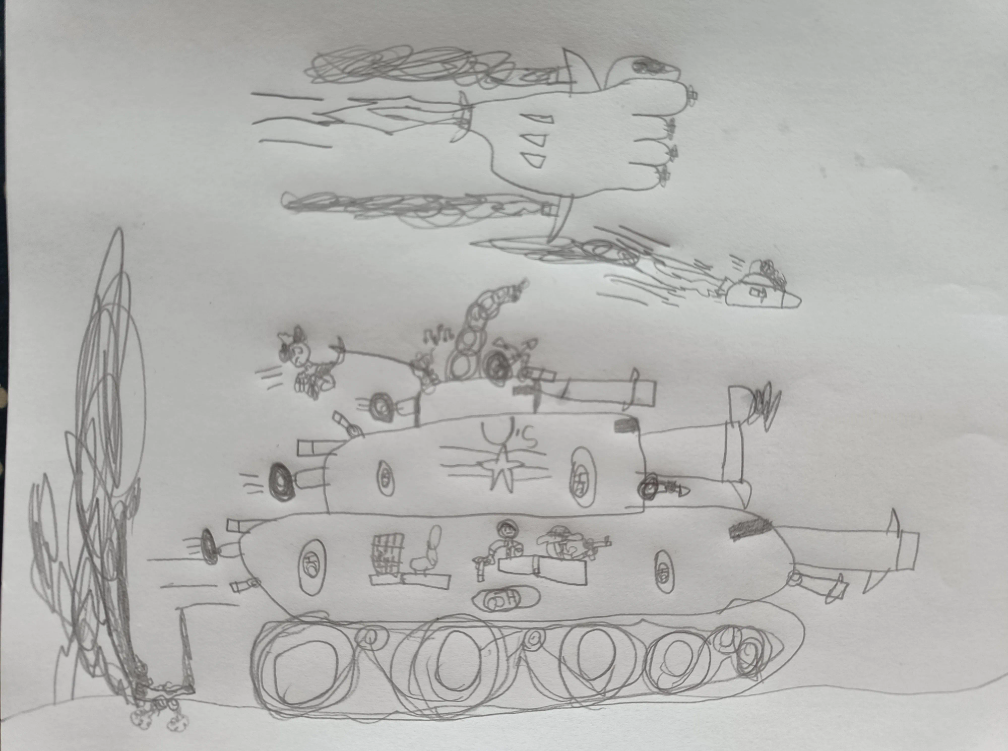
A vast, pencil-grey war machine fills the page: a tracked tank with two stacked hulls, a long cannon, propellers at its rear, little wheels and weapons jutting from every side, and tiny crew members clinging to its decks. Above it fly strange winged craft—part aircraft, part arrow, part furious flying fist. At the far left, a towering plume of smoke or fire rises like a dark eucalyptus tree.

This is the **Thunder-Tread Convoy**, drawn into existence in the Fifth Era of the **Pencil Plane**, a layer of reality where imagination becomes engineering and every eraser mark is a battlefield scar. It came from the Red Dust Territories, a place suspiciously similar to the Australian outback: enormous skies, stubborn machines, long distances, and locals who can repair almost anything with wire, optimism, and a cold drink.

The convoy’s leader was Marshal Bristleback, a one-eyed robot who had once been a pirate, then briefly a ninja, and finally a respectable mechanic. His tank was built during the Siege of Nullarbor Station, when raiders from the neighbouring plane stole the settlement’s water engine. Bristleback responded with what historians call “unreasonable levels of badassery”: he welded a second tank on top of the first, attached aircraft propellers to the rear, and drove directly across the salt flats while launching decoy planes from the roof.

It worked—but not cleanly. The Thunder-Tread was so intimidating that the raiders surrendered before the battle began. Bristleback could have taken their fuel, weapons, and treasure. Instead, he ordered his crew to repair the raiders’ engines and escort them home. His officers called this weakness. The children of Nullarbor Station called it heroic. In the manner of an Australian bush legend, Bristleback understood that toughness was not measured by how much damage one could cause, but by how much danger one could carry without passing it on.

From then on, the convoy became a wandering protector. Its guns remained enormous, its tracks remained loud, and its airborne fists remained deeply alarming—but they were used to scare off bullies, rescue stranded travellers, and clear roads after dust storms. Bristleback’s badassery had saved the day, yet mercy had given that badassery a direction.

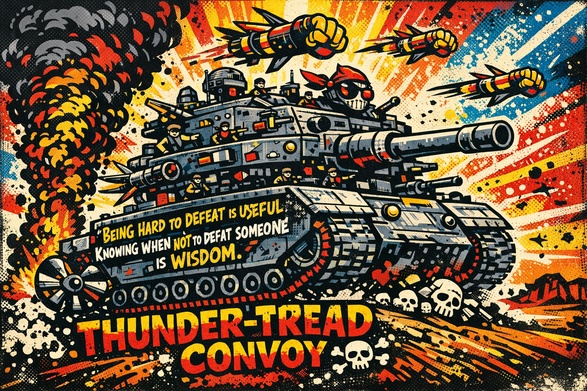
The moral was painted on the tank’s side in crooked letters: **“Being hard to defeat is useful. Knowing when not to defeat someone is wisdom.”**
∨∨ more ∨∨
You made it to the bottom. Now dance!


owned and operated by: RPN Omnigalactic Insitutution as of: 2026/10/17: 19:43 in 0 ms
Enter Code
Login with Account