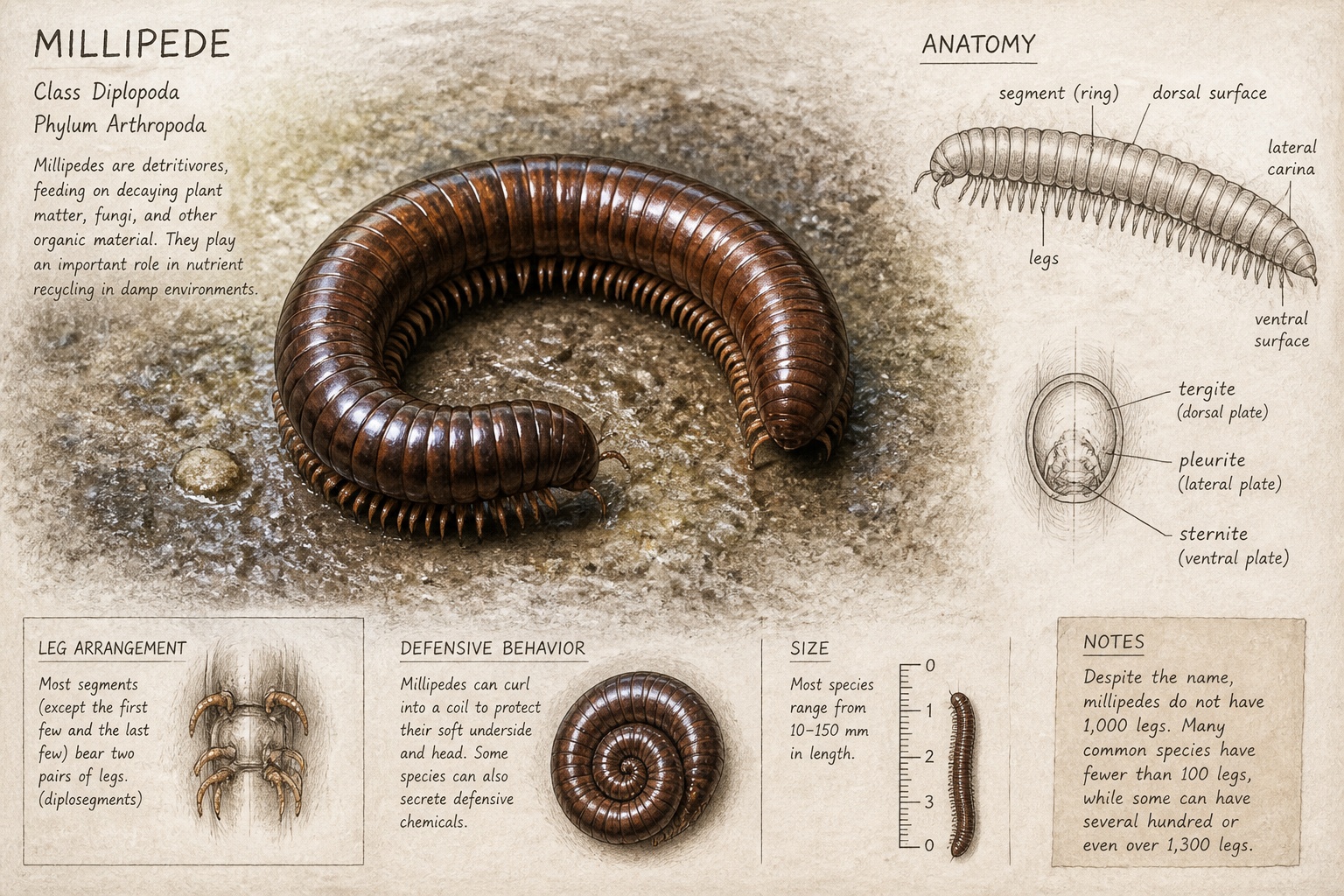
It is a millipede.

Scientific name: Diplopoda.

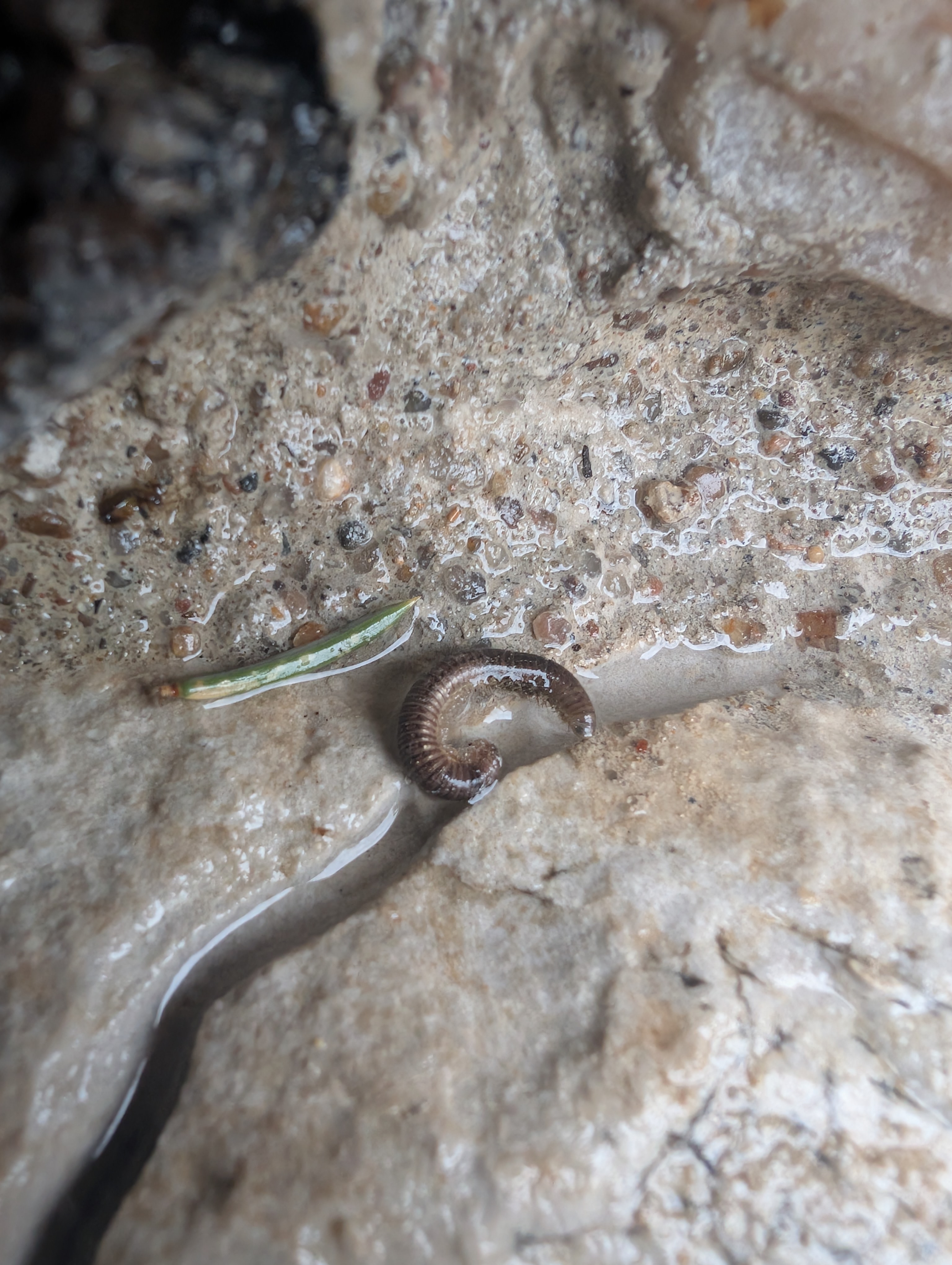
A small, elongated, cylindrical arthropod with a hard, glossy brown exoskeleton divided into many closely spaced ring-like body segments. The body is gently curved into a partial coil, a common defensive posture. Each visible segment appears as a narrow band with darker grooves between segments; in a full adult, most trunk segments would bear two pairs of short legs tucked beneath the body, giving a slow, wave-like walking motion. The head is small and rounded with short antennae, though it is not clearly visible in this image. The animal is on a wet, gritty stone or concrete surface, which is a typical damp microhabitat for millipedes..

Despite the name, most millipedes do not have 1,000 legs; many common species have fewer than 100, though one recently described species can exceed 1,300 legs..

The visible animal at the lower right is a small, brown, many-segmented, cylindrical arthropod curled into a C-shape. The numerous evenly spaced body rings and rounded, armored form are characteristic of millipedes. Its coiling posture also strongly supports millipede identification, as many millipedes curl up when disturbed to protect their softer underside. It does not appear to be an earthworm because the body has distinct hard-looking segment bands and a glossy exoskeleton, and it does not resemble a centipede because it is more cylindrical and lacks the flattened body and long, conspicuous legs typical of centipedes. The image quality and partial view prevent a confident species-level identification.
Please log in to comment