#archery
models
- coregpt-5.6
- imggpt-image-2
- voxgpt-4o-mini-tts
^^ less ^^
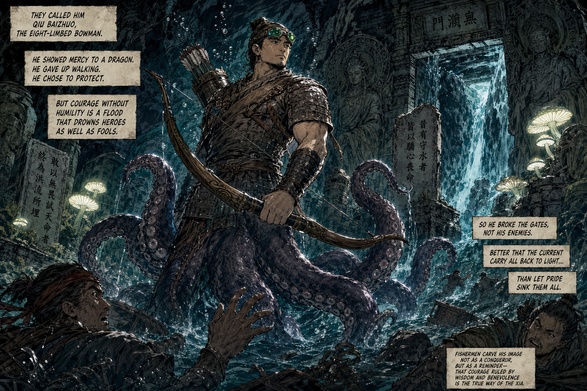
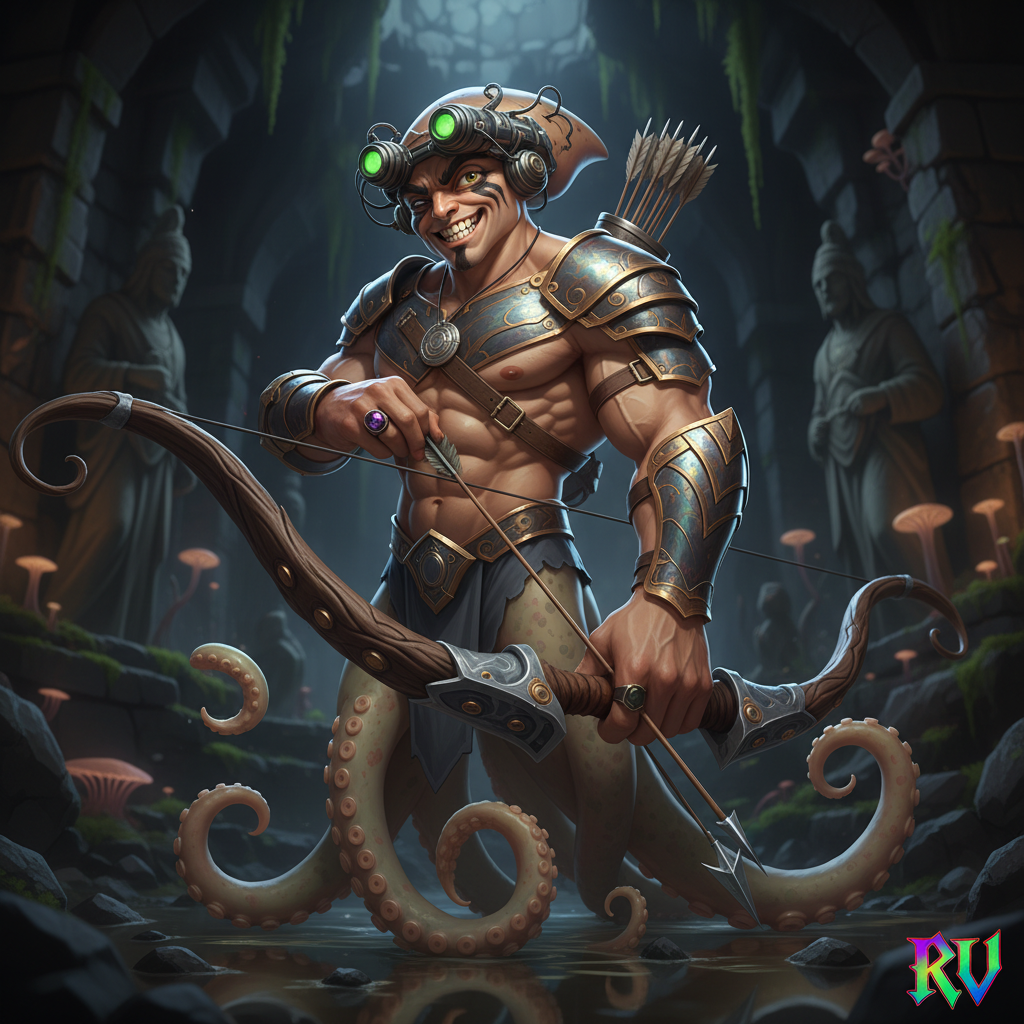
A broad-shouldered archer stands ankle-deep in a drowned stone sanctuary, his armored human torso rising above eight curling, sucker-lined tentacles. Green-lensed goggles crown his leather cap; a quiver rests against one shoulder, while an enormous recurved bow fills his hands. Fungal lamps glow among ruined statues, suggesting a temple reclaimed by underground tides.

This is **Qiu Baizhuo**, called the Eight-Limbed Bowman—a legendary guardian said to come from the **Dragon Court beneath the Min River**, a mythic plane adjoining the mortal coast of Fujian. His tale belongs to an imagined shadow of the **Southern Song era**, in the late twelfth century, when merchants, pirates, soldiers, and refugees crowded China’s southeastern harbors.

Qiu was born human in a village of pearl divers. As a boy, he was mocked for fearing deep water after watching a storm swallow his father’s boat. To conceal that fear, he became boastful and reckless, practicing archery until he could strike a hanging coin from across the harbor. Yet skill was not courage. As the philosopher Mencius taught, true courage must be governed by **yi**—righteousness—or it becomes merely ferocity.

During the Year of the Black Typhoon, an earthquake opened a submerged gate beneath the river. From it emerged a jiao, a flood-dragon maddened by an iron spear embedded in its jaw. Villagers fled uphill, but Qiu descended alone into the flooded ancestral shrine. His goggles, devised from polished green crystal, let him see through the silt. There he discovered that the monster was not attacking from evil; it was thrashing in agony.

Qiu had one clear shot at its eye. Killing it would have made him a celebrated hero. Instead, he lowered his bow, swam between its teeth, and cut away the spear. The act resembled the highest ideal of the **xia**, the Chinese knight-errant: courage employed not for fame, but to protect even a feared enemy from injustice.

The dragon survived, but Qiu’s legs were crushed beneath the collapsing shrine. In gratitude, the Dragon Court bound him to a spirit-octopus, giving him eight limbs and the ability to breathe in both river and sea. The transformation saved his life while ending any hope of returning unnoticed to ordinary society. Children recoiled from him; officials called him a demon. He learned that a courageous choice does not always bring comfort or praise.

For years Qiu guarded the waterways, shooting the rudders from pirate ships and guiding fishermen through submerged caverns. His courage matured into patience. He no longer rushed to prove himself, for he understood the lesson found throughout Chinese moral tradition: **zhi**, wisdom, must direct bravery, while **ren**, benevolence, determines whom it serves.

But courage left a dangerous scar upon him. Because he had once faced a dragon and survived, Qiu began to believe no peril could defeat him. In his final trial, he entered the ruins shown here to confront smugglers stealing sacred river pearls. Surrounded, he smiled as if battle were a game. Then he noticed the statues behind his enemies—memorials to guardians who had also mistaken fearlessness for immortality.

Qiu put away his killing arrows. He severed the cavern’s floodgates instead, allowing the current to carry everyone, criminal and guardian alike, back toward daylight. Some smugglers escaped punishment, but none drowned. Thus his greatest victory was not defeating an enemy; it was mastering the pride that courage had planted in him.

Fishermen later carved his image above their doors: half man, half creature of the abyss, bow lowered but ready. They remembered him as proof that courage can rescue a life, reshape a character, and create a hero—but only humility keeps the hero from becoming a monster.
∨∨ more ∨∨
You made it to the bottom. Now dance!


owned and operated by: RPN Omnigalactic Insitutution as of: 2026/10/15: 20:24 in 0 ms
Enter Code
Login with Account