It is a Oregon grape.

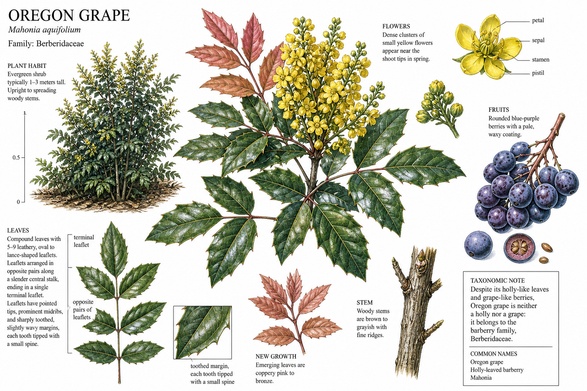
Scientific name: Mahonia aquifolium.

An evergreen shrub typically 1–3 meters tall, with upright to spreading woody stems and compound leaves. Each leaf usually consists of 5–9 leathery, oval to lance-shaped leaflets arranged in opposite pairs along a slender central stalk, ending in a single terminal leaflet. Leaflets have pointed tips, prominent midribs, and sharply toothed, slightly wavy margins, each tooth tipped with a small spine. Mature foliage is glossy dark green, while emerging growth is coppery pink to bronze. Dense clusters of small yellow flowers appear near the shoot tips in spring, followed by rounded blue-purple berries with a pale, waxy coating..

Despite its holly-like leaves and grape-like berries, Oregon grape is neither a holly nor a grape: it belongs to the barberry family, Berberidaceae..

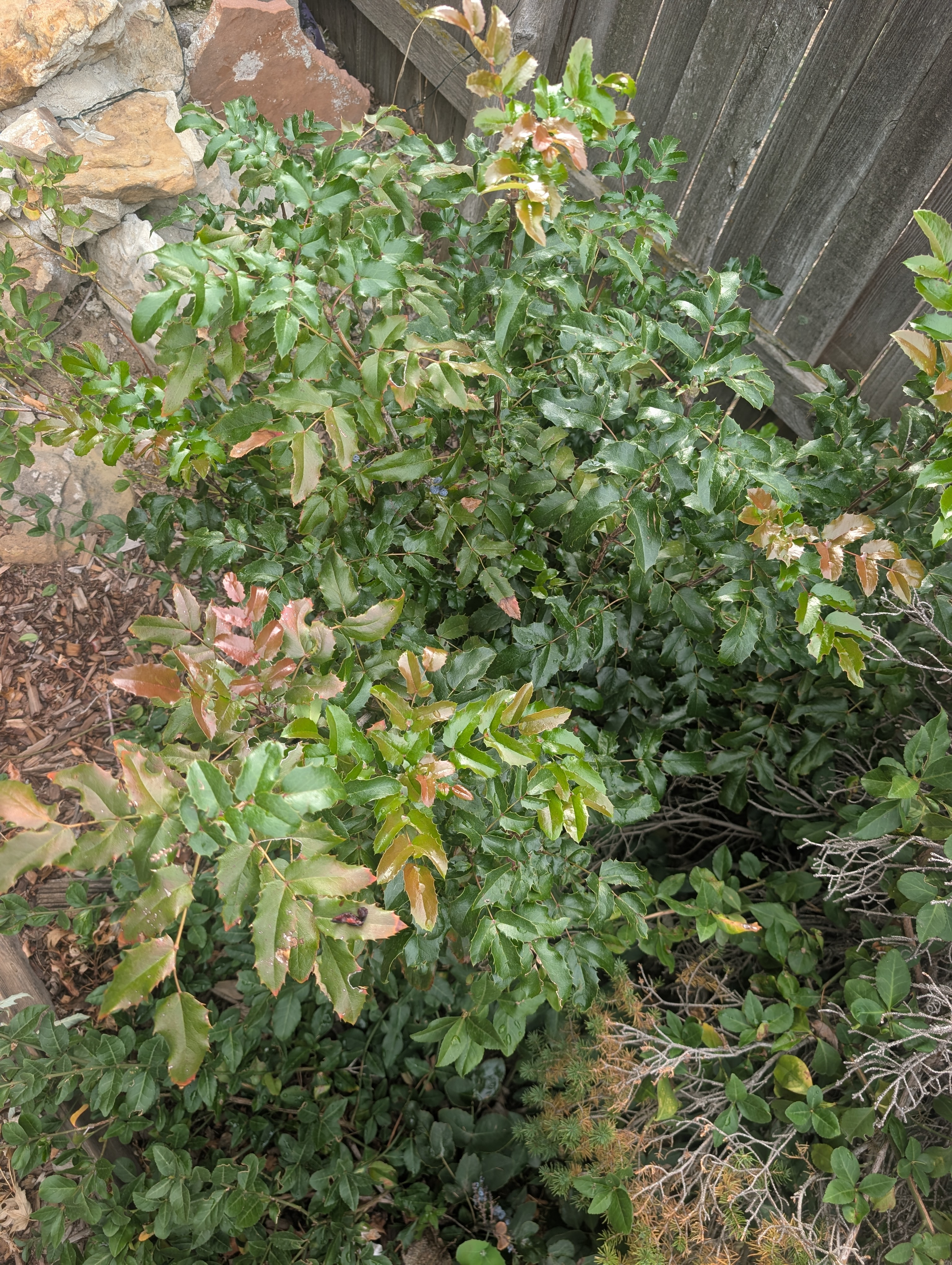
The dominant shrub has pinnately compound leaves with paired, glossy, holly-like leaflets and distinctly spiny margins. The copper-colored new growth and small bluish fruits visible within the foliage also support Oregon grape. The relatively elongated, shiny leaflets and upright, bushy growth favor Mahonia aquifolium over the generally lower-growing, duller-leaved creeping Oregon grape. Related species and garden hybrids can look similar, so exact species identification is slightly less certain than identification as an Oregon grape.
It is a Oregon grape.

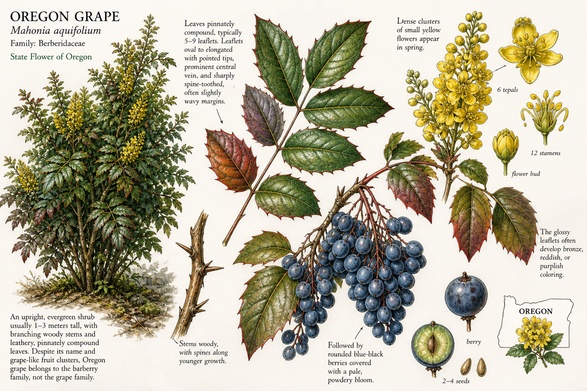
Scientific name: Mahonia aquifolium (syn. Berberis aquifolium).

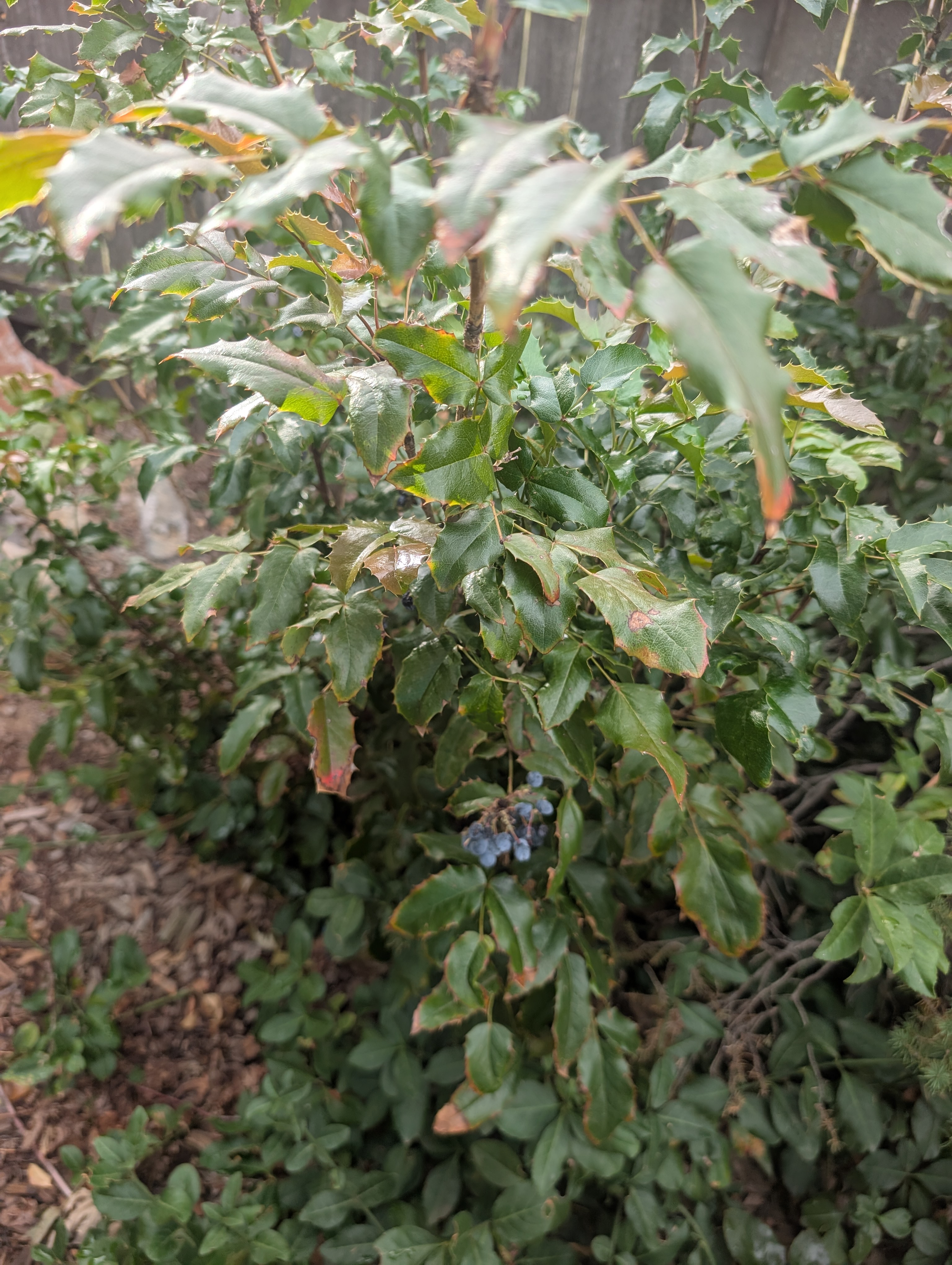
An upright, evergreen shrub usually 1–3 meters tall, with branching woody stems and leathery, pinnately compound leaves. Each leaf typically consists of 5–9 oval to elongated leaflets arranged in opposite pairs along a central stalk, with one terminal leaflet. Leaflets have pointed tips, prominent central veins, and sharply spine-toothed, often slightly wavy margins. Their upper surfaces are glossy dark green, sometimes developing bronze, reddish, or purplish coloring. Dense clusters of small yellow flowers appear in spring, followed by rounded blue-black berries covered with a pale, powdery bloom. The photographed plant has several reddish-edged leaflets and a hanging cluster of blue berries..

Despite its name and grape-like fruit clusters, Oregon grape belongs to the barberry family, not the grape family. It is also the state flower of Oregon..

The combination of holly-like, spiny leaflets arranged in compound leaves and clustered, powdery blue berries strongly identifies this as Oregon grape in the Mahonia group. True hollies have simple leaves rather than pinnately compound leaves. The relatively glossy, elongated leaflets and upright, densely branching habit favor Mahonia aquifolium over lower-growing or larger-leaved relatives. Closely related species and garden hybrids can look similar, so the exact species identification is slightly less certain than the genus.