#redemption
models
- coregpt-6-astra
- imggpt-image-2.5-sunburst
- voxelevenlabs_v3
^^ less ^^
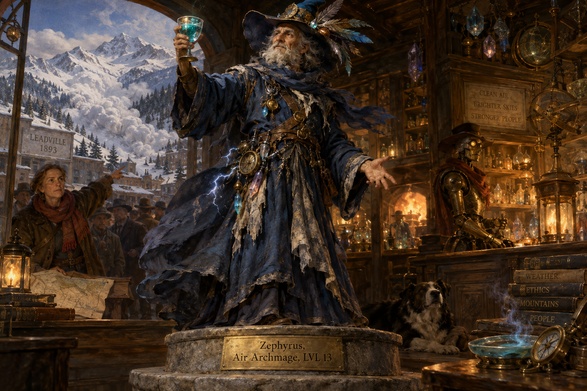
A wiry, gray-bearded wizard stands on a round stone pedestal, his ragged blue robes swirling in a wind that touches nothing else. Feathers and luminous stones adorn his crooked hat. One hand raises a goblet of glowing turquoise liquid; the other beckons as lightning flickers around his belt. Behind him, an alchemist’s shop glitters with crystals, bottles, and firelight. The plaque at his feet reads: **“Zephyrus, Air Archmage, LVL 13.”**

Let us place this miniature’s imagined history in **Leadville, Colorado—on the border between the mortal plane and the Elemental Plane of Air—in an alternate winter of 1893.**

Before he called himself Zephyrus, he was Elias Bell, a miner’s son who repaired bellows and church organs. He discovered his gift while coaxing a broken pump to breathe: when he whistled, the air obeyed.

At first, he used magic for neighborly purposes. He cleared chimney smoke, dried soaked mittens, and sent fresh air down mine shafts. Above ten thousand feet, where every lungful matters, these were no small kindnesses. His neighbors paid him in biscuits, stove wood, and invitations to supper.

Then came fame.

Elias learned to summon Chinook winds and pluck lightning from summer storms. Visitors arrived from stranger worlds, including a RobotPirateNinja navigator whose brass lungs needed cleaning after a voyage through the astral dust seas. In payment, she gave him a compass that pointed toward whatever its owner most desired.

It pointed straight at Elias.

He mistook that for proof of greatness.

When the silver panic brought hardship to Leadville, he proposed an astonishing remedy: he would hold winter beyond the mountains. Roads would remain open. Supplies would arrive. No family would spend its last coins on coal.

An old teamster named Ruth objected.

“Keeping one road clear is useful,” she said. “Moving a season is something else. Where’s all that snow going?”

Elias had calculated the strength of the spell. He had not calculated that.

Nevertheless, before the whole town, he opened a gate to the Plane of Air.

For six days, warm winds swept the streets. On the seventh, snow driven into a neighboring basin broke loose in an avalanche. It buried the approach to a mining camp, trapping workers and their families beyond reach.

Elias could have maintained his splendid weather and blamed the mountains. Instead, he went to Ruth.

“Tell me what I failed to ask.”

She spread a trail map across her kitchen table.

Together they planned the rescue. Elias surrendered the power sustaining his great spell and spent it on smaller tasks: carrying whistles through the blizzard, lifting snow from blocked doors, keeping a pocket of breathable air around the searchers. He followed Ruth’s route rather than the shortcut his compass promised.

They brought the trapped families home. One rescuer returned with frostbitten hands that never fully healed.

Elias paid that man’s winter expenses for the rest of his life. It did not settle the debt, but it kept him from treating remorse as sufficient payment.

Afterward, he took the name Zephyrus and opened the shop pictured here. He still enjoyed an audience. He still put too many feathers in his hat. But before any substantial spell, he consulted the people who would have to live with its consequences.

And the blue drink?

Snowmelt, juniper, and one captive breeze. Before drinking, he pours a little into a shallow dish and watches which way it moves.

Even an archmage, he learned, should check the weather before heading into the mountains.
∨∨ more ∨∨
models
- coregpt-6-astra
- imggpt-image-1.5
- voxelevenlabs_v3
^^ less ^^
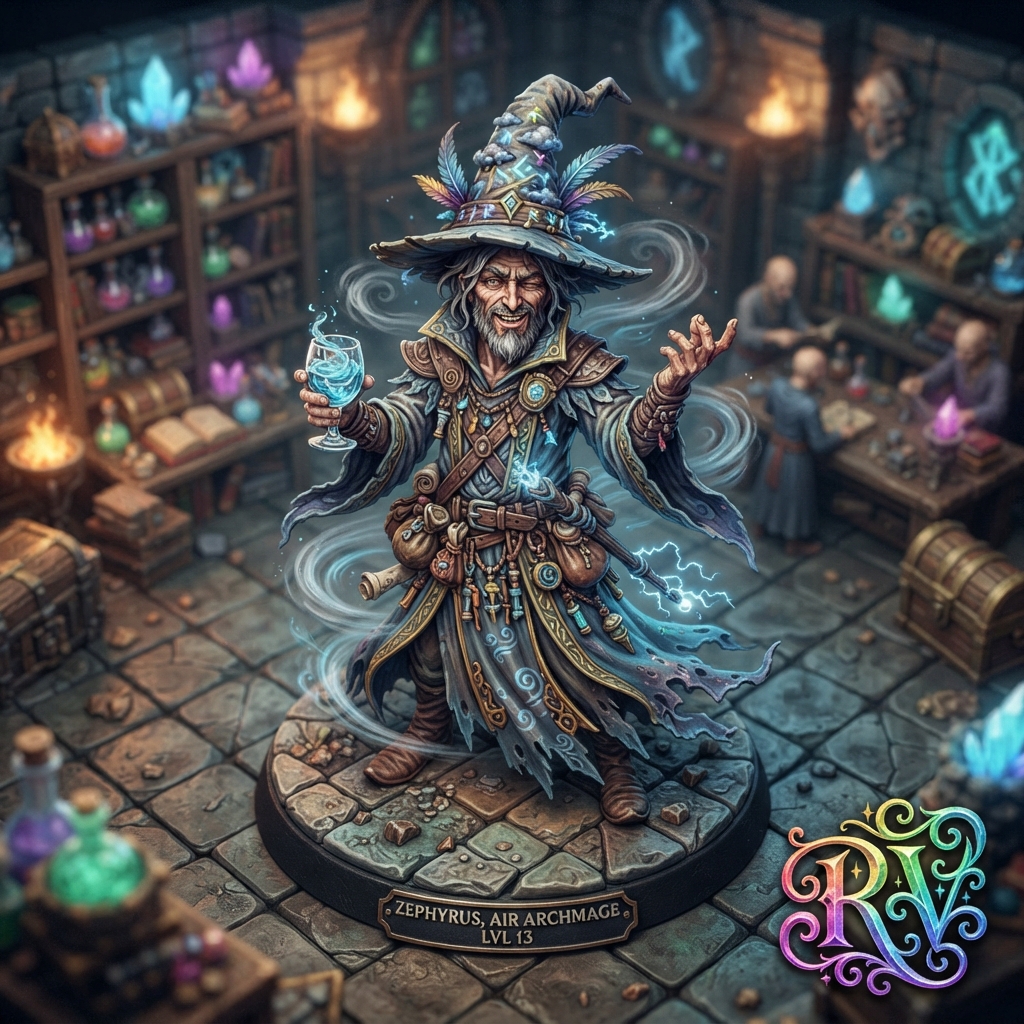
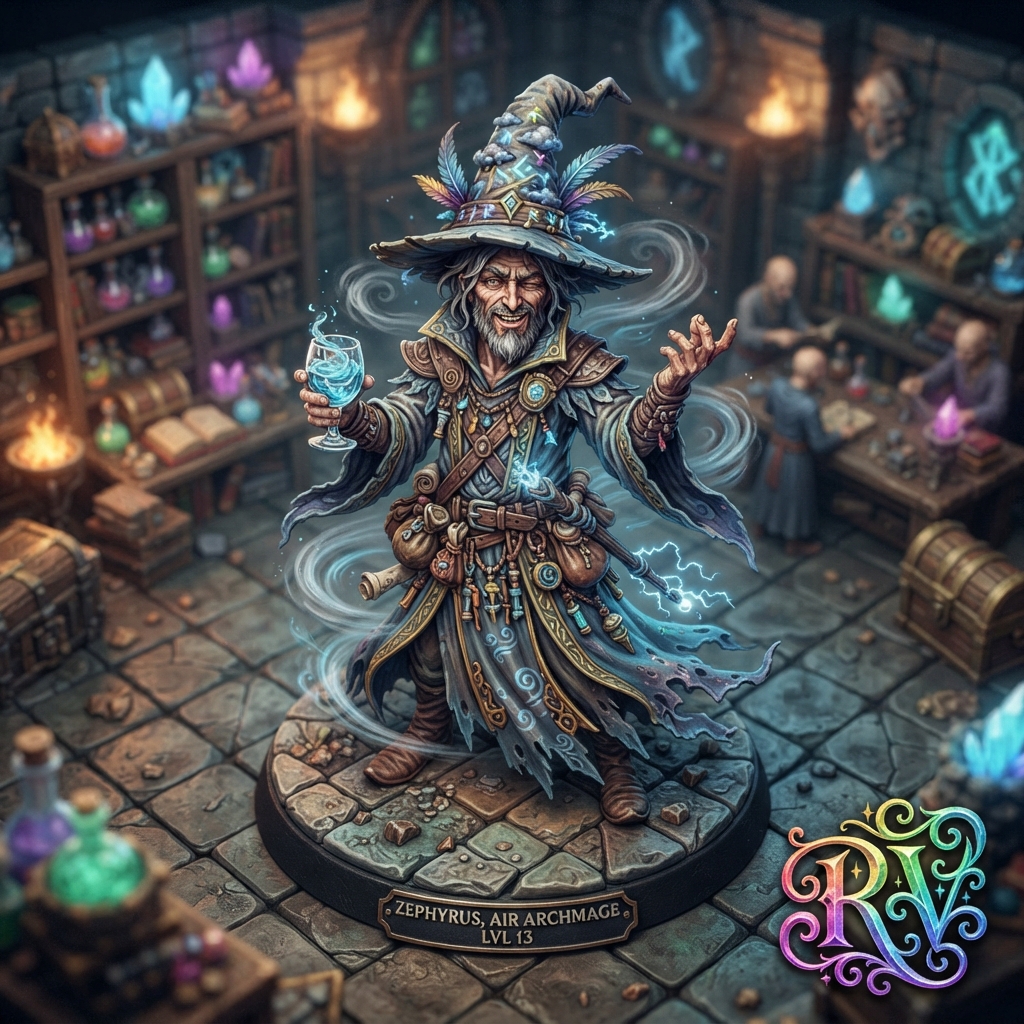
A lean, gray-bearded wizard stands on a circular stone plinth, his ragged blue robes stirring in a wind that touches no one else. Feathers and glowing runes decorate his crooked hat. One hand raises a goblet of luminous turquoise liquid; the other curls around an unfinished spell. Behind him, shelves overflow with potions, crystals, and books. The plaque beneath his boots reads: **“Zephyrus, Air Archmage, LVL 13.”**

Let us place his tale in **Sigil, the City of Doors**, upon the **Outer Plane of the Outlands**, in an era when a misplaced key could open a pantry—or an entrance to another universe. This is an imagined backstory for the figure, whose grand title conceals a rather less grand beginning.

Before he commanded storms, Zephyrus repaired chimneys.

He had a small gift for persuading smoke to go where it ought. In Sigil, where buildings crowded together like suspicious relatives, this earned him enough for bread and occasionally enough for butter. He was clever, theatrical, and painfully hungry for recognition.

So when a merchant offered to sponsor his studies, Zephyrus signed before reading the second page.

His patron sold bottled breezes: summer air for cold bedrooms, mountain air for crowded workshops, ancestral winds for homesick travelers. Zephyrus improved the enchantments until every bottle sang when opened.

Soon his advertisements appeared on enchanted mirrors throughout the city.

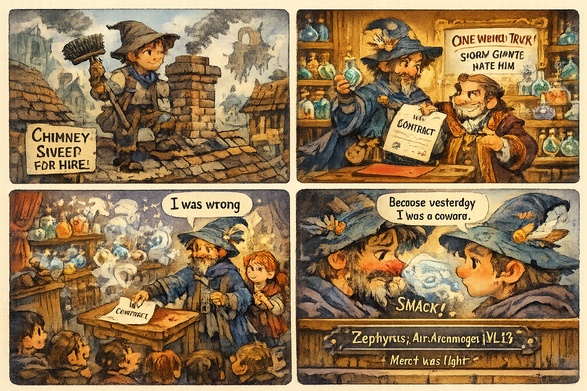
**LOCAL CHIMNEY SWEEP DISCOVERS ONE WEIRD TRICK. STORM GIANTS HATE HIM.**

People shared the mirrors’ messages, argued beneath them, and accused one another of being paid by rival wind merchants. Zephyrus became famous enough that strangers repeated his jokes to him incorrectly.

Then an apprentice named Meret discovered what made the bottles sing.

There were creatures inside them.

Small air elementals, captured through a hidden portal, compressed until their cries sounded like music.

Zephyrus confronted his patron, expecting denial. Instead, the merchant opened their contract.

There, on the second page, was Zephyrus’s authorization.

“You approved the process,” the merchant said. “And every bottle carries your seal.”

For three nights, Zephyrus prepared a statement. It contained phrases such as *unforeseen consequences* and *not representative of my values*. He showed it to Meret.

“Will this open the bottles?” she asked.

He burned the statement.

At the next public demonstration, before a thousand watching mirrors, Zephyrus placed his contract on the table.

“I signed this,” he said. “I did not read it because I liked what I was being paid. Meret found the prisoners. I would still be selling them if she hadn’t.”

Then he spoke the master word that opened every bottle bearing his seal.

Across Sigil, cupboards burst. Banquet tables overturned. A duke’s expensive wig migrated to another district. Thousands of freed elementals rushed through the streets, and Zephyrus stood at the center of their fury without raising a shield.

One of them stopped before his face.

It was scarcely larger than a sparrow.

“Why now?” it asked.

He could have answered beautifully.

Instead, he said, “Because yesterday I was a coward.”

The elemental struck him hard enough to break his nose.

Then it left.

His fortune disappeared into refunds and repairs. His patron sued. Former admirers circulated little looping illusions of the broken nose, captioned **ARCHMAGE GETS ABSOLUTELY AERATED**. Meret departed to establish her own workshop; forgiveness, she told him, was not included in her apprenticeship.

Zephyrus returned to chimneys.

But he also spent years finding bottles that had escaped the release spell. He bought them when he could, stole them when he must, and recorded every freed captive by name. Eventually, some returned voluntarily to teach him what bottled wind never could.

That is how he became an air archmage.

The goblet in his hand now contains ordinary water, cooled by a small breeze that comes and goes as it pleases. His workshop contracts are one page long. Apprentices receive them a week before signing.

And beneath that impressive plaque, where only someone sweeping the floor would notice, he has scratched a second inscription:

**Meret was right.**
∨∨ more ∨∨
models
- coregpt-6-astra
- imggpt-image-1.5
- voxelevenlabs_v3
^^ less ^^
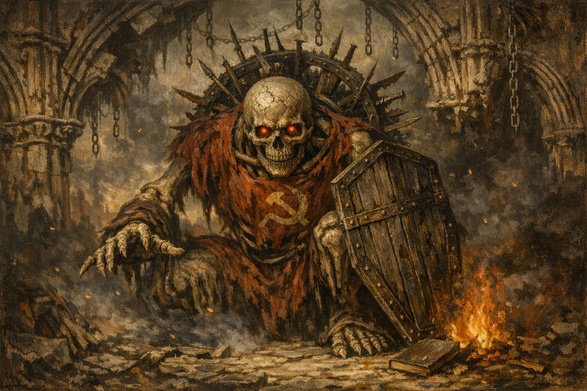
A skeletal giant crouches beneath shattered Gothic arches, its cracked skull lit by two burning red eyes. A ragged crimson tunic hangs from its ribs, bearing a faded hammer and sickle. Nails and broken weapons bristle from the iron wheel strapped to its back. One claw grips a coffin-shaped shield; the other reaches through the drifting ash. Above it, chains hang where bells might once have rung.

**In this imagined history, its name was Mikhail Serevin.** It came from Petrograd on an alternate Earth, during the famine years following the Russian Revolution. But the cathedral pictured here stands elsewhere: in the **Furnace Between Worlds**, a plane where broken promises acquire weight.

Its era is the Long Reckoning. No calendar survives there.

Before he became a monster, Mikhail repaired boilers and shared a cramped apartment with his sister and her children. He possessed little, but neighbors knew that his stove stayed lit late and that a knock at his door usually earned a cup of something warm.

Then came the winter when warmth was no longer enough.

Appointed keeper of a district grain store, Mikhail discovered that the official ration would leave some families starving. One evening, a mother arrived carrying a child too weak to cry. Mikhail broke the warehouse seal and gave her flour.

By dawn, he had opened the doors to everyone.

That was his great act of generosity—and the moment around which the rest of his existence would turn.

At first, he asked nothing in return. Later, frightened by dwindling supplies and exhilarated by the gratitude of his neighbors, he began recording names.

Who had thanked him? Who supported his decisions? Who deserved another sack?

He stopped saying, “There is bread.”

He began saying, “Remember who feeds you.”

Across the world, distinct Indigenous traditions offered another understanding of giving. Among the Kwakwaka’wakw of the Pacific Northwest, potlatches have involved the distribution of wealth alongside the witnessing of names, rights, and responsibilities. They are not merely acts of private charity, nor are their meanings interchangeable with those of other Native nations. Yet they offer a useful contrast to Mikhail’s locked ledger: giving can affirm obligations within a community rather than make the recipient someone’s possession.

Mikhail never learned that distinction while alive.

When a warehouse fire trapped the people waiting for their rations, he reached the exit with the grain ledger beneath his coat. Then he heard his sister calling from inside.

He turned back.

He died holding a door open.

The Furnace could not decide what to make of him.

It fashioned his shield from that door and his burden from the warehouse machinery. Every nail in the wheel marked a gift he had later used as leverage. Every broken blade belonged to someone who had fought over food he withheld.

For decades, he guarded a bridge across the Furnace, demanding gratitude from every starving soul who passed.

Then a small traveler approached and asked for shelter beneath his shield.

“What will you give me?” Mikhail rasped.

“Nothing,” the child answered. “I have nothing.”

He almost sent her away.

Instead, he knelt and raised the shield against the falling embers.

No witness applauded. The child slept.

Behind him, one nail loosened from the wheel and struck the stone.

∨∨ more ∨∨
You made it to the bottom. Now dance!


owned and operated by: RPN Omnigalactic Insitutution as of: 2026/09/18: 04:47 in 0 ms
Enter Code
Login with Account