| gen: 2026/07/11:22:49 in 2 min 13.2 sec (old)bias: 6 (Center-Left) |
| type: newsquality: 72 |
| pts: 0 |
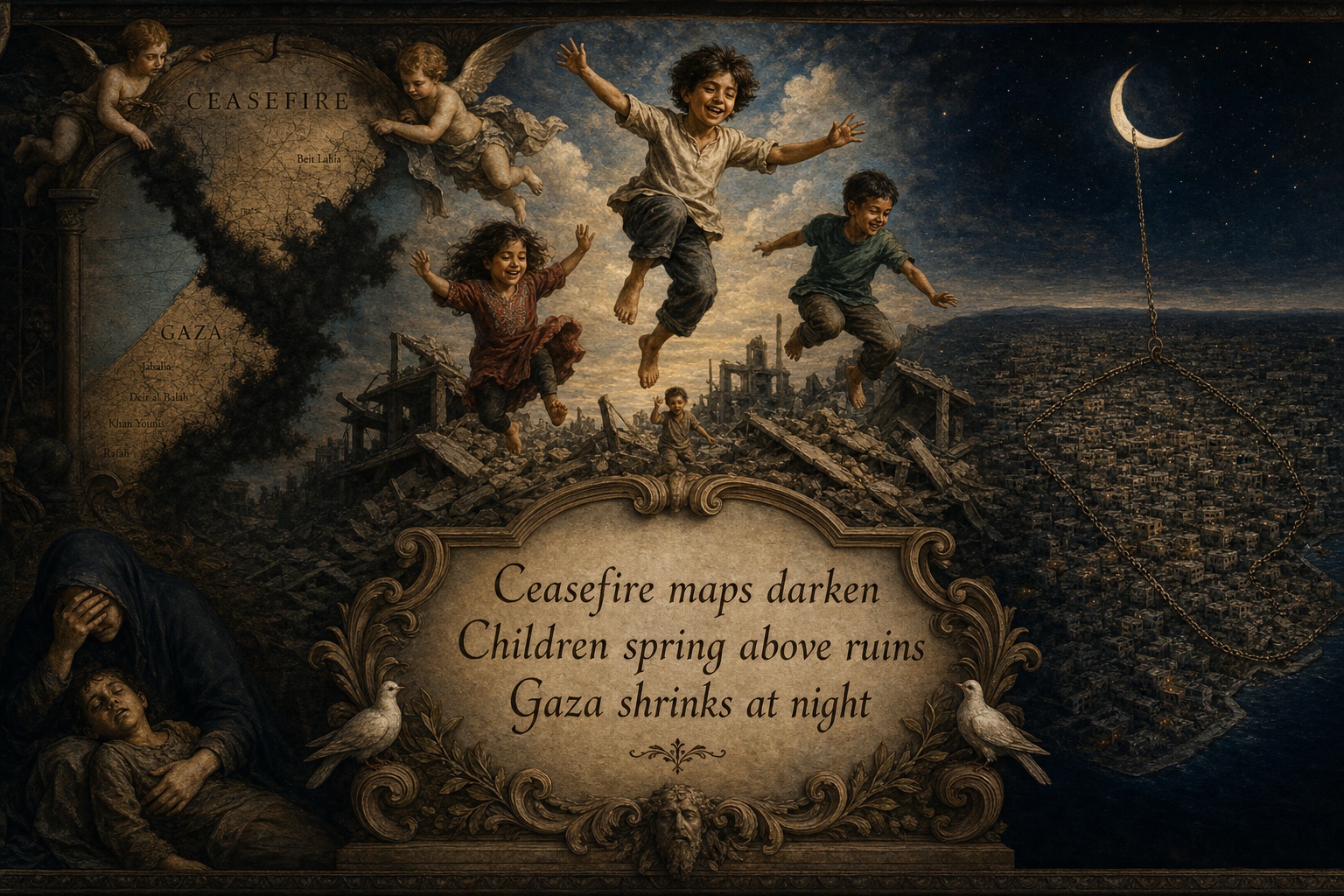
Ceasefire maps darken
Children spring above ruins
Gaza shrinks at night
 | author: | Anas Baba, Aya Batrawy | institution: | NPR | ¿porque no los dos? |
| tl;dr | This NPR special-series article, dated July 10, 2026, reports that Israel controls nearly 70% of Gaza nine months after a ceasefire. It focuses on Palestinian civilians living amid destruction, restricted movement, shortages, and expanding Israeli military zones, including the so-called “orange zone.” The article attributes the 70% estimate to Israeli leaders, maps, and NPR analysis, and cites Israeli Prime Minister Benjamin Netanyahu’s statements about surrounding Hamas. The image is a long screenshot of the article with repeated sections and does not show the full report. | ||||
| deeper: | The report uses firsthand Palestinian testimony, credited photographs, geographic detail, and multiple sourcing methods, including Israeli statements, aid-group information, United Nations figures, and NPR’s map analysis. It also notes that Israel’s military did not respond to repeated requests for comment, which is transparent but leaves the Israeli perspective underdeveloped. The framing is strongly centered on Palestinian civilian suffering and uses emotionally charged descriptions such as “bombed-out homes,” “no hope,” and “expanding zone of control.” Hamas’s role is mentioned mainly through the ceasefire’s disarmament terms and Netanyahu’s stated military objective; the article provides little examination of Hamas’s conduct, military presence, or Israel’s stated operational rationale beyond brief references. The central 70% figure is not fully explained: the article does not clearly define “control,” provide the underlying map, or distinguish military presence, restricted-access areas, and permanent territorial administration. The screenshot is also future-dated, incomplete, and contains duplicated material, limiting confidence in evaluating the entire article. Overall, it appears to be serious field reporting with substantial evidentiary value, but its selection and framing of evidence lean toward a Palestinian civilian-impact perspective. | ||||
media: | |||||
Please log in to comment