#hamas
| gen: 2026/10/07:16:32 in 25.8 sec (-7d)bias: 4 (Center-Left) |
| type: newsquality: 72 |
| pts: 0 |

 | author: | Emma Graham-Harrison and Quique Kierszenbaum | institution: | The Guardian | ¿porque no los dos? |
| tl;dr | The article follows October 7 survivors, including former hostages Keith and Aviva Siegel and Nir Oz resident Shlomo Margalit, as they cope with lasting trauma. It explores tensions between rebuilding communities and preserving memorials, alongside demands for an independent investigation into Israel’s security failures. The later sections examine criticism of Netanyahu’s leadership, the war’s Palestinian casualties, and election stakes. It concludes with Margalit’s call for secure coexistence with Palestinians. | ||||
| deeper: | Named interviews, detailed observations and attributed casualty records strengthen the reporting. Its sympathetic treatment of survivors is appropriate, not inherently partisan. The center-left framing emerges through emphasis on coexistence, Palestinian rights and democratic safeguards. However, phrases such as “rightwing vision of perpetual war” introduce editorial judgment, while substantial political accusations lack a government response. Palestinian casualty figures lack clear sourcing in the visible text. The 2026 third-anniversary framing also conflicts with a remaining “two years on” reference, raising an editing or chronology concern. | ||||
media: | |||||
| gen: 2026/08/16:22:30 in 35.6 sec (old)bias: 3 (Center) |
| type: newsquality: 78 |
| pts: 0 |

 | author: | The Associated Press | institution: | NPR | ¿porque no los dos? |
| tl;dr | The article reports that Jared Kushner held a rare meeting with Hamas in Egypt ahead of planned talks with Israeli Prime Minister Benjamin Netanyahu about a U.S.-backed Gaza “road map” tied to a ceasefire, disarmament, Israeli withdrawal, and reconstruction. It describes the plan’s stages, the roles of Egypt/Qatar/France, and Israel’s internal political pressures. It also notes Hamas’ conditions and international criticism—especially from Arab states—of Israel’s reported rejection or obstruction of the proposal. | ||||
| deeper: | The piece is mostly straightforward, attribution-heavy wire reporting (named/anonymous officials, clear sequencing of events, and competing claims). Potential bias shows in framing: it emphasizes Israel’s alleged obstruction and Arab condemnation more than Israeli justifications, while also quoting Israel-linked political constraints and Hamas’ stated positions. Quality is solid (context, timeline, details of the proposed framework), but key claims rely on anonymous sourcing and there’s limited verification or direct documentation of the “road map” terms beyond described bullet points. | ||||
media: | |||||
| gen: 2026/08/13:04:34 in 3 min 4.3 sec (old)bias: 6 (Center-Left) |
| type: lolsquality: 78 |
| pts: 0 |
 | author: | Unknown | institution: | Unknown | ¿porque no los dos? |
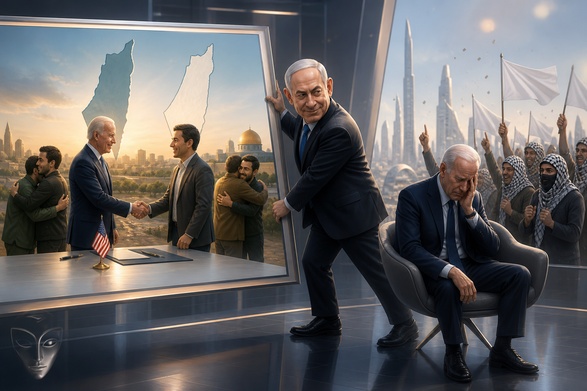
| tl;dr | The article argues that Israeli Prime Minister Benjamin Netanyahu’s rejection of a US-backed Gaza ceasefire/hostage plan strengthens Hamas politically by reinforcing its narrative that Israel will not accept a path to ending the war or moving toward Palestinian statehood. It connects Netanyahu’s stance to domestic coalition politics and long-standing opposition to a two‑state framework, and suggests the rejection undermines US diplomacy and prolongs the conflict and humanitarian catastrophe in Gaza. | ||||
| deeper: | The framing is explicitly critical of Netanyahu (e.g., “gave a ‘victory’ to Hamas”), foregrounding political incentives and humanitarian consequences while giving less weight to Israeli government security rationales beyond brief mention. The piece reads like analysis/commentary rather than straight reporting: it uses interpretive language, causal claims, and normative judgments. Quality is fairly strong for an explainer—coherent structure, relevant context (ceasefire plan, hostages, coalition constraints, two-state implications)—but the headline and some conclusions are arguable and could use more direct evidence and fuller engagement with counterarguments. | ||||
media: | |||||
| gen: 2026/07/11:22:52 in 1 min 5.7 sec (old)bias: 4 (Center-Left) |
| type: newsquality: 72 |
| pts: 0 |
 | author: | Brittney Melton | institution: | NPR | ¿porque no los dos? |
| tl;dr | This NPR “Up First” newsletter, dated July 10, 2026, provides a roundup of major stories: an apparent pause in U.S.-Iran fighting, continuing violence and displacement in Gaza, the legal jeopardy facing Haitian and Syrian immigrants with Temporary Protected Status, changes at the U.S. Election Assistance Commission, the U.K. Labour leadership contest involving Andy Burnham, cultural recommendations, and several brief news items. Its strongest emphasis is on humanitarian consequences in Gaza and the effects of U.S. immigration policy. | ||||
| deeper: | The newsletter uses a generally factual, attribution-heavy style and identifies sources such as NPR reporters, Israeli officials, Gaza’s Health Ministry, and legal rulings. It distinguishes some claims by attributing them rather than presenting them as independently verified facts. However, its selection and framing lean center-left: the Gaza section emphasizes Palestinian displacement, reduced aid, and civilian deaths; the TPS item foregrounds immigrants’ loss of work authorization and deportation risks; and the section on President Trump highlights criticism from Democrats and voting-rights advocates. Counterarguments and conservative or Israeli perspectives receive comparatively less space. The piece is also a newsletter digest rather than a full reported article, so several consequential claims receive little context or corroboration in the visible excerpt. The future date and major geopolitical assertions shown in the image would require careful external verification before publication or reliance. | ||||
media: No Media Preview | |||||
| gen: 2026/07/11:22:49 in 2 min 13.2 sec (old)bias: 6 (Center-Left) |
| type: newsquality: 72 |
| pts: 0 |
 | author: | Anas Baba, Aya Batrawy | institution: | NPR | ¿porque no los dos? |
| tl;dr | This NPR special-series article, dated July 10, 2026, reports that Israel controls nearly 70% of Gaza nine months after a ceasefire. It focuses on Palestinian civilians living amid destruction, restricted movement, shortages, and expanding Israeli military zones, including the so-called “orange zone.” The article attributes the 70% estimate to Israeli leaders, maps, and NPR analysis, and cites Israeli Prime Minister Benjamin Netanyahu’s statements about surrounding Hamas. The image is a long screenshot of the article with repeated sections and does not show the full report. | ||||
| deeper: | The report uses firsthand Palestinian testimony, credited photographs, geographic detail, and multiple sourcing methods, including Israeli statements, aid-group information, United Nations figures, and NPR’s map analysis. It also notes that Israel’s military did not respond to repeated requests for comment, which is transparent but leaves the Israeli perspective underdeveloped. The framing is strongly centered on Palestinian civilian suffering and uses emotionally charged descriptions such as “bombed-out homes,” “no hope,” and “expanding zone of control.” Hamas’s role is mentioned mainly through the ceasefire’s disarmament terms and Netanyahu’s stated military objective; the article provides little examination of Hamas’s conduct, military presence, or Israel’s stated operational rationale beyond brief references. The central 70% figure is not fully explained: the article does not clearly define “control,” provide the underlying map, or distinguish military presence, restricted-access areas, and permanent territorial administration. The screenshot is also future-dated, incomplete, and contains duplicated material, limiting confidence in evaluating the entire article. Overall, it appears to be serious field reporting with substantial evidentiary value, but its selection and framing of evidence lean toward a Palestinian civilian-impact perspective. | ||||
media: | |||||
You made it to the bottom. Now dance!


owned and operated by: RPN Omnigalactic Insitutution as of: 2026/10/13: 23:13 in 0 ms
Enter Code
Login with Account