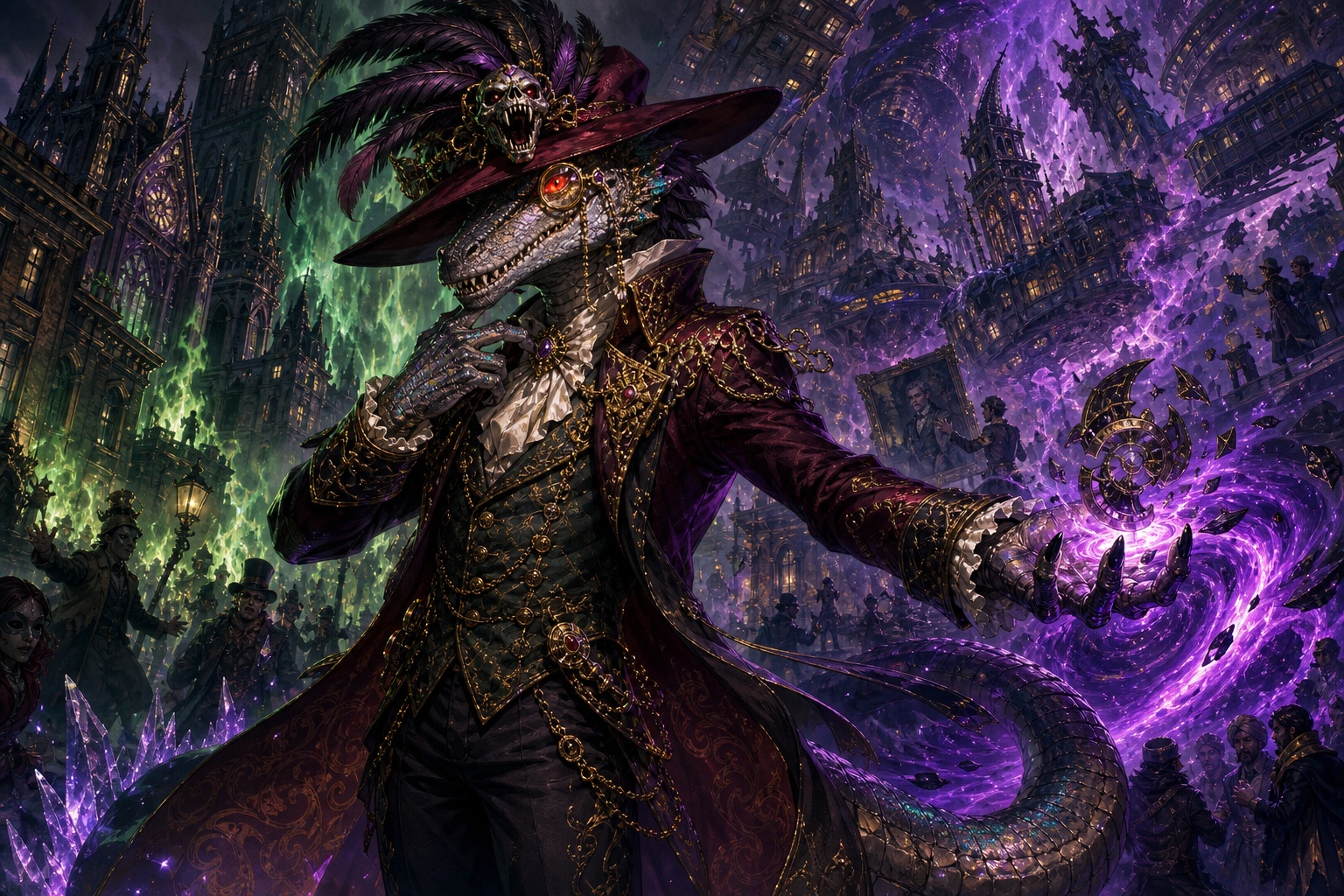
A reptilian aristocrat fills the scene: iridescent scales, a glowing crimson eye, serrated teeth arranged in a courtier’s smile, and one claw resting thoughtfully beneath his chin. A jeweled monocle, gold chains, embroidered waistcoat, and enormous wine-coloured hat proclaim extravagant wealth. Yet the tiny fanged skull pinned among its feathers betrays something predatory beneath the refinement. Green witchfire illuminates the stone chamber behind him, while a pool of violet magic churns at his side.

He was **Marquis Séraphin Sauriel**, called *the Gentleman of Broken Rules*. He came from **Montréal-sur-Minuit**, a distorted reflection of Montreal located on the **Plane of Gloaming**, where forgotten possibilities gather after being discarded by our world. His era corresponded roughly to Canada’s late nineteenth century, when railways, factories, political bargains, and waves of immigration were rapidly transforming the young country.

Montréal-sur-Minuit resembled the real city viewed through dark carnival glass. Its towers borrowed the grandeur of Notre-Dame Basilica, its alleys twisted like those of Old Montreal, and every winter its inhabitants held a masquerade inspired by Quebec’s winter carnivals. Merchants bargained in English, French, Mohawk, Punjabi, and the secret language of dragons. Above them all ruled the Calendar Court, which demanded that every citizen follow a destiny assigned at birth.

Séraphin was born in the district beneath Mount Royal, the son of an apothecary and a disgraced court astrologer. The Calendar declared that he would become a sewer keeper. Instead, he taught himself etiquette, illusion, and law, recognizing that authority often depended less upon truth than upon costume and confidence. His flamboyant clothing became armour: if society insisted on treating appearances as destiny, he would master appearances better than anyone.

His defining trial came during the **Night of Thirteen Bells**. Hoping to destroy the Calendar Court’s monopoly on fate, Séraphin stole its central mechanism—the Compass of Consequence. He intended to liberate the city. But when he opened the device, raw chaos poured into Montréal-sur-Minuit.

For one night, streets changed direction, portraits argued with their owners, and the frozen St. Lawrence flowed upward into the stars. Respectable judges became buskers; imprisoned thieves awoke in council chambers; and children discovered memories belonging to their grandparents. The confusion recalled the disruptive force of a Canadian ice storm: familiar systems failed, neighbours had to improvise, and survival depended less on rank than on cooperation. Like voyageurs navigating an unmapped river, citizens learned to read changing conditions rather than demand that the world remain still.

But chaos was not harmless. Séraphin’s own mother vanished when her apothecary transformed into a door leading to an unwritten future. He could have restored the old order by returning the Compass. Instead, he shattered it, ensuring that no ruler could dictate destiny again—even though doing so meant he might never find her.

That choice made him both liberator and villain. The poor gained paths once forbidden to them, but thousands lost the certainty by which they had built their lives. Séraphin thereafter wore the broken Compass as the fanged ornament on his hat. To admirers, it symbolized freedom. To his enemies, it was the grinning face of irresponsibility.

In later years he governed through riddles, wagers, and carefully staged disorder. He welcomed newcomers with the hospitality of a crowded Canadian kitchen, where many traditions can share one table, yet he never permitted any custom to become unquestionable law. He believed chaos was a virtue because it broke prisons disguised as traditions. His tragedy was failing to understand that people also need trust, continuity, and shelter from constant upheaval.

Thus the Marquis learned the great moral of his age: **chaos can open the locked gate, but it cannot decide what should be built beyond it**. Freedom begins when destiny loosens its grip; character is revealed by what one does with the uncertainty that follows.

Please log in to comment