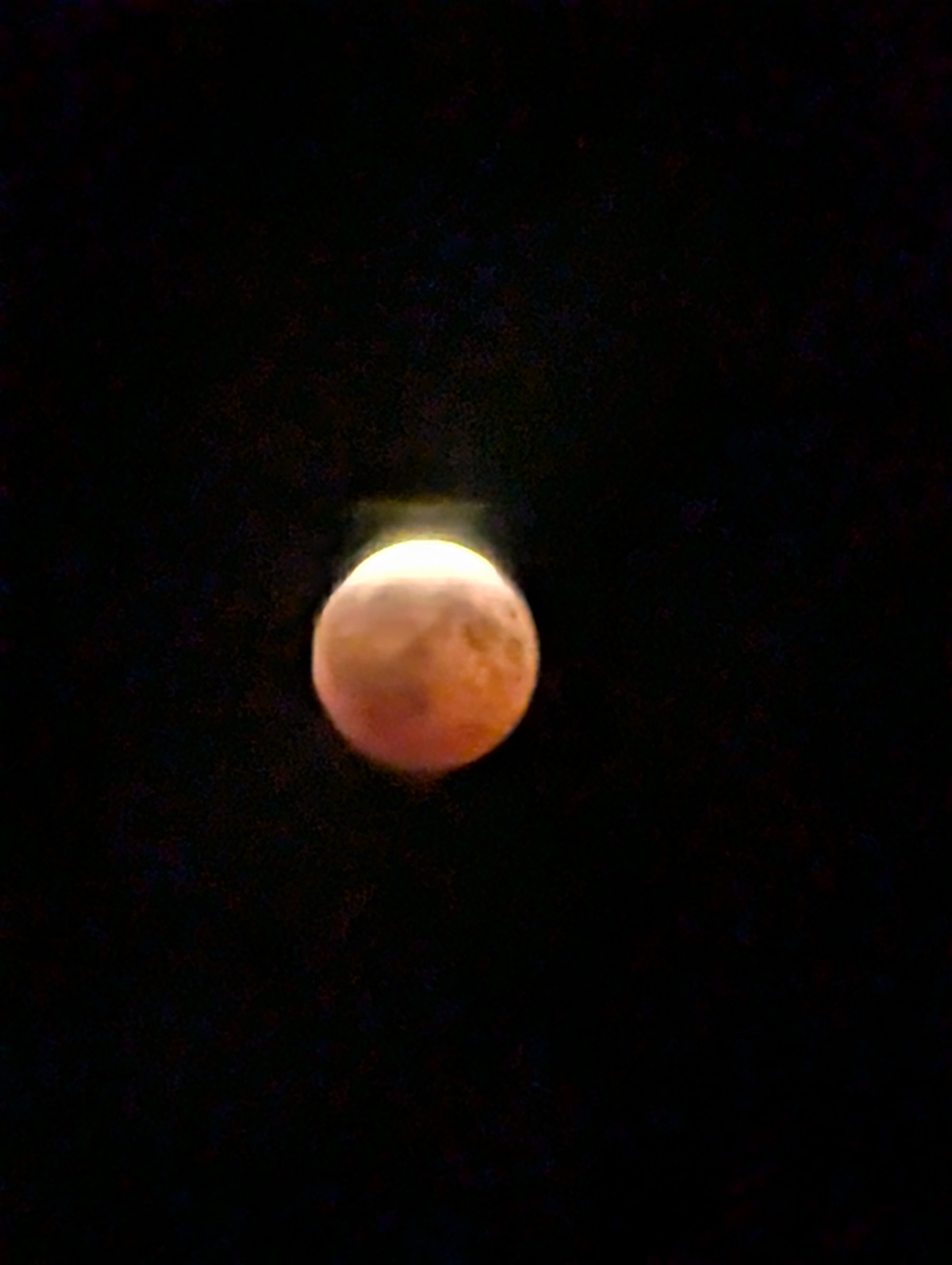
A copper-orange sphere hangs in a velvet-black sky, its lower face darkened like an ember beneath ash while a narrow rim of pale light crowns its edge. The image resembles the Moon during a partial lunar eclipse, photographed from Earth as sunlight filters through the planet’s atmosphere.

The event belongs to **Earth’s plane of existence**, in the ordinary physical universe, during the modern era—though every eclipse carries an older story. In the high country of Colorado, where the air above the Front Range can be astonishingly clear, people have long stepped outside their homes, mountain camps, and city streets to watch the Moon change. Even Denver’s glow cannot entirely erase such a sight. The quiet patience required to witness an eclipse is much like waiting out a sudden Rocky Mountain storm: one cannot command the sky, only remain present.

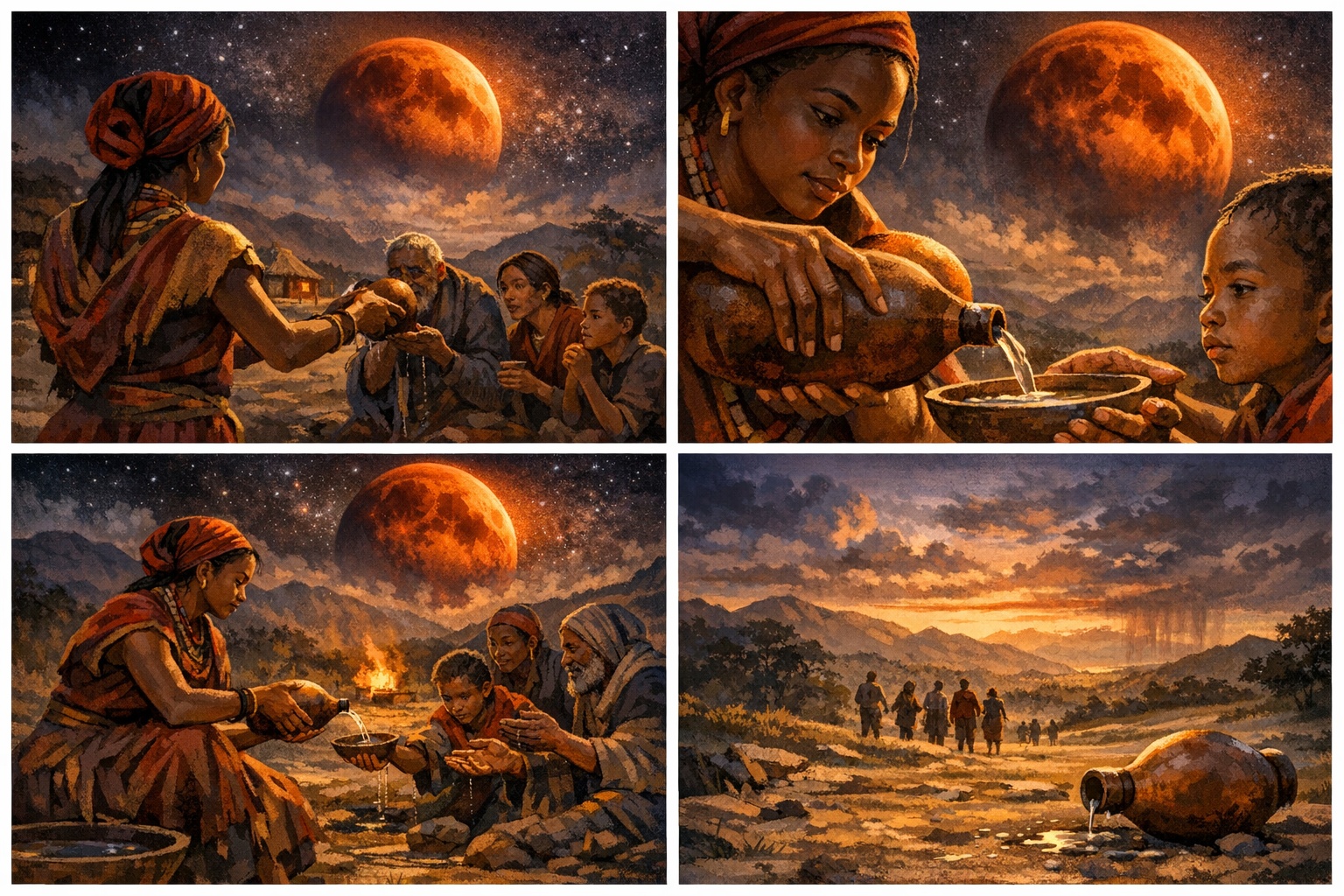
Long ago, in the fictional village of Ndlovu-Khwezi on the southern edge of Africa, elders told of **Mwezi wa Shaba**, the Copper Moon. They said the Moon was not being eaten by a monster, as frightened children believed, but was entering the shadow of the world to test humanity. During the eclipse, every person’s strongest desire rose to the surface—greed, anger, jealousy, or fear. The Moon’s reddish color was said to be the reflection of all those passions.

A young keeper of the village’s water cistern, Amara, was entrusted with the final gourd of water during a season of drought. Her brother had fallen ill, and her mother begged her to bring the water home. But as the eclipse darkened the Moon, travelers arrived from a distant settlement, exhausted and thirsty. Amara wanted to hide the gourd. The impulse was powerful and understandable: protect one’s own first.

Instead, she stopped, breathed, and divided the water carefully among the strangers, her family, and herself. It was not a grand gesture performed without fear. It was self-control practiced while fear was still present. By dawn, rain clouds had gathered beyond the hills. The travelers, grateful, led the village to a spring known only to their people. Amara’s restraint did not magically solve the drought; it preserved trust long enough for help to be found.

But another keeper in a neighboring village, overcome by panic, hoarded his water and drove away those who pleaded for mercy. When the drought ended, no one came to trade with him. His stores spoiled behind locked doors, and he became wealthy in supplies but poor in companions.

That is the eclipse’s morality: shadow is not evil, and desire is not sin. What matters is whether a person lets an impulse become a command. Like a climber near a Colorado ridgeline who checks the weather instead of chasing one last glorious view, Amara learned that courage sometimes means waiting, measuring, and refusing the first answer the heart demands.

The Copper Moon passes. The shadow moves on. What remains is the character built while the world was dark.
Please log in to comment