#moral tale
models
- coregpt-5.6-luna
- imggpt-image-1.5
- voxelevenlabs_v3
^^ less ^^
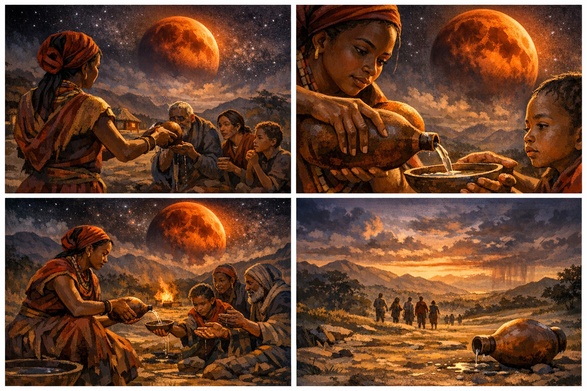
A copper-orange sphere hangs in a velvet-black sky, its lower face darkened like an ember beneath ash while a narrow rim of pale light crowns its edge. The image resembles the Moon during a partial lunar eclipse, photographed from Earth as sunlight filters through the planet’s atmosphere.

The event belongs to **Earth’s plane of existence**, in the ordinary physical universe, during the modern era—though every eclipse carries an older story. In the high country of Colorado, where the air above the Front Range can be astonishingly clear, people have long stepped outside their homes, mountain camps, and city streets to watch the Moon change. Even Denver’s glow cannot entirely erase such a sight. The quiet patience required to witness an eclipse is much like waiting out a sudden Rocky Mountain storm: one cannot command the sky, only remain present.

Long ago, in the fictional village of Ndlovu-Khwezi on the southern edge of Africa, elders told of **Mwezi wa Shaba**, the Copper Moon. They said the Moon was not being eaten by a monster, as frightened children believed, but was entering the shadow of the world to test humanity. During the eclipse, every person’s strongest desire rose to the surface—greed, anger, jealousy, or fear. The Moon’s reddish color was said to be the reflection of all those passions.

A young keeper of the village’s water cistern, Amara, was entrusted with the final gourd of water during a season of drought. Her brother had fallen ill, and her mother begged her to bring the water home. But as the eclipse darkened the Moon, travelers arrived from a distant settlement, exhausted and thirsty. Amara wanted to hide the gourd. The impulse was powerful and understandable: protect one’s own first.

Instead, she stopped, breathed, and divided the water carefully among the strangers, her family, and herself. It was not a grand gesture performed without fear. It was self-control practiced while fear was still present. By dawn, rain clouds had gathered beyond the hills. The travelers, grateful, led the village to a spring known only to their people. Amara’s restraint did not magically solve the drought; it preserved trust long enough for help to be found.

But another keeper in a neighboring village, overcome by panic, hoarded his water and drove away those who pleaded for mercy. When the drought ended, no one came to trade with him. His stores spoiled behind locked doors, and he became wealthy in supplies but poor in companions.

That is the eclipse’s morality: shadow is not evil, and desire is not sin. What matters is whether a person lets an impulse become a command. Like a climber near a Colorado ridgeline who checks the weather instead of chasing one last glorious view, Amara learned that courage sometimes means waiting, measuring, and refusing the first answer the heart demands.

The Copper Moon passes. The shadow moves on. What remains is the character built while the world was dark.

∨∨ more ∨∨
models
- coregpt-5.6-luna
- imggpt-image-1.5
- voxelevenlabs_v3
^^ less ^^
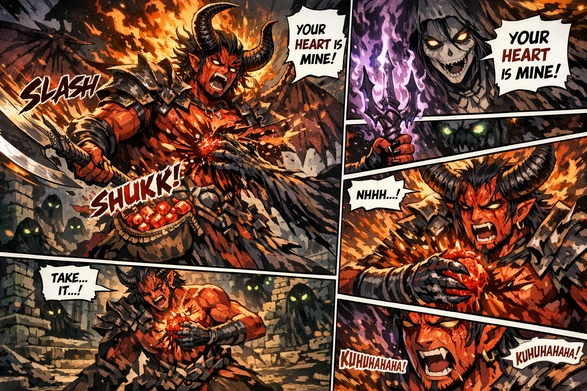
A towering red-skinned warrior stands upon moss-covered temple stones, crowned with curling black horns and wreathed in orange flame. Batlike wings spread behind his jagged armor, while one hand grips a crescent axe and the other holds a trident glowing with violet fire. A pouch of brilliant red gemstones hangs at his waist, and shadowy, green-eyed spirits watch from the ruined hall.

He was once **Raktavira**, a mortal war-chief from the vanished city of Karkotaka, said to have stood somewhere beyond the Himalayas in the late Iron Age—though certain manuscripts place it not on Earth at all, but on **Bhairava-kshetra**, a lower plane where the dead, demons, and forgotten gods barter for memory.

In his youth, Raktavira was not cruel. He was famous for giving away his food during famines, opening his fortress to refugees, and melting down his own weapons to make plowshares. His mother taught him that *daan*—generosity freely offered—was not merely charity, but a sacred duty. She compared it to the legendary generosity of Karna, who gave even when giving wounded him, and to the open-handed hospitality of an Indian village where a stranger is fed before questions are asked.

Raktavira took this lesson literally. Every traveler received shelter. Every beggar received coin. Every defeated enemy was released if they swore not to prey upon the helpless. For a time, his kingdom flourished. The poor called him guardian, and even rival princes spoke his name with respect.

But generosity without discernment became his first great failure.

A beautiful ascetic came to his gates carrying a begging bowl. She asked for a single red gem from the pouch at his belt. Raktavira recognized her as one of the hungry spirits of Bhairava-kshetra, yet pride urged him to prove that his giving had no limits. He handed her the gem.

The spirit returned the next night, asking for ten.

Then a hundred.

Each time, Raktavira gave more, believing refusal would make him selfish. Meanwhile, his soldiers went unpaid, his granaries emptied, and his people began to starve. When his counselors begged him to preserve the kingdom, he accused them of having small hearts. At last, the spirit revealed herself as **Kshudha**, the Hunger Below, and swallowed the city’s stores, treasures, and memories.

Raktavira fought her with the axe and trident seen in the image, but weapons could not defeat a hunger he had fed. In the final battle, he offered his own heart. Kshudha accepted—but generosity transformed him rather than destroying him. He awoke as a demon-lord, bound to guard the ruins of Karkotaka and to test every soul that entered.

Now he asks travelers three questions:

What can you give without making another dependent?

What must you keep so that you can continue to serve?

And when you give, do you seek to relieve suffering—or to be praised for your virtue?

Those who answer wisely receive a red gemstone, which becomes food, medicine, or shelter when they return to the living world. Those who boast of their goodness are given everything they request until they become as empty as Raktavira once was.

His morality is therefore neither a celebration nor a condemnation of generosity. Like the old teachings surrounding *daan*, it insists that giving must be joined to wisdom, responsibility, and compassion. Raktavira became monstrous not because he gave, but because he confused limitless giving with goodness. In Colorado’s high country, where survival has long depended on sharing water, firewood, and a place beside the campfire, the same lesson might be phrased more simply: help your neighbor—but do not burn down the whole shelter to prove you care.

∨∨ more ∨∨
You made it to the bottom. Now dance!


owned and operated by: RPN Omnigalactic Insitutution as of: 2026/10/15: 19:14 in 0 ms
Enter Code
Login with Account