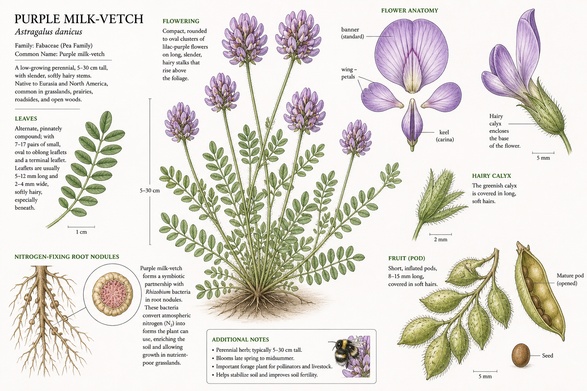
It is a Purple milk-vetch.

Scientific name: Astragalus danicus.

A low-growing perennial in the pea family, typically 5–30 cm tall, with slender, softly hairy stems. Its alternate, pinnately compound leaves bear numerous small, oval to oblong leaflets arranged in opposite pairs, plus a terminal leaflet. Compact, rounded to oval clusters of lilac-purple flowers rise above the foliage on long stalks. Each flower has a broad, upright banner petal with fine darker veins and a pale central area, two smaller wing petals, and a central keel. The flower bases are enclosed by conspicuously hairy greenish calyces. The fruits are short, inflated, hairy pods..

Purple milk-vetch forms a partnership with nitrogen-fixing bacteria in its root nodules, allowing it to obtain nitrogen from the air and grow in relatively nutrient-poor grassland..

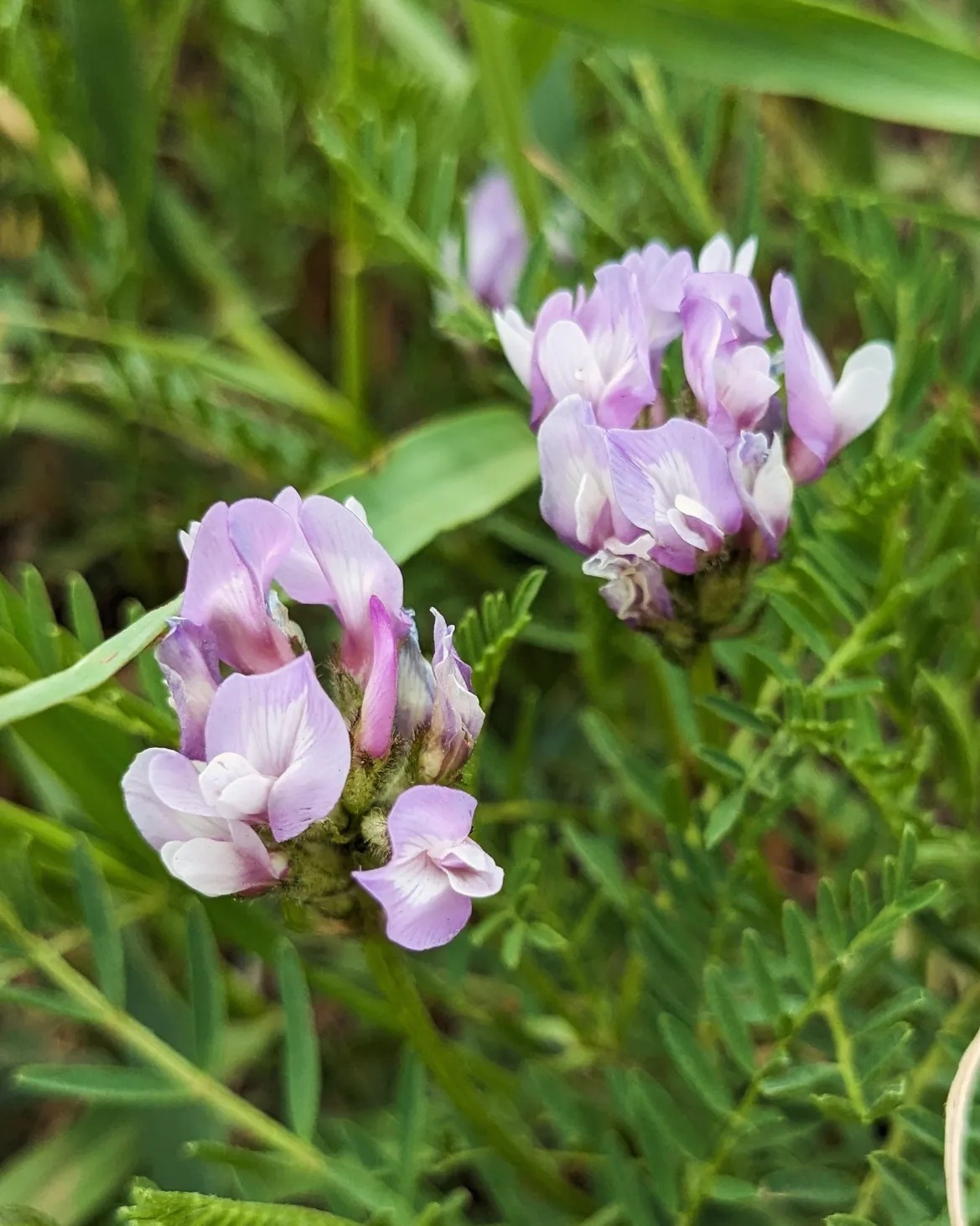
The photograph shows compact clusters of pea-shaped, pale purple flowers with broad banners, whitish wing and keel petals, and densely hairy calyces. The surrounding pinnate foliage has many small, oblong leaflets. This combination strongly suggests an Astragalus milk-vetch, and the short, crowded flower heads and broad floral proportions are particularly consistent with Astragalus danicus. Similar Astragalus and Oxytropis species can be difficult to distinguish from a photograph; location and clear views of mature pods would help confirm the species.
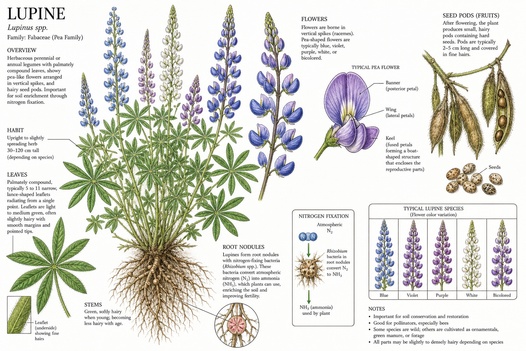
It is a Lupine.

Scientific name: Lupinus sp..

A herbaceous legume with upright to slightly spreading, softly hairy green stems. The leaves are palmately compound: typically 5 to 11 narrow, lance-shaped leaflets radiate from a single point like the fingers of a hand. Leaflets are light to medium green, often slightly fuzzy, with smooth margins and pointed tips. Mature plants produce vertical flower spikes or racemes bearing pea-shaped blossoms, commonly blue, violet, purple, white, or bicolored. Each flower has the typical legume structure with a banner petal, wing petals, and a keel. After flowering, the plant forms small, hairy seed pods containing hard seeds..

Lupines are members of the pea family and can form root nodules with nitrogen-fixing bacteria, helping enrich soil by converting atmospheric nitrogen into forms plants can use..

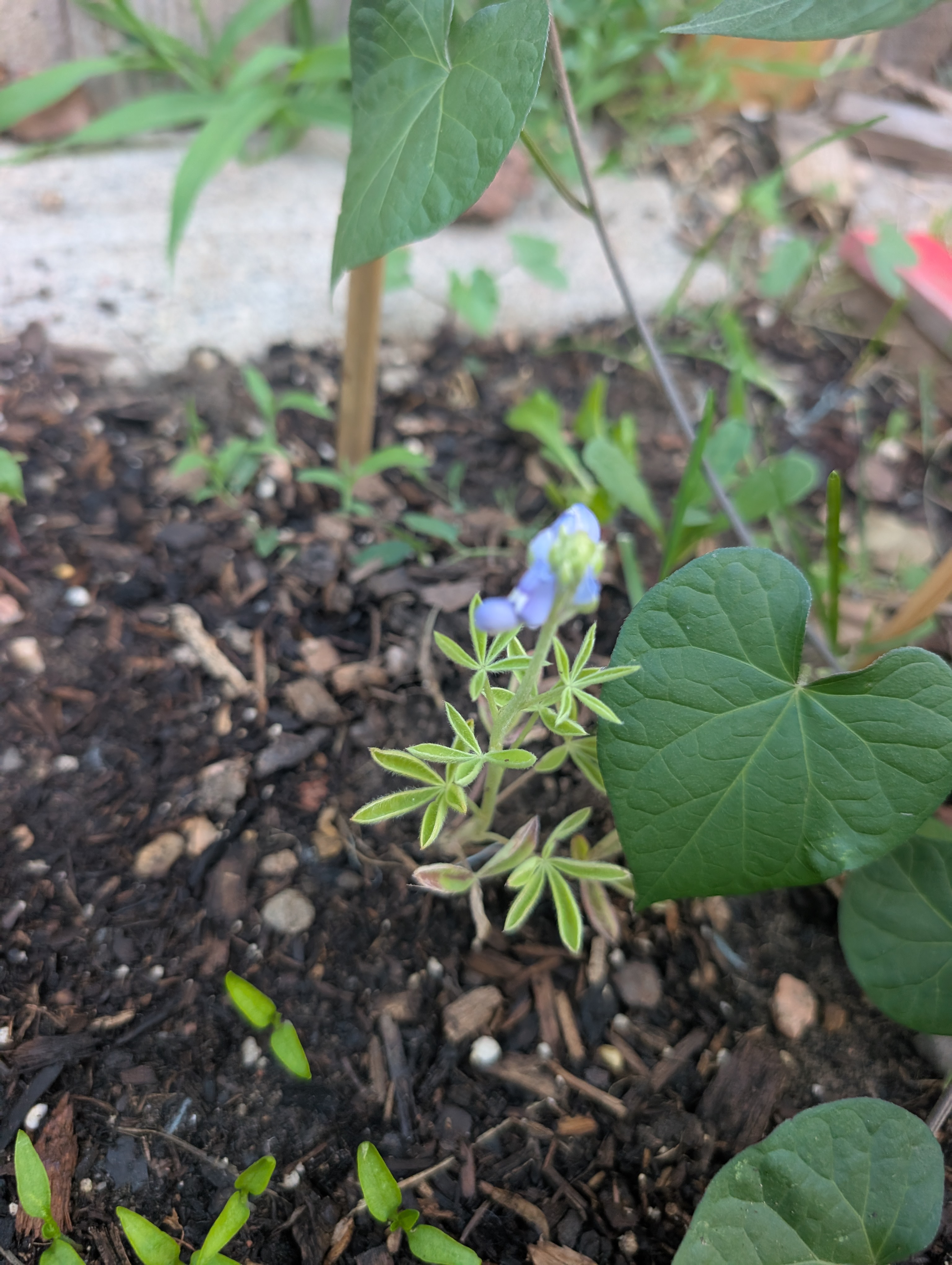
The clearest identifiable plant features are the palmate, star-like compound leaves with several narrow leaflets and the small blue-purple pea-type flower visible near the lower center of the image. These traits are characteristic of Lupinus, commonly called lupines or, in some regions, bluebonnets. The image also contains large heart- to shield-shaped leaves from a neighboring plant, so the identification is made from the lupine-like flower and compound leaves rather than those larger leaves. Because the photo is somewhat blurred and shows mixed vegetation, I can identify the genus with moderate confidence but not the exact species.