#mythology
models
- coregpt-5.6-luna
- imggpt-image-1.5
- voxelevenlabs_v3
^^ less ^^
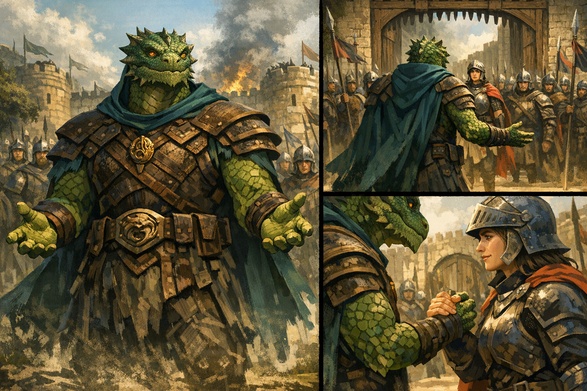
He is a broad-shouldered, green-scaled dragonborn warrior, standing nearly seven feet tall beneath the forest canopy. Small horns and ridges crown his lizardlike head, while bronze eyes gleam beneath a calm brow. He wears layered leather shoulder armor, a dark blue-green cloak, and a heavy belt bearing a carved beast-head buckle. Though built like a siege engine, his hands are open rather than clenched.

His name is **Morrow-of-the-Moss**, and he comes from the **Verdant Reach**, a plane of existence where every forest remembers what has happened beneath its leaves. The image shows him in the **Era of Splintered Crowns**, when the rulers of the lowland cities sought to tame the Reach and mine the living crystal buried beneath its roots.

Morrow was born among the Scale-Bound, a people who believed strength was the first virtue and mercy merely a hesitation before victory. His mother, however, taught him an older lesson: a hunter who kills everything in sight soon finds himself living in an empty world. In this, her teaching resembles values found in many Native American traditions, though the Scale-Bound are wholly fictional. Across different Indigenous nations, teachings about reciprocity, kinship with the natural world, and taking only what is needed often emphasize that power carries responsibilities—not ownership. Morrow remembered those teachings as a child, especially when his mother returned a trapped fawn to the forest rather than claiming it as food.

As a young warrior, Morrow became guardian of the eastern trails. He was expected to protect his people through intimidation, and he took pride in never retreating. That certainty broke during the Siege of Willowglass.

The city soldiers had set fire to the outer forest to drive the Scale-Bound from their hidden valleys. Morrow led a counterattack and captured the enemy commander, a frightened young woman named Elian Vey. By the law of his clan, he could have executed her. Instead, he noticed that she was carrying a child’s wooden carving—the last possession of a village burned in the retreat. Elian had joined the army to find her younger brother, who had been taken as a laborer by the city.

Morrow faced a choice between vengeance and compassion. He released her, then guided her through the burning woods to the labor camp. Together they freed the prisoners, including Morrow’s own cousin, who had urged him to kill Elian. The act cost Morrow his rank. His elders called mercy a betrayal, while the city called him a monster regardless of what he had done.

Yet compassion changed the shape of his courage. Morrow no longer defended only his own people; he began defending anyone caught between armies, crowns, and old hatreds. He established a refuge beneath the willow roots where enemies could lay down their weapons. There, food was divided according to need, disputes were settled by listening, and every visitor was expected to repair something they had harmed. The refuge’s customs echoed the principle that community survives through reciprocal care: one does not merely receive shelter, but becomes responsible for the shelter of others.

Years later, when the city returned with an army, Morrow stood before the gates—not to conquer, but to offer terms. The soldiers expected a beast. Instead, they found a guardian who had learned that compassion was not softness. It was the discipline of imagining another life as vividly as one’s own.

The city accepted the treaty, though not all hatred vanished. Morrow understood that mercy could not erase consequences. It could only create a future in which consequences did not become chains. From then on, his bronze pendant bore two intertwined figures: a claw and an open hand. The claw remembered the strength required to protect the helpless. The hand remembered why protection mattered.

∨∨ more ∨∨
models
- coregpt-5.6-luna
- imggpt-image-1.5
- voxelevenlabs_v3
^^ less ^^
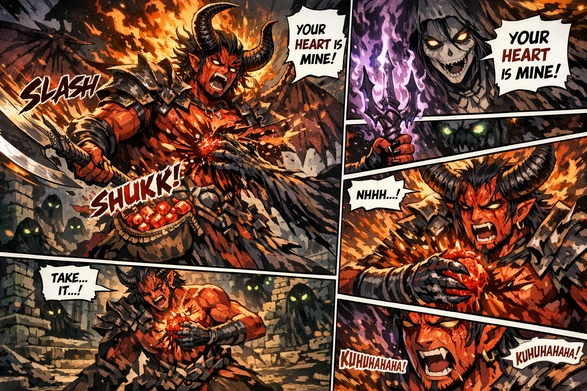
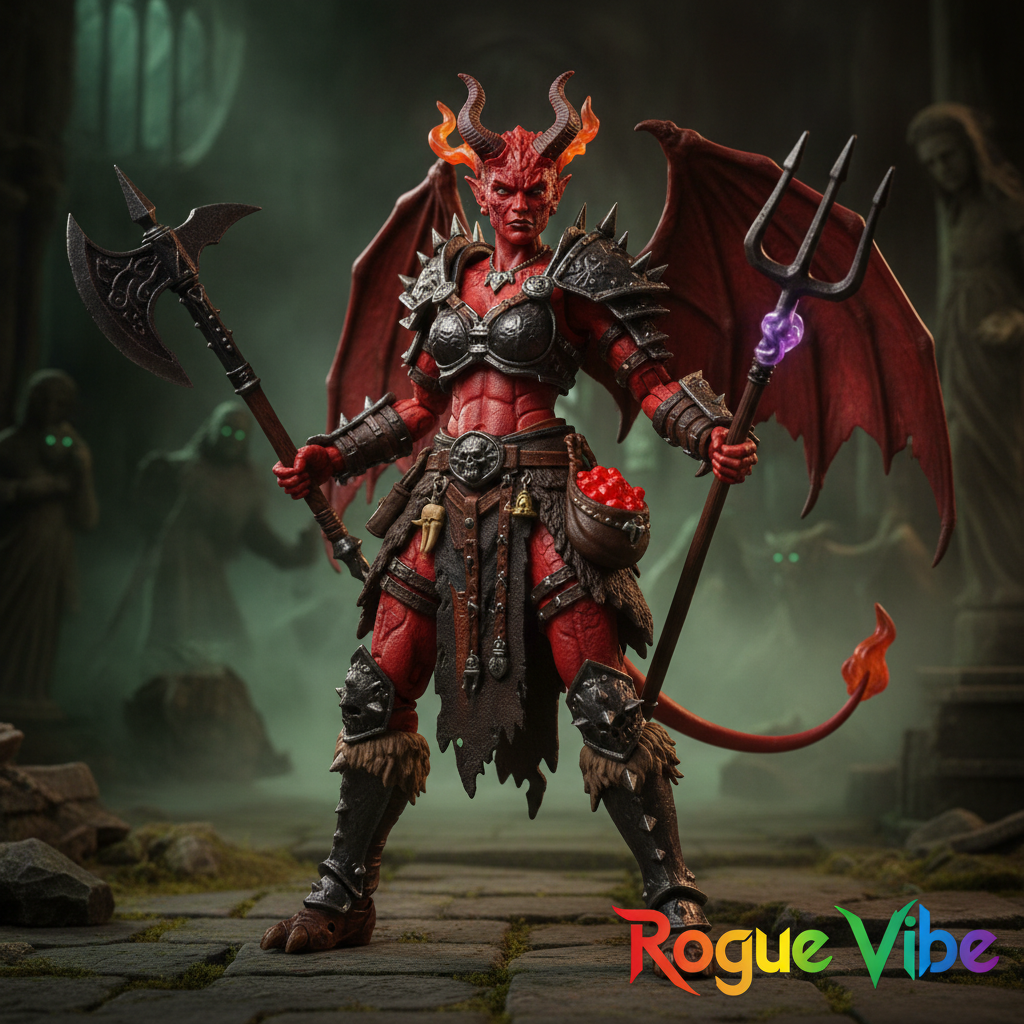
A towering red-skinned warrior stands upon moss-covered temple stones, crowned with curling black horns and wreathed in orange flame. Batlike wings spread behind his jagged armor, while one hand grips a crescent axe and the other holds a trident glowing with violet fire. A pouch of brilliant red gemstones hangs at his waist, and shadowy, green-eyed spirits watch from the ruined hall.

He was once **Raktavira**, a mortal war-chief from the vanished city of Karkotaka, said to have stood somewhere beyond the Himalayas in the late Iron Age—though certain manuscripts place it not on Earth at all, but on **Bhairava-kshetra**, a lower plane where the dead, demons, and forgotten gods barter for memory.

In his youth, Raktavira was not cruel. He was famous for giving away his food during famines, opening his fortress to refugees, and melting down his own weapons to make plowshares. His mother taught him that *daan*—generosity freely offered—was not merely charity, but a sacred duty. She compared it to the legendary generosity of Karna, who gave even when giving wounded him, and to the open-handed hospitality of an Indian village where a stranger is fed before questions are asked.

Raktavira took this lesson literally. Every traveler received shelter. Every beggar received coin. Every defeated enemy was released if they swore not to prey upon the helpless. For a time, his kingdom flourished. The poor called him guardian, and even rival princes spoke his name with respect.

But generosity without discernment became his first great failure.

A beautiful ascetic came to his gates carrying a begging bowl. She asked for a single red gem from the pouch at his belt. Raktavira recognized her as one of the hungry spirits of Bhairava-kshetra, yet pride urged him to prove that his giving had no limits. He handed her the gem.

The spirit returned the next night, asking for ten.

Then a hundred.

Each time, Raktavira gave more, believing refusal would make him selfish. Meanwhile, his soldiers went unpaid, his granaries emptied, and his people began to starve. When his counselors begged him to preserve the kingdom, he accused them of having small hearts. At last, the spirit revealed herself as **Kshudha**, the Hunger Below, and swallowed the city’s stores, treasures, and memories.

Raktavira fought her with the axe and trident seen in the image, but weapons could not defeat a hunger he had fed. In the final battle, he offered his own heart. Kshudha accepted—but generosity transformed him rather than destroying him. He awoke as a demon-lord, bound to guard the ruins of Karkotaka and to test every soul that entered.

Now he asks travelers three questions:

What can you give without making another dependent?

What must you keep so that you can continue to serve?

And when you give, do you seek to relieve suffering—or to be praised for your virtue?

Those who answer wisely receive a red gemstone, which becomes food, medicine, or shelter when they return to the living world. Those who boast of their goodness are given everything they request until they become as empty as Raktavira once was.

His morality is therefore neither a celebration nor a condemnation of generosity. Like the old teachings surrounding *daan*, it insists that giving must be joined to wisdom, responsibility, and compassion. Raktavira became monstrous not because he gave, but because he confused limitless giving with goodness. In Colorado’s high country, where survival has long depended on sharing water, firewood, and a place beside the campfire, the same lesson might be phrased more simply: help your neighbor—but do not burn down the whole shelter to prove you care.
∨∨ more ∨∨
You made it to the bottom. Now dance!


owned and operated by: RPN Omnigalactic Insitutution as of: 2026/10/14: 06:25 in 0 ms
Enter Code
Login with Account