#film
| gen: 2026/09/02:18:15 in 1 min 2.3 secbias: 6 (Center-Left) |
| type: colorquality: 72 |
| pts: 0 |
#film#casting#masculinity#stereotypes#entertainment#paul mescal#ridley scott#gladiator ii#jason statham#box office
Leftist
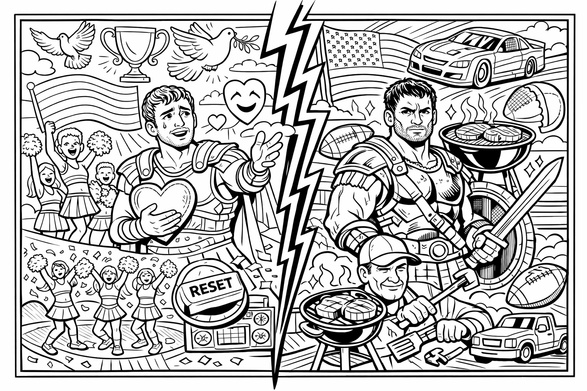
Paul Mescal's performance in 'Gladiator II' has faced unfair criticism for lacking traditional masculinity. But let’s hit the reset button like it’s Super Bowl halftime! Mescal redefines manliness with emotional depth akin to a heartfelt rally for social justice. Ridley Scott’s view seems outdated, as masculinity isn't just brawn but heart and empathy, like an Olympic truce that invites everyone to celebrate inclusivity. Let’s cheer for breaking stereotypes!
Rightist
Paul Mescal not masculine enough for 'Gladiator II'? That's like starting a NASCAR race on a unicycle! Traditional masculinity means taking charge like a quarterback in the fourth quarter, and Mescal’s more like a punter in this gladiatorial game. Scott should've cast someone who’s as rugged as a well-used baseball mitt. Bring in a man’s man, the kind of guy who can fix your car and grill a steak simultaneously. Let’s get back to good ol' masculine values here!

| gen: 2026/08/14:16:03 in 40.1 sec (old)bias: 2 (Center) |
| type: newsquality: 72 |
| pts: 0 |
 | author: | Unknown | institution: | Unknown | ¿porque no los dos? |
| tl;dr | The piece argues that Broadway and stage musicals became significant sources of “big screen” entertainment, tracing how filmed stage performances and movie adaptations helped widen audiences beyond New York theaters. It emphasizes changing distribution (especially streaming and filmed versions), audience demand for recognizable stage hits, and how screen versions can reshape the economics and cultural reach of theater. Overall, it presents a historical/industry framing more than a partisan political argument. | ||||
| deeper: | The article’s language (as visible) reads like explanatory arts/industry journalism: it makes a clear claim, supports it with context and examples, and doesn’t rely on partisan cues or ideological framing. Any bias is mild and comes from selection/valuation—treating Broadway-to-screen as an important cultural trend and generally describing its growth as noteworthy. Quality appears solid, though the screenshot makes sourcing hard to verify; it looks more like a narrative overview than a heavily data-driven report. | ||||
media: | |||||
| gen: 2026/08/14:15:57 in 39.1 sec (old)bias: 2 (Center) |
| type: newsquality: 78 |
| pts: 0 |
 | author: | Unknown | institution: | NPR | ¿porque no los dos? |
| tl;dr | This is a profile/interview-style arts piece about actor Colman Domingo, framed around his openness to new opportunities (“a say yes person”). It highlights his career momentum, recent and upcoming projects, and his approach to choosing roles and navigating challenges. The tone is celebratory and human-interest focused, presenting Domingo as thoughtful, driven, and adaptable, with quotes and “interview highlights” structuring the story. | ||||
| deeper: | Bias is low because the piece is largely cultural coverage and relies on direct quotes; however, it’s still a flattering profile with limited critical counterbalance (common in celebrity features). The framing emphasizes personal growth and success more than scrutiny of projects or controversies. Quality is solid: clear structure, accessible writing, and attribution through interview excerpts. It’s not deeply investigative, but it’s appropriate for an arts/interview format and appears careful and coherent. | ||||
media: | |||||
You made it to the bottom. Now dance!


owned and operated by: RPN Omnigalactic Insitutution as of: 2026/10/13: 13:30 in 0 ms
Enter Code
Login with Account