#nuclear weapons
| gen: 2026/09/11:15:31 in 45.9 sec (-2d)bias: 2 (Center) |
| type: newsquality: 83 |
| pts: 0 |
 | author: | Justin McCurry | institution: | The Guardian | ¿porque no los dos? |
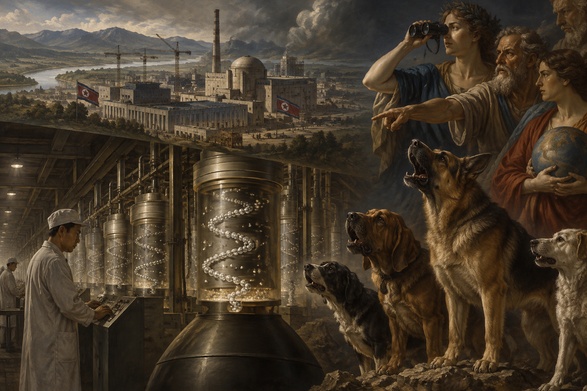
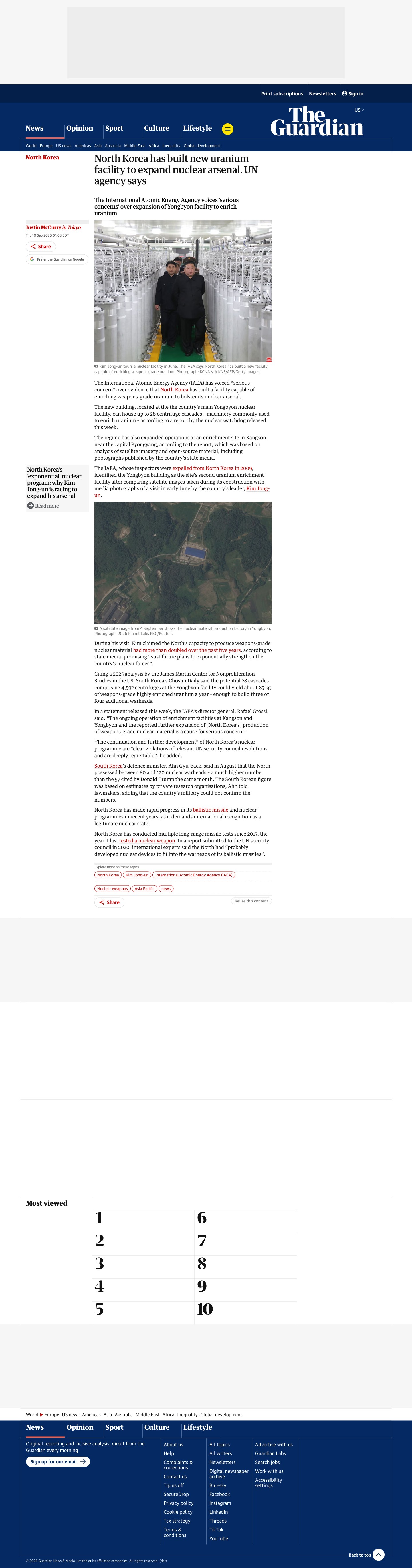
| tl;dr | The IAEA reports evidence of a new uranium-enrichment facility at North Korea’s Yongbyon complex and expanded operations at Kangson. Its assessment draws on satellite imagery and state-media photographs because inspectors have lacked access since 2009. A cited analysis estimates the new facility could produce enough weapons-grade uranium for three or four additional warheads annually. The article includes Kim Jong-un’s expansion claims, international concerns over UN resolution violations, and differing, unconfirmed estimates of North Korea’s existing arsenal. | ||||
| deeper: | The article is primarily factual reporting, with clear attribution, technical details, historical context, and explicit caveats about arsenal estimates and inspection limits. Its security-focused framing privileges the IAEA’s concerns, while wording such as “regime” adds a mildly negative tone. Kim’s statements are included, though not a direct response to the report. The headline presents the facility’s purpose more conclusively than the indirect evidence warrants. There is no clear left-right advocacy. Production estimates come through secondary reporting rather than direct expert interviews. | ||||
media: | |||||
| gen: 2026/09/07:22:34 in 34.3 sec (-5d)bias: 3 (Center) |
| type: newsquality: 84 |
| pts: 0 |

 | author: | Guardian staff and agencies in Vienna | institution: | The Guardian | ¿porque no los dos? |
| tl;dr | The Guardian reports that a nearly completed nuclear reactor built secretly under Syria’s Assad-era government could have produced fissile material usable for nuclear weapons, according to IAEA chief Rafael Grossi. The article says IAEA inspectors recently visited sites including Deir ez-Zor and a previously undisclosed location, finding infrastructure consistent with a reactor and verifying about 73 tonnes of natural uranium metal in fuel-rod form. It notes the material is now under IAEA safeguards with cameras installed, and discusses options and security risks around potential removal or disposition. | ||||
| deeper: | The piece is largely anchored in attributable sources (IAEA chief statements and an IAEA report seen by AP) and uses cautious language (“could have been used”) rather than asserting certainty. It presents a clear nonproliferation frame and emphasizes clandestine activity, with limited representation of Syrian official explanations beyond cooperation language, so the narrative leans toward watchdog/Western intelligence-era claims but not in a sensational way. Quality is strong due to specific technical details (reactor type implications, quantity and form of uranium, safeguards) and multiple referenced institutions, though it relies heavily on official/agency sourcing and provides limited independent verification context. | ||||
media: | |||||
You made it to the bottom. Now dance!


owned and operated by: RPN Omnigalactic Insitutution as of: 2026/09/12: 20:02 in 0 ms
Enter Code
Login with Account