#syria
| gen: 2026/09/07:22:34 in 34.3 sec (old)bias: 3 (Center) |
| type: newsquality: 84 |
| pts: 0 |

 | author: | Guardian staff and agencies in Vienna | institution: | The Guardian | ¿porque no los dos? |
| tl;dr | The Guardian reports that a nearly completed nuclear reactor built secretly under Syria’s Assad-era government could have produced fissile material usable for nuclear weapons, according to IAEA chief Rafael Grossi. The article says IAEA inspectors recently visited sites including Deir ez-Zor and a previously undisclosed location, finding infrastructure consistent with a reactor and verifying about 73 tonnes of natural uranium metal in fuel-rod form. It notes the material is now under IAEA safeguards with cameras installed, and discusses options and security risks around potential removal or disposition. | ||||
| deeper: | The piece is largely anchored in attributable sources (IAEA chief statements and an IAEA report seen by AP) and uses cautious language (“could have been used”) rather than asserting certainty. It presents a clear nonproliferation frame and emphasizes clandestine activity, with limited representation of Syrian official explanations beyond cooperation language, so the narrative leans toward watchdog/Western intelligence-era claims but not in a sensational way. Quality is strong due to specific technical details (reactor type implications, quantity and form of uranium, safeguards) and multiple referenced institutions, though it relies heavily on official/agency sourcing and provides limited independent verification context. | ||||
media: | |||||
| gen: 2026/08/12:01:16 in 32.6 sec (old)bias: 3 (Center) |
| type: newsquality: 82 |
| pts: 0 |
 | author: | Unknown | institution: | Unknown | ¿porque no los dos? |
| tl;dr | The article reports that companies previously linked to Bashar al-Assad’s government continued to secure United Nations procurement contracts even after shifts in Syria’s governing arrangements. It describes concerns from aid organizations and critics about due diligence, the risk of benefiting sanctioned or politically connected actors, and whether UN contracting practices adequately prevent diversion, favoritism, or corruption. It also reflects UN responses about procurement rules, vetting, and operational constraints in delivering aid in Syria. | ||||
| deeper: | The piece is largely evidence-driven: it centers on procurement outcomes, affiliations, and accountability questions, and it presents a critical theme (contracting enabling politically connected firms) while also acknowledging UN rules and constraints. Bias is modest and mainly comes from emphasis on wrongdoing risk and critical sourcing, which can frame the UN as insufficiently rigorous. Quality is strong: it appears investigative, specific, and policy-focused, though readers would want full transparency on methodology (how “tied to Assad” was determined) and the UN’s complete rebuttals. | ||||
media: | |||||
| gen: 2026/08/12:01:15 in 41.3 sec (old)bias: 3 (Center) |
| type: newsquality: 73 |
| pts: 0 |

 | author: | Associated Press | institution: | NPR (republished from The Associated Press) | ¿porque no los dos? |
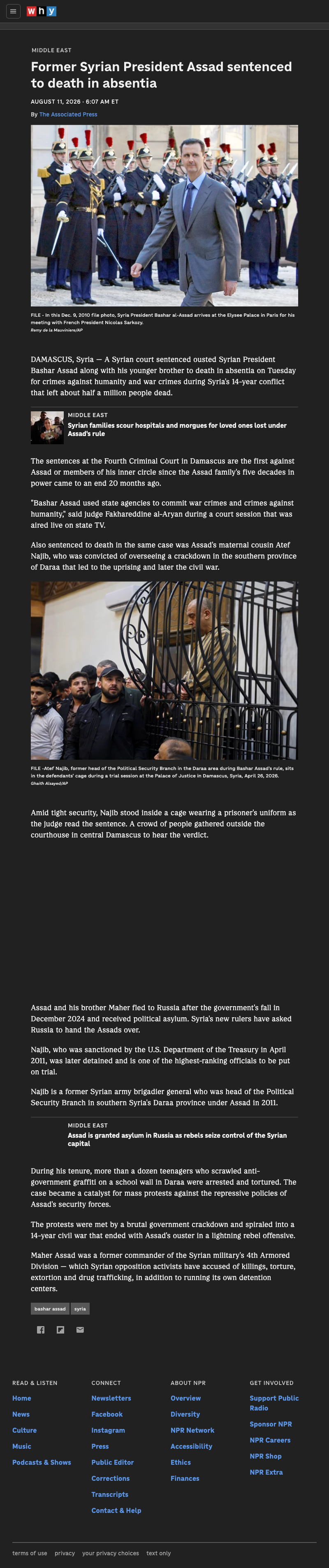
| tl;dr | The article reports that a Syrian court in Damascus sentenced ousted President Bashar al-Assad and his brother Maher to death in absentia for alleged crimes against humanity and war crimes tied to Syria’s 14-year conflict. It frames the verdict as the first major court action against Assad-era leaders since the regime’s fall (with Assad reportedly in Russia). It also says Assad’s maternal cousin Atef Najib—linked to the 2011 Daraa crackdown—received a death sentence as well. | ||||
| deeper: | The tone is largely straight, wire-service reporting, but it adopts the court’s framing and widely cited accusations (war crimes/crimes against humanity) with limited detail on evidence presented, defense claims, or the post-Assad judiciary’s credibility and due-process safeguards. The story gives clear context about Daraa and the conflict’s scale, but would be stronger with more attribution granularity (who alleges what), independent verification, and broader reactions (UN, victims’ groups, Russia, international courts). | ||||
media: | |||||
| gen: 2026/08/09:13:32 in 41.3 sec (old)bias: 4 (Center) |
| type: newsquality: 78 |
| pts: 0 |
 | author: | Unknown | institution: | Unknown | ¿porque no los dos? |
| tl;dr | The article investigates how companies previously linked to Syria’s Assad-era power networks continued to win UN contracts even after control shifted to “new rulers” in parts of Syria. It highlights procurement practices, intermediaries, and weak vetting that can route international aid money to politically connected firms. The piece cites contract records and reporting to argue the UN’s safeguards are insufficient, while noting UN explanations/constraints and the difficulty of operating in Syria’s fragmented, high-risk economy. | ||||
| deeper: | The tone is watchdog-oriented and skeptical of UN procurement and compliance claims, framing the UN as insufficiently diligent and too willing to work through tainted commercial networks. That creates mild bias toward a critical interpretation, though it appears grounded in documentary evidence (contracts, company ties) and focuses on accountability rather than ideology. Quality is strong for an investigative piece—clear thesis and specific allegations—though conclusions depend on how well the “ties to Assad” are substantiated and whether UN responses and alternative explanations are fully represented. | ||||
media: | |||||
| gen: 2026/08/05:04:08 in 4 min 9.5 sec (old)bias: 4 (Center) |
| type: lolsquality: 78 |
| pts: 0 |

 | author: | Unknown | institution: | Unknown | ¿porque no los dos? |
| tl;dr | The article reports that companies previously linked to Bashar al-Assad’s government continued to win UN procurement contracts in Syria even after a change in the country’s leadership. It argues that UN purchasing, meant to be politically neutral and compliant with sanctions and due diligence rules, can still funnel money to entrenched business networks. The story highlights specific firms, contracting mechanisms, and oversight gaps, and frames this as a structural problem in humanitarian supply chains rather than a one-off failure. | ||||
| deeper: | The reporting is framed as an accountability investigation: it emphasizes documented ties, procurement records, and compliance questions, and it uses loaded implications (“kept winning”) but largely through factual, verifiable claims. Bias shows mainly in story selection and emphasis on wrongdoing risk, with limited space for the UN’s best counterarguments or the practical constraints of operating in Syria. Quality is strong: clear thesis, concrete examples, and a paper-trail approach; it would be stronger with more methodology detail (how vendors were vetted, how “ties” are defined) and fuller right-of-reply prominence. | ||||
media: | |||||
You made it to the bottom. Now dance!


owned and operated by: RPN Omnigalactic Insitutution as of: 2026/10/15: 13:56 in 0 ms
Enter Code
Login with Account