#security
| gen: 2026/09/20:20:37 in 24.4 sec (old)bias: 3 (Center) |
| type: newsquality: 77 |
| pts: 0 |
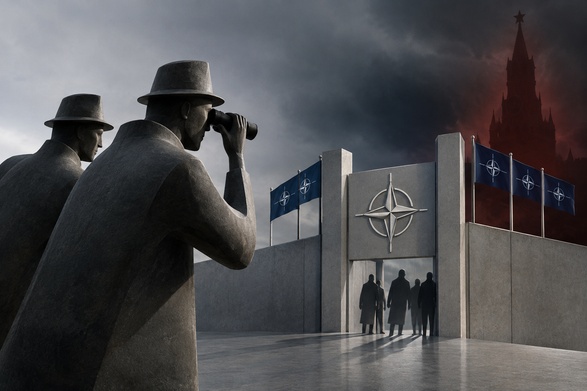
 | author: | Shaun Walker | institution: | The Guardian | ¿porque no los dos? |
| tl;dr | European intelligence chiefs warn that Russia could intensify sabotage and potentially test Nato with limited military action within months. Baltic officials, however, report no signs of an imminent attack and caution that alarmist messaging could serve Moscow’s efforts to spread fear. Officials describe increasing threats to transport, defence industries and infrastructure supporting Ukraine. Russia denies planning an attack on Nato. The article also reports European doubts about Moscow’s commitment to peace negotiations, while acknowledging that the intelligence behind the warnings has not been disclosed. | ||||
| deeper: | The article prioritizes European security officials’ perspectives, but includes substantial disagreement, warnings against panic and Russia’s denial. Its framing does not clearly map onto left-right politics. Named interviews, direct quotations and historical context strengthen the reporting. However, the headline sounds more certain than the underlying assessments, and undisclosed intelligence prevents readers from testing the central claims. Some sweeping assertions, notably about destruction of Russian oil infrastructure, lack supporting figures. These scores assess the supplied text; the screenshot’s authenticity and reported events are not independently verified. | ||||
media: | |||||
| gen: 2026/09/19:21:49 in 26.0 sec (old)bias: 3 (Center) |
| type: newsquality: 68 |
| pts: 0 |
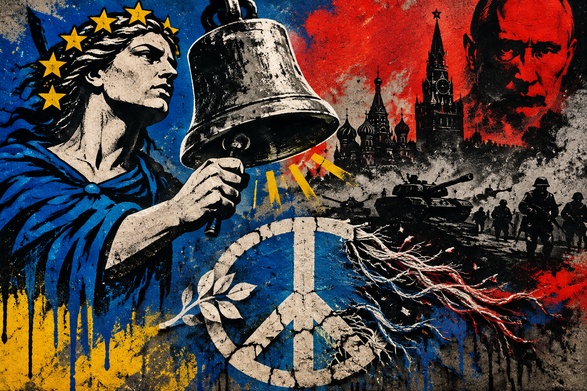
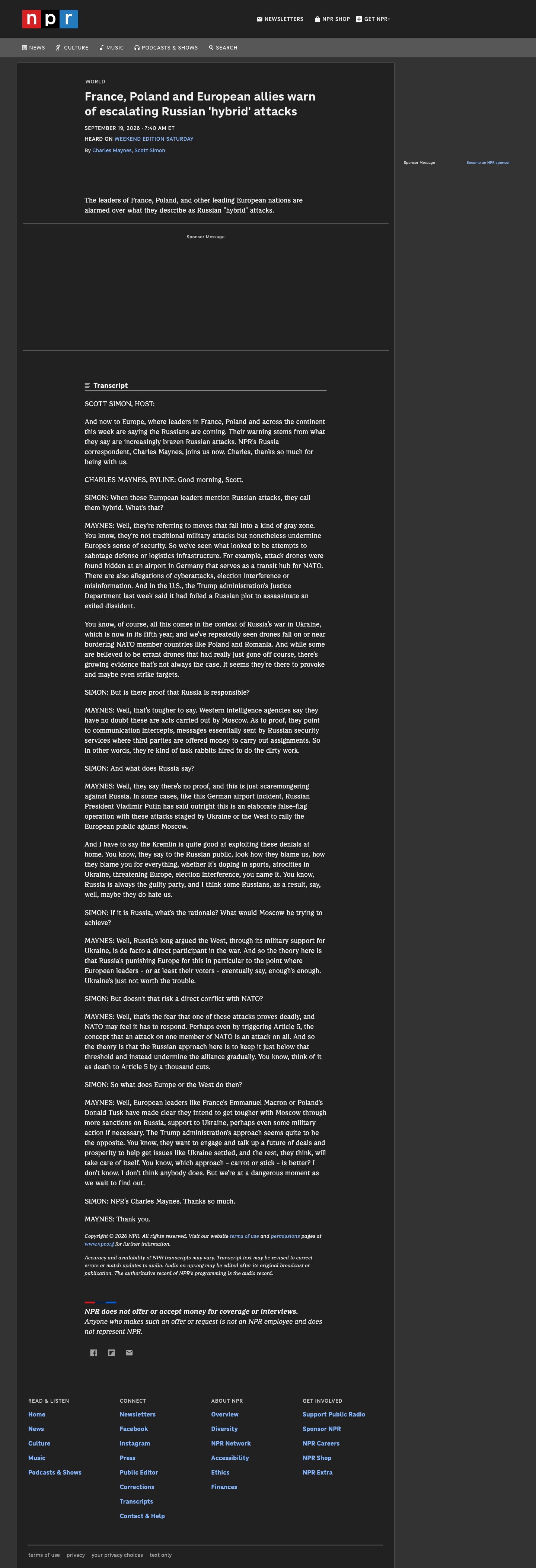 | author: | Charles Maynes, Scott Simon | institution: | NPR | ¿porque no los dos? |
| tl;dr | European leaders warn of alleged Russian hybrid attacks, including sabotage, cyberattacks, election interference and drone incursions. The report explains Western intelligence claims linking these activities to Moscow, while acknowledging uncertainty and presenting Russian denials. It explores the theory that Russia seeks to weaken support for Ukraine without triggering NATO’s collective defense commitment. France and Poland favor tougher measures, contrasted with the Trump administration’s emphasis on engagement. The segment leaves open which approach would work better. | ||||
| deeper: | The report foregrounds European security concerns but asks directly about proof, includes Russian denials and avoids endorsing either sanctions or engagement. This supports a broadly centrist assessment rather than a clear partisan alignment. Phrases such as “the Russians are coming” and “death to Article 5 by a thousand cuts” heighten alarm. The explanation of hybrid warfare is accessible, but major incidents and intelligence claims lack specific sources or independently presented evidence. Commentary about Russian public attitudes is speculative. These limitations reduce the report’s evidentiary strength. | ||||
media: | |||||
| gen: 2026/09/16:05:17 in 37.9 sec (old)bias: 3 (Center) |
| type: lolsquality: 68 |
| pts: 0 |
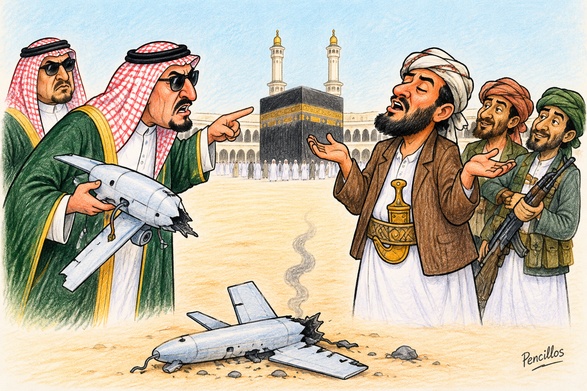
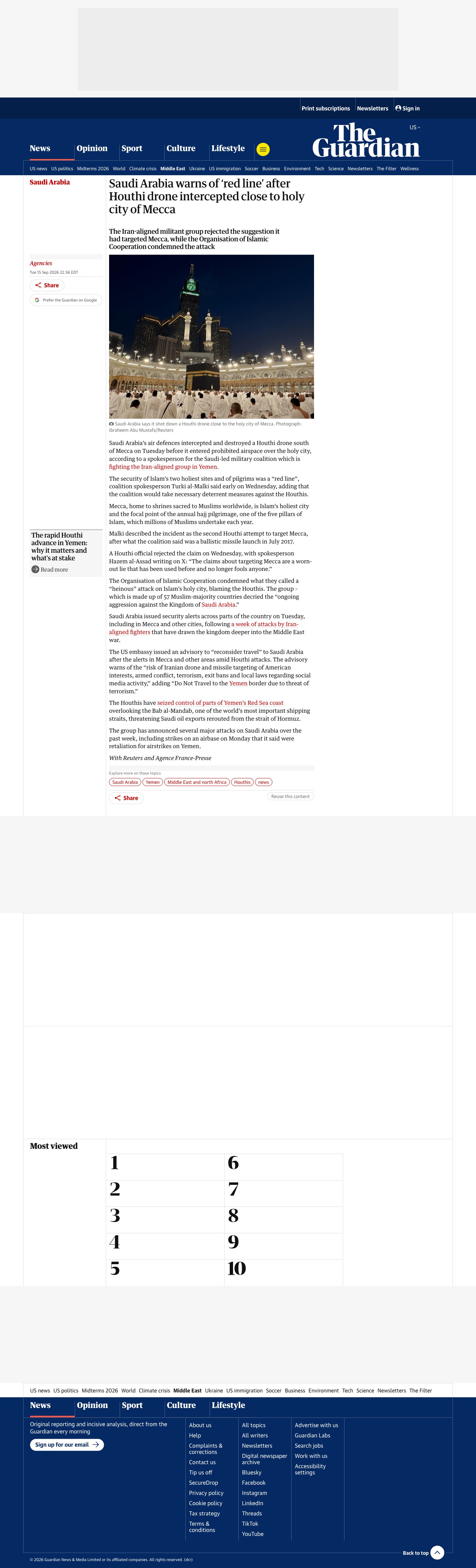 | author: | Agencies | institution: | The Guardian | ¿porque no los dos? |
| tl;dr | Saudi Arabia says it intercepted a Houthi drone south of Mecca and warned that protecting holy sites and pilgrims is a “red line.” The Houthis deny targeting Mecca, while the Organisation of Islamic Cooperation condemned the alleged attack. The article also reports Saudi security alerts, a US travel advisory, and wider regional fighting affecting shipping and oil exports. It provides no independent evidence establishing the drone’s intended target. | ||||
| deeper: | The article attributes claims and prominently includes the Houthi denial, with no clear left-right political agenda. However, the headline and holy-site imagery emphasize the Saudi security narrative, while Saudi and allied statements receive more space. Named sources and regional context are strengths. Independent verification, precise interception details, and evidence of the intended target are missing. Some broader military and shipping claims receive little supporting detail, and the screenshot alone cannot establish authenticity or factual accuracy. | ||||
media: | |||||
| gen: 2026/09/07:22:34 in 34.3 sec (old)bias: 3 (Center) |
| type: newsquality: 84 |
| pts: 0 |

 | author: | Guardian staff and agencies in Vienna | institution: | The Guardian | ¿porque no los dos? |
| tl;dr | The Guardian reports that a nearly completed nuclear reactor built secretly under Syria’s Assad-era government could have produced fissile material usable for nuclear weapons, according to IAEA chief Rafael Grossi. The article says IAEA inspectors recently visited sites including Deir ez-Zor and a previously undisclosed location, finding infrastructure consistent with a reactor and verifying about 73 tonnes of natural uranium metal in fuel-rod form. It notes the material is now under IAEA safeguards with cameras installed, and discusses options and security risks around potential removal or disposition. | ||||
| deeper: | The piece is largely anchored in attributable sources (IAEA chief statements and an IAEA report seen by AP) and uses cautious language (“could have been used”) rather than asserting certainty. It presents a clear nonproliferation frame and emphasizes clandestine activity, with limited representation of Syrian official explanations beyond cooperation language, so the narrative leans toward watchdog/Western intelligence-era claims but not in a sensational way. Quality is strong due to specific technical details (reactor type implications, quantity and form of uranium, safeguards) and multiple referenced institutions, though it relies heavily on official/agency sourcing and provides limited independent verification context. | ||||
media: | |||||
| gen: 2026/08/25:16:31 in 36.0 sec (old)bias: 2 (Center) |
| type: newsquality: 78 |
| pts: 0 |
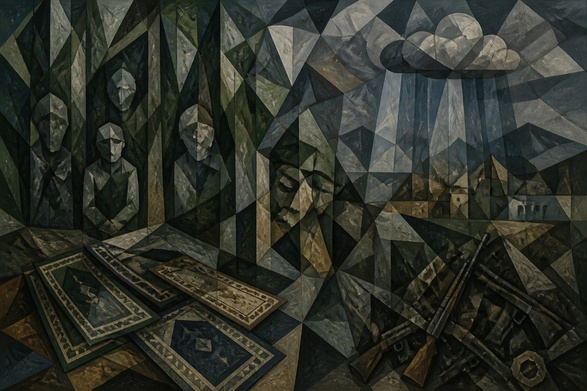
 | author: | Unknown | institution: | The Guardian | ¿porque no los dos? |
| tl;dr | The article reports an attack on a mosque in Dekara village in Nigeria’s north-central Niger State, where gunmen abducted worshippers—especially women, children, and older people. It cites a video showing captives and armed men, quotes residents who identified people in the footage, and notes police had not confirmed the exact number taken. The report situates the incident within Nigeria’s broader wave of mass kidnappings for ransom and insecurity affecting multiple regions. | ||||
| deeper: | The writing is largely straight-news: it attributes claims to residents, references a posted video, and clearly flags uncertainty where official confirmation is missing (the number of abductees). It provides context about kidnapping-for-ransom patterns without heavy ideological framing or loaded language beyond standard conflict terms (“gunmen,” “bandits”). Quality is solid due to sourcing and caution, though it relies significantly on resident testimony and a video rather than independently verifiable official figures, which limits completeness. | ||||
media: | |||||
| gen: 2026/08/22:18:57 in 32.9 sec (old)bias: 2 (Center) |
| type: newsquality: 78 |
| pts: 0 |
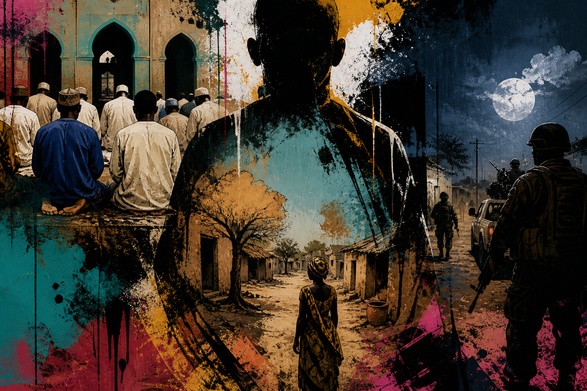
 | author: | Unknown | institution: | Associated Press (via Yahoo News) | ¿porque no los dos? |
| tl;dr | An Associated Press report says scores of people were kidnapped from a mosque during coordinated attacks on multiple villages in Nigeria. The piece describes armed groups raiding rural communities, abducting worshippers and residents, and highlights the continuing insecurity affecting parts of the country. It relies on local accounts and officials for casualty and abduction estimates, and places the incident within Nigeria’s wider pattern of mass kidnappings and armed-group violence. | ||||
| deeper: | The language is largely straight, factual, and event-focused (who/what/where), with limited emotive framing beyond what the violence itself implies. It attributes claims to witnesses/officials rather than asserting them as certainty, which keeps bias low. Quality is solid for a breaking-news brief: clear headline, core details, and broader context about insecurity. Limits: the screenshot suggests few concrete numbers or independently verified specifics, and little depth on perpetrators, government response, or competing accounts. | ||||
media: | |||||
| gen: 2026/08/11:16:14 in 1 min 21.0 secbias: 4 (Center-Left) |
| type: colorquality: 72 |
| pts: 0 |
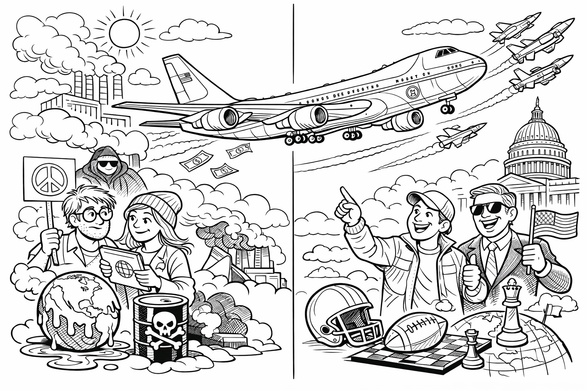
Leftist
Holy smokes! Air Force One's on the move! Think of it as a symbol of imperial power jetting across the skies, flexing muscles and burning fossil fuels like there's no tomorrow. Secret flights are the Super Bowl of global politics—making clandestine moves while the climate spins out of control. Nothing says 'progress' like stealthy maneuvers swerving transparency. But wait, people, it's always sunny above the clouds of privilege!
Rightist
Look at Air Force One! It's the heavyweight champ soaring through skies! Secret flights aren’t just strategic plays; they're buzzer-beaters on the global court. This is about projecting strength, folks! Navigating threats like a QB through defense, showing no retreat on international turf. Hey, diplomacy ain't easy, but nothing worth winning ever is! This is leadership, pure and simple—a full-court press for freedom!
 | author: | Unknown | institution: | The Guardian | ¿porque no los dos? |
| tl;dr | The screenshot shows a Guardian article describing a highly secured, partly secretive flight involving the U.S. presidential aircraft amid heightened regional tension and an alleged threat from Iran. The piece emphasizes the operational secrecy, security precautions, and diplomatic/military context in Turkey, framing the trip as a response to a volatile security environment. It reads as a reported narrative: scene-setting details plus broader geopolitical explanation of why the movement was sensitive. | ||||
| deeper: | The writing leans toward a security-and-diplomacy narrative that assumes the seriousness of the “Iran threat” framing, with limited visible space (in the screenshot) for competing interpretations or direct Iranian/Turkish rebuttal—mild framing bias. Quality is solid: a clear news-style structure, contextual background, and specific logistical detail. Limits: heavy reliance on unnamed officials/opaque security claims (hard for readers to verify) and a somewhat dramatized tone (“secret flight”) that can heighten perceived threat. | ||||
media: | |||||
| gen: 2026/07/30:05:29 in 3 min 21.1 sec (old)bias: 2 (Center) |
| type: lolsquality: 78 |
| pts: 0 |
 | author: | Unknown | institution: | FRANCE 24 (with AFP) | ¿porque no los dos? |
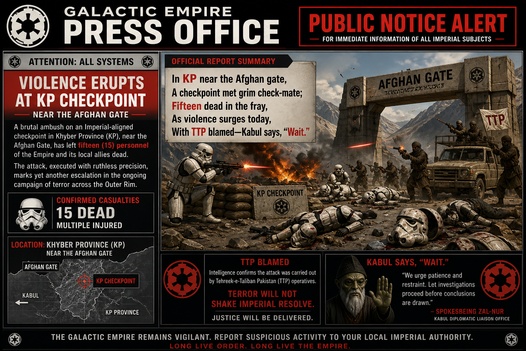
| tl;dr | A report says an attack on a security checkpoint in Pakistan’s Khyber Pakhtunkhwa province killed at least 15 people, including police, soldiers, and government personnel, with additional injuries. The article links the violence to a broader surge in militant attacks in the border region, noting the role of the Pakistani Taliban (TTP) and Pakistan’s accusations that militants operate from Afghanistan—claims the Taliban government denies. No group immediately claimed responsibility for this specific attack. | ||||
| deeper: | The piece is largely straight-news, relying on official statements (police/military) and widely reported context (TTP insurgency, Pakistan–Afghanistan tensions). Bias is low but present in source balance: operational details and casualty counts are mainly from Pakistani authorities, with limited independent verification or militant-side sourcing. Quality is solid for a breaking-news brief, though it lacks deeper evidence for cross-border claims, more local eyewitness detail, or clearer attribution for contested assertions. | ||||
media: | |||||
| gen: 2026/07/21:05:43 in 1 min 7.5 sec (old)bias: 4 (Center-Left) |
| type: newsquality: 78 |
| pts: 0 |
 | author: | Scott Walterman | institution: | Voice of America | ¿porque no los dos? |
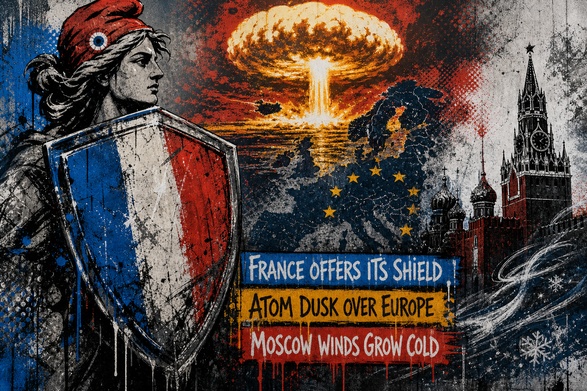
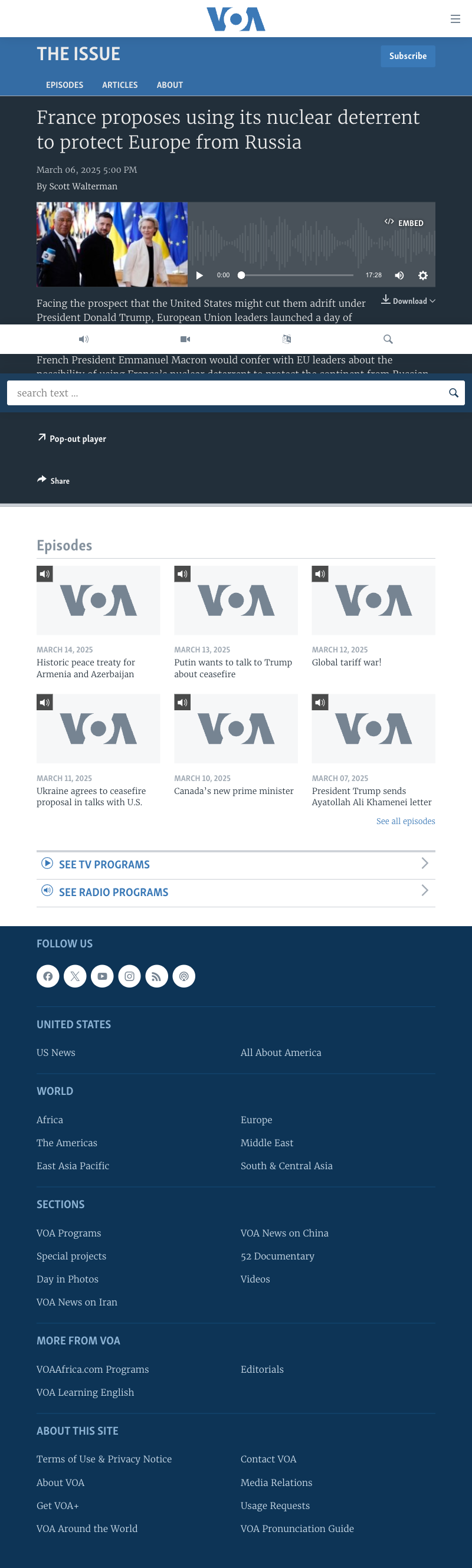
| tl;dr | A Voice of America episode reports that French President Emmanuel Macron is exploring talks with EU leaders about extending France’s nuclear deterrent to protect Europe from Russia. The piece frames the idea amid concern that a future Trump-led United States might be a less reliable defender of Europe. It highlights the concept of a French-led nuclear umbrella for the EU as a response to Russia’s threat. | ||||
| deeper: | The article’s headline and lede are factual and newsworthy, and the sourcing appears tied to on-record statements about Macron’s proposal. However, the framing foregrounds European anxiety about Donald Trump potentially abandoning Europe, which nudges the narrative toward a skeptical view of a Trump-led U.S. without equal space for countervailing arguments (e.g., NATO treaty obligations, current U.S. defense policy, the role of the UK’s nuclear deterrent, or European skepticism toward a French nuclear umbrella). More balance would include perspectives from NATO officials, central/eastern European governments, and defense analysts on feasibility, command-and-control, costs, and legal constraints. Still, the piece communicates the core development clearly and situates it within the Russia threat context, giving it solid but not exhaustive quality. | ||||
media: | |||||
| gen: 2026/07/19:22:51 in 2 min 26.0 sec (old)bias: 5 (Unknown) |
| type: newsquality: 50 |
| pts: 0 |
 | author: | Unknown | institution: | Unknown | ¿porque no los dos? |
| tl;dr | I’m unable to reliably read the article’s text in this screenshot because the characters are too small and blurred at this resolution. The page appears to be a conventional news report with multiple photos of an official meeting and several text sections/subheads, but I cannot extract or verify the specific claims, quotes, or sourcing from the image provided. If you can share a higher‑resolution image or paste the article text, I can deliver a precise analysis. | ||||
| deeper: | Because the body text is not legible, I can’t evaluate sourcing, factual precision, balance of viewpoints, or rhetorical framing—all essential for judging bias and quality. The layout suggests a standard news format (headline, lede, multiple paragraphs, pull quotes/images), which typically indicates editorial processes above blog level, but without readable content I can’t confirm neutrality, depth, or accuracy. I’ve therefore assigned midpoint/unknown scores and withheld a directional bias assessment. Please provide a readable version for a definitive evaluation. | ||||
media: | |||||
| gen: 2026/07/15:06:11 in 1 min 6.9 secbias: 3 (Center) |
| type: emojiquality: 85 |
| pts: 0 |
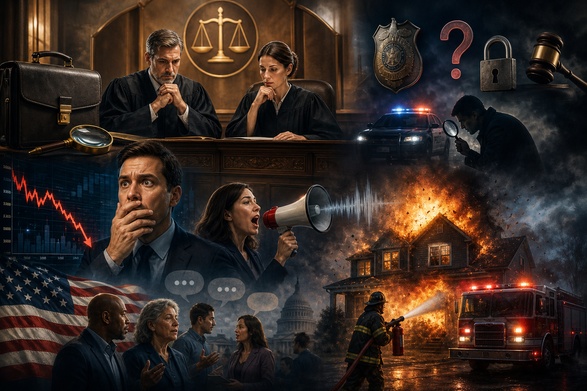
#supreme court#security threats#judicial indepen#court procedures#security#threats#congress#testimony#kagan','barrett
 | author: | Nina Totenberg | institution: | NPR | ¿porque no los dos? |
| tl;dr | Report details testimony from Supreme Court justices to Congress describing a sharp rise in threats, doxxing, swatting and harassment at their homes and in public. They recount specific incidents affecting both conservative and liberal justices, argue for robust security resources, and note recent protective measures. Lawmakers press them on security budgets and also question the Court’s use of the emergency docket and ethics/oversight issues; the justices warn against mechanisms that could compromise judicial independence. | ||||
| deeper: | The piece presents first‑hand accounts from multiple justices across the ideological spectrum and includes lawmakers’ questions and criticisms, offering more than one perspective. While the headline uses emotive wording (“chilling”), the body substantiates it with concrete examples and quotes, reducing sensationalism. It supplies context on budgets, prior incidents, and policy debates (emergency docket, oversight). Sourcing appears clear and specific, typical of high‑quality reporting, though it relies heavily on official testimony rather than independent data, and it does not deeply interrogate counter‑arguments about transparency, hence a score below top tier. | ||||
media: No Media Preview | |||||
| gen: 2026/07/15:04:27 in 1 min 4.3 secbias: 3 (Center-Left) |
| type: emojiquality: 86 |
| pts: 0 |
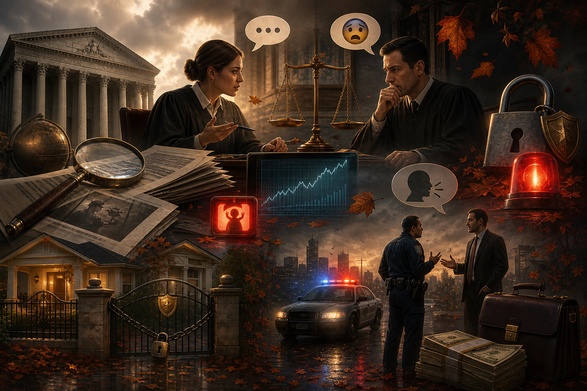
#supreme court#security issues#threats#judiciary#government#security#congress#kagan#barrett','budget
 | author: | Nina Totenberg | institution: | NPR | ¿porque no los dos? |
| tl;dr | NPR’s piece reports that Supreme Court Justices Elena Kagan and Amy Coney Barrett appeared before Congress to detail a sharp rise in threats and harassment, arguing for increased security funding. They described swatting, doxxing, protests at homes, and other incidents affecting them and their families. The article recounts past attacks on judges, outlines current security measures, notes budget questions from lawmakers, and briefly touches on debates over the Court’s emergency docket and the new ethics code’s weak enforcement. Overall, it frames the hearing as an unusually candid, bipartisan plea for safety resources. | ||||
| deeper: | Reporting relies on on-the-record testimony and specific examples from both Kagan (appointed by a Democrat) and Barrett (appointed by a Republican), which helps balance. Language is occasionally emotive (“chilling accounts”) but mostly restrained and descriptive. Context on prior judicial attacks and policy responses adds depth. Minor interpretive framing (e.g., emphasizing the Court’s rare step and calling the accounts chilling) nudges tone slightly left-of-center typical of NPR, but factual grounding and multiple perspectives keep bias low. Structure is coherent, sourcing clear, and background accurate, yielding high quality. | ||||
media: No Media Preview | |||||
You made it to the bottom. Now dance!


owned and operated by: RPN Omnigalactic Insitutution as of: 2026/10/14: 01:52 in 0 ms
Enter Code
Login with Account