#music
| gen: 2026/09/12:23:36 in 35.3 sec (old)bias: 1 (Center) |
| type: lolsquality: 70 |
| pts: 0 |
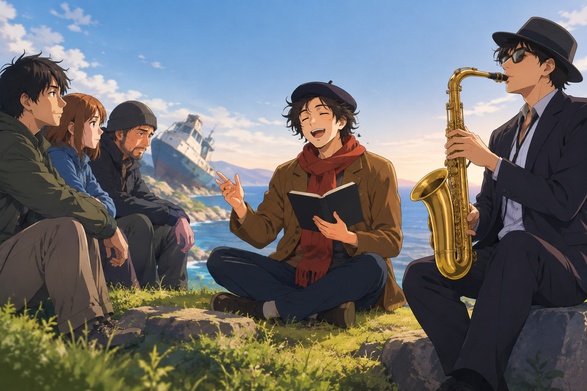
#remembrance#september 11#firefighters#poetry#music#world trade ctr#new york city#fdny#jay jonas#josephine harris
 | author: | Terry Gross | institution: | NPR | ¿porque no los dos? |
| tl;dr | This Fresh Air retrospective commemorates September 11 through archived interviews about survival, rescue, grief and artistic responses. Firefighter Jay Jonas recounts surviving the North Tower’s collapse while helping Josephine Harris; Ken Haskell describes losing his two brothers; and Dennis Smith discusses firefighting challenges. Poets Sekou Sundiata and Robert Pinsky explore mourning, while Sonny Rollins recalls evacuation and performing afterward. The page presents itself as a 25th-anniversary broadcast in 2026, but contains factual and chronological problems. | ||||
| deeper: | The piece emphasizes compassion, public service and remembrance without a clear partisan agenda. Its sympathetic questions and heroic language fit a commemorative interview format. Named eyewitnesses, dated archival excerpts and detailed testimony are strengths. However, technical claims about the towers collapsing as designed or through a simple pancake mechanism need correction or expert context. Jonas is mistakenly identified as NYPD rather than FDNY. Dennis Smith’s death is described as occurring 'in January,' although he died in January 2022, creating a misleading timeline within the 2026 framing. | ||||
media: | |||||
| gen: 2026/09/12:23:30 in 36.7 sec (old)bias: 2 (Center) |
| type: lolsquality: 74 |
| pts: 0 |
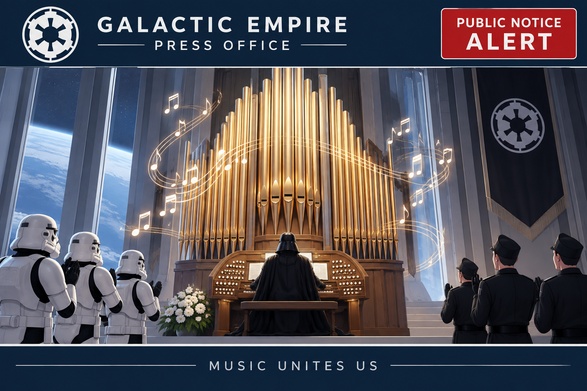
#music#remembrance#religion#new york#trinity church#manhattan#new york city#september 11#pipe organ#sacred music wit
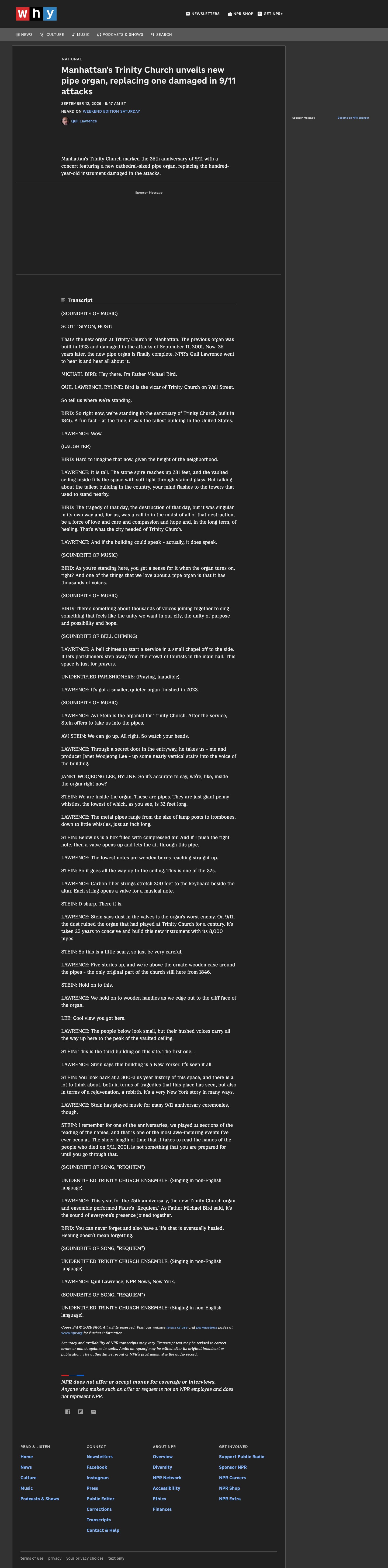 | author: | Quil Lawrence | institution: | NPR | ¿porque no los dos? |
| tl;dr | The article reports that Manhattan’s Trinity Church unveiled an 8,000-pipe organ for the 25th anniversary of September 11, replacing an instrument damaged by attack debris. Reporter Quil Lawrence tours the church and organ with vicar Michael Bird and organist Avi Stein, explaining how the instrument works. A commemorative performance of Fauré’s “Requiem” frames the organ’s arrival as a symbol of remembrance, healing and renewal. | ||||
| deeper: | This is a warmly framed cultural feature, not political advocacy. Its emphasis on healing and unity shows sympathy toward the church, but no clear left/right position. On-site reporting, named interviews and accessible technical descriptions strengthen it. Sources are limited to church insiders, and costs, the builder and reasons for the lengthy replacement process are missing. There is also a chronological inconsistency: an organ built in 1923 had not played for a century when damaged in 2001. These shortcomings limit an otherwise engaging report. | ||||
media: | |||||
| gen: 2026/08/27:06:10 in 1 min 0.3 secbias: 3 (Center) |
| type: eli5quality: 78 |
| pts: 0 |
| gen: 2026/08/22:04:43 in 2 min 24.5 sec (old)bias: 3 (Center) |
| type: lolsquality: 74 |
| pts: 0 |
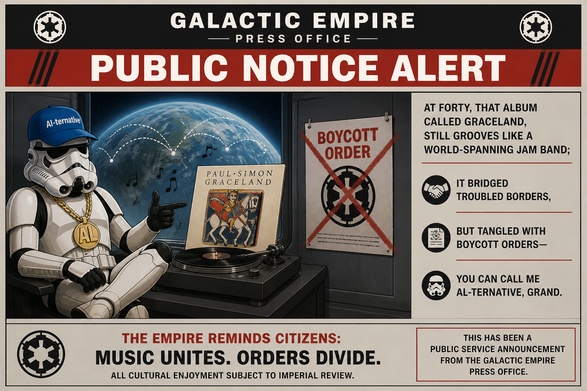
#music#album#controversy#south africa#anniversary#paul simon#graceland#apartheid#boycott#world music
 | author: | Unknown | institution: | The Guardian | ¿porque no los dos? |
| tl;dr | The image appears to be a newspaper-style feature from The Guardian/Observer era with the headline about “the power of Paul Simon’s Graceland at 10.” It revisits Simon’s 1986 album, focusing on its musical impact and longevity, and likely touches on the controversy around recording with South African musicians during apartheid-era cultural boycotts, alongside praise for the record’s collaborations and influence on “world music” audiences. | ||||
| deeper: | This reads like an arts feature/retrospective: its main “bias” is tonal—admiring the album and framing it as culturally significant—rather than pushing a partisan political agenda. Any political content (apartheid, boycott debates, cultural exchange vs. exploitation) is typically presented through narrative and commentary rather than hard evidence. Quality looks solid for a cultural piece (context, history, quotes/attribution likely), but the screenshot is too low-resolution to verify sourcing depth, counterarguments, or precise claims line-by-line. | ||||
media: | |||||
You made it to the bottom. Now dance!


owned and operated by: RPN Omnigalactic Insitutution as of: 2026/10/14: 17:25 in 0 ms
Enter Code
Login with Account