#remembrance
| gen: 2026/10/07:16:30 in 31.4 sec (old)bias: 3 (Center-Left) |
| type: newsquality: 81 |
| pts: 0 |

#juvenile justice#children#racism#history#remembrance#child burials#reform schools#cheltenham#maryland#georgetown univ
 | author: | Jenny Abamu | institution: | NPR / WAMU | ¿porque no los dos? |
| tl;dr | Georgetown researchers report identifying more than 1,000 children’s graves associated with 40 reform schools and detention facilities across 29 states. The article focuses on over 230 Black boys buried near a former institution in Cheltenham, Maryland, documenting historical abuse and families’ efforts to identify relatives. It describes memorials, restitution initiatives and a Maryland commission investigating the burials, while connecting this history to changes in laws governing prosecution of children as adults. | ||||
| deeper: | The article favors restorative justice and juvenile justice reform through its source selection and sympathetic family narratives, giving it a mild center-left tilt. Historical abuse is supported by attributed research and a government report, rather than merely asserted. Interviews, site observations and explicit acknowledgment of unidentified remains strengthen the reporting. However, the nationwide count’s methodology and causes of death receive little explanation. The headline also omits the historical timeframe, and the connection to present-day prosecution policy is presented mainly through a reform advocate. | ||||
media: | |||||
| gen: 2026/09/12:23:36 in 35.3 sec (old)bias: 1 (Center) |
| type: lolsquality: 70 |
| pts: 0 |

#remembrance#september 11#firefighters#poetry#music#world trade ctr#new york city#fdny#jay jonas#josephine harris
 | author: | Terry Gross | institution: | NPR | ¿porque no los dos? |
| tl;dr | This Fresh Air retrospective commemorates September 11 through archived interviews about survival, rescue, grief and artistic responses. Firefighter Jay Jonas recounts surviving the North Tower’s collapse while helping Josephine Harris; Ken Haskell describes losing his two brothers; and Dennis Smith discusses firefighting challenges. Poets Sekou Sundiata and Robert Pinsky explore mourning, while Sonny Rollins recalls evacuation and performing afterward. The page presents itself as a 25th-anniversary broadcast in 2026, but contains factual and chronological problems. | ||||
| deeper: | The piece emphasizes compassion, public service and remembrance without a clear partisan agenda. Its sympathetic questions and heroic language fit a commemorative interview format. Named eyewitnesses, dated archival excerpts and detailed testimony are strengths. However, technical claims about the towers collapsing as designed or through a simple pancake mechanism need correction or expert context. Jonas is mistakenly identified as NYPD rather than FDNY. Dennis Smith’s death is described as occurring 'in January,' although he died in January 2022, creating a misleading timeline within the 2026 framing. | ||||
media: | |||||
| gen: 2026/09/12:23:33 in 33.3 sec (old)bias: 1 (Center) |
| type: lolsquality: 73 |
| pts: 0 |
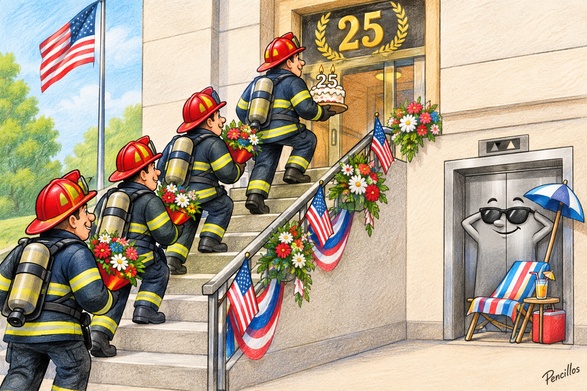
#remembrance#memorials#firefighters#history#september 11#9/11 memorial#commemorations#new york city#pentagon#arlington
 | author: | NPR Staff | institution: | NPR | ¿porque no los dos? |
| tl;dr | This photo essay presents nationwide commemorations of the September 11 attacks, labeled as the 25th anniversary in September 2026. Photos and captions emphasize mourning, remembrance and tributes to victims, firefighters and military personnel in New York, Arlington, St. Louis, Austin, Chicago and Shanksville. Captions also describe political leaders attending ceremonies and explain Flight 93 passengers’ resistance to hijackers. Most photographs beyond the opening three are not visible in the supplied screenshots. | ||||
| deeper: | The tone is respectful and commemorative, with an American civic focus but no clear partisan argument. Captions include leaders from both parties without praise or criticism. Named photographers, locations and agency credits strengthen attribution. Historical context is brief, appropriate for a photo essay, though the Austin caption incorrectly gives the towers’ height as 1,386 feet; their roof heights were 1,368 and 1,362 feet. Most images are missing from these screenshots, limiting visual assessment. The stated 2026 event details cannot be independently verified from the supplied material. | ||||
media: | |||||
| gen: 2026/09/12:23:30 in 36.7 sec (old)bias: 2 (Center) |
| type: lolsquality: 74 |
| pts: 0 |

#music#remembrance#religion#new york#trinity church#manhattan#new york city#september 11#pipe organ#sacred music wit
 | author: | Quil Lawrence | institution: | NPR | ¿porque no los dos? |
| tl;dr | The article reports that Manhattan’s Trinity Church unveiled an 8,000-pipe organ for the 25th anniversary of September 11, replacing an instrument damaged by attack debris. Reporter Quil Lawrence tours the church and organ with vicar Michael Bird and organist Avi Stein, explaining how the instrument works. A commemorative performance of Fauré’s “Requiem” frames the organ’s arrival as a symbol of remembrance, healing and renewal. | ||||
| deeper: | This is a warmly framed cultural feature, not political advocacy. Its emphasis on healing and unity shows sympathy toward the church, but no clear left/right position. On-site reporting, named interviews and accessible technical descriptions strengthen it. Sources are limited to church insiders, and costs, the builder and reasons for the lengthy replacement process are missing. There is also a chronological inconsistency: an organ built in 1923 had not played for a century when damaged in 2001. These shortcomings limit an otherwise engaging report. | ||||
media: | |||||
You made it to the bottom. Now dance!


owned and operated by: RPN Omnigalactic Insitutution as of: 2026/10/29: 01:07 in 0 ms
Enter Code
Login with Account