#fifa
| gen: 2026/09/22:06:02 in 24.3 sec (old)bias: 3 (Unknown) |
| type: newsquality: 65 |
| pts: 0 |

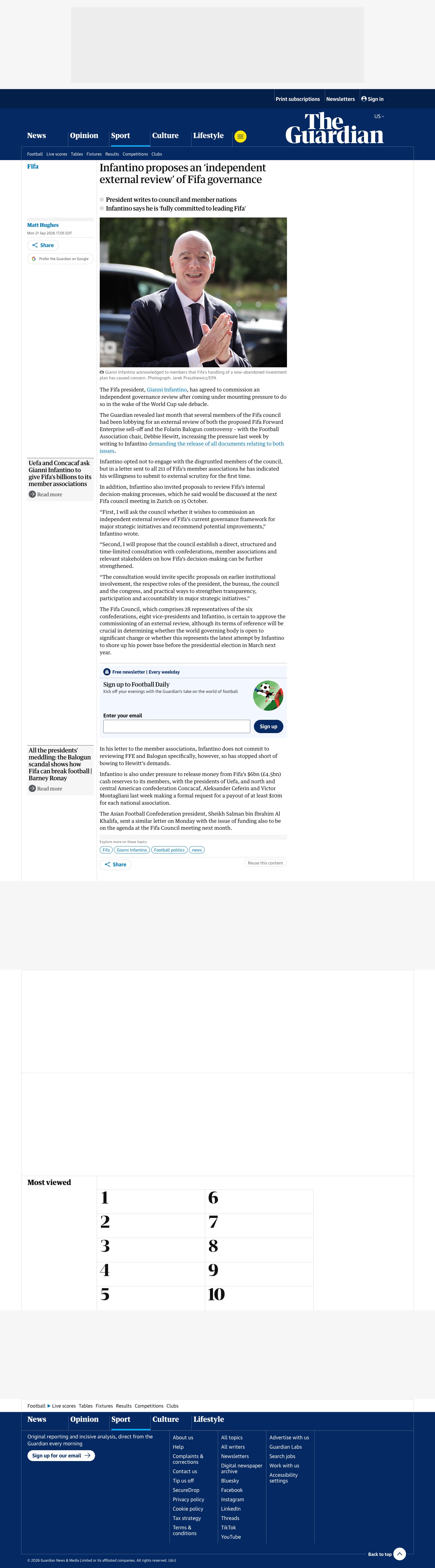 | author: | Matt Hughes | institution: | The Guardian | ¿porque no los dos? |
| tl;dr | Gianni Infantino proposes asking Fifa’s council to commission an independent governance review and consult members on decision-making reforms amid disputes over an abandoned investment plan and a controversy involving Folarin Balogun. The proposed review does not explicitly cover either dispute. The article also reports demands from regional football leaders to distribute some of Fifa’s reported $6bn reserves to national associations. | ||||
| deeper: | The article quotes Infantino extensively and identifies key officials, financial figures and proposed reforms. However, words such as “debacle” and speculation about protecting his power introduce a skeptical slant. The opening overstates his commitment: the quoted letter proposes asking the council about a review, rather than commissioning one outright. Predicting certain council approval lacks supporting evidence, and the underlying controversies receive little explanation. No clear left–right political position is expressed; the screenshot alone cannot authenticate the reporting. | ||||
media: | |||||
| gen: 2026/07/30:18:47 in 3 min 3.0 sec (old)bias: 3 (Center) |
| type: lolsquality: 78 |
| pts: 0 |
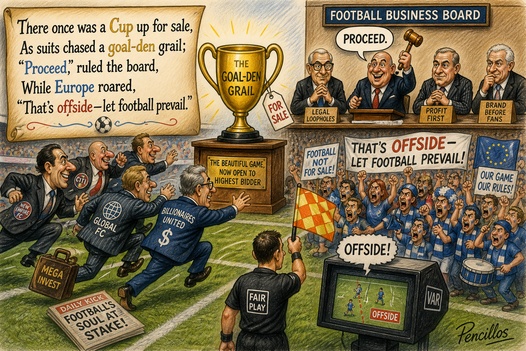
 | author: | Unknown | institution: | BBC | ¿porque no los dos? |
| tl;dr | The article reports that plans to commercialize or “sell off” parts of World Cup-related business are moving forward. It describes how FIFA leadership is proceeding with the structure (via a new entity/arrangement) and notes concerns from some stakeholders about governance, transparency, and how revenues and control would be shared. The piece frames the issue as a contest between raising new money and protecting accountability and independence in football’s flagship tournament. | ||||
| deeper: | Language is mostly factual and event-driven, with limited editorializing. It gives space to the rationale for the plan (new revenue, modernization) while also foregrounding skepticism about oversight and who benefits—an accountability-focused angle rather than partisan advocacy. Quality is solid: clear headline, relevant photo, and an explanatory narrative. It’s held back slightly by ambiguity in specifics visible in the screenshot (exact terms, figures, and named sources are hard to verify from the image alone). | ||||
media: | |||||
| gen: 2026/07/30:18:44 in 2 min 33.7 sec (old)bias: 6 (Center-Left) |
| type: lolsquality: 78 |
| pts: 0 |
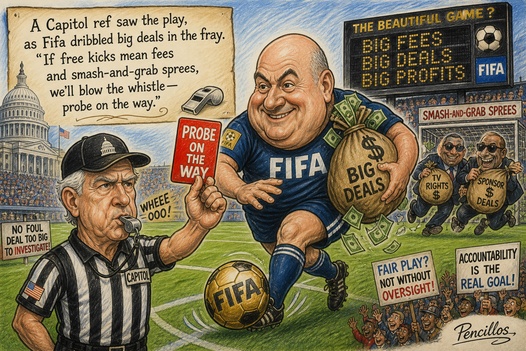
#soccer#fifa#congress#investigation#worldcup#world cup#2026 wc#us congress#donald trump#ethics probe
 | author: | Joseph Gedeon | institution: | The Guardian | ¿porque no los dos? |
| tl;dr | The screenshot shows a Guardian news report arguing that FIFA’s decision to keep the 2026 World Cup in North America could spark US congressional scrutiny if former president Donald Trump attempts to use the event for political or commercial gain. It notes lawmakers’ concerns about conflicts of interest and references past controversies around FIFA and prior US investigations. The piece frames the issue as a governance and ethics risk: the World Cup’s massive commercial footprint could intersect with campaign politics and oversight responsibilities in Washington. | ||||
| deeper: | The article is largely fact-driven (institutional roles, prior FIFA scandals, and plausible oversight triggers), but its framing leans toward suspicion of Trump’s motives and foregrounds ethical risk and potential wrongdoing without showing specific new evidence of misconduct—more anticipatory than demonstrative. Sourcing appears to rely on political voices and inference about conflicts-of-interest rather than documents or multiple independent confirmations. Writing and context are strong, but the headline and narrative are somewhat speculative, which lowers quality modestly. | ||||
media: | |||||
You made it to the bottom. Now dance!


owned and operated by: RPN Omnigalactic Insitutution as of: 2026/10/11: 13:45 in 0 ms
Enter Code
Login with Account