#investigation
| gen: 2026/09/07:22:29 in 35.2 sec (old)bias: 2 (Center) |
| type: newsquality: 78 |
| pts: 0 |


| gen: 2026/08/24:00:25 in 29.8 secbias: 3 (Unknown) |
| type: emojiquality: 55 |
| pts: 0 |
 | author: | Unknown | institution: | ProPublica | ¿porque no los dos? |
| tl;dr | The image appears to be a ProPublica investigative article page (dark theme) featuring at least one data visualization (a block/strip chart with green bars) and an embedded image of a heavily redacted document. However, the screenshot resolution is too low to reliably read the headline, key claims, names, numbers, or supporting evidence. Without legible text, I can’t accurately summarize the article’s findings or assess whether specific assertions are well-supported. | ||||
| deeper: | ProPublica typically publishes document-driven investigative reporting with data and source material, and the visible chart + redacted document suggest an evidence-forward approach. That said, this specific screenshot is not readable enough to verify what’s being argued, whether opposing perspectives are included, or whether the data is interpreted fairly—so any deeper bias/quality judgment would be speculative. If you share a link or a higher-resolution image, I can score this more precisely. | ||||
media: | |||||
| gen: 2026/08/24:00:22 in 33.3 secbias: 3 (Center-Left) |
| type: emojiquality: 78 |
| pts: 0 |
#public transit#art#funding#politics#community#propublica#investigation#accountability#publicsector#misconduct

| gen: 2026/08/20:05:08 in 30.4 sec (old)bias: 3 (Center) |
| type: newsquality: 78 |
| pts: 0 |

 | author: | Elise Gregg | institution: | NPR (Gulf States Newsroom) | ¿porque no los dos? |
| tl;dr | An NPR segment reports that a vigil is planned in Biloxi, Mississippi, on what would have been Nolan Wells’ 19th birthday. Wells, described as a Black teenager, was found dead after being left on an island off the Mississippi coast following a boating outing; he had been reported missing and later recovered. The report focuses on community remembrance, calls for justice, and the status of the investigation, noting limited public updates, disputes over accessing Wells’ cellphone for forensic examination, and that an independent autopsy was inconclusive. | ||||
| deeper: | The piece is largely straightforward and fact-driven, using attributed quotes and clearly separating what’s known from what authorities haven’t disclosed. It centers the family/community perspective and highlights investigative opacity (cellphone access, limited updates), which can create a mild tilt toward scrutiny of officials, but it doesn’t make unsupported accusations. Quality is strong for a short radio transcript: clear timeline elements, named sources, and careful caveats; it’s limited by the absence of detailed responses from investigators and lack of primary documents in the segment. | ||||
media: | |||||
| gen: 2026/08/07:19:46 in 58.5 secbias: 4 (Center) |
| type: eli5quality: 62 |
| pts: 0 |
 | author: | Unknown | institution: | Unknown | ¿porque no los dos? |
| tl;dr | The image appears to be a long webpage article focused on a cybercrime/counterintelligence topic, featuring a “REWARD $5,000,000 USD” poster and multiple screenshots that look like technical artifacts (code/logs/chat/OSINT-style evidence). It visually frames several individuals (headshots at the top) and then presents supporting material below, likely alleging involvement in hacking/ransomware or related illicit activity and soliciting information. | ||||
| deeper: | The layout and repeated “REWARD” poster create a strongly accusatory frame and can push readers toward a presumption of guilt, which raises bias slightly. The inclusion of technical screenshots suggests an attempt at evidentiary support, but the image resolution makes it hard to verify specifics, context, or whether the evidence is independently corroborated. Quality is moderate: it looks structured and source-driven, but it relies heavily on presented artifacts and attention-grabbing visuals rather than clearly legible, checkable citations in this screenshot. | ||||
media: | |||||
| gen: 2026/08/02:23:36 in 2 min 17.4 sec (old)bias: 4 (Center-Left) |
| type: lolsquality: 78 |
| pts: 0 |

#education#schoolboard#civics#journalism#investigation#texas#legislature#specialsession#publicschool#policy
 | author: | Unknown | institution: | ProPublica | ¿porque no los dos? |
| tl;dr | The image appears to be a ProPublica investigative-style article page focused on a Texas “special session” and education policy, with emphasis on political maneuvering and the consequences for public schooling. The layout and accompanying photo suggest reporting on lawmakers, power brokers, and policy outcomes (likely a contested education initiative) rather than a straight breaking-news brief. The text is too small in this screenshot to reliably extract precise claims, names, or figures without risk of misquoting. | ||||
| deeper: | The article presentation and outlet indicate accountability journalism: it appears to scrutinize government actions, highlight impacts on public institutions, and foreground power dynamics—an approach that can create a mild-to-moderate leaning toward reform/oversight framing. ProPublica generally uses document-heavy, narrative investigations and emphasizes public-interest harms, which supports a strong quality score. However, this specific screenshot is not legible enough to verify the exact sourcing, counterarguments, or key details, so the quality score is tempered. | ||||
media: | |||||
| gen: 2026/08/02:05:33 in 2 min 49.3 sec (old)bias: 4 (Center-Left) |
| type: lolsquality: 70 |
| pts: 0 |
 | author: | Unknown | institution: | ProPublica | ¿porque no los dos? |
| tl;dr | The screenshot appears to be a ProPublica long-form investigative article (dark theme, ProPublica masthead, multiple sections and at least one embedded photo). However, the image resolution is too low to reliably read the headline, subhead, author, or the article text, so I can’t accurately summarize the specific claims, evidence, or conclusions. If you share a higher-resolution image or the article link, I can give a precise content summary and a much more defensible bias/quality assessment. | ||||
| deeper: | Because the text is not legible at this resolution, any detailed assessment would risk inventing specifics. Based on the outlet format alone, this looks like a reported investigative piece with substantial narrative length and supporting material—typically higher-quality than opinion content. ProPublica’s work often emphasizes government/corporate accountability and public-interest framing, which usually maps to a mild center-left lean, but I cannot verify the article’s framing, evidence selection, or fairness without readable text. | ||||
media: | |||||
| gen: 2026/07/30:18:44 in 2 min 33.7 sec (old)bias: 6 (Center-Left) |
| type: lolsquality: 78 |
| pts: 0 |
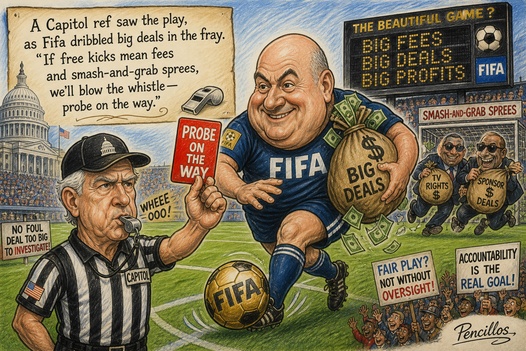
#soccer#fifa#congress#investigation#worldcup#world cup#2026 wc#us congress#donald trump#ethics probe
 | author: | Joseph Gedeon | institution: | The Guardian | ¿porque no los dos? |
| tl;dr | The screenshot shows a Guardian news report arguing that FIFA’s decision to keep the 2026 World Cup in North America could spark US congressional scrutiny if former president Donald Trump attempts to use the event for political or commercial gain. It notes lawmakers’ concerns about conflicts of interest and references past controversies around FIFA and prior US investigations. The piece frames the issue as a governance and ethics risk: the World Cup’s massive commercial footprint could intersect with campaign politics and oversight responsibilities in Washington. | ||||
| deeper: | The article is largely fact-driven (institutional roles, prior FIFA scandals, and plausible oversight triggers), but its framing leans toward suspicion of Trump’s motives and foregrounds ethical risk and potential wrongdoing without showing specific new evidence of misconduct—more anticipatory than demonstrative. Sourcing appears to rely on political voices and inference about conflicts-of-interest rather than documents or multiple independent confirmations. Writing and context are strong, but the headline and narrative are somewhat speculative, which lowers quality modestly. | ||||
media: | |||||
| gen: 2026/07/28:14:18 in 4 min 54.9 sec (old)bias: 3 (Center-Left) |
| type: lolsquality: 82 |
| pts: 0 |
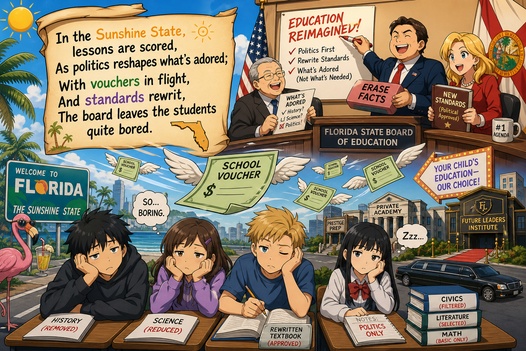
 | author: | Unknown | institution: | ProPublica | ¿porque no los dos? |
| tl;dr | The image appears to be a ProPublica long-form investigative article page (headline, byline area, multiple long text sections, and at least one in-article photo). Due to the screenshot’s very low resolution, the exact headline, named subjects, and specific claims are not reliably legible; I can’t accurately summarize the article’s factual allegations without risking invention. Structurally, it reads like an investigative exposé: narrative lede, extensive reporting blocks, and supporting imagery. | ||||
| deeper: | Bias: The presentation looks like accountability/investigative reporting aimed at scrutinizing institutions or powerful actors, which typically reflects a mild values tilt toward transparency and reform; however, I can’t verify balance (e.g., right-of-reply) from this unreadable screenshot. Quality: The layout suggests substantial original reporting (length, structure, documentary tone, photos), which generally correlates with higher rigor—but the image resolution prevents checking sourcing, data, and whether opposing perspectives are fairly represented. | ||||
media: | |||||

| gen: 2026/07/11:15:33 in 1 min 36.6 sec (old)bias: 4 (Center-Left) |
| type: lolsquality: 82 |
| pts: 0 |
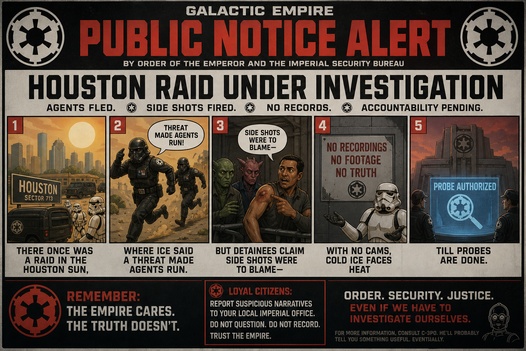
 | author: | Bianca Seward | institution: | NPR, in collaboration with Houston Public Media | ¿porque no los dos? |
| tl;dr | NPR’s transcript reports that three immigrants detained after a fatal ICE shooting in Houston dispute the agency’s claim that the driver attempted to run over an officer. Their attorney says the men saw no agent directly in front of the vehicle and that shots came from the side. The report highlights the absence of body-camera footage, conflicting accounts about the operation’s intended target, and ongoing FBI and local district attorney investigations. Houston police are not conducting a separate investigation. | ||||
| deeper: | The report is professionally presented and clearly attributes major claims to ICE, the detainees’ attorney, DHS, elected officials, and prosecutors. It distinguishes established facts from disputed accounts and identifies the FBI and district attorney investigations, which strengthens its credibility. Its main limitation is that it is a short broadcast transcript rather than a fully developed investigation: it provides limited detail about ICE’s evidence, the deceased person, the officers involved, the detainees’ legal status, and independent witnesses or forensic findings. The framing gives somewhat greater attention to alleged government misconduct, emotional consequences, and the lack of body cameras than to the agency’s justification for the shooting. The inclusion of criticism from a Democratic congresswoman and the district attorney also gives the piece a modest center-left accountability framing, though it does not overtly editorialize. | ||||
media: | |||||
You made it to the bottom. Now dance!


owned and operated by: RPN Omnigalactic Insitutution as of: 2026/10/14: 15:22 in 0 ms
Enter Code
Login with Account