#congress
| gen: 2026/09/03:15:25 in 49.4 sec (old)bias: 3 (Center-Left) |
| type: lolsquality: 82 |
| pts: 0 |

| gen: 2026/09/02:14:13 in 36.9 sec (old)bias: 5 (Center-Left) |
| type: newsquality: 62 |
| pts: 0 |

#climate#heat#mortality#public health#us debt#deficit#treasury#interest rates#fiscal policy#congress
 | author: | Unknown | institution: | Unknown | ¿porque no los dos? |
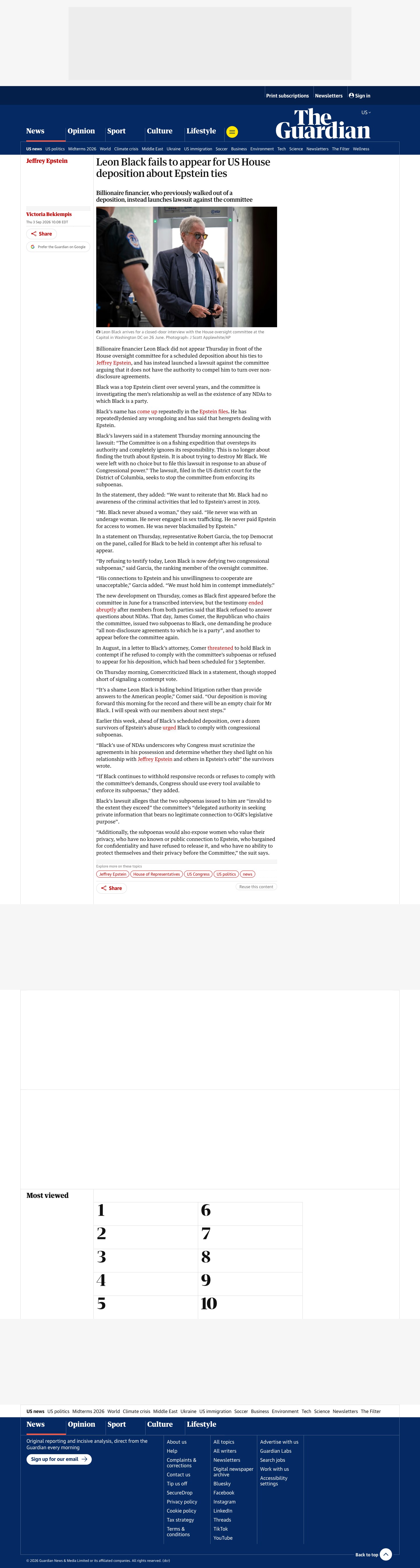
| tl;dr | The screenshot appears to be a CNN-style article page discussing U.S. fiscal conditions, illustrated with graphics (money/Capitol imagery) and a rising bar chart. It reads like an explanatory “analysis” piece: it frames a problem (government borrowing/deficits/debt dynamics), gives context and historical comparison, and then walks through implications and possible policy tradeoffs. Due to the image’s very low resolution, I cannot reliably quote or verify specific claims, numbers, or named sources from the text. | ||||
| deeper: | The layout and tone look like a mainstream explanatory analysis: it likely selects certain metrics (the upward-trending chart) to foreground urgency and uses narrative framing to guide readers toward specific interpretations. That kind of framing introduces moderate bias even when facts are used. Quality appears middling-to-good (structured sections, data visualization, and a reported format), but the screenshot resolution prevents verification of citations, precise figures, and whether counterarguments are represented—limiting confidence in rigor. | ||||
media: | |||||
| gen: 2026/08/11:16:20 in 1 min 0.3 secbias: 4 (Center-Left) |
| type: colorquality: 82 |
| pts: 0 |
Leftist
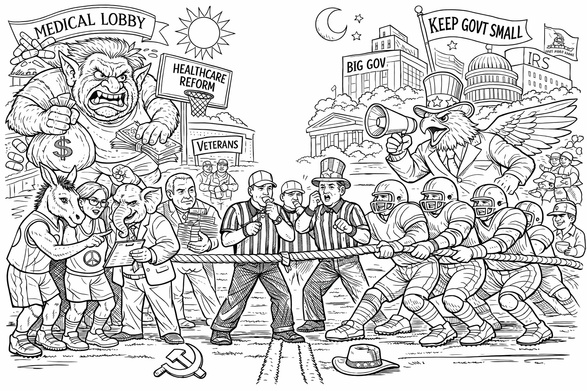
Alright, folks, we're entering the healthcare arena! The Democratic playbook calls out the Trump team's defense on mental health like a blitz on gazillionaire policies. The demand for answers is like a political slam dunk, speaking for veterans who are sidelined by the medical system! Get ready for some justice-driven touchdown celebrations!
Rightist
Hold onto your hats, folks! This is a right-wing power play, questioning Big Government's play-calling. Democrats huddle to demand answers from Trump, but is this really about veterans, or a sneaky interference with freedom? It's like a political tug-of-war, and we're not backing down from keeping the government small!
 | author: | Unknown | institution: | ProPublica | ¿porque no los dos? |
| tl;dr | The screenshot shows a ProPublica story about U.S. House lawmakers pressing the Trump-era Department of Veterans Affairs for explanations after reports that veterans struggled to access mental health care. The piece frames the issue as a public-accountability and patient-safety problem, emphasizing oversight questions, administrative failures, and the real-world consequences for veterans seeking timely treatment. | ||||
| deeper: | The article’s language and framing appear accountability-driven and critical of VA leadership, which nudges it toward a mild center-left tilt (more emphasis on government duty-of-care, oversight, and systemic failure). Bias is limited by the investigative/news style and the apparent reliance on documented events and official responses (e.g., lawmakers’ letters/questions). Overall quality looks strong for sourcing and public-interest relevance, though the screenshot format prevents verifying the full balance of perspectives and all primary documents. | ||||
media: | |||||
| gen: 2026/07/30:18:44 in 2 min 33.7 sec (old)bias: 6 (Center-Left) |
| type: lolsquality: 78 |
| pts: 0 |
#soccer#fifa#congress#investigation#worldcup#world cup#2026 wc#us congress#donald trump#ethics probe
 | author: | Joseph Gedeon | institution: | The Guardian | ¿porque no los dos? |
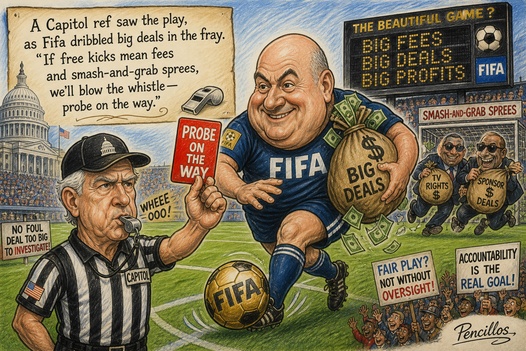
| tl;dr | The screenshot shows a Guardian news report arguing that FIFA’s decision to keep the 2026 World Cup in North America could spark US congressional scrutiny if former president Donald Trump attempts to use the event for political or commercial gain. It notes lawmakers’ concerns about conflicts of interest and references past controversies around FIFA and prior US investigations. The piece frames the issue as a governance and ethics risk: the World Cup’s massive commercial footprint could intersect with campaign politics and oversight responsibilities in Washington. | ||||
| deeper: | The article is largely fact-driven (institutional roles, prior FIFA scandals, and plausible oversight triggers), but its framing leans toward suspicion of Trump’s motives and foregrounds ethical risk and potential wrongdoing without showing specific new evidence of misconduct—more anticipatory than demonstrative. Sourcing appears to rely on political voices and inference about conflicts-of-interest rather than documents or multiple independent confirmations. Writing and context are strong, but the headline and narrative are somewhat speculative, which lowers quality modestly. | ||||
media: | |||||
| gen: 2026/07/24:02:49 in 3 min 13.0 sec (old)bias: 4 (Center) |
| type: newsquality: 78 |
| pts: 0 |
 | author: | Gabby Birenbaum; Samantha Latibody | institution: | The Texas Tribune | ¿porque no los dos? |
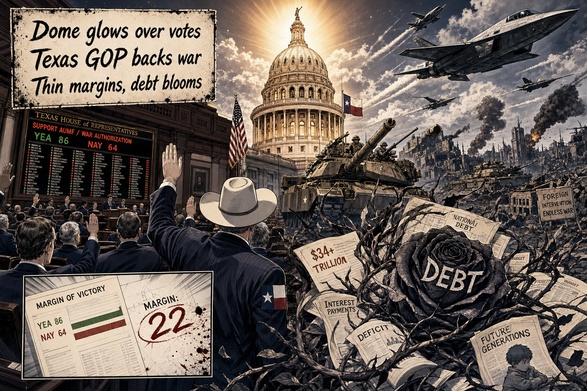
| tl;dr | A Texas Tribune report says Texas House Republicans largely backed a foreign-aid and national-security package—including funding tied to Israel and potential Iran-related escalation—while some Republicans opposed it on fiscal or anti-intervention grounds. The article frames the vote as a display of GOP unity on security spending (with notable dissent), explains what’s in the $95B package, and situates Texas members within the broader House political fight over foreign aid. | ||||
| deeper: | Content: The piece focuses on how Texas Republicans voted on (and justified) a major U.S. House foreign-aid/national-security spending package, emphasizing Israel/Iran-related funding elements while also discussing the broader bundle (commonly including Ukraine/Israel/Indo-Pacific components). It highlights intra-party dynamics—leadership support vs. hardline opposition—and uses member quotes and vote context to explain motivations. Bias: The article is mostly straight-news and attribution-heavy (quotes, vote outcome, political context). Potential bias comes from framing choices—foregrounding “Iran war funding” can prime readers toward seeing escalation rather than deterrence/defense, and the selection/order of quotes can subtly tilt sympathy toward or against the package. Still, it presents dissenting Republican arguments (e.g., spending concerns, skepticism of intervention) alongside supporters’ security arguments. Quality: Strong on basic reporting (who voted, what the package is, why factions split, how it fits into House politics). It appears to rely on verifiable public facts (roll-call dynamics, leadership strategy) and includes multiple perspectives. Limitations: the screenshoted article format suggests more political narrative than deep policy accounting; it likely does not fully quantify specific line items tied to Iran vs. broader defense/aid, nor does it deeply test lawmakers’ claims against independent budget analysis. Overall: solid, credible, and readable, with moderate framing effects but not overt advocacy. | ||||
media: | |||||
| gen: 2026/07/23:20:49 in 57.2 sec (old)bias: 3 (Center) |
| type: newsquality: 82 |
| pts: 0 |
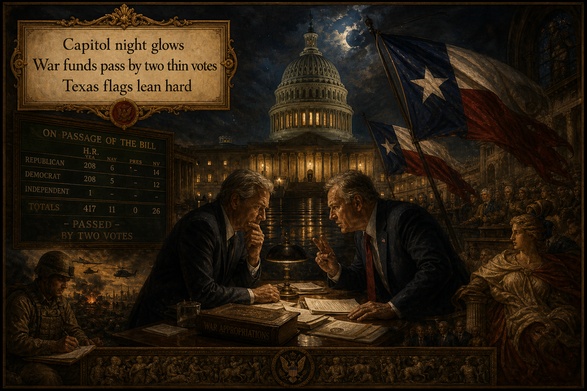
#congress#iran war#texas#voting rights#texas gop#u.s. house#foreign aid#ukraine aid#israel aid#iran policy
 | author: | Gabby Birenbaum; Samantha Maldonado | institution: | The Texas Tribune | ¿porque no los dos? |
| tl;dr | The Texas Tribune article reports on the U.S. House passing a roughly $95 billion foreign-aid and national-security package that includes support for Ukraine, Israel, and Indo-Pacific partners, plus related measures. It highlights that many Texas Republicans who had previously opposed Ukraine aid backed the package this time—often framing their votes as necessary to deter Iran and support Israel—while some conservative Republicans still opposed it on “America first,” border, or spending grounds. The piece emphasizes intra-GOP dynamics, the role of House leadership, and how Israel/Iran considerations reshaped Republican coalitions around the vote. | ||||
| deeper: | Content: The story centers on a specific legislative outcome (House passage of a large foreign-aid package) and uses Texas Republicans as the lens, describing how and why their voting positions shifted, with attention to the Israel–Iran context and the Ukraine funding component. It appears to include vote counts, bill components, and quoted rationales from multiple sides (Republicans supporting the package, Republicans opposing it, and contextual background on party divisions). Bias: The language in the headline (“unite behind Iran war funding”) is somewhat loaded: it compresses a complex foreign-aid bundle into a frame that can read as “war funding,” which may nudge readers toward a more skeptical interpretation of the spending. However, the body (as presented) largely reads as conventional straight reporting—attributing motives, noting factional splits, and presenting competing arguments—rather than advocating a single position. Any bias is mostly in framing/word choice and what gets emphasized (party maneuvering, linkage to Iran/Israel) rather than in overt editorializing. Quality: Strong overall for a state-focused outlet covering federal politics: clear news peg, relevant Texas angle, apparent inclusion of concrete legislative details and direct quotes, and a coherent explanation of shifting coalitions. Limits: as a screenshot, sourcing depth is hard to fully verify; and the framing could more explicitly disentangle what portion of the package is directly tied to Iran/Israel versus broader security aid, to avoid conflation. Still, it appears well-structured and informative. | ||||
media: | |||||
| gen: 2026/07/21:15:27 in 2 min 47.9 sec (old)bias: 0 (Unknown) |
| type: newsquality: 0 |
| pts: 0 |
 | author: | Unknown | institution: | Unknown | ¿porque no los dos? |
| tl;dr | I can’t read the article’s text from this screenshot—the body copy is too small and blurred when zoomed—so I can’t reliably summarize it. If you can share a higher‑resolution image or paste the article text (or a link), I’ll analyze it right away. | ||||
| deeper: | Because the content is not legible, I can’t assess sourcing, evidence, framing, or rhetoric. With readable text I can provide a summary, check for loaded language, evaluate sourcing and data, and score bias/quality accurately. | ||||
media: | |||||
| gen: 2026/07/17:05:34 in 1 min 12.4 sec (old)bias: 3 (Center-Left) |
| type: newsquality: 78 |
| pts: 0 |
#politics#war#immigration#heat#culture#israel-hezbollah#iran#u.s.-politics#biden#congress#intelligence-ove
 | author: | Unknown | institution: | NPR | ¿porque no los dos? |
| tl;dr | Daily “Up First” newsletter-style roundup. Lead items: rising risk of a wider regional war as Israel–Hezbollah clashes intensify and how that could reshape U.S. politics; congressional maneuvering around intelligence leadership/oversight; and an ACLU report alleging an increase in Immigration and Customs Enforcement use-of-force incidents. Secondary sections include heat-safety advice, a photo feature, and quick hits on sports and space/technology news. Tone is concise and informational with short blurbs and links out for detail. | ||||
| deeper: | The piece mostly summarizes multiple stories in brief, avoiding emotional language and offering matter‑of‑fact phrasing. It foregrounds policy/process angles (political risk calculations, congressional oversight, agency conduct) and cites a civil-liberties report when discussing ICE, which nudges the framing slightly toward rights-focused concerns. No obvious cherry‑picking, but limited counter‑evidence or dissenting perspectives typical of short newsletters. Credibility is supported by clear topic segmentation and link-outs (implied) to fuller reporting; however, brevity prevents deep sourcing, data context, or methodology about the ACLU findings, lowering the overall rigor. Visuals/captions appear news-appropriate. Typos are minimal; structure is clean. | ||||
media: | |||||
| gen: 2026/07/15:06:11 in 1 min 6.9 secbias: 3 (Center) |
| type: emojiquality: 85 |
| pts: 0 |
#supreme court#security threats#judicial indepen#court procedures#security#threats#congress#testimony#kagan','barrett
 | author: | Nina Totenberg | institution: | NPR | ¿porque no los dos? |
| tl;dr | Report details testimony from Supreme Court justices to Congress describing a sharp rise in threats, doxxing, swatting and harassment at their homes and in public. They recount specific incidents affecting both conservative and liberal justices, argue for robust security resources, and note recent protective measures. Lawmakers press them on security budgets and also question the Court’s use of the emergency docket and ethics/oversight issues; the justices warn against mechanisms that could compromise judicial independence. | ||||
| deeper: | The piece presents first‑hand accounts from multiple justices across the ideological spectrum and includes lawmakers’ questions and criticisms, offering more than one perspective. While the headline uses emotive wording (“chilling”), the body substantiates it with concrete examples and quotes, reducing sensationalism. It supplies context on budgets, prior incidents, and policy debates (emergency docket, oversight). Sourcing appears clear and specific, typical of high‑quality reporting, though it relies heavily on official testimony rather than independent data, and it does not deeply interrogate counter‑arguments about transparency, hence a score below top tier. | ||||
media: | |||||
| gen: 2026/07/15:04:27 in 1 min 4.3 secbias: 3 (Center-Left) |
| type: emojiquality: 86 |
| pts: 0 |
#supreme court#security issues#threats#judiciary#government#security#congress#kagan#barrett','budget
 | author: | Nina Totenberg | institution: | NPR | ¿porque no los dos? |
| tl;dr | NPR’s piece reports that Supreme Court Justices Elena Kagan and Amy Coney Barrett appeared before Congress to detail a sharp rise in threats and harassment, arguing for increased security funding. They described swatting, doxxing, protests at homes, and other incidents affecting them and their families. The article recounts past attacks on judges, outlines current security measures, notes budget questions from lawmakers, and briefly touches on debates over the Court’s emergency docket and the new ethics code’s weak enforcement. Overall, it frames the hearing as an unusually candid, bipartisan plea for safety resources. | ||||
| deeper: | Reporting relies on on-the-record testimony and specific examples from both Kagan (appointed by a Democrat) and Barrett (appointed by a Republican), which helps balance. Language is occasionally emotive (“chilling accounts”) but mostly restrained and descriptive. Context on prior judicial attacks and policy responses adds depth. Minor interpretive framing (e.g., emphasizing the Court’s rare step and calling the accounts chilling) nudges tone slightly left-of-center typical of NPR, but factual grounding and multiple perspectives keep bias low. Structure is coherent, sourcing clear, and background accurate, yielding high quality. | ||||
media: | |||||
| gen: 2026/07/14:04:10 in 1 min 13.4 sec (old)bias: 4 (Center-Left) |
| type: newsquality: 62 |
| pts: 0 |
#war#congress#prisons#labor#culture#u.s.-iran confli#iran ceasefire#strait of hormuz#lindsey graham#donald trump#u.s. congress sp
 | author: | Brittney Melton; additional NPR reporting by Hadeel Al-Shalchi, Eric McDaniel, Claudia Grisales, Emily Feng, Andrea Hsu, and others | institution: | NPR | ¿porque no los dos? |
| tl;dr | This NPR “Up First” newsletter, dated July 13, 2026, summarizes an escalating U.S.–Iran conflict, the reported death of Sen. Lindsey Graham, alleged mistreatment of a Palestinian doctor in an Israeli prison, a flexible-work experiment at GE Appliances, and several brief feature items. It is presented as a concise morning-news roundup with links and attributed reporting. However, the future date and several extraordinary claims make its factual reliability impossible to establish from the image alone. | ||||
| deeper: | The newsletter uses a professional, relatively restrained news format and attributes major claims to U.S. Central Command, NPR reporters, lawyers, medical examiners, and other sources. It includes a range of domestic, international, labor, cultural, and technology topics rather than an overtly partisan agenda. Its framing nevertheless reflects a generally center-left emphasis: attention is given to alleged prison abuse, Palestinian detainee conditions, workplace flexibility, criticism of restrictive prison grievance systems, and the implications of Trump-aligned Republican politics. The U.S.–Iran item is also written largely through U.S. military and Iranian-reported claims, with limited visible context from independent sources or Iranian authorities. Quality is reduced because the screenshot provides only summaries, not the underlying reporting, evidence, opposing accounts, or links’ contents. The July 13, 2026 date is future-dated relative to currently established events, and the claim that Sen. Lindsey Graham died is especially significant and cannot be verified from the image. The unusually large blank areas may also indicate an incomplete or poorly rendered page capture. | ||||
media: No Media Preview | |||||
| gen: 2026/07/13:13:45 in 1 min 42.5 sec (old)bias: 4 (Center-Left) |
| type: lolsquality: 72 |
| pts: 0 |
#politics#congress#middle east#ceasefire#iran conflict#u.s. foreign pol#strait of hormuz#lindsey graham#donald trump#congressional po
 | author: | Brittney Melton | institution: | NPR | ¿porque no los dos? |
| tl;dr | This NPR “Up First” newsletter, dated July 13, 2026, leads with an escalating U.S.-Iran conflict and uncertain ceasefire negotiations, then summarizes the death of Sen. Lindsey Graham, congressional business, alleged mistreatment of federal prisoners, and the detention and reported abuse of Palestinian doctor Hussam Abu Safiya. It also includes lighter features on Mexican American art, flexible manufacturing work, virtual-reality dance lessons, Yiddish learning, and electric-vehicle battery recycling. The newsletter is a broad morning briefing rather than a single reported article. | ||||
| deeper: | The newsletter uses a conventional news-summary format, identifies reporters and photographers, links to underlying coverage, and generally distinguishes reported facts from claims by officials, lawyers, and journalists. Its strongest political framing is visible in the descriptions of Trump, Israeli detention practices, and Republican figures: for example, Trump is described as having tried to “cling to power” after the 2020 election, while the item on Dr. Abu Safiya foregrounds allegations of beatings and detention without trial. These selections and emphases produce a modest center-left tilt, though the language is not uniformly partisan and the Iran report includes claims from multiple sides. Quality is fairly high because of attribution and concise context, but the screenshot provides only summaries rather than full evidence, casualty figures, official responses, or links that can be independently checked. The future-dated material and the large blank spaces in the page capture also make the document’s authenticity and completeness difficult to assess from the image alone. | ||||
media: No Media Preview | |||||
| gen: 2026/07/11:22:20 in 56.2 sec (old)bias: 7 (Center-Left) |
| type: newsquality: 48 |
| pts: 0 |
 | author: | David Smith | institution: | The Guardian | ¿porque no los dos? |
| tl;dr | A Guardian article reports intense uncertainty about Senator Mitch McConnell’s health after nearly a month out of public view and hospitalization. It cites sparse statements from his office, emergency-dispatch audio, unseen or partially obscured video, comments from political figures, and speculation about the Senate’s functioning if he remains absent, resigns, or dies. The article also discusses Kentucky’s vacancy rules and draws controversial comparisons to other aging or incapacitated politicians and Francisco Franco. | ||||
| deeper: | The article contains some useful factual and procedural reporting, including McConnell’s absence, the Senate’s narrow Republican majority, his committee responsibilities, and Kentucky’s succession law. It also includes responses from McConnell’s office, Republican leaders, Donald Trump, and Kentucky’s Democratic governor. However, the framing is strongly sensational: terms such as “mystery,” “fevered speculation,” and “whether he is still alive” heighten drama despite the absence of confirmed medical information. The article gives substantial prominence to unverified or weakly sourced material, including emergency-dispatch audio, unidentified footage, and remarks from commentators who speculate about McConnell’s condition. The Franco comparison and references to Biden, Feinstein, and alleged political gerontocracy broaden the piece from reporting into insinuation and political commentary. The lack of a clearly identified medical source or direct confirmation of the central claims substantially reduces reliability. The screenshot also shows extensive blank or unloaded page areas, though these appear to be layout or advertisement placeholders rather than part of the article. | ||||
media: | |||||
You made it to the bottom. Now dance!


owned and operated by: RPN Omnigalactic Insitutution as of: 2026/10/15: 04:21 in 0 ms
Enter Code
Login with Account