#germany
| gen: 2026/09/07:22:31 in 34.8 sec (old)bias: 5 (Center-Left) |
| type: newsquality: 78 |
| pts: 0 |

 | author: | Deborah Cole | institution: | The Guardian | ¿porque no los dos? |
| tl;dr | The article reports that German chancellor Friedrich Merz intends to remain in office after the AfD won a landslide in Saxony-Anhalt (about 44%). It describes the defeat as a major shock for Merz’s CDU, cites exit-poll evidence of very low approval for Merz, and outlines how coalition partners and commentators are reacting. It also summarizes AfD positions (immigration, public broadcasting, Russia/Ukraine) and notes concerns about extremist classification, potential coalition arithmetic, and alleged Russian interference ahead of further regional elections. | ||||
| deeper: | The reporting is largely factual (results, quotes, polling) but uses loaded descriptors (“far-right triumph,” “nativist,” “ash(en)-faced,” “fragrance salesman”) that signal a skeptical, alarmed framing toward AfD and a personalizing tone toward its candidate. It includes multiple viewpoints (Merz, critics, coalition partner, intelligence-service designation) but gives comparatively limited space to AfD voters’ policy motivations beyond grievance/identity themes. Quality is solid: clear narrative, relevant context, and specific figures; weaker on sourcing detail for some claims (e.g., interference allegations) and on distinguishing analysis from description. | ||||
media: | |||||
| gen: 2026/09/07:05:25 in 25.3 sec (old)bias: 6 (Center-Left) |
| type: newsquality: 78 |
| pts: 0 |

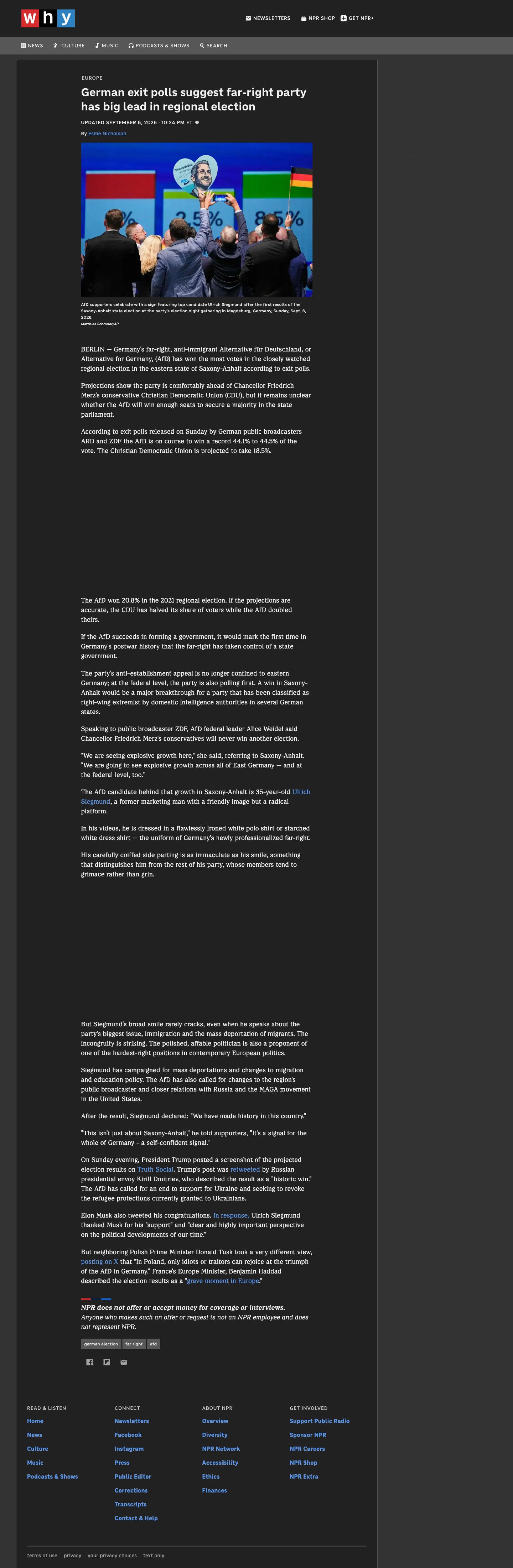 | author: | Esme Nicholson | institution: | NPR | ¿porque no los dos? |
| tl;dr | NPR reports that exit polls in Germany’s Saxony-Anhalt state election show the far-right AfD with a large lead (projected ~44.1–44.5%), far ahead of the CDU (~18.5%). The piece notes AfD’s rapid growth since 2021, the possibility of forming a first postwar far-right-led state government, and highlights top candidate Ulrich Siegmund’s messaging—especially on immigration and mass deportations. It also describes international reactions, including comments from Donald Tusk and France’s Europe minister, and references AfD’s positions on Russia and Ukraine aid. | ||||
| deeper: | The article is strongly framed around AfD as “far-right” and “anti-immigrant,” and includes subjective, image-focused characterizations of Siegmund (his smile, grooming, “incongruity”) that tilt toward editorial coloring rather than straight reporting. Still, core claims are anchored in specific exit-poll numbers and attributable sources (ARD/ZDF), and it distinguishes projections from confirmed outcomes. It could be higher quality with more detail on methodology/uncertainty of exit polls, coalition math, and a fuller presentation of AfD voters’ stated motivations beyond immigration. | ||||
media: | |||||
| gen: 2026/09/06:07:27 in 39.2 sec (old)bias: 3 (Center) |
| type: newsquality: 78 |
| pts: 0 |
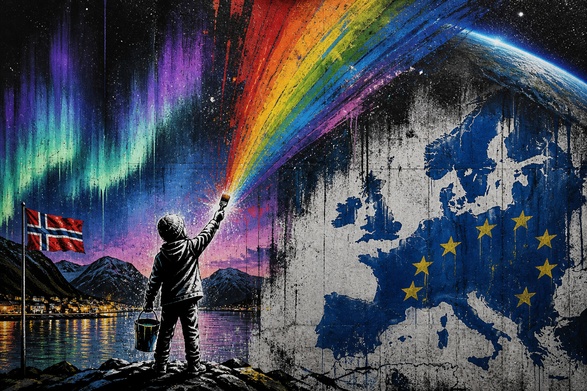
 | author: | Mike Wall | institution: | Space.com | ¿porque no los dos? |
| tl;dr | Space.com reports that German startup Isar Aerospace successfully launched its two-stage Spectrum rocket from Andøya Space Center in northern Norway on Sept. 5, 2026, reaching orbit—described as the first orbital launch from Western European soil. The piece recounts Spectrum’s failed March 2025 debut and the investigation findings, notes subsequent delays and scrubbed attempts, and says five cubesats and a non-deployable experiment were carried on the successful Flight 2. It also contextualizes European orbital launches by noting Russia’s long-running Plesetsk site. | ||||
| deeper: | The article is largely straightforward and fact-focused, with specific times, locations, vehicle size, payload mass-to-LEO capability, and orbital parameters. Bias is mild: the framing is celebratory (“makes history”) and relies heavily on company statements/webcast quotes and company-posted updates (including via X) without much independent verification or outside expert perspective. Quality is solid for a short news write-up: clear timeline, relevant technical context, and an editor’s note updating outcomes, but limited sourcing diversity and deeper scrutiny (e.g., regulatory/safety/environmental impacts, market/competition). | ||||
media: | |||||
| gen: 2026/08/29:16:19 in 29.9 sec (old)bias: 2 (Center) |
| type: newsquality: 78 |
| pts: 0 |

 | author: | Unknown | institution: | Reuters (via Yahoo News) | ¿porque no los dos? |
| tl;dr | The screenshot shows a Yahoo News article (from Reuters) reporting that the Taliban have sent a team to Germany to help with the logistics/identification paperwork for deporting Afghans from Germany back to Afghanistan. The piece frames the move in the context of Germany’s efforts to restart deportations—generally focused on people convicted of serious crimes—despite the lack of formal diplomatic recognition of the Taliban government. It highlights political pressure inside Germany, operational constraints, and the sensitivities of dealing with Taliban authorities. | ||||
| deeper: | The language appears largely factual and attribution-heavy (typical of Reuters), with limited emotive wording. It presents the policy action (Taliban team assisting deportations) and the political/administrative rationale without overt editorializing. Potential bias mainly comes from story selection and which concerns are emphasized (security/political pressure vs. humanitarian risk), but the tone is still restrained. Quality is solid: clear headline, relevant context, and a straightforward structure; it’s limited by the screenshot format and what appears to be a relatively brief, event-driven report. | ||||
media: | |||||
| gen: 2026/07/23:20:55 in 1 min 1.5 sec (old)bias: 3 (Center) |
| type: newsquality: 74 |
| pts: 0 |

 | author: | Unknown | institution: | UEFA.com | ¿porque no los dos? |
| tl;dr | The image is a screenshot of a UEFA-style web article presenting a women’s national-team “power rankings” feature centered on Spain as the current benchmark and discussing other top challengers (with separate sections for teams such as Spain, England, and others). It’s written as a preview/analysis piece rather than a hard-news report, highlighting strengths, storylines, and what could determine who catches Spain. | ||||
| deeper: | Content-wise, this is sports analysis with a “power rankings” framing. That format is inherently subjective (rankings depend on editorial judgment, selective criteria, and narrative emphasis), which introduces mild bias—mainly toward compelling storylines, star players, and recent form—rather than partisan or ideological bias. The article appears to structure the discussion team-by-team (e.g., a clear section header like “1 Spain,” followed by other contenders), which is a coherent way to present comparative analysis, but it can also oversimplify by implying a precise hierarchy even when teams are close. On quality: it looks professionally produced (layout, team sections, and consistent formatting) and likely reflects informed football context, but “power rankings” are not a transparent methodology-driven product unless the piece clearly states criteria (recent results, squad strength, injuries, competition level, etc.). From the screenshot alone, there’s no obvious data methodology or sourcing visible beyond the editorial write-up, which limits rigor. Overall it’s strong as a readable preview and conversation-starter, moderate on analytical transparency, and not designed as investigative reporting. | ||||
media: | |||||
You made it to the bottom. Now dance!


owned and operated by: RPN Omnigalactic Insitutution as of: 2026/10/14: 13:17 in 0 ms
Enter Code
Login with Account