#europe
| gen: 2026/09/20:20:37 in 24.4 sec (old)bias: 3 (Center) |
| type: newsquality: 77 |
| pts: 0 |
 | author: | Shaun Walker | institution: | The Guardian | ¿porque no los dos? |
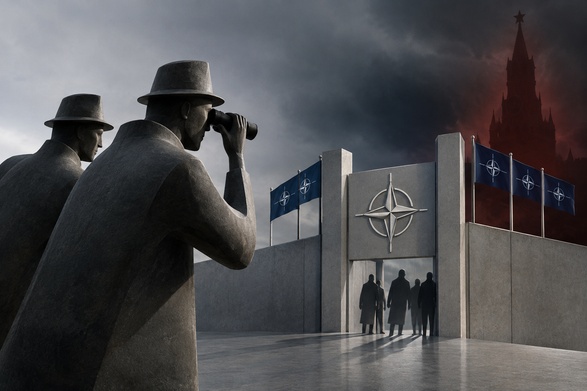
| tl;dr | European intelligence chiefs warn that Russia could intensify sabotage and potentially test Nato with limited military action within months. Baltic officials, however, report no signs of an imminent attack and caution that alarmist messaging could serve Moscow’s efforts to spread fear. Officials describe increasing threats to transport, defence industries and infrastructure supporting Ukraine. Russia denies planning an attack on Nato. The article also reports European doubts about Moscow’s commitment to peace negotiations, while acknowledging that the intelligence behind the warnings has not been disclosed. | ||||
| deeper: | The article prioritizes European security officials’ perspectives, but includes substantial disagreement, warnings against panic and Russia’s denial. Its framing does not clearly map onto left-right politics. Named interviews, direct quotations and historical context strengthen the reporting. However, the headline sounds more certain than the underlying assessments, and undisclosed intelligence prevents readers from testing the central claims. Some sweeping assertions, notably about destruction of Russian oil infrastructure, lack supporting figures. These scores assess the supplied text; the screenshot’s authenticity and reported events are not independently verified. | ||||
media: | |||||
| gen: 2026/09/19:21:49 in 26.0 sec (old)bias: 3 (Center) |
| type: newsquality: 68 |
| pts: 0 |

 | author: | Charles Maynes, Scott Simon | institution: | NPR | ¿porque no los dos? |
| tl;dr | European leaders warn of alleged Russian hybrid attacks, including sabotage, cyberattacks, election interference and drone incursions. The report explains Western intelligence claims linking these activities to Moscow, while acknowledging uncertainty and presenting Russian denials. It explores the theory that Russia seeks to weaken support for Ukraine without triggering NATO’s collective defense commitment. France and Poland favor tougher measures, contrasted with the Trump administration’s emphasis on engagement. The segment leaves open which approach would work better. | ||||
| deeper: | The report foregrounds European security concerns but asks directly about proof, includes Russian denials and avoids endorsing either sanctions or engagement. This supports a broadly centrist assessment rather than a clear partisan alignment. Phrases such as “the Russians are coming” and “death to Article 5 by a thousand cuts” heighten alarm. The explanation of hybrid warfare is accessible, but major incidents and intelligence claims lack specific sources or independently presented evidence. Commentary about Russian public attitudes is speculative. These limitations reduce the report’s evidentiary strength. | ||||
media: | |||||
| gen: 2026/09/11:15:43 in 31.8 sec (old)bias: 3 (Center) |
| type: newsquality: 68 |
| pts: 0 |

#europe#politics#elections#extremism#diplomacy#luc frieden#luxembourg#european union#ukraine#united states#diplomacy ha
 | author: | Armen Georgian | institution: | France 24 | ¿porque no los dos? |
| tl;dr | Luxembourg Prime Minister Luc Frieden warns about extremists winning European elections. In the visible interview excerpts, he supports Ukraine, argues that borders must not be changed by force, and advocates preserving economic and technological ties with the United States. The interviewer questions whether Washington treats Europe as a genuine diplomatic partner. Frieden calls for Europe's voice to be heard while maintaining transatlantic cooperation. Much of the article's middle section is obscured in the supplied images. | ||||
| deeper: | The visible text emphasizes European cooperation, multilateral diplomacy and transatlantic ties—positions spanning the political center. The emotionally charged headline is clearly attributed to Frieden rather than presented as the reporter's judgment. Direct quotations and a skeptical question provide useful firsthand reporting, but the excerpt largely conveys one leader's perspective without independent corroboration. A repeated attribution suggests minor editing weakness. These scores are provisional because substantial text is obscured and the video cannot be assessed from screenshots. | ||||
media: | |||||
| gen: 2026/09/07:05:25 in 25.3 sec (old)bias: 6 (Center-Left) |
| type: newsquality: 78 |
| pts: 0 |

 | author: | Esme Nicholson | institution: | NPR | ¿porque no los dos? |
| tl;dr | NPR reports that exit polls in Germany’s Saxony-Anhalt state election show the far-right AfD with a large lead (projected ~44.1–44.5%), far ahead of the CDU (~18.5%). The piece notes AfD’s rapid growth since 2021, the possibility of forming a first postwar far-right-led state government, and highlights top candidate Ulrich Siegmund’s messaging—especially on immigration and mass deportations. It also describes international reactions, including comments from Donald Tusk and France’s Europe minister, and references AfD’s positions on Russia and Ukraine aid. | ||||
| deeper: | The article is strongly framed around AfD as “far-right” and “anti-immigrant,” and includes subjective, image-focused characterizations of Siegmund (his smile, grooming, “incongruity”) that tilt toward editorial coloring rather than straight reporting. Still, core claims are anchored in specific exit-poll numbers and attributable sources (ARD/ZDF), and it distinguishes projections from confirmed outcomes. It could be higher quality with more detail on methodology/uncertainty of exit polls, coalition math, and a fuller presentation of AfD voters’ stated motivations beyond immigration. | ||||
media: | |||||
| gen: 2026/09/06:07:27 in 39.2 sec (old)bias: 3 (Center) |
| type: newsquality: 78 |
| pts: 0 |

 | author: | Mike Wall | institution: | Space.com | ¿porque no los dos? |
| tl;dr | Space.com reports that German startup Isar Aerospace successfully launched its two-stage Spectrum rocket from Andøya Space Center in northern Norway on Sept. 5, 2026, reaching orbit—described as the first orbital launch from Western European soil. The piece recounts Spectrum’s failed March 2025 debut and the investigation findings, notes subsequent delays and scrubbed attempts, and says five cubesats and a non-deployable experiment were carried on the successful Flight 2. It also contextualizes European orbital launches by noting Russia’s long-running Plesetsk site. | ||||
| deeper: | The article is largely straightforward and fact-focused, with specific times, locations, vehicle size, payload mass-to-LEO capability, and orbital parameters. Bias is mild: the framing is celebratory (“makes history”) and relies heavily on company statements/webcast quotes and company-posted updates (including via X) without much independent verification or outside expert perspective. Quality is solid for a short news write-up: clear timeline, relevant technical context, and an editor’s note updating outcomes, but limited sourcing diversity and deeper scrutiny (e.g., regulatory/safety/environmental impacts, market/competition). | ||||
media: | |||||
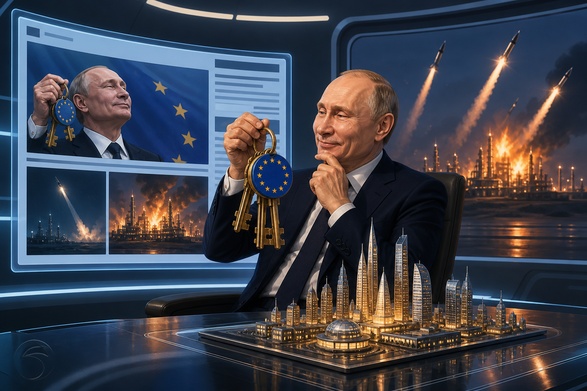
| gen: 2026/08/13:04:37 in 2 min 51.8 sec (old)bias: 4 (Center) |
| type: lolsquality: 60 |
| pts: 0 |

| gen: 2026/08/09:13:29 in 39.6 sec (old)bias: 3 (Center) |
| type: newsquality: 82 |
| pts: 0 |


| gen: 2026/08/01:04:53 in 41.5 sec (old)bias: 4 (Center-Left) |
| type: newsquality: 78 |
| pts: 0 |

 | author: | Unknown | institution: | Grist | ¿porque no los dos? |
| tl;dr | A Grist article reports that the European Union is considering changes that could weaken parts of its flagship climate policy framework (often described as among the world’s most influential). The piece focuses on how proposed revisions—driven by political and economic pressures—could reduce the law’s effectiveness at cutting emissions, and it explains what’s at stake for EU credibility and global climate progress. | ||||
| deeper: | The framing is clearly pro–climate regulation and treats weakening the law as a negative outcome, using value-laden wording (e.g., “landmark,” “most impactful,” “weaken”). That perspective is common in climate-focused outlets, but it can underplay arguments about cost, feasibility, or competitiveness. Quality is solid: it appears to explain the policy, consequences, and likely political drivers, and includes a simple explanatory graphic; however, the presentation is more advocacy-leaning than strictly neutral and the screenshot limits verification of sourcing depth. | ||||
media: | |||||
| gen: 2026/07/24:13:10 in 1 min 33.1 sec (old)bias: 6 (Center-Left) |
| type: newsquality: 72 |
| pts: 0 |
 | author: | Renaud Lefort | institution: | France 24 | ¿porque no los dos? |
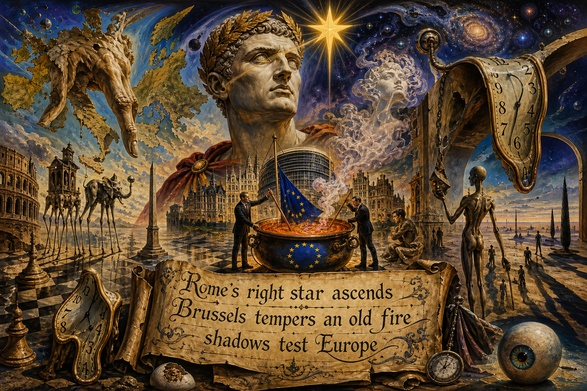
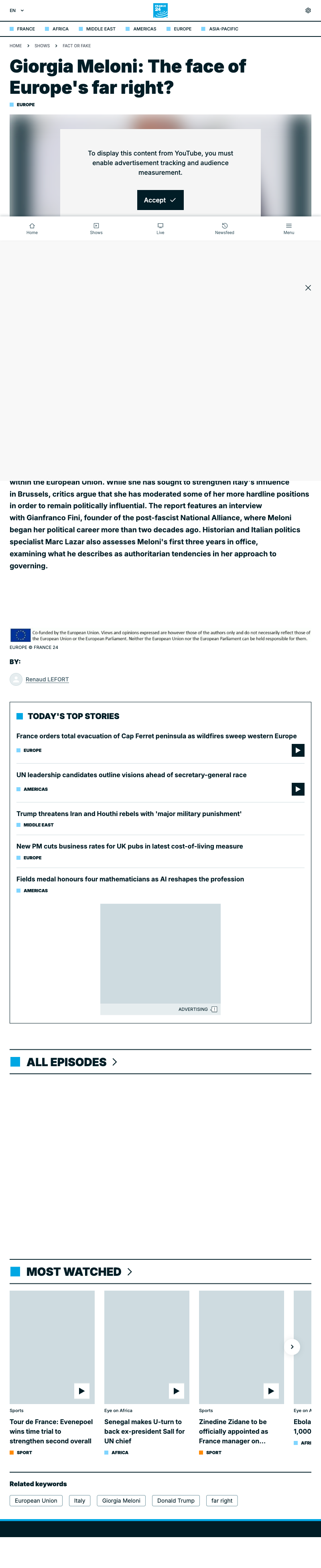
| tl;dr | A France 24 piece asks whether Italian Prime Minister Giorgia Meloni has become the leading figure of Europe’s far right. It frames her as a politician with roots in post-fascist politics whose government has shown what the article calls authoritarian tendencies, while also noting arguments that she has moderated some hardline positions and remains influential in EU politics. The report leans on interviews (including with a founder of a post-fascist party) and expert commentary to assess her first years in office and her role in Brussels. | ||||
| deeper: | Bias: The headline (“The face of Europe’s far right?”) is a loaded framing choice that primes readers toward a particular interpretation and treats a contested label (“far right”) as the organizing lens. The visible text emphasizes criticism—post-fascist roots, “authoritarian tendencies”—while giving some space to the counter-claim that she has moderated positions. Overall, the piece appears more prosecutorial than neutral, but not purely polemical. Quality: The article looks like a reported analysis segment rather than an evidence-heavy investigation. It cites interviews and specialist commentary (historian/political specialist), which supports credibility, but the on-page excerpt doesn’t show much direct sourcing (e.g., specific policies, voting records, legal texts, quantitative indicators) that would let readers independently evaluate claims like “authoritarian tendencies.” As presented, it’s solid explanatory journalism with a strong frame, but limited transparent evidentiary detail in what’s visible. | ||||
media: | |||||
| gen: 2026/07/24:13:04 in 1 min 27.1 sec (old)bias: 4 (Center) |
| type: newsquality: 72 |
| pts: 0 |
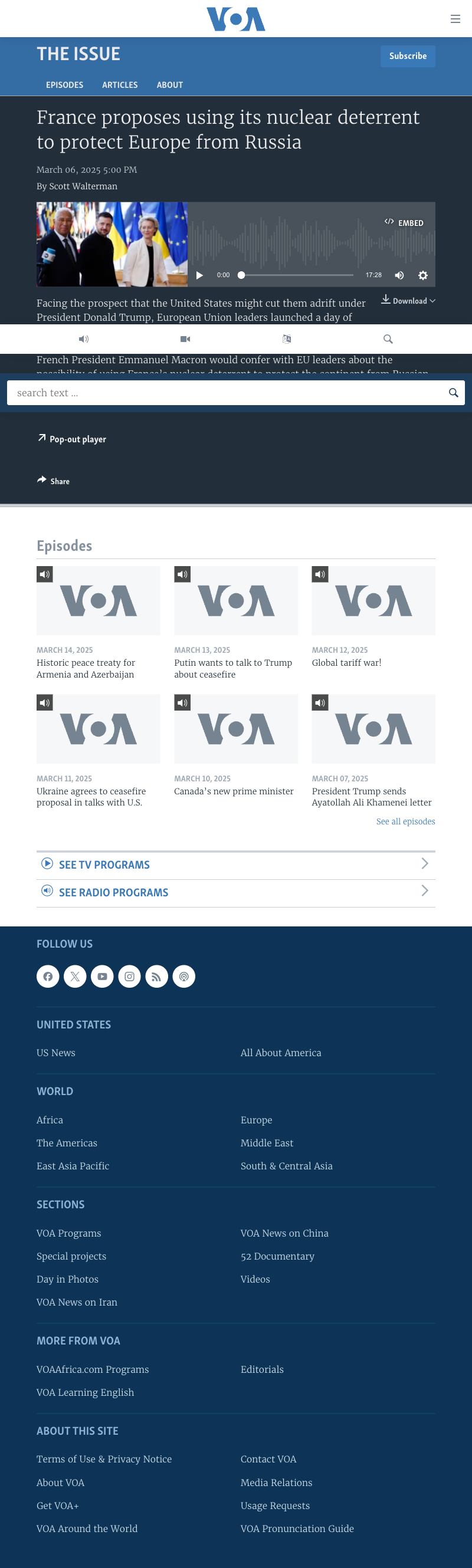 | author: | Scott Walterman | institution: | VOA (Voice of America) | ¿porque no los dos? |
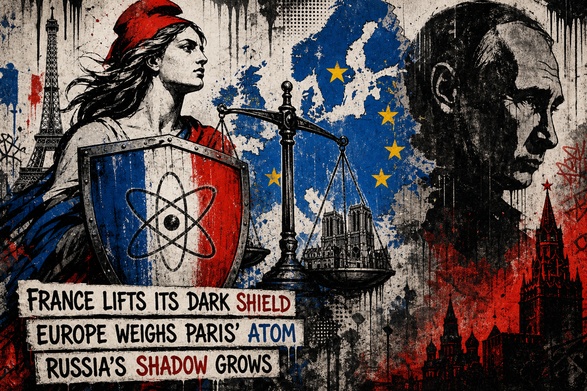
| tl;dr | The VOA “The Issue” episode/article reports that France is floating the idea of extending or leveraging its nuclear deterrent to help protect Europe against Russia, amid European anxiety that U.S. security guarantees could weaken under President Donald Trump. It frames the proposal as part of broader EU leader discussions on defense and deterrence, with Macron expected to consult EU partners on feasibility and implications. | ||||
| deeper: | Content & framing: The headline and lede position Russia as the primary external threat and present France’s nuclear umbrella concept as a protective measure for Europe, which is a broadly mainstream Western-security framing. The story also foregrounds uncertainty about U.S. commitments under Trump, which adds a political angle that may shape readers’ interpretation of urgency. Bias indicators: Language such as “protect Europe from Russia” is assertive and threat-forward; it largely treats the Russian threat premise as given rather than argued. From what’s visible, there’s limited sign of Russia’s perspective, skeptical European voices, or detailed counterarguments (e.g., escalation risks, legal/command-and-control constraints, NATO cohesion concerns) being equally centered—suggesting mild narrative slant rather than overt partisanship. Quality: The piece appears to be a reported explainer tied to a current policy debate, with clear identification of time, author, and subject, and an audio format that likely includes additional context. However, based on the screenshot, the visible text does not show sourcing depth (named officials, documents, experts), concrete policy mechanics (what “using” the deterrent would mean operationally), or explicit differentiation between proposal, trial balloon, and actionable plan. That keeps it solid but not top-tier. | ||||
media: | |||||
| gen: 2026/07/22:05:40 in 3 min 28.4 sec (old)bias: 4 (Center-Left) |
| type: lolsquality: 74 |
| pts: 0 |
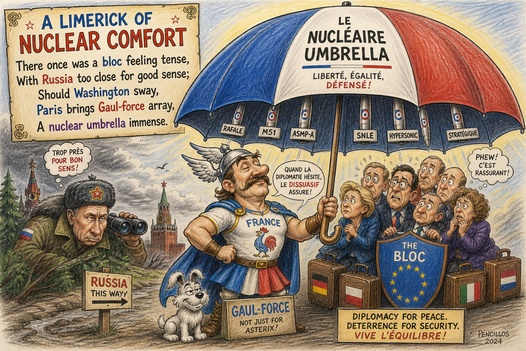
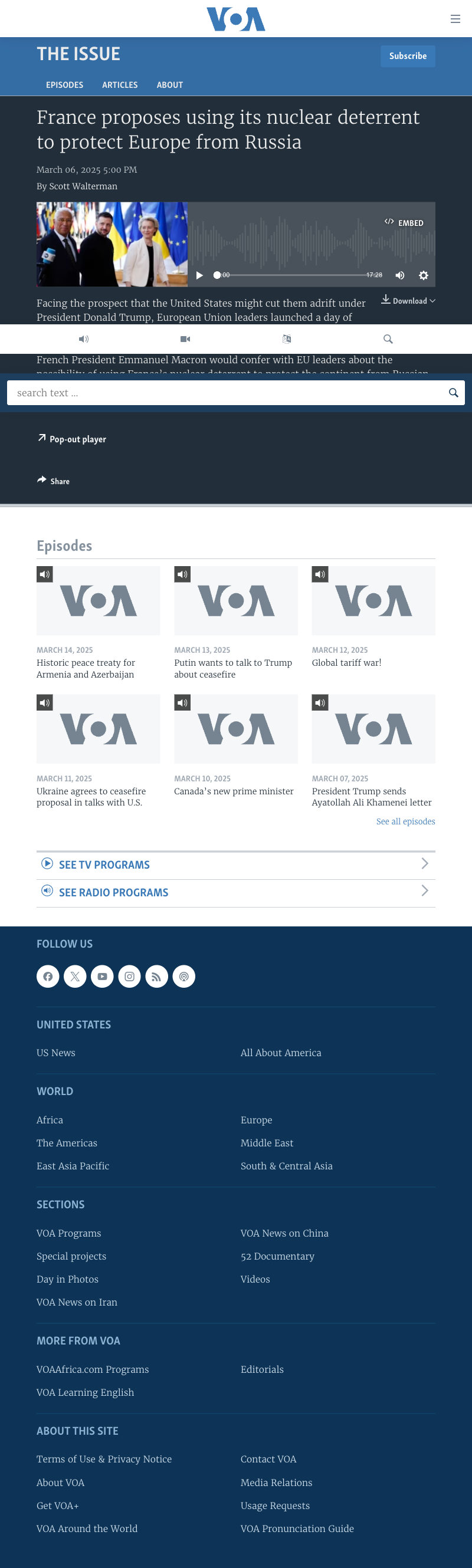 | author: | Scott Walterman | institution: | Voice of America | ¿porque no los dos? |
| tl;dr | A Voice of America (VOA) “The Issue” episode/article (March 6, 2025) by Scott Walterman reports that France is proposing its nuclear deterrent as a way to help protect Europe against Russia, amid concerns that the United States could reduce its security commitment under President Donald Trump. The framing emphasizes European anxiety about U.S. reliability and highlights French President Emmanuel Macron’s intent to discuss the idea with EU leaders. | ||||
| deeper: | Content & framing: The headline and lede frame Russia as the primary threat (“protect Europe from Russia”) and present France’s nuclear deterrent as a prospective solution, which is a defensible news frame given the post-2022 European security context. The visible text also foregrounds a political premise—European leaders fear being “cut … adrift” by the U.S. under President Trump—without showing, in the screenshot, balancing language that would test that claim (e.g., references to stated U.S. policy, NATO commitments, or countervailing views from U.S. officials). Bias: The piece appears to lean mildly toward a pro-EU strategic autonomy perspective (treating U.S. retrenchment as plausible and Russian threat as central) and uses emotionally loaded phrasing (“cut … adrift”). However, it is not overtly ideological in the portion shown; it reads like mainstream security reporting, hence a moderate (not high) bias score. Quality: As presented, it’s a VOA program page with an audio segment (~17 minutes). The topic is timely and clearly stated; author and date are provided. Quality is limited in this screenshot by the lack of visible sourcing, direct quotations, and presentation of opposing arguments (e.g., Russia’s response, NATO nuclear-sharing context, French doctrine constraints, and critique from European states wary of nuclear escalation). If the audio includes multiple expert voices and hard details, quality would rise; based on what’s visible, it’s solid but not deeply evidenced. What would strengthen it: explicit sourcing for the U.S.-retrenchment premise, concrete description of what France is actually proposing (political guarantee vs. operational nuclear posture), legal/doctrinal limits of France’s force de frappe, reactions from key EU/NATO members (Germany, Poland, Baltics), and a clearer distinction between deterrence signaling and actual defense commitments. | ||||
media: No Media Preview | |||||
| gen: 2026/07/22:01:53 in 1 min 1.8 sec (old)bias: 3 (Center-Left) |
| type: newsquality: 76 |
| pts: 0 |
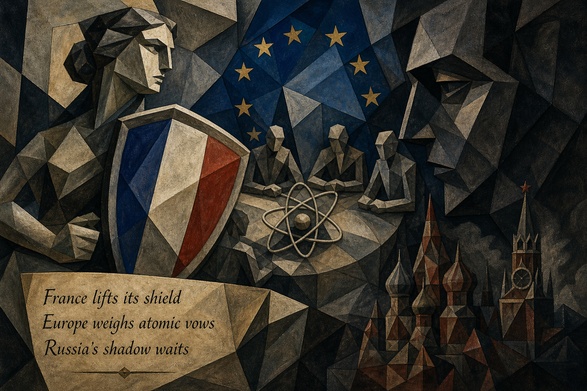
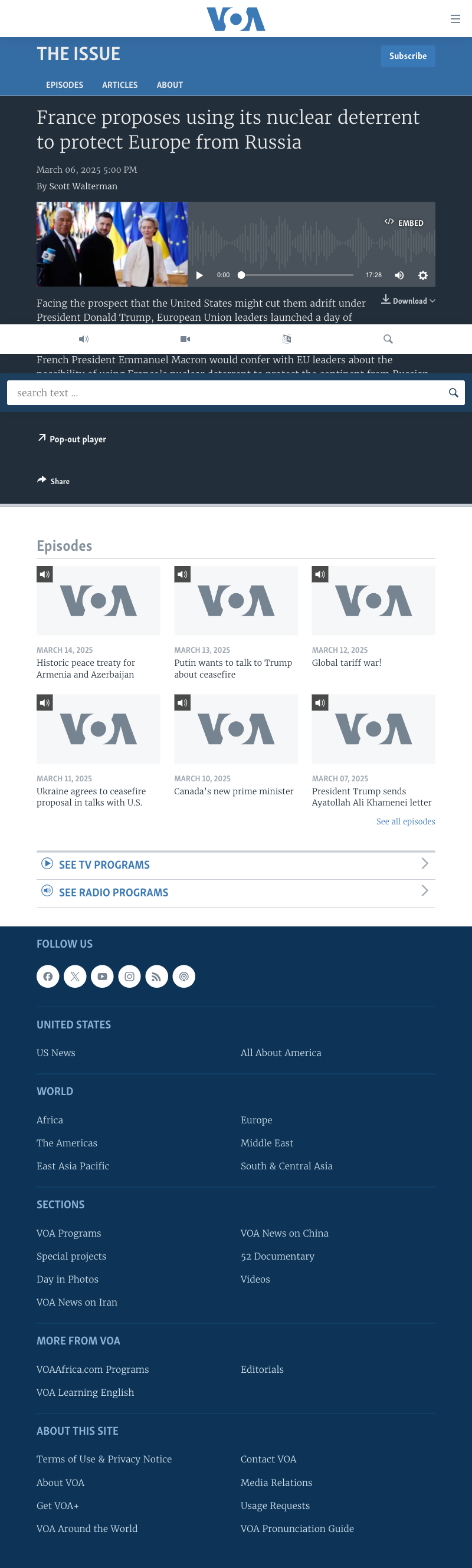 | author: | Scott Walterman | institution: | Voice of America (VOA) | ¿porque no los dos? |
| tl;dr | Article reports that France is floating the idea of extending its nuclear deterrent to protect Europe from Russia, amid EU worries the U.S. might reduce its security role under Donald Trump. French President Emmanuel Macron would discuss the concept with EU leaders. The piece appears as an audio episode page with brief text framing. | ||||
| deeper: | Straightforward headline and lede summarize a real policy debate in Europe. The framing emphasizes EU anxiety about a possible U.S. pullback under Trump, which introduces a mild anti‑Trump tilt but is relevant context. Evidence is thin on key details: no explanation of France’s nuclear doctrine, legal constraints, NATO nuclear‑sharing, the UK deterrent, or reactions from other EU states and Russia. As an episode page, sourcing is limited and relies on a single narrative, lowering depth but not accuracy. Language is neutral and avoids sensationalism. | ||||
media: No Media Preview | |||||
| gen: 2026/07/21:05:43 in 1 min 7.5 sec (old)bias: 4 (Center-Left) |
| type: newsquality: 78 |
| pts: 0 |
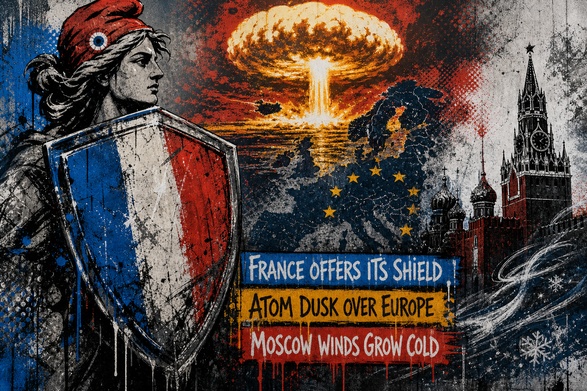
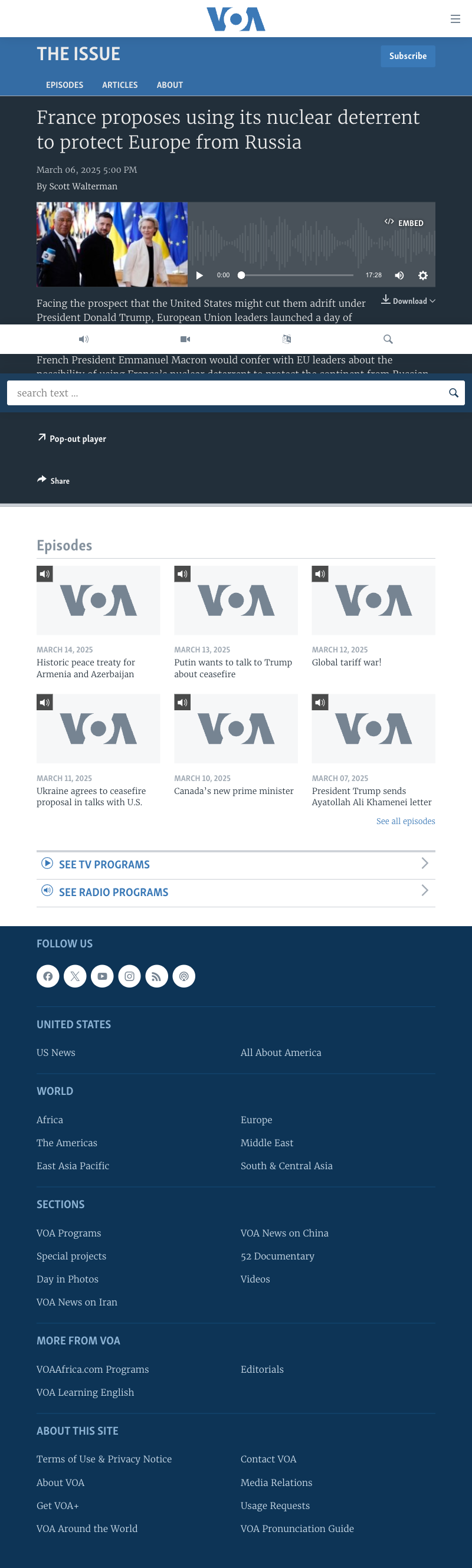 | author: | Scott Walterman | institution: | Voice of America | ¿porque no los dos? |
| tl;dr | A Voice of America episode reports that French President Emmanuel Macron is exploring talks with EU leaders about extending France’s nuclear deterrent to protect Europe from Russia. The piece frames the idea amid concern that a future Trump-led United States might be a less reliable defender of Europe. It highlights the concept of a French-led nuclear umbrella for the EU as a response to Russia’s threat. | ||||
| deeper: | The article’s headline and lede are factual and newsworthy, and the sourcing appears tied to on-record statements about Macron’s proposal. However, the framing foregrounds European anxiety about Donald Trump potentially abandoning Europe, which nudges the narrative toward a skeptical view of a Trump-led U.S. without equal space for countervailing arguments (e.g., NATO treaty obligations, current U.S. defense policy, the role of the UK’s nuclear deterrent, or European skepticism toward a French nuclear umbrella). More balance would include perspectives from NATO officials, central/eastern European governments, and defense analysts on feasibility, command-and-control, costs, and legal constraints. Still, the piece communicates the core development clearly and situates it within the Russia threat context, giving it solid but not exhaustive quality. | ||||
media: No Media Preview | |||||
| gen: 2026/07/18:02:17 in 1 min 0.8 sec (old)bias: 0 (Unknown) |
| type: newsquality: 5 |
| pts: 0 |
 | author: | Unknown | institution: | Voice of America (VOA) | ¿porque no los dos? |
| tl;dr | The image shows an "Access Denied" page from voanews.com via Akamai. No article text is visible, so the content of the reported piece cannot be evaluated. The URL slug implies a story about France proposing to use its nuclear deterrent to help protect Europe from Russia, but the article itself is inaccessible in the screenshot. | ||||
| deeper: | Because the article text is not accessible, I cannot judge framing, sourcing, or balance. The bias score is set to 0 only because there is no content to evaluate, not because the story is unbiased. The quality score is low (5/100) for this screenshot since it contains only an error message and provides no reporting. The institution appears to be Voice of America based on the domain, but the author and the article’s details are unknown. | ||||
media: No Media Preview | |||||
| gen: 2026/07/10:17:15 in 1 min 7.1 sec (old)bias: 2 (Center) |
| type: newsquality: 85 |
| pts: 0 |

 | author: | The Associated Press | institution: | NPR | ¿porque no los dos? |
| tl;dr | A wildfire in Spain, one of the deadliest in recent history, has killed at least 12 people and left 23 missing in the Almería province. The extreme heat and climate conditions have intensified the fire's impact, and foreign nationals are among those affected. This is part of a trend of increasing wildfires attributed to climate change in southern Europe. | ||||
| deeper: | The article provides factual reporting on the wildfire with insights into climate change as a contributing factor. It remains balanced while highlighting the severity of weather patterns that may be influenced by global warming. The quality is high, with data and expert opinions supporting the narrative, and it avoids sensationalism. | ||||
media: | |||||
You made it to the bottom. Now dance!


owned and operated by: RPN Omnigalactic Insitutution as of: 2026/10/14: 11:11 in 0 ms
Enter Code
Login with Account