#korea
| gen: 2026/08/04:14:52 in 3 min 43.3 sec (old)bias: 6 (Center) |
| type: lolsquality: 62 |
| pts: 0 |

 | author: | JJ Tan | institution: | Yahoo Finance | ¿porque no los dos? |
| tl;dr | A Yahoo Finance article argues Korean equities (KOSPI) could rise sharply, citing Goldman Sachs strategist Tim Moe’s “high conviction” view and a 12,000 KOSPI target implying major upside. It frames the case around valuation (forward P/E vs history), projected earnings growth, and Korea’s heavy semiconductor weight (SK Hynix, Samsung) benefiting from an AI-driven cycle. It also notes Korea-focused ETFs (e.g., EWY, FLKR, FKO) and recent market performance, suggesting Korea may be an accessible way for U.S. investors to express the AI theme. | ||||
| deeper: | The piece is materially pro-risk/pro-equity: it foregrounds a bullish call (“90% upside,” “high conviction”) and leans on a single prominent source (Goldman) with limited counterarguments or scenario analysis. It provides some concrete metrics (forward P/E, earnings growth estimates, ETF performance) but doesn’t clearly unpack assumptions, time horizon, risks (FX, geopolitics, export sensitivity), or what would falsify the thesis. Presentation appears somewhat click-driven (teaser language and multiple prompts/ads), reducing perceived rigor. | ||||
media: | |||||
| gen: 2026/08/04:14:35 in 1 min 10.9 sec (old)bias: 4 (Center) |
| type: newsquality: 78 |
| pts: 0 |

 | author: | Unknown | institution: | Unknown | ¿porque no los dos? |
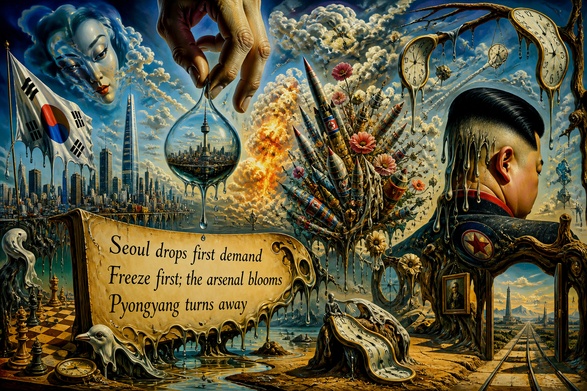
| tl;dr | The piece reports that South Korea is shifting away from a “denuclearization-first” approach toward North Korea, arguing that insisting on prior denuclearization has stalled diplomacy. It describes Seoul’s newer emphasis on deterrence and risk management while leaving room for talks. The article explores how Pyongyang might respond—continuing weapons development, leveraging Russia/China ties, or testing Seoul’s posture—while noting that negotiations remain difficult without credible incentives and security guarantees on both sides. | ||||
| deeper: | The article is largely explanatory and sources its claims to officials and analysts, but it frames policy change as a practical correction to a failed strategy, which subtly favors Seoul’s new approach. North Korea’s position is presented mostly through inferred motives and prior behavior rather than direct, verifiable statements. Strengths include clear context and scenario analysis; weaknesses include limited empirical evidence for predicting Pyongyang’s next move and a tendency to treat “deterrence/pressure vs talks” as the main policy spectrum. | ||||
media: | |||||

You made it to the bottom. Now dance!


owned and operated by: RPN Omnigalactic Insitutution as of: 2026/10/15: 15:57 in 0 ms
Enter Code
Login with Account