#geopolitics
| gen: 2026/10/06:04:06 in 20.9 sec (old)bias: 2 (Center) |
| type: newsquality: 76 |
| pts: 0 |

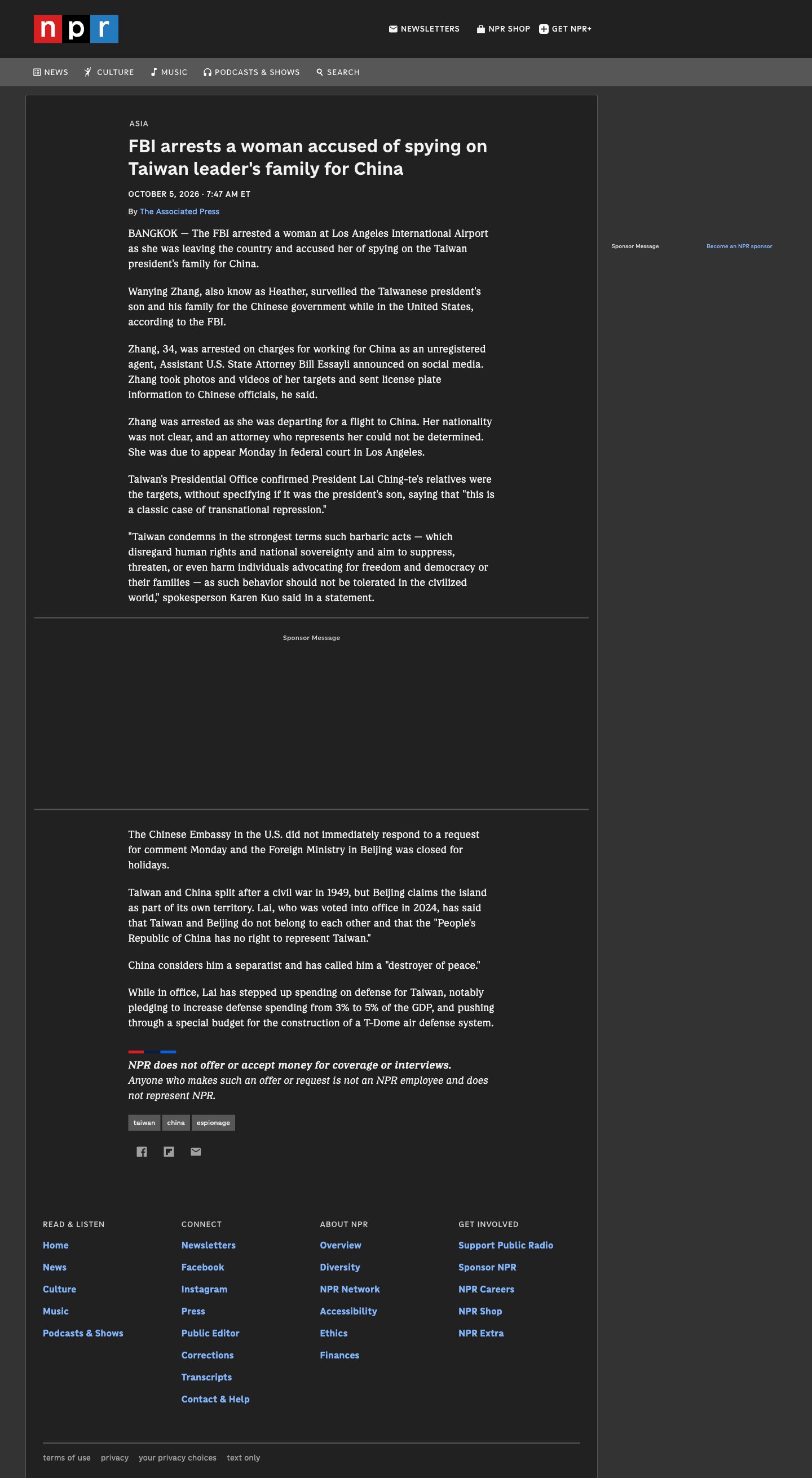 | author: | The Associated Press | institution: | NPR | ¿porque no los dos? |
| tl;dr | The article reports that the FBI arrested Wanying Zhang at Los Angeles International Airport for allegedly acting as an unregistered Chinese agent. Authorities accuse her of monitoring Taiwanese President Lai Ching-te’s relatives in the United States and sending photographs, videos, and license plate information to Chinese officials. Taiwan condemned the alleged surveillance as transnational repression. No defense response was available, and China’s embassy did not immediately comment. The article also outlines tensions over Taiwan’s status and Lai’s defense spending plans. | ||||
| deeper: | The report generally distinguishes accusations from established facts and attributes inflammatory language to officials rather than adopting it. U.S. and Taiwanese government accounts dominate, but it notes efforts to obtain Chinese comment and the absence of an identifiable defense lawyer. This creates a limited official-source slant without a clear left–right agenda. Useful context and specific allegations strengthen the reporting; the lack of court-document detail or independent corroboration limits it. The unusual title “Assistant U.S. State Attorney” also warrants verification. | ||||
media: | |||||
| gen: 2026/09/28:05:17 in 26.6 sec (old)bias: 3 (Center) |
| type: newsquality: 82 |
| pts: 0 |
 | author: | Scilla Alecci | institution: | International Consortium of Investigative Journalists (ICIJ) | ¿porque no los dos? |
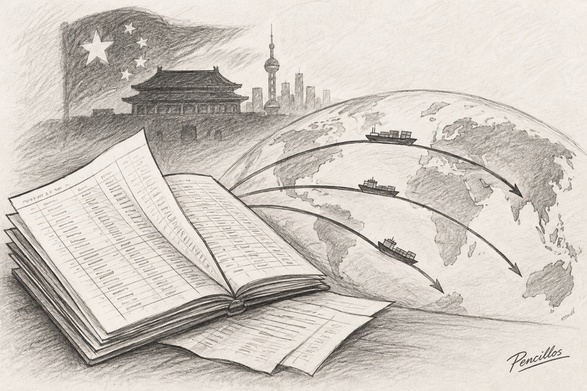
| tl;dr | The article summarizes an ICIJ investigation alleging that ICBC used international lending to advance China’s political and strategic interests, sometimes overriding financial risks and compliance concerns. Drawing on 4.8 million confidential records and partner reporting, it describes deals involving infrastructure, natural resources, technology and military-linked companies across four continents. It also examines relationships involving businesses connected to sanctioned Belarusian interests. ICBC did not respond to requests for comment; Zoomlion said it complies with applicable laws. | ||||
| deeper: | Specific document quotations, financial figures, named sources and links to partner reporting give the article substantial evidentiary support. It acknowledges an unknown loan outcome, includes Zoomlion’s response and notes unanswered requests for comment. However, phrases such as “notoriously secretive” and the consistently geopolitical framing sometimes blur commercial strategy with political intent. Alternative explanations receive limited attention. Its emphasis on transparency and regulatory accountability does not establish a clear left-right agenda. This is a well-supported investigative roundup, although the underlying records cannot be independently checked from these screenshots. | ||||
media: | |||||
| gen: 2026/09/19:21:46 in 25.6 sec (old)bias: 3 (Center) |
| type: newsquality: 76 |
| pts: 0 |
 | author: | Jacob Silverman | institution: | International Consortium of Investigative Journalists (ICIJ) | ¿porque no los dos? |
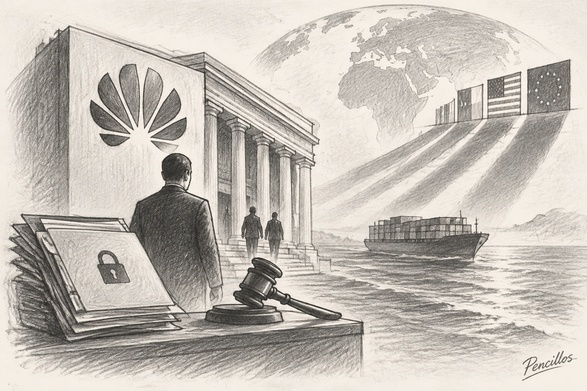
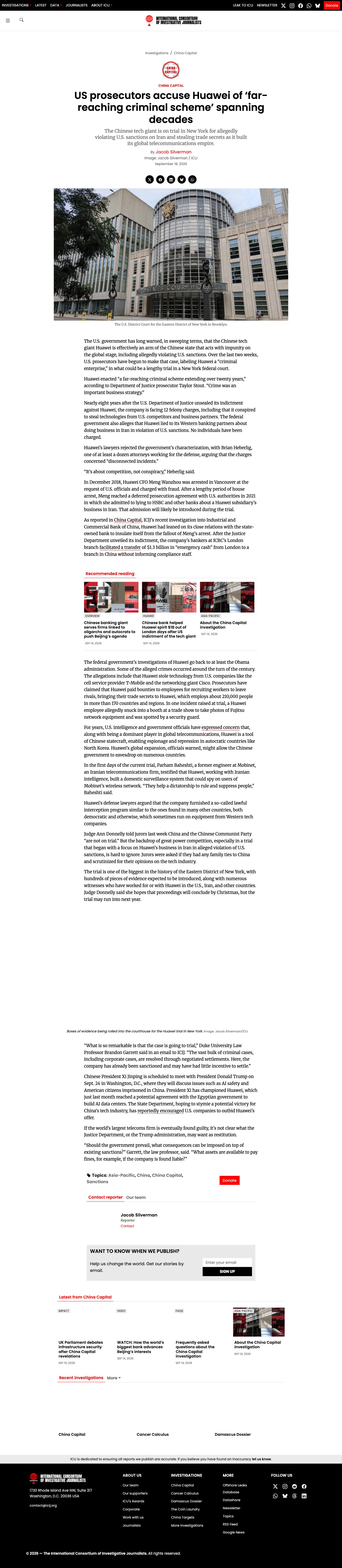
| tl;dr | The article reports on Huawei’s New York federal trial over alleged trade-secret theft, bank deception and violations of U.S. sanctions on Iran. Prosecutors describe a decades-long criminal scheme; Huawei’s lawyers characterize the accusations as disconnected incidents and legitimate competition. The report also covers testimony about surveillance technology in Iran, Huawei’s banking relationships and U.S.–China technology rivalry. A legal expert questions what additional penalties could accomplish given existing sanctions. No verdict is reported. | ||||
| deeper: | The headline accurately attributes its strong accusation, and the article includes defense arguments, named sources and independent legal commentary. However, prosecution claims and national-security concerns dominate, giving Huawei’s alleged wrongdoing greater emphasis than its rebuttals. This is a prosecution-leaning frame, not a clear left–right position. Historical context adds value, but “No individuals have been charged” needs qualification given the later account of Meng’s charges. The sweeping claim about the trial’s historic size is unsupported, and the screenshots alone cannot verify the reported proceedings. | ||||
media: | |||||
| gen: 2026/09/19:21:43 in 34.5 sec (old)bias: 3 (Center) |
| type: newsquality: 88 |
| pts: 0 |

| gen: 2026/09/14:19:34 in 33.1 sec (old)bias: 3 (Center) |
| type: newsquality: 65 |
| pts: 0 |
 | author: | Diaa Hadid | institution: | NPR | ¿porque no los dos? |
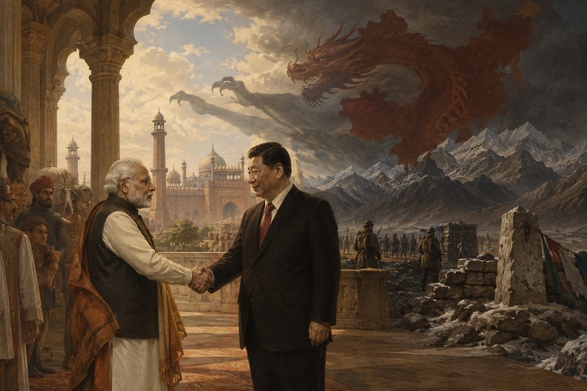
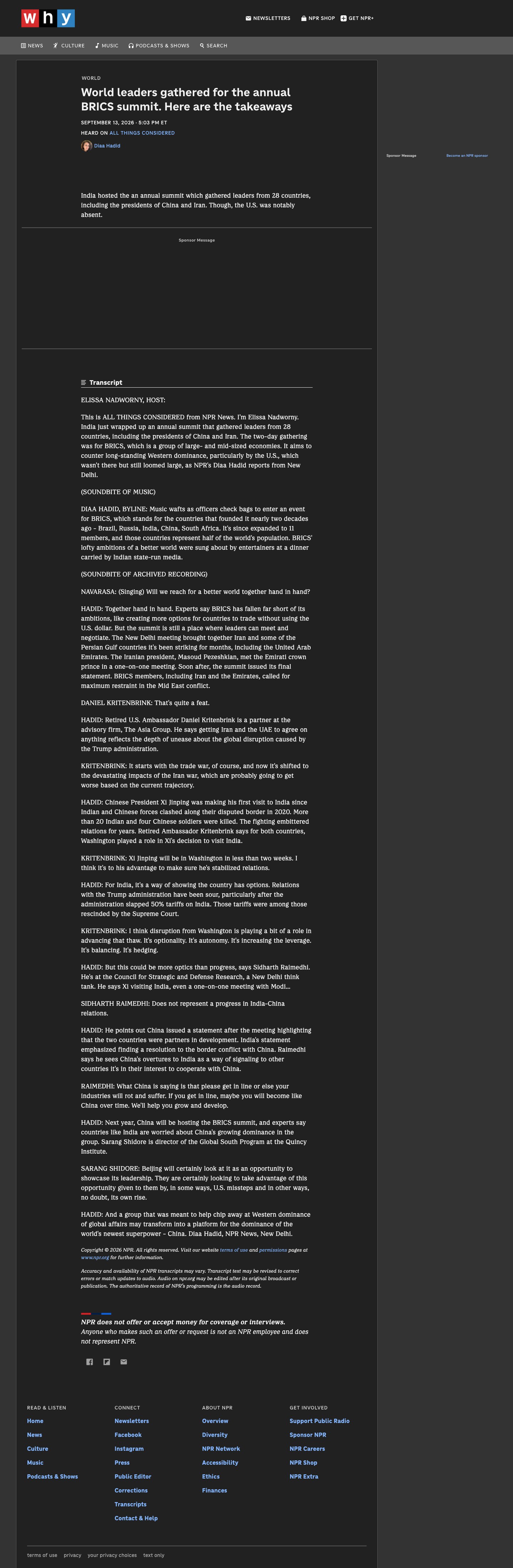
| tl;dr | The article reports that India hosted a BRICS summit focused on diplomacy amid trade tensions and Middle East conflict. It highlights an Iran–UAE meeting, renewed India–China engagement, and calls for restraint. Analysts suggest U.S. policies are encouraging countries to seek alternatives, while unresolved border disputes limit India–China cooperation. The report concludes that China could increasingly dominate BRICS, despite the group’s limited progress toward goals such as reducing reliance on the U.S. dollar. | ||||
| deeper: | The report includes named experts, historical context, and skepticism about BRICS’ achievements. Its geopolitical outlook does not clearly favor a left- or right-wing agenda. However, repeated emphasis on U.S. disruption and China’s dominance narrows the framing, with little direct response from those governments. Some dramatic interpretations receive limited scrutiny. There are factual imprecisions: South Africa joined later rather than founding the original group, and the established Indian death toll in the 2020 border clash was 20, not more than 20. The screenshot alone cannot authenticate its major event claims. | ||||
media: | |||||
| gen: 2026/09/13:15:25 in 41.5 sec (old)bias: 3 (Center) |
| type: newsquality: 57 |
| pts: 0 |
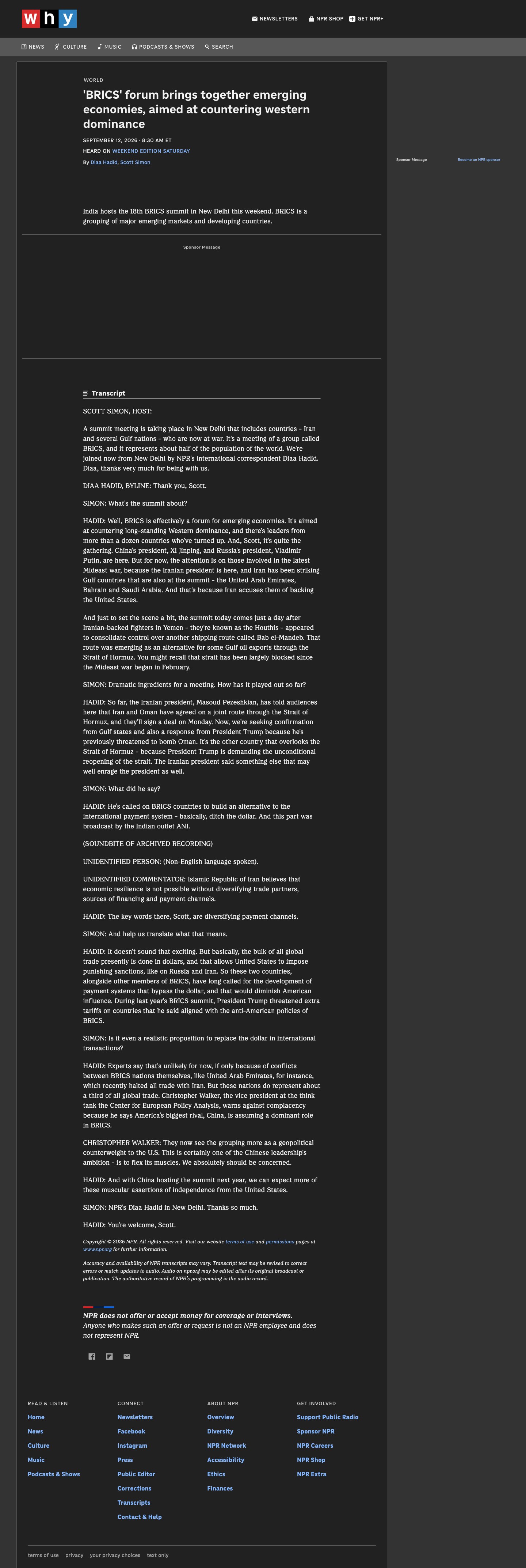 | author: | Diaa Hadid, Scott Simon | institution: | NPR | ¿porque no los dos? |
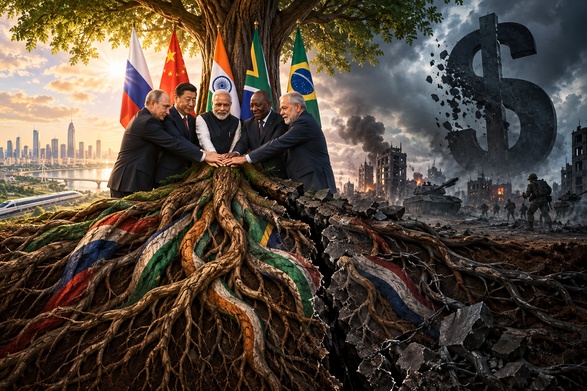
| tl;dr | The article describes a BRICS summit in New Delhi focused on Middle East conflict and efforts to reduce reliance on the U.S. dollar. It reports Iran’s announcement of a proposed shipping arrangement with Oman and calls for alternative payment channels. Internal disputes among BRICS members are presented as obstacles to replacing the dollar, while an analyst warns of China’s growing influence. Significant claims about warfare, shipping disruptions and U.S. threats are presented but cannot be independently verified from the screenshots. | ||||
| deeper: | The report explains financial issues accessibly, attributes Iran’s proposed deal and acknowledges that confirmation is pending. However, major claims about attacks, trade restrictions and threats to bomb Oman lack supporting evidence in the text. Its U.S.-centered framing and closing warning about China favor a security-threat perspective, without a clear left/right agenda. Phrases such as “enrage the president” introduce speculation. One analyst supplies the main outside assessment, and “ditch the dollar” oversimplifies the quoted call to diversify payment channels. | ||||
media: | |||||
| gen: 2026/09/09:15:27 in 44.7 sec (old)bias: 4 (Center-Left) |
| type: newsquality: 78 |
| pts: 0 |

#russia#north korea#infrastructure#geopolitics#war#northkorea#tumenriver#khasan#tumangang#bridgeopening1st

| gen: 2026/08/20:14:39 in 3 min 38.3 sec (old)bias: 3 (Center) |
| type: lolsquality: 72 |
| pts: 0 |

#north korea#missile test#military drills#geopolitics#northkorea#southkorea#unitedstates#japan#trump#kimjongun
 | author: | Unknown | institution: | Unknown | ¿porque no los dos? |
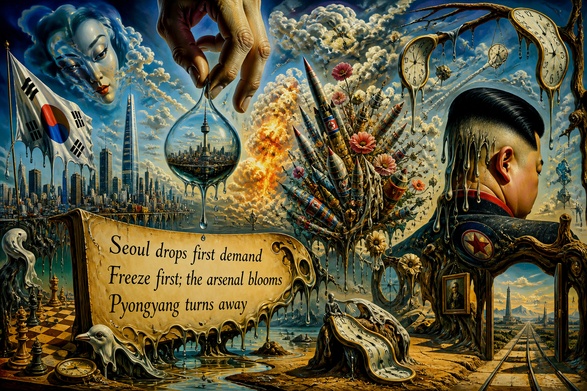
| tl;dr | The article reports that North Korea launched short-range ballistic missiles toward the sea and claims this was in response to renewed South Korea–U.S. military exercises. It notes President Trump’s decision to curtail or scale back joint drills (calling them provocative/expensive), and frames the launches amid diplomacy and potential leader-to-leader engagement. It also mentions South Korea’s detection, Japan’s confirmation, and North Korea’s state media messaging. | ||||
| deeper: | The piece is largely straight-news: it attributes claims (e.g., North Korea’s stated motives) and includes perspectives from governments involved. Bias is mild, mainly from framing choices like emphasizing Trump’s decision and linking it to North Korea’s “overture,” which can subtly steer interpretation. Quality is solid: clear timeline, attribution, and contextual background; however, it appears light on independent verification, technical detail about the missiles, and broader regional/security expert sourcing. | ||||
media: | |||||
| gen: 2026/08/13:04:37 in 2 min 51.8 sec (old)bias: 4 (Center) |
| type: lolsquality: 60 |
| pts: 0 |
| gen: 2026/08/12:19:27 in 49.4 sec (old)bias: 4 (Center-Left) |
| type: newsquality: 78 |
| pts: 0 |
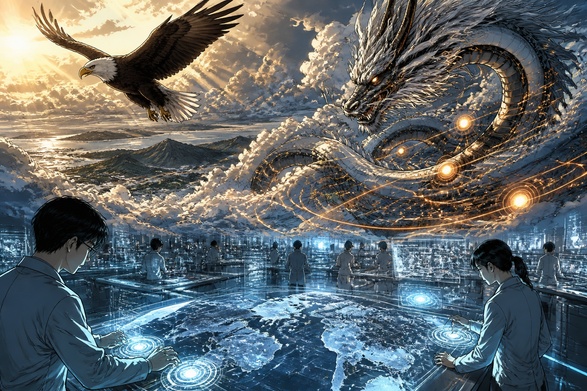
 | author: | Terry Gross | institution: | WHYY / NPR | ¿porque no los dos? |
| tl;dr | A WHYY/NPR World segment titled “Has the U.S. lost its dominance to China?” (Aug. 12, 2026) frames U.S.–China relations as a great-power rivalry focused on technology, research, sanctions, and trade. The page highlights related items about China retaliating against U.S. sanctions and the U.S. losing ground in university research. The teaser says Beijing may be benefiting from the war in Iran and Trump-era tariffs, and features discussion with The New Yorker’s Evan Osnos about “The Future, Made in China.” | ||||
| deeper: | The framing (“lost its dominance,” “great power rivalry,” “losing ground”) emphasizes competition and U.S. relative decline, which can steer interpretation before evidence is presented. The teaser also asserts causal benefits to Beijing (Iran war, tariffs) without showing data in the screenshot, suggesting some agenda-setting via selection and tone. Still, it appears to be an interview-based explainer referencing a named journalist and specific reported work, which generally supports credibility; what’s missing here are visible primary sources, quantified measures of “dominance,” and explicit countervailing views in the excerpt shown. | ||||
media: | |||||
| gen: 2026/08/10:02:38 in 3 min 48.9 sec (old)bias: 4 (Center) |
| type: lolsquality: 62 |
| pts: 0 |
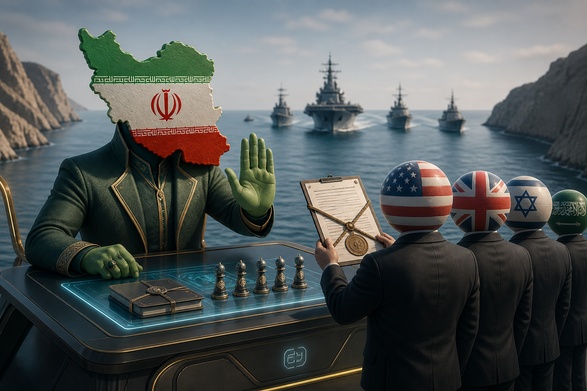
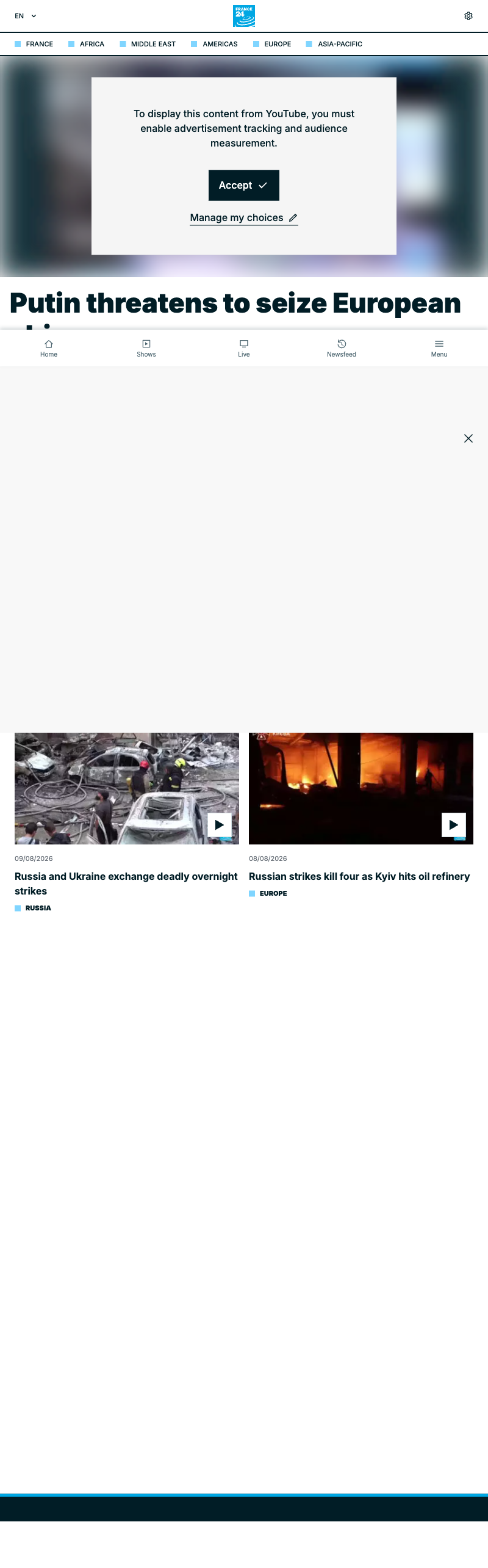
 | author: | Unknown | institution: | France 24 | ¿porque no los dos? |
| tl;dr | The image shows a France 24 news page focused on Middle East coverage. The main visible headline reads “Iran sets tough terms to reopen …” (the remainder is cut off), with related video items about Iran demanding concessions and a Saudi–Turkey–Pakistan pact framed as fallout from US–Iran conflict dynamics. A cookie/YouTube tracking consent pop-up blocks much of the primary story text, limiting what can be verified from the screenshot alone. | ||||
| deeper: | France 24’s presentation appears largely straight-news, but wording like “tough terms” and “demands” can subtly prime readers toward a confrontational frame. The screenshot provides headlines and thumbnails but little sourcing detail (no quoted officials, documents, or context visible) because the consent overlay blocks the article/video content. Quality is therefore moderate: reputable outlet and clear topic labeling, but the available evidence here is incomplete and headline-driven. | ||||
media: | |||||
| gen: 2026/08/08:22:43 in 3 min 3.1 sec (old)bias: 3 (Center) |
| type: lolsquality: 78 |
| pts: 0 |
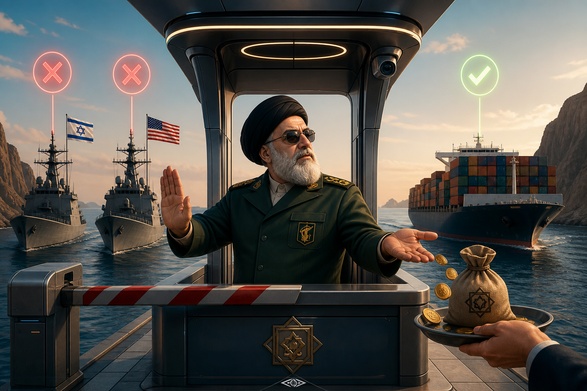
 | author: | Jon Gambrell | institution: | NPR | ¿porque no los dos? |
| tl;dr | The article reports Iran’s parliament advancing a proposal to bar U.S. and Israeli ships from transiting the Strait of Hormuz and to levy fees on other vessels, framing it as retaliation tied to regional conflict dynamics and maritime security. It situates the proposal within the strategic importance of Hormuz for global oil trade, notes reactions/concerns from the U.S. and regional actors, and references prior incidents and Iran-linked threats affecting shipping in and around the Red Sea and Gulf. | ||||
| deeper: | The writing is largely straight-news: it emphasizes verifiable facts (the proposal, the waterway’s importance, recent security context) and includes attribution to officials and prior events. Bias is limited but present in story framing that prioritizes Western/industry security concerns and treats Iran’s stated rationale with some skepticism. Quality is solid: clear headline, relevant background, and contextual history; it would be stronger with more direct Iranian parliamentary quotes and clearer distinction between proposal, likelihood of passage, and enforcement capability. | ||||
media: No Media Preview | |||||
| gen: 2026/08/05:04:14 in 3 min 37.6 sec (old)bias: 3 (Center) |
| type: lolsquality: 78 |
| pts: 0 |
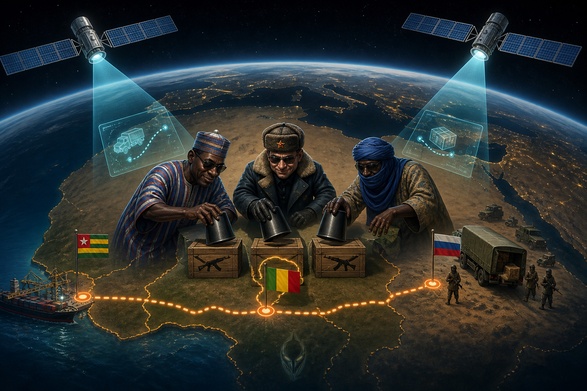
 | author: | Unknown | institution: | Unknown | ¿porque no los dos? |
| tl;dr | The piece argues that Togo—especially the port of Lomé—has become a key transit route for military equipment shipped from Russia and ultimately reaching Mali. It describes a tracked shipment, outlines Lomé’s role as a logistics corridor into the Sahel, and cites open-source evidence such as satellite imagery of a Russian cargo vessel and visuals of armored vehicles (including references to Chinese-made equipment). The article frames this as part of deepening Russia–Sahel security ties amid Mali’s shifting alliances. | ||||
| deeper: | Bias is relatively low: the article is largely evidence-driven and focused on tracing logistics, but it is framed around suspicion of Russian arms flows and may rely on inference when direct documentation is limited. Quality is strong: it uses concrete reporting hooks (tracked ship), specific locations (Lomé), and OSINT-style indicators (satellite imagery/visual identification). Limits include unclear visibility in places on sourcing granularity and the difficulty of conclusively proving end-users across borders without customs/manifest disclosures. | ||||
media: No Media Preview | |||||
| gen: 2026/08/05:04:11 in 3 min 39.7 sec (old)bias: 6 (Center-Left) |
| type: lolsquality: 72 |
| pts: 0 |

 | author: | Unknown | institution: | Al Jazeera (via Yahoo News) | ¿porque no los dos? |
| tl;dr | The image shows a Yahoo News page syndicating an Al Jazeera report titled “Israel approves $37m to seize more than 70 occupied West Bank sites.” The piece frames an Israeli government decision to allocate funds toward taking control of dozens of locations in the West Bank, describing the area as “occupied.” It presents the move as part of a broader policy affecting land, heritage/religious sites, and settlement-related control, with likely reference to international-law disputes and Palestinian impacts. | ||||
| deeper: | The headline and repeated use of “occupied West Bank” signals a clear framing aligned with common international-law language and emphasizes seizure/appropriation, which can prime readers toward viewing the policy as illegitimate. That’s a perspective, though also a widely used descriptor outside Israeli government messaging. The article appears to be straight-news focused on a concrete budget decision and specific counts (“$37m,” “more than 70”), which supports credibility, but the framing likely foregrounds Palestinian/legal critique more than Israeli justifications or internal legal arguments. | ||||

| gen: 2026/07/29:04:35 in 3 min 33.7 sec (old)bias: 3 (Center) |
| type: lolsquality: 83 |
| pts: 0 |
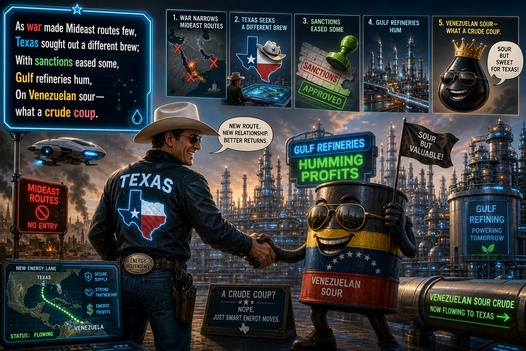
 | author: | Unknown | institution: | The Texas Tribune | ¿porque no los dos? |
| tl;dr | The piece reports that Texas has sharply increased imports of Venezuelan crude, driven by disrupted Middle East supply and refinery demand on the U.S. Gulf Coast. It explains how U.S. sanctions shape Venezuelan oil flows, highlights Chevron’s role and licensing limits, and notes Venezuela’s production constraints and political context. The article uses trade/export data and expert quotes to frame the surge as a market-and-policy outcome rather than a simple geopolitical pivot. | ||||
| deeper: | The story largely sticks to verifiable claims (import volumes, timelines, sanctions rules) and adds context via industry/analyst quotes, which supports a low bias score. Any tilt comes from emphasis choices—e.g., focusing on U.S. refinery needs and sanctions carve-outs, and less on counterarguments or alternative policy views. Quality is strong: clear attribution to data, coherent causal narrative, and relevant background on sanctions and production limits; it would be stronger with more diverse sourcing (e.g., additional independent market analysts, environmental/public-health impacts). | ||||
media: No Media Preview | |||||
| gen: 2026/07/28:14:04 in 4 min 48.9 sec (old)bias: 7 (Center-Right) |
| type: lolsquality: 45 |
| pts: 0 |
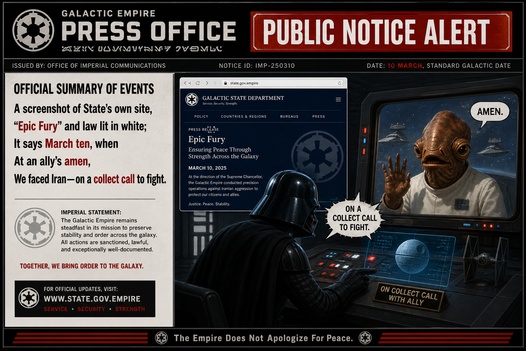
#geopolitics#intl law#diplomacy#middle east#us-iran#us state dept#israel#iran#self-defense#un security#operation epicfu
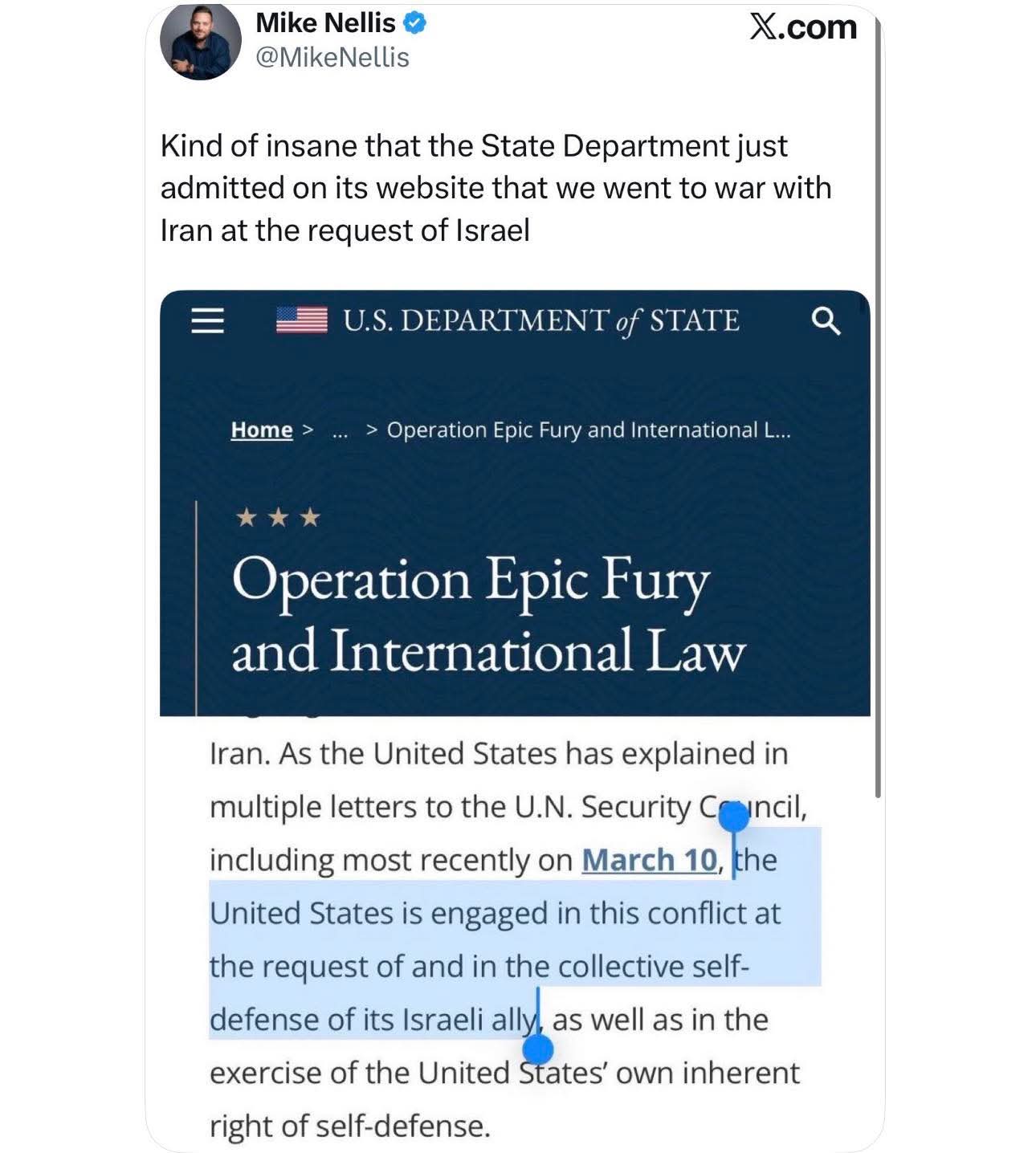 | author: | Mike Nellis | institution: | X.com | ¿porque no los dos? |
| tl;dr | The image is a screenshot of an X (Twitter) post claiming the U.S. State Department “admitted” the U.S. went to war with Iran “at the request of Israel.” The post cites a State Department page titled “Operation Epic Fury and International Law,” highlighting language that the U.S. is engaged in a conflict “at the request of” and in “collective self-defense of its Israeli ally.” The framing suggests a dramatic revelation, but the excerpt appears to describe a legal justification for U.S. actions tied to protecting an ally, not necessarily a broad U.S.–Iran war declaration. | ||||
| deeper: | The post uses loaded phrasing (“Kind of insane,” “admitted”) to imply scandal and simplify a complex legal/strategic context into a single causal claim. It relies on a cropped excerpt without the full surrounding text, definitions (what “this conflict” refers to), or the State Department’s broader argument. The underlying source (a State Department page) can be high-value evidence, but the presentation is selective and interpretive rather than explanatory, reducing reliability and increasing rhetorical bias. | ||||
media: No Media Preview | |||||
| gen: 2026/07/25:04:58 in 1 min 1.6 sec (old)bias: 4 (Center) |
| type: newsquality: 62 |
| pts: 0 |
 | author: | Unknown | institution: | Unknown | ¿porque no los dos? |
| tl;dr | The image is a very low-resolution, tall screenshot of a news article (appears to be from CNN based on layout/logo style) about oil markets. The headline and body text are not fully legible, but the visuals (an oil tanker at sea and a large refinery with a U.S. flag) and the structure suggest an explainer focused on why a recent oil-related development (likely production decisions, export dynamics, or price moves) is being interpreted a certain way—and why the immediate “panic” narrative may be overstated. Because key paragraphs and numbers can’t be reliably read, only high-level content assessment is possible from the visible formatting and imagery. | ||||
| deeper: | Content: The article is presented as an explainer (headline phrased as a ‘why’ question, long-form text, and contextual imagery). The inclusion of oil-tanker and refinery photography signals a focus on supply chains/production and U.S. energy infrastructure. Bias: What’s visible suggests an interpretive frame—guiding the reader toward a particular conclusion (e.g., “don’t overreact,” “here’s why this isn’t as bad/good as it sounds”). That kind of framing is not inherently partisan, but it can steer perception by selecting which risks, time horizons, and comparators to emphasize. Without readable quotations/data, I can’t verify balance across viewpoints (industry vs. consumers; producing states vs. importing states; environmental vs. energy-security angles). Hence a modest bias score rather than high. Quality: The layout indicates a standard, edited news explainer with sections and at least one prominent data/quote block, which typically supports clarity. However, from the image provided, I cannot confirm the accuracy of claims, whether it cites primary sources (EIA/IEA/OPEC), whether it separates fact from analysis, or whether it includes key counterarguments. That uncertainty lowers the score. If you can upload a higher-resolution screenshot (or paste the text/URL), I can score source use, numerical rigor, and argument balance more precisely. | ||||
| gen: 2026/07/24:13:04 in 1 min 27.1 sec (old)bias: 4 (Center) |
| type: newsquality: 72 |
| pts: 0 |
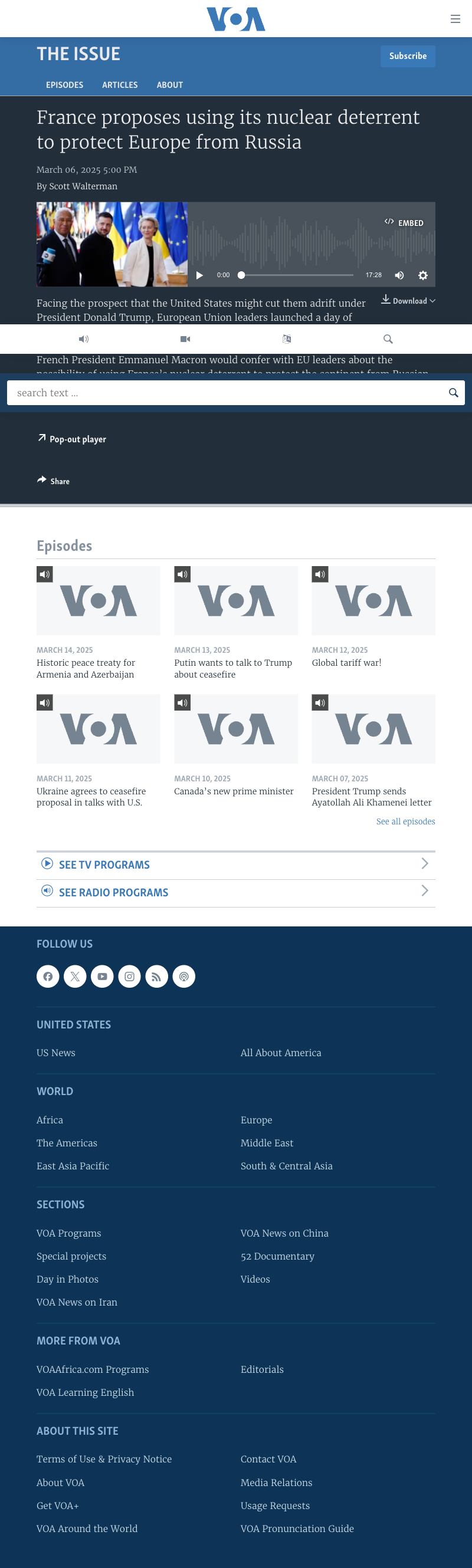 | author: | Scott Walterman | institution: | VOA (Voice of America) | ¿porque no los dos? |
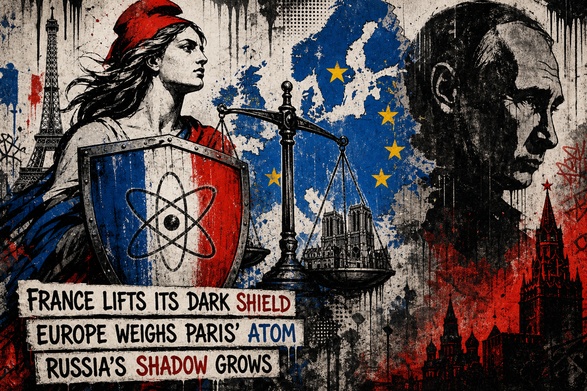
| tl;dr | The VOA “The Issue” episode/article reports that France is floating the idea of extending or leveraging its nuclear deterrent to help protect Europe against Russia, amid European anxiety that U.S. security guarantees could weaken under President Donald Trump. It frames the proposal as part of broader EU leader discussions on defense and deterrence, with Macron expected to consult EU partners on feasibility and implications. | ||||
| deeper: | Content & framing: The headline and lede position Russia as the primary external threat and present France’s nuclear umbrella concept as a protective measure for Europe, which is a broadly mainstream Western-security framing. The story also foregrounds uncertainty about U.S. commitments under Trump, which adds a political angle that may shape readers’ interpretation of urgency. Bias indicators: Language such as “protect Europe from Russia” is assertive and threat-forward; it largely treats the Russian threat premise as given rather than argued. From what’s visible, there’s limited sign of Russia’s perspective, skeptical European voices, or detailed counterarguments (e.g., escalation risks, legal/command-and-control constraints, NATO cohesion concerns) being equally centered—suggesting mild narrative slant rather than overt partisanship. Quality: The piece appears to be a reported explainer tied to a current policy debate, with clear identification of time, author, and subject, and an audio format that likely includes additional context. However, based on the screenshot, the visible text does not show sourcing depth (named officials, documents, experts), concrete policy mechanics (what “using” the deterrent would mean operationally), or explicit differentiation between proposal, trial balloon, and actionable plan. That keeps it solid but not top-tier. | ||||
media: No Media Preview | |||||
| gen: 2026/07/22:05:43 in 4 min 4.8 sec (old)bias: 2 (Center) |
| type: lolsquality: 78 |
| pts: 0 |
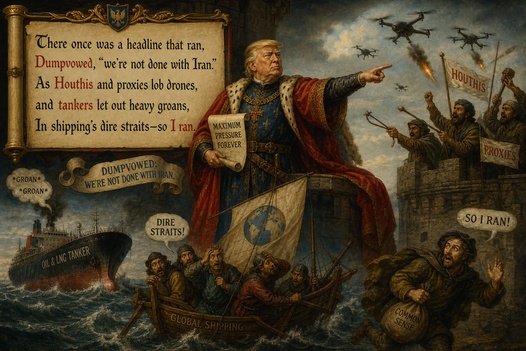
 | author: | Unknown | institution: | Unknown | ¿porque no los dos? |
| tl;dr | The piece reports on Donald Trump saying the U.S. is “not finished” attacking Iran as regional conflict escalates, and it situates his remarks alongside key developments (military actions, diplomatic reactions, and market/security implications). It relies heavily on direct quotations and attributed claims, aiming to summarize what was said and what happened rather than argue a single thesis. | ||||
| deeper: | Content: The central focus is Trump’s statement that the U.S. is “not finished” with attacks on Iran, framed within a broader, fast-moving conflict narrative. The story appears structured around (1) what Trump said, (2) what actions have occurred or are alleged, and (3) reactions/implications (regional actors, security posture, and likely economic/energy concerns). Bias: The language in the visible headline and sections is mostly descriptive and attribution-driven (quoting Trump and other officials/actors rather than asserting conclusions). The piece does use conflict-escalation framing (“conflict widens”), which is common in breaking-news coverage and can heighten urgency, but it is not overtly editorial. Any slant is mainly in story selection and emphasis—foregrounding Trump’s rhetoric and military escalation—rather than loaded adjectives or unchallenged moral claims. Quality: Stronger-than-average for a spot-news article: it appears to use multiple attributed sources, direct quotes, and sectioned context (e.g., health/threat and cost-of-war-type subsections visible in the screenshot). Limitations: it’s constrained by the breaking-news format (less space for deep verification, competing narratives, legal/strategic analysis, and historical background). It also appears to have intrusive overlays/pop-ups that interrupt reading (presentation/UX issue rather than reporting). Overall, it reads like a standard wire-style report: informative, but not deeply investigative. | ||||
media: | |||||


owned and operated by: RPN Omnigalactic Insitutution as of: 2026/10/13: 19:43 in 0 ms
Enter Code
Login with Account