#pentagon
| gen: 2026/09/12:23:33 in 33.3 sec (old)bias: 1 (Center) |
| type: lolsquality: 73 |
| pts: 0 |
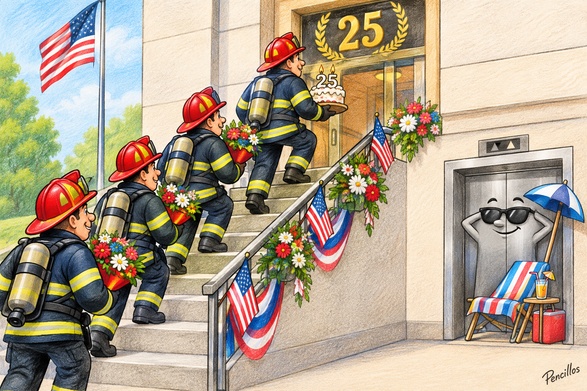
#remembrance#memorials#firefighters#history#september 11#9/11 memorial#commemorations#new york city#pentagon#arlington
 | author: | NPR Staff | institution: | NPR | ¿porque no los dos? |
| tl;dr | This photo essay presents nationwide commemorations of the September 11 attacks, labeled as the 25th anniversary in September 2026. Photos and captions emphasize mourning, remembrance and tributes to victims, firefighters and military personnel in New York, Arlington, St. Louis, Austin, Chicago and Shanksville. Captions also describe political leaders attending ceremonies and explain Flight 93 passengers’ resistance to hijackers. Most photographs beyond the opening three are not visible in the supplied screenshots. | ||||
| deeper: | The tone is respectful and commemorative, with an American civic focus but no clear partisan argument. Captions include leaders from both parties without praise or criticism. Named photographers, locations and agency credits strengthen attribution. Historical context is brief, appropriate for a photo essay, though the Austin caption incorrectly gives the towers’ height as 1,386 feet; their roof heights were 1,368 and 1,362 feet. Most images are missing from these screenshots, limiting visual assessment. The stated 2026 event details cannot be independently verified from the supplied material. | ||||
media: | |||||
| gen: 2026/09/03:04:17 in 35.1 sec (old)bias: 6 (Center-Left) |
| type: newsquality: 78 |
| pts: 0 |

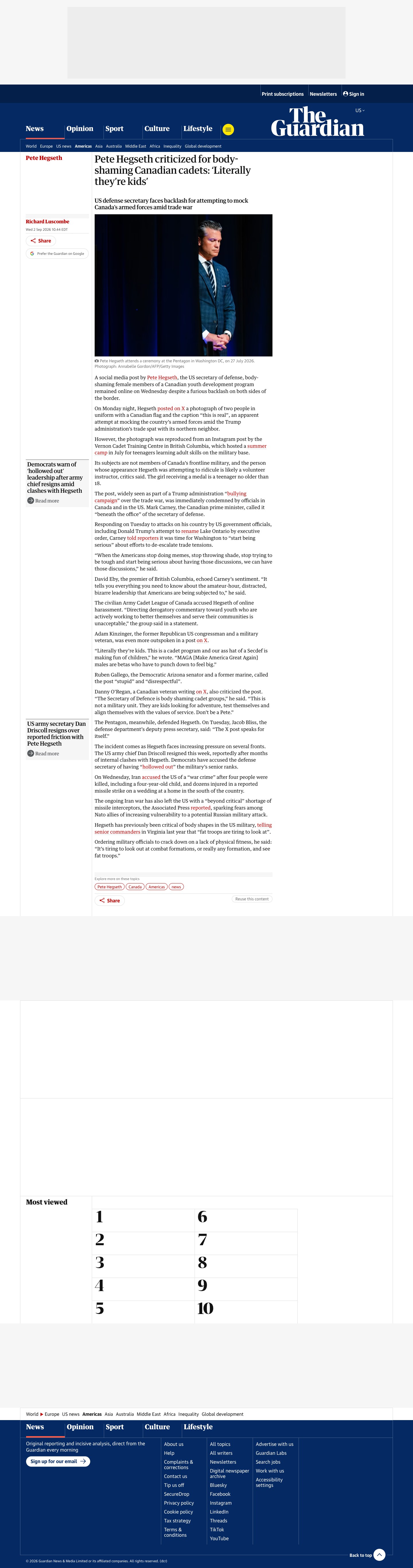 | author: | Richard Luscombe | institution: | The Guardian | ¿porque no los dos? |
| tl;dr | The article reports backlash after US defense secretary Pete Hegseth shared an X post mocking people in Canadian uniforms, which critics said amounted to body-shaming and targeting youths. The story says the photo actually came from a Canadian cadet/youth training program in British Columbia, not Canada’s frontline military. Canadian leaders including Prime Minister Mark Carney and BC premier David Eby condemned the post, as did US figures like Adam Kinzinger and Sen. Ruben Gallego. The Pentagon offered a minimal defense, saying the post “speaks for itself.” | ||||
| deeper: | The framing is strongly critical of Hegseth from the headline onward (“body-shaming”, “kids”) and foregrounds condemnations and harsh characterizations (“bullying campaign”, “amateur-hour”). It does include basic factual context (origin of the photo, cadet program) and a brief Pentagon response, but the balance of sourcing and tone leans toward amplifying criticism more than explaining Hegseth’s intent or providing fuller context about the trade dispute. Overall reporting is coherent and specific, with named sources and attributable quotes, but limited verification detail beyond the image provenance and reactions. | ||||
media: | |||||
| gen: 2026/08/19:05:17 in 1 min 6.5 secbias: 4 (Center-Left) |
| type: colorquality: 78 |
| pts: 0 |
Leftist
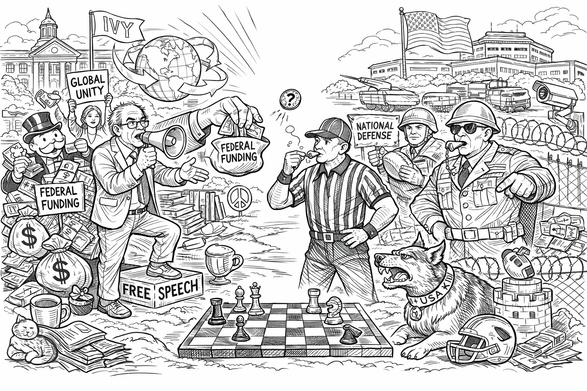
Folks, we're witnessing a wild move by the Pentagon, threatening to strip federal funding like a greedy Monopoly player hording cash! Thirty universities, including the Ivy League elites, caught in the capitalist crossfire for daring to collaborate globally. This is a slap-shot of nationalism right into the net of academic freedom. Institutions should be arenas
of cultural exchange, not battlegrounds for political grandstanding. The academic pitch is tilted, and education's getting the short end of the stick!
Rightist
Ladies and gents, the Pentagon's putting on a masterclass in safeguarding national interests! They're calling out universities like a football referee, ensuring no backdoor passes to foreign influence threaten the homeland! Those ivory towers need to wise up—can't be mingling with potential adversaries. It's about time we play defense like a seasoned linebacker!
America's got to ensure its brain trust runs right down patriotic lines. Secure the boundary, fortify the fort!
 | author: | Joseph Gedeon | institution: | The Guardian | ¿porque no los dos? |
| tl;dr | A Guardian report says the US Department of Defense has warned about 30 universities—including Harvard, Yale, and Stanford—that federal funding could be cut unless they review and potentially end certain foreign academic partnerships the Pentagon considers national-security risks. The piece describes the directive as part of broader US scrutiny of research ties (often involving China) and notes universities face pressure to increase transparency, reassess collaborations, and demonstrate compliance with federal reporting and security expectations. | ||||
| deeper: | The story is largely fact-driven (specific number of universities, named schools, and the asserted Pentagon warning) and uses a straightforward news tone. It leans slightly toward a civil-liberties/academic-freedom framing by emphasizing “threatens to cut funding” and highlighting security-driven scrutiny as pressure on universities, while giving less space to the Pentagon’s detailed rationale or concrete examples of compromised research. Overall quality is solid but limited by the screenshot context: it’s not clear how many primary documents are quoted or linked, and sourcing appears more descriptive than documentary. | ||||
media: | |||||
You made it to the bottom. Now dance!


owned and operated by: RPN Omnigalactic Insitutution as of: 2026/10/14: 15:08 in 0 ms
Enter Code
Login with Account