#texas gop
| gen: 2026/07/24:02:49 in 3 min 13.0 sec (old)bias: 4 (Center) |
| type: newsquality: 78 |
| pts: 0 |
 | author: | Gabby Birenbaum; Samantha Latibody | institution: | The Texas Tribune | ¿porque no los dos? |
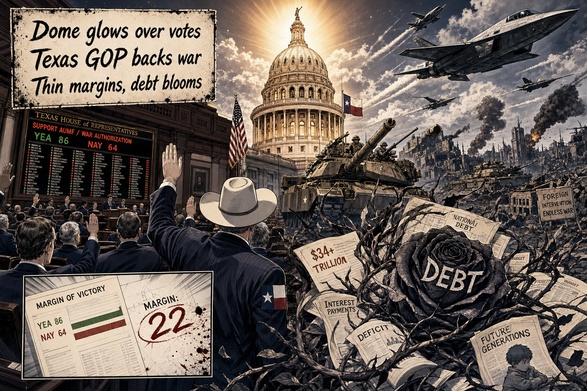
| tl;dr | A Texas Tribune report says Texas House Republicans largely backed a foreign-aid and national-security package—including funding tied to Israel and potential Iran-related escalation—while some Republicans opposed it on fiscal or anti-intervention grounds. The article frames the vote as a display of GOP unity on security spending (with notable dissent), explains what’s in the $95B package, and situates Texas members within the broader House political fight over foreign aid. | ||||
| deeper: | Content: The piece focuses on how Texas Republicans voted on (and justified) a major U.S. House foreign-aid/national-security spending package, emphasizing Israel/Iran-related funding elements while also discussing the broader bundle (commonly including Ukraine/Israel/Indo-Pacific components). It highlights intra-party dynamics—leadership support vs. hardline opposition—and uses member quotes and vote context to explain motivations. Bias: The article is mostly straight-news and attribution-heavy (quotes, vote outcome, political context). Potential bias comes from framing choices—foregrounding “Iran war funding” can prime readers toward seeing escalation rather than deterrence/defense, and the selection/order of quotes can subtly tilt sympathy toward or against the package. Still, it presents dissenting Republican arguments (e.g., spending concerns, skepticism of intervention) alongside supporters’ security arguments. Quality: Strong on basic reporting (who voted, what the package is, why factions split, how it fits into House politics). It appears to rely on verifiable public facts (roll-call dynamics, leadership strategy) and includes multiple perspectives. Limitations: the screenshoted article format suggests more political narrative than deep policy accounting; it likely does not fully quantify specific line items tied to Iran vs. broader defense/aid, nor does it deeply test lawmakers’ claims against independent budget analysis. Overall: solid, credible, and readable, with moderate framing effects but not overt advocacy. | ||||
media: | |||||
| gen: 2026/07/23:20:49 in 57.2 sec (old)bias: 3 (Center) |
| type: newsquality: 82 |
| pts: 0 |

#congress#iran war#texas#voting rights#texas gop#u.s. house#foreign aid#ukraine aid#israel aid#iran policy
 | author: | Gabby Birenbaum; Samantha Maldonado | institution: | The Texas Tribune | ¿porque no los dos? |
| tl;dr | The Texas Tribune article reports on the U.S. House passing a roughly $95 billion foreign-aid and national-security package that includes support for Ukraine, Israel, and Indo-Pacific partners, plus related measures. It highlights that many Texas Republicans who had previously opposed Ukraine aid backed the package this time—often framing their votes as necessary to deter Iran and support Israel—while some conservative Republicans still opposed it on “America first,” border, or spending grounds. The piece emphasizes intra-GOP dynamics, the role of House leadership, and how Israel/Iran considerations reshaped Republican coalitions around the vote. | ||||
| deeper: | Content: The story centers on a specific legislative outcome (House passage of a large foreign-aid package) and uses Texas Republicans as the lens, describing how and why their voting positions shifted, with attention to the Israel–Iran context and the Ukraine funding component. It appears to include vote counts, bill components, and quoted rationales from multiple sides (Republicans supporting the package, Republicans opposing it, and contextual background on party divisions). Bias: The language in the headline (“unite behind Iran war funding”) is somewhat loaded: it compresses a complex foreign-aid bundle into a frame that can read as “war funding,” which may nudge readers toward a more skeptical interpretation of the spending. However, the body (as presented) largely reads as conventional straight reporting—attributing motives, noting factional splits, and presenting competing arguments—rather than advocating a single position. Any bias is mostly in framing/word choice and what gets emphasized (party maneuvering, linkage to Iran/Israel) rather than in overt editorializing. Quality: Strong overall for a state-focused outlet covering federal politics: clear news peg, relevant Texas angle, apparent inclusion of concrete legislative details and direct quotes, and a coherent explanation of shifting coalitions. Limits: as a screenshot, sourcing depth is hard to fully verify; and the framing could more explicitly disentangle what portion of the package is directly tied to Iran/Israel versus broader security aid, to avoid conflation. Still, it appears well-structured and informative. | ||||
media: | |||||
You made it to the bottom. Now dance!


owned and operated by: RPN Omnigalactic Insitutution as of: 2026/10/16: 02:17 in 0 ms
Enter Code
Login with Account