#adaptation
| gen: 2026/08/08:22:49 in 2 min 52.1 sec (old)bias: 4 (Center-Left) |
| type: lolsquality: 78 |
| pts: 0 |

 | author: | Mélodie Sforza; Aruna Popuri; Constantin Simon; Théo Collet | institution: | France 24 | ¿porque no los dos? |
| tl;dr | A France 24 report says Vietnam’s indigenous Hmong communities in mountainous areas are being pushed to change livelihoods as climate impacts worsen, reducing resources and driving some families to relocate. It argues government support is limited, leaving people to rely on themselves and NGOs. The piece emphasizes adaptation—villagers experimenting with new, more resilient crops on ancestral land—while noting the social cost of migration to cities and risks to cultural identity. | ||||
| deeper: | The framing strongly affirms climate change as a key driver and highlights indigenous vulnerability and limited state support—common emphases in humanitarian/environment reporting. Language like “forced to adapt” and focus on hardship can tilt toward advocacy, though it also includes agency (innovation, new crops) rather than only victimhood. Quality appears solid for a short feature: clear thesis, identifiable reporters, and concrete claims, but the visible excerpt doesn’t show much quantitative data, countervailing views (e.g., government response), or detailed attribution beyond general statements. | ||||
media: | |||||
| gen: 2026/07/31:00:32 in 4 min 51.2 sec (old)bias: 4 (Center-Left) |
| type: lolsquality: 78 |
| pts: 0 |
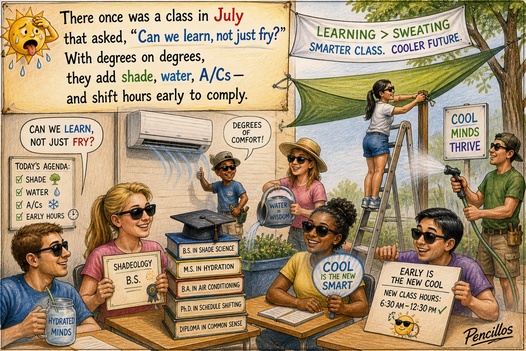
#climatechange#summerschool#extremeheat#adaptation#education#grist#summer school#heat waves#climate change#schools#ac cooling
 | author: | Unknown | institution: | Grist | ¿porque no los dos? |
| tl;dr | This Grist article argues that rising heat and more frequent heat waves are making summer school harder to run safely, especially in older school buildings without air conditioning. It describes how extreme heat affects student learning and health, how districts are canceling classes or shortening days during heat events, and how inequities widen because low-income communities are more likely to have under-cooled facilities. The piece discusses adaptation options (cooling upgrades, shade, ventilation, heat plans) and the cost and policy challenges of implementing them. | ||||
| deeper: | The article is framed through a climate-impact lens and emphasizes public investment and equity, which nudges it toward center-left advocacy rather than neutral “both-sides” framing. However, it largely sticks to practical reporting: describing heat risks, citing research on learning/health impacts, and using real-world examples from schools and districts. Quality is solid (clear narrative, concrete examples, relevant context), though it appears more focused on harms and remedies than on deeply testing counterarguments or providing extensive quantitative comparisons across regions. | ||||
media: | |||||
You made it to the bottom. Now dance!


owned and operated by: RPN Omnigalactic Insitutution as of: 2026/10/16: 08:43 in 0 ms
Enter Code
Login with Account