#education
| gen: 2026/09/23:04:50 in 35.9 sec (old)bias: 4 (Center-Left) |
| type: lolsquality: 85 |
| pts: 0 |
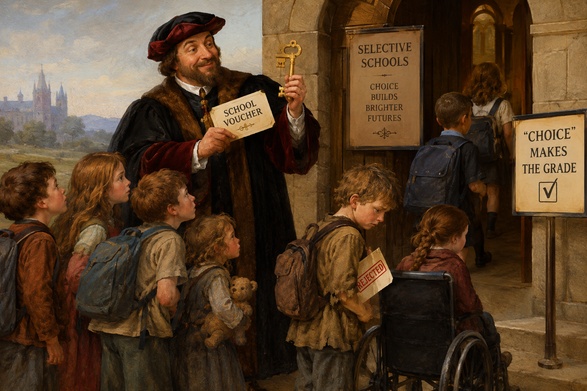
#education#disability#school vouchers#public policy#disability right#education policy#special educatio#private schools#public schools

| gen: 2026/09/03:23:24 in 30.9 sec (old)bias: 5 (Center-Left) |
| type: newsquality: 82 |
| pts: 0 |

| gen: 2026/08/20:15:15 in 34.7 sec (old)bias: 5 (Unknown) |
| type: newsquality: 20 |
| pts: 0 |
 | author: | Unknown | institution: | Unknown | ¿porque no los dos? |
| tl;dr | The provided image appears to be a long, dark-mode screenshot of a web article with a headline, an introductory section, and multiple subheadings/paragraph blocks. However, the text is too low-resolution to read reliably, so I can’t accurately summarize the article’s claims, evidence, or conclusions without risking inventing details. | ||||
| deeper: | Because the text isn’t legible at this resolution, any specific assessment of framing, sourcing, factuality, or loaded language would be guesswork. I’m assigning a middle bias score (unknown direction) and a low quality score based solely on the inability to audit the content. If you upload a higher-resolution screenshot or paste the article text/link, I can provide a grounded bias/quality/content analysis. | ||||
media: | |||||
| gen: 2026/08/20:15:13 in 47.1 sec (old)bias: 5 (Unknown) |
| type: newsquality: 20 |
| pts: 0 |


| gen: 2026/08/20:05:02 in 32.5 sec (old)bias: 5 (Unknown) |
| type: newsquality: 35 |
| pts: 0 |
 | author: | Unknown | institution: | Unknown | ¿porque no los dos? |
| tl;dr | The provided image appears to be a tall, low-resolution screenshot of a long-form web article with multiple subheads and at least one repeated header image (a flat-lay photo featuring a smartphone/desk items). However, the text is too small/blurry to read accurately, so I can’t reliably summarize the article’s claims, evidence, or conclusions without risking fabrication. If you share a higher-resolution image or the article URL/text, I can produce a precise content and bias/quality assessment. | ||||
| deeper: | Because the body text and headline are not legible at this resolution, any specific description of the story would be guesswork. The only observable features are presentation-level signals: a structured long-form layout with subheads and a stock-style hero image, which is common across outlets of varying rigor. With content unreadable, bias direction can’t be determined; a mid bias score reflects uncertainty rather than a finding. Quality is scored low-to-mid due to inability to verify sourcing, factual claims, or context from the image provided. | ||||
media: | |||||
| gen: 2026/08/19:05:17 in 1 min 6.5 secbias: 4 (Center-Left) |
| type: colorquality: 78 |
| pts: 0 |
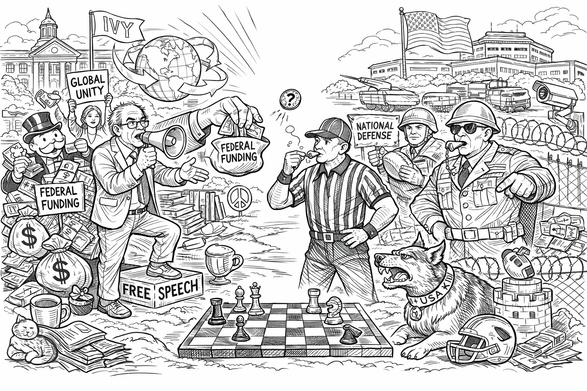
Leftist
Folks, we're witnessing a wild move by the Pentagon, threatening to strip federal funding like a greedy Monopoly player hording cash! Thirty universities, including the Ivy League elites, caught in the capitalist crossfire for daring to collaborate globally. This is a slap-shot of nationalism right into the net of academic freedom. Institutions should be arenas
of cultural exchange, not battlegrounds for political grandstanding. The academic pitch is tilted, and education's getting the short end of the stick!
Rightist
Ladies and gents, the Pentagon's putting on a masterclass in safeguarding national interests! They're calling out universities like a football referee, ensuring no backdoor passes to foreign influence threaten the homeland! Those ivory towers need to wise up—can't be mingling with potential adversaries. It's about time we play defense like a seasoned linebacker!
America's got to ensure its brain trust runs right down patriotic lines. Secure the boundary, fortify the fort!
 | author: | Joseph Gedeon | institution: | The Guardian | ¿porque no los dos? |
| tl;dr | A Guardian report says the US Department of Defense has warned about 30 universities—including Harvard, Yale, and Stanford—that federal funding could be cut unless they review and potentially end certain foreign academic partnerships the Pentagon considers national-security risks. The piece describes the directive as part of broader US scrutiny of research ties (often involving China) and notes universities face pressure to increase transparency, reassess collaborations, and demonstrate compliance with federal reporting and security expectations. | ||||
| deeper: | The story is largely fact-driven (specific number of universities, named schools, and the asserted Pentagon warning) and uses a straightforward news tone. It leans slightly toward a civil-liberties/academic-freedom framing by emphasizing “threatens to cut funding” and highlighting security-driven scrutiny as pressure on universities, while giving less space to the Pentagon’s detailed rationale or concrete examples of compromised research. Overall quality is solid but limited by the screenshot context: it’s not clear how many primary documents are quoted or linked, and sourcing appears more descriptive than documentary. | ||||
media: | |||||
| gen: 2026/08/17:18:43 in 37.8 sec (old)bias: 5 (Unknown) |
| type: newsquality: 25 |
| pts: 0 |

 | author: | Unknown | institution: | Unknown | ¿porque no los dos? |
| tl;dr | The provided image appears to be a long, vertically-scrolled screenshot of a news/article page featuring a photo of a brick institutional building (likely a school or public facility) and multiple paragraphs of text. However, the text is too low-resolution to read reliably, so I can’t accurately summarize the article’s specific claims, evidence, or conclusions from this image alone. | ||||
| deeper: | Because the text is not legible, I can’t verify what is being asserted, what sources are cited, or whether competing viewpoints are represented. That makes any bias/quality judgment inherently uncertain. The only clear elements are the layout (headline area, author block, long body text, and at least one subscription/prompt box), which suggests a standard article format but provides no readable substantiation. | ||||
media: | |||||
| gen: 2026/08/02:23:36 in 2 min 17.4 sec (old)bias: 4 (Center-Left) |
| type: lolsquality: 78 |
| pts: 0 |

#education#schoolboard#civics#journalism#investigation#texas#legislature#specialsession#publicschool#policy
 | author: | Unknown | institution: | ProPublica | ¿porque no los dos? |
| tl;dr | The image appears to be a ProPublica investigative-style article page focused on a Texas “special session” and education policy, with emphasis on political maneuvering and the consequences for public schooling. The layout and accompanying photo suggest reporting on lawmakers, power brokers, and policy outcomes (likely a contested education initiative) rather than a straight breaking-news brief. The text is too small in this screenshot to reliably extract precise claims, names, or figures without risk of misquoting. | ||||
| deeper: | The article presentation and outlet indicate accountability journalism: it appears to scrutinize government actions, highlight impacts on public institutions, and foreground power dynamics—an approach that can create a mild-to-moderate leaning toward reform/oversight framing. ProPublica generally uses document-heavy, narrative investigations and emphasizes public-interest harms, which supports a strong quality score. However, this specific screenshot is not legible enough to verify the exact sourcing, counterarguments, or key details, so the quality score is tempered. | ||||
media: | |||||
| gen: 2026/07/31:00:32 in 4 min 51.2 sec (old)bias: 4 (Center-Left) |
| type: lolsquality: 78 |
| pts: 0 |
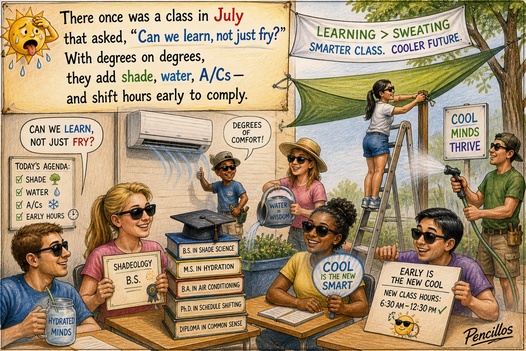
#climatechange#summerschool#extremeheat#adaptation#education#grist#summer school#heat waves#climate change#schools#ac cooling
 | author: | Unknown | institution: | Grist | ¿porque no los dos? |
| tl;dr | This Grist article argues that rising heat and more frequent heat waves are making summer school harder to run safely, especially in older school buildings without air conditioning. It describes how extreme heat affects student learning and health, how districts are canceling classes or shortening days during heat events, and how inequities widen because low-income communities are more likely to have under-cooled facilities. The piece discusses adaptation options (cooling upgrades, shade, ventilation, heat plans) and the cost and policy challenges of implementing them. | ||||
| deeper: | The article is framed through a climate-impact lens and emphasizes public investment and equity, which nudges it toward center-left advocacy rather than neutral “both-sides” framing. However, it largely sticks to practical reporting: describing heat risks, citing research on learning/health impacts, and using real-world examples from schools and districts. Quality is solid (clear narrative, concrete examples, relevant context), though it appears more focused on harms and remedies than on deeply testing counterarguments or providing extensive quantitative comparisons across regions. | ||||
media: | |||||
| gen: 2026/07/28:14:18 in 4 min 54.9 sec (old)bias: 3 (Center-Left) |
| type: lolsquality: 82 |
| pts: 0 |
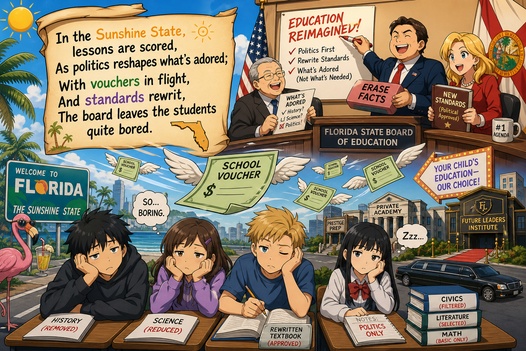
 | author: | Unknown | institution: | ProPublica | ¿porque no los dos? |
| tl;dr | The image appears to be a ProPublica long-form investigative article page (headline, byline area, multiple long text sections, and at least one in-article photo). Due to the screenshot’s very low resolution, the exact headline, named subjects, and specific claims are not reliably legible; I can’t accurately summarize the article’s factual allegations without risking invention. Structurally, it reads like an investigative exposé: narrative lede, extensive reporting blocks, and supporting imagery. | ||||
| deeper: | Bias: The presentation looks like accountability/investigative reporting aimed at scrutinizing institutions or powerful actors, which typically reflects a mild values tilt toward transparency and reform; however, I can’t verify balance (e.g., right-of-reply) from this unreadable screenshot. Quality: The layout suggests substantial original reporting (length, structure, documentary tone, photos), which generally correlates with higher rigor—but the image resolution prevents checking sourcing, data, and whether opposing perspectives are fairly represented. | ||||
media: | |||||
| gen: 2026/07/22:15:47 in 5 min 40.3 sec (old)bias: 6 (Center-Left) |
| type: lolsquality: 82 |
| pts: 0 |
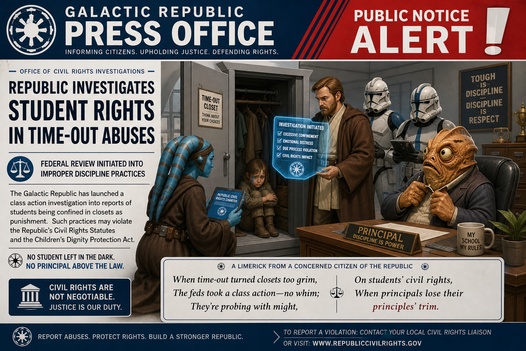
#education#civil rights#schools#government#investigations#teachers#socialmedia#dei#curriculum#censorship
 | author: | Unknown | institution: | ProPublica | ¿porque no los dos? |
| tl;dr | The piece reports that a new education leadership team has moved quickly to restrict teachers’ online speech and tighten control over what school websites and materials can include—explicitly targeting DEI-related content and what officials label “indoctrination.” It frames these actions as an aggressive, top-down shift that could chill speech, reshape curricula, and limit students’ access to information, while describing the rationale offered by the administration and the concerns raised by educators and critics. | ||||
| deeper: | Bias: The headline and framing use loaded, evaluative wording (e.g., “crackdown”) and the narrative emphasis appears to foreground harms such as chilling effects, censorship concerns, and politicization of schools. Quotation marks around “indoctrination” also signal skepticism toward the administration’s premise. That said, the article is largely presented as reported accountability journalism rather than pure opinion, and it appears to rely on policy descriptions and documented actions. Quality: Strong overall. The layout and structure are consistent with a reported investigation: it is long-form, specific about the actions being taken (social media restrictions; removal/blocking of DEI-related web content), and it reads like it is based on sourcing and documentation rather than anonymous assertion. The main quality limitation from what’s visible in the screenshot is that the article’s balance depends on how fully it includes the administration’s full justification and the precise text of policies; the rhetorical framing may lead some readers to feel the conclusion is signposted early. But as presented, it looks thoroughly reported and substantively grounded. | ||||
| gen: 2026/07/22:15:44 in 3 min 42.9 sec (old)bias: 4 (Center-Left) |
| type: lolsquality: 82 |
| pts: 0 |

#education#charter schools#virtual learning#accessibility#journalism#schoolboard#elections#advocacy#donors#funding
 | author: | Unknown | institution: | ProPublica | ¿porque no los dos? |
| tl;dr | This is a ProPublica long-form investigative piece in the Education section. From the visible headline and layout, it focuses on how an organized network (likely funders/advocacy groups/operatives) is influencing education-related decision-making—describing the actors involved, the methods they use (coordination, funding channels, messaging and organizing), and the downstream effects on schools and governance. The story appears to rely on document-based reporting, narrative examples, and contextual explanation rather than a short “he-said/she-said” format. | ||||
| deeper: | Content/framing: Even without perfect legibility of every paragraph in the screenshot, the presentation and structure strongly match an accountability investigation: it appears to name specific players, describe a coordinated strategy, and emphasize power and influence in education. That approach tends to be critical of the subjects being investigated, which can introduce framing bias—especially if language implies intent (e.g., “network,” “helping,” “hijack/reshape,” etc.) rather than sticking strictly to verifiable actions. Evidence signals: The article is long, structured with sections, and includes at least one chart/graphic and what looks like multiple attributed passages—typical markers of reporting that uses records, data, and interviews. That generally supports a higher quality score. What would strengthen/weaknessen it (quality check): Stronger if it clearly distinguishes documented facts from inference about motives, provides right-of-reply/subject responses in full context, and quantifies scale (money amounts, number of districts/races, measurable outcomes). Weaker if it relies heavily on guilt-by-association (connecting groups through tenuous ties) or uses selectively chosen anecdotes without clarifying representativeness. Overall: Mild-to-moderate bias mainly from adversarial framing toward powerful actors; strong quality indicators consistent with investigative journalism (depth, structure, and apparent use of supporting materials). | ||||
| gen: 2026/07/13:15:57 in 1 min 15.4 secbias: 3 (Center-Left) |
| type: colorquality: 78 |
| pts: 0 |
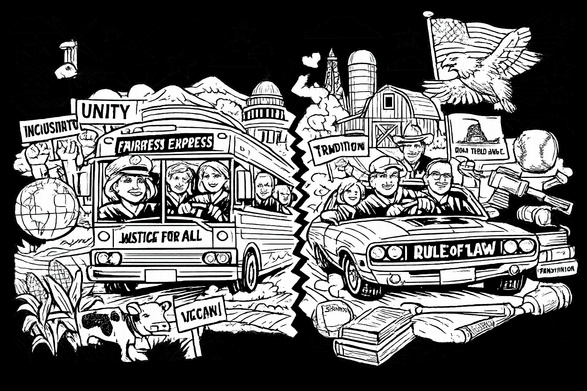
#law#judiciary#politics#democracy#education#judicial indepen#rule of law#justice in motio#npr#ohio courts#pennsylvania cou
Leftist
And they're off! Judges crisscrossing the Midwest in their unassuming bus of fairness! High stakes on the line. This is a tour de force for democracy! The rule of law needs guardians, not politicians in robes. It's about unity, inclusivity, and ensuring the legislative playing field is even! Maureen O'Connor leading like a captain on field. Forget party lines, it's about the common good—game on!
Rightist
Straight off the line, we’ve got an all-star lineup driving through the heartland, talking about law like it’s the World Series! Judges on the move, tackling the misunderstandings of judicial integrity! It's a gritty faceoff against those trying to politicize the bench. Ohio’s tossed its hat in the contentious ring, keeping tradition alive. Discipline meets liberty—a champion's rally to recall the judiciary's sacred duty!
 | author: | Sarah Donaldson | institution: | NPR News | ¿porque no los dos? |
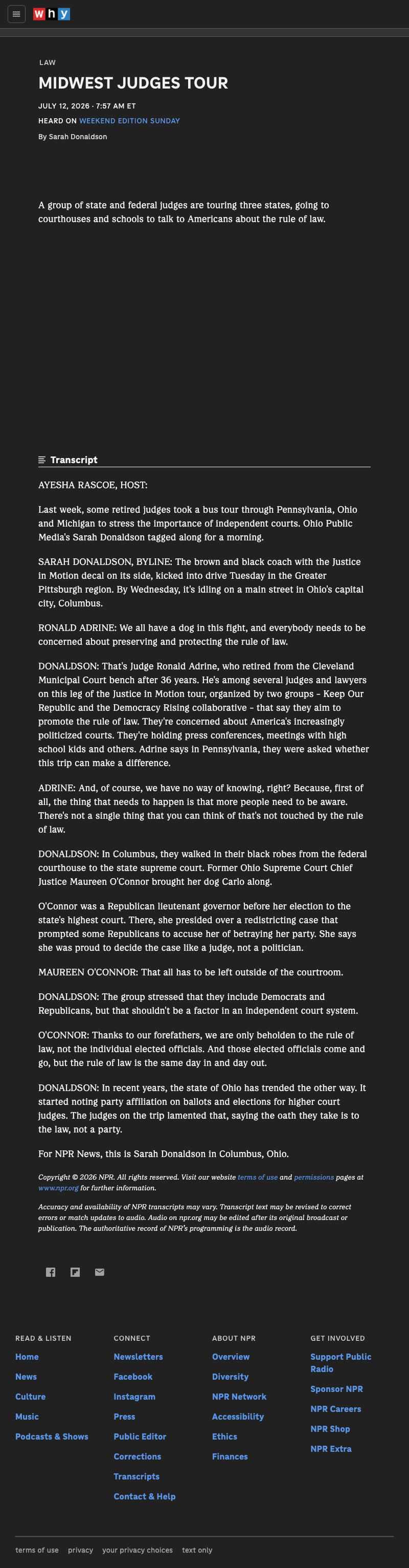
| tl;dr | NPR reports on a “Justice in Motion” bus tour through Pennsylvania, Ohio, and Michigan, where retired state and federal judges visit courthouses and schools to promote the rule of law and independent courts. Participants, including former Ohio Chief Justice Maureen O’Connor, express concern about increasingly politicized courts and partisan judicial elections. The brief report emphasizes civic education and judicial independence but offers little opposing commentary or detailed evidence about the alleged politicization. | ||||
| deeper: | The report is concise, clearly attributed, and distinguishes narration from interview statements. It provides relevant context about the tour’s organizers, participants’ backgrounds, and Ohio’s move toward identifying judicial candidates by party. Its framing is favorable toward judicial independence and the rule of law, values commonly associated with reform-oriented or center-left civic discourse, but it does not use inflammatory language or overtly attack a political party. The main limitation is narrow sourcing: the story primarily features tour participants and does not include critics of partisan judicial elections, state officials, or independent data assessing whether courts have become more politicized. The image shows a complete NPR transcript page, though the displayed date—July 12, 2026—is future-dated relative to the present context and may indicate a mockup, scheduled item, or metadata issue. | ||||
media: No Media Preview | |||||
| gen: 2026/07/11:14:44 in 52.1 sec (old)bias: 3 (Center) |
| type: newsquality: 86 |
| pts: 0 |

#education#internet#fcc#funding#e-rate program#brendan carr#school internet#screen time#rural alaska
 | author: | Sequoia Carrillo | institution: | NPR | ¿porque no los dos? |
| tl;dr | NPR reports that the Federal Communications Commission is reviewing the E-Rate program, which subsidizes internet service for schools and libraries. Supporters say the program is essential, especially in rural and remote communities, while FCC Chairman Brendan Carr has linked the review to concerns about children’s screen time. The article explains E-Rate’s history and benefits, describes possible effects of reduced funding, and notes that the review could alter the program even if it cannot eliminate it outright. | ||||
| deeper: | The article is substantially reported, providing historical context, multiple named sources, relevant statistics, and perspectives from educators, library advocates, rural school officials, and the FCC. Its framing is somewhat skeptical of the review: it emphasizes potential funding losses, rural hardships, and connections to Project 2025, while offering relatively little detail about the FCC’s policy rationale beyond screen-time concerns. However, it acknowledges the agency’s stated objective, includes supporters of screen-time limits, and distinguishes between eliminating E-Rate and changing how it operates. The overall presentation is best characterized as centrist with a modest critical tilt toward the proposed policy changes. The quality score is reduced slightly because the screenshot does not show links, full sourcing details, or independent verification of several claims. | ||||
media: | |||||
You made it to the bottom. Now dance!


owned and operated by: RPN Omnigalactic Insitutution as of: 2026/10/15: 15:20 in 0 ms
Enter Code
Login with Account