#research
| gen: 2026/10/07:04:39 in 1 min 12.6 secbias: 2 (Unknown) |
| type: eli5quality: 76 |
| pts: 0 |
 | author: | Unknown | institution: | OpenAI | ¿porque no los dos? |
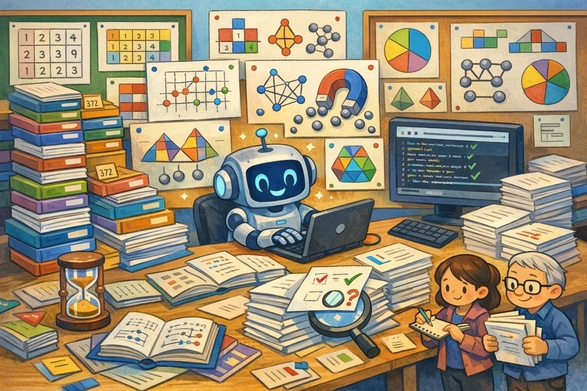
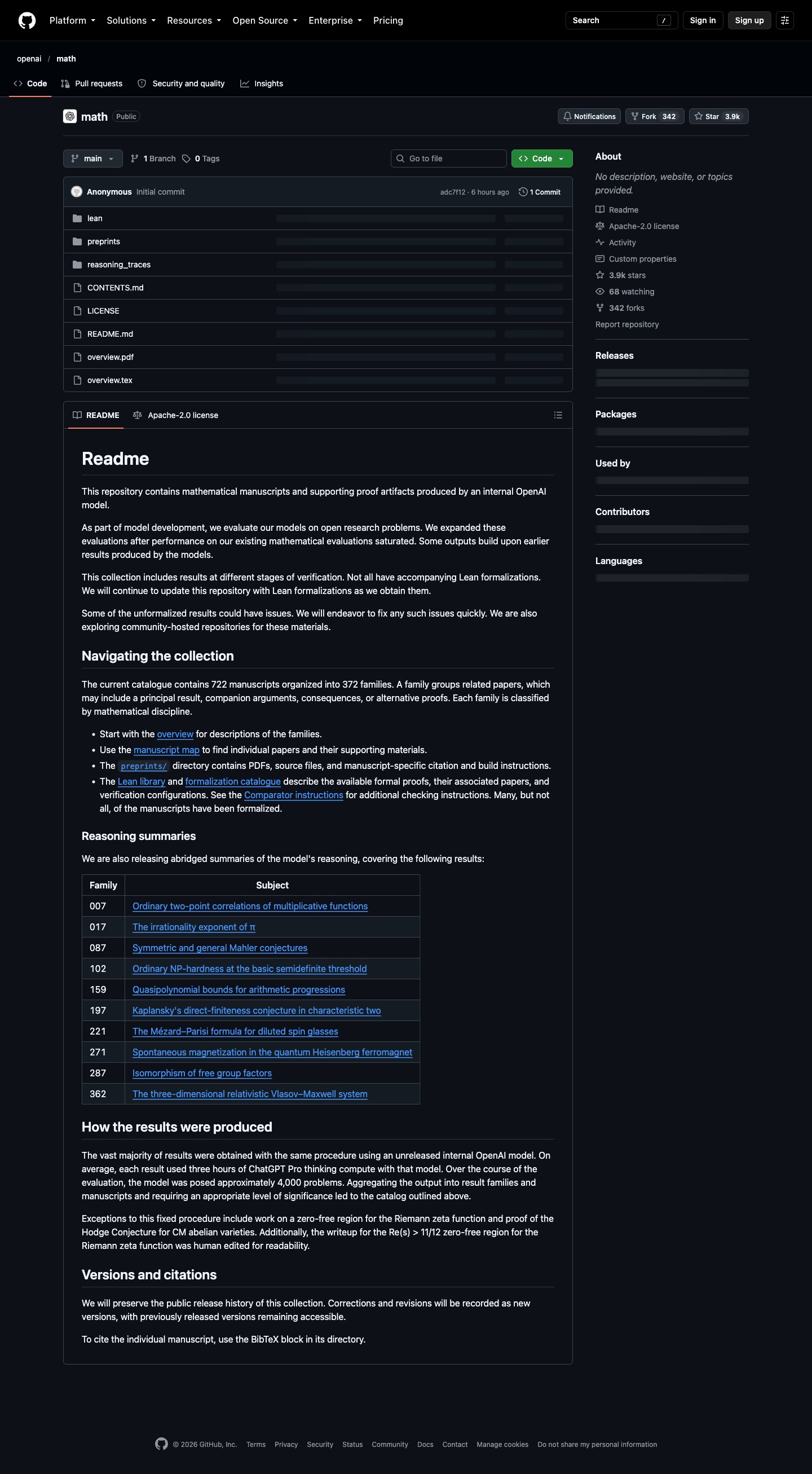
| tl;dr | The repository README describes 722 mathematical manuscripts in 372 related families produced by an unreleased OpenAI model evaluated on approximately 4,000 problems. It links to papers, supporting materials, Lean formal proofs, and selected reasoning summaries. The document acknowledges differing verification levels and possible errors in unformalized results. It outlines the production process, notes exceptions and limited human editing, and promises to preserve corrections and earlier versions. The screenshots alone do not establish the mathematical claims’ correctness or novelty. | ||||
| deeper: | This is technical repository documentation, not independent reporting. Its language is mostly restrained, with explicit warnings about potential errors and incomplete verification. Links to proof materials, production details, and version histories support transparency. However, the visible text does not provide independent assessments, precise verification totals, or clear criteria for selecting significant results. Highlighting selected outputs offers an incomplete picture of overall performance. No political position is evident; the score evaluates the documentation, not the underlying mathematics. | ||||
media: | |||||
| gen: 2026/08/12:19:27 in 49.4 sec (old)bias: 4 (Center-Left) |
| type: newsquality: 78 |
| pts: 0 |

 | author: | Terry Gross | institution: | WHYY / NPR | ¿porque no los dos? |
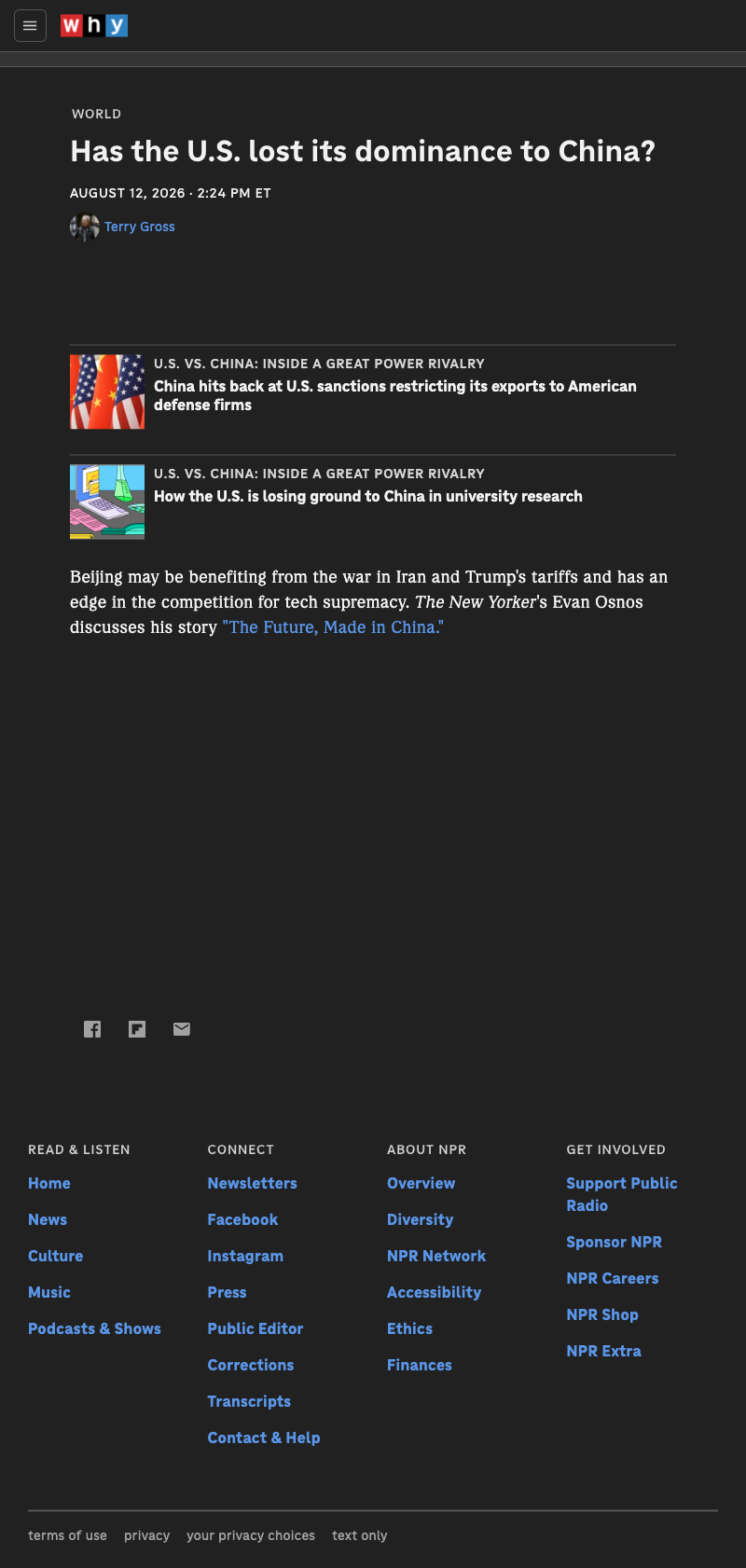
| tl;dr | A WHYY/NPR World segment titled “Has the U.S. lost its dominance to China?” (Aug. 12, 2026) frames U.S.–China relations as a great-power rivalry focused on technology, research, sanctions, and trade. The page highlights related items about China retaliating against U.S. sanctions and the U.S. losing ground in university research. The teaser says Beijing may be benefiting from the war in Iran and Trump-era tariffs, and features discussion with The New Yorker’s Evan Osnos about “The Future, Made in China.” | ||||
| deeper: | The framing (“lost its dominance,” “great power rivalry,” “losing ground”) emphasizes competition and U.S. relative decline, which can steer interpretation before evidence is presented. The teaser also asserts causal benefits to Beijing (Iran war, tariffs) without showing data in the screenshot, suggesting some agenda-setting via selection and tone. Still, it appears to be an interview-based explainer referencing a named journalist and specific reported work, which generally supports credibility; what’s missing here are visible primary sources, quantified measures of “dominance,” and explicit countervailing views in the excerpt shown. | ||||
media: | |||||
| gen: 2026/08/07:16:34 in 1 min 3.3 secbias: 3 (Center) |
| type: eli5quality: 78 |
| pts: 0 |

 | author: | Unknown | institution: | The Guardian | ¿porque no los dos? |
| tl;dr | The article reports analysis suggesting pedestrians in England and Wales who are struck by motorbikes or bicycles are more likely to suffer traumatic brain injuries than those struck by cars. It highlights that while motorbikes/cycles are involved in a smaller share of collisions, the head-injury proportion is higher, and discusses possible reasons (impact dynamics, underreporting, infrastructure). It includes calls from researchers for better data, safety measures, and street design that reduces conflict between pedestrians and two-wheeled vehicles. | ||||
| deeper: | The piece is largely evidence-led, anchored in a specific study/analysis and framed around injury outcomes rather than culture-war claims. It still has mild selection bias: focusing on traumatic brain injury can make relatively rare events feel more common, and the headline may invite fear of cycling/motorbikes without always matching exposure rates (miles traveled, speeds, volumes). Quality is solid: clear news framing, attributable findings and expert voices, but limited methodological detail in the article view and likely relies on a single analysis rather than multiple independent sources. | ||||
media: | |||||
| gen: 2026/07/31:18:10 in 4 min 47.3 sec (old)bias: 8 (Unknown) |
| type: lolsquality: 35 |
| pts: 0 |
#healthcare#diabetes#integrative med#research#china#type1diabetes#insulin#shenzhen#shanghai#prnewswire
 | author: | Unknown | institution: | PR Newswire | ¿porque no los dos? |
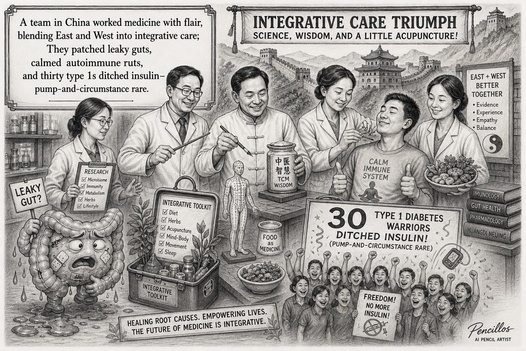
| tl;dr | A paid PR Newswire release on Yahoo Finance claims a Chinese medical team at Shanghai Fudan Group Shenzhen Hong Sung Hospital helped 30 type 1 diabetes patients discontinue insulin through “integrative medicine,” describing “functional remission” and immune/gut mechanisms. The piece frames this as a major breakthrough and outlines a treatment philosophy, but provides few verifiable study details (trial design, outcomes, duration, safety, independent confirmation, or peer-reviewed publication). | ||||
| deeper: | The content is promotional and one-sided: it highlights dramatic outcomes and “breakthrough” language without critical context or independent validation. Key scientific specifics are missing (patient selection, baseline characteristics, objective endpoints, follow-up length, adverse events, and whether insulin independence was sustained). It appears as a paid press release, which increases incentive to persuade rather than scrutinize. Quality is limited by lack of sourcing, peer-reviewed citations, and absence of counterpoints or expert verification. | ||||
media: | |||||
You made it to the bottom. Now dance!


owned and operated by: RPN Omnigalactic Insitutution as of: 2026/10/15: 20:29 in 0 ms
Enter Code
Login with Account