#united nations
| gen: 2026/09/25:15:26 in 1 min 5.0 secbias: 3 (Center-Left) |
| type: eli5quality: 76 |
| pts: 0 |
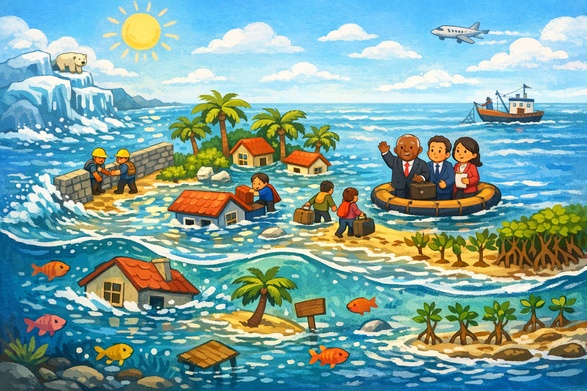
#climate change#oceans#islands#cooperation#sea level rise#united nations#island states#statehood#maritime borders
 | author: | Jake Bittle | institution: | Grist | ¿porque no los dos? |
| tl;dr | The article reports that the UN General Assembly unanimously approved a declaration supporting continued statehood and maritime boundaries for countries threatened by sea level rise. Island leaders welcome the agreement as protection for sovereignty and ocean resources. It also calls for greater access to climate adaptation funding, although it provides no new money itself. The United States did not block the declaration; a legal adviser suggests preserving maritime rights serves wealthy countries’ interests too. | ||||
| deeper: | The visible article favors international cooperation and expanded climate assistance, calling the declaration a “rare win.” Its sources largely represent island governments or their advisers. Interviews, document quotations, links, funding context, and an unanswered request for State Department comment strengthen the reporting. It acknowledges that the declaration adds no funding. However, it does not clearly distinguish political commitments from enforceable legal protections, and sweeping descriptions of maritime control and future inundation need qualification. The opening is partly obscured, limiting assessment. | ||||
media: | |||||
| gen: 2026/09/24:02:27 in 28.2 sec (old)bias: 3 (Center) |
| type: newsquality: 70 |
| pts: 0 |

 | author: | Hadeel Al-Shalchi, Alex Leff | institution: | NPR | ¿porque no los dos? |
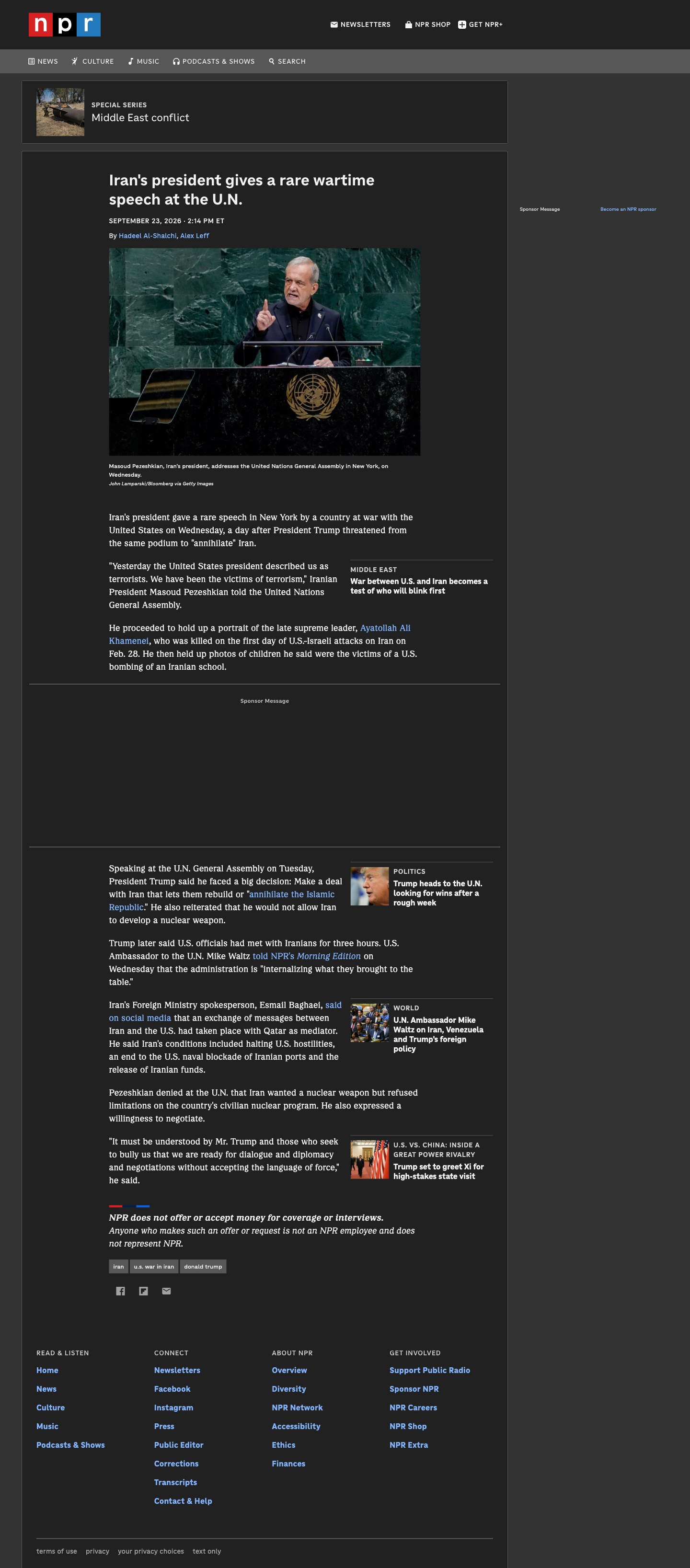
| tl;dr | The article reports that Iranian President Masoud Pezeshkian addressed the United Nations during a war with the United States, criticizing U.S. attacks while expressing willingness to negotiate. It contrasts his remarks with President Trump’s threat to annihilate the Islamic Republic and his insistence that Iran not develop nuclear weapons. U.S. and Iranian officials describe diplomatic exchanges mediated by Qatar. Iran seeks an end to hostilities and a naval blockade, release of funds, and protection of its civilian nuclear program. | ||||
| deeper: | The report quotes both governments and generally distinguishes officials’ claims from established facts. Its opening emphasizes Trump’s threat and Iranian suffering, giving Iran’s perspective some emotional prominence. However, it also includes U.S. nuclear concerns and Iran’s refusal of restrictions, without clearly endorsing a political ideology. Named sources and links strengthen transparency. Limited independent scrutiny of wartime claims and little historical or nuclear-monitoring context weaken the reporting. The screenshots alone cannot establish the authenticity of the page or verify its consequential factual claims. | ||||
media: | |||||
| gen: 2026/09/18:18:42 in 31.0 secbias: 2 (Center) |
| type: colorquality: 82 |
| pts: 0 |
#war crimes#international la#human rights#u.s. politics#iran conflict#iran#united states#united nations#israel#minab#lamerd city stri
Leftist
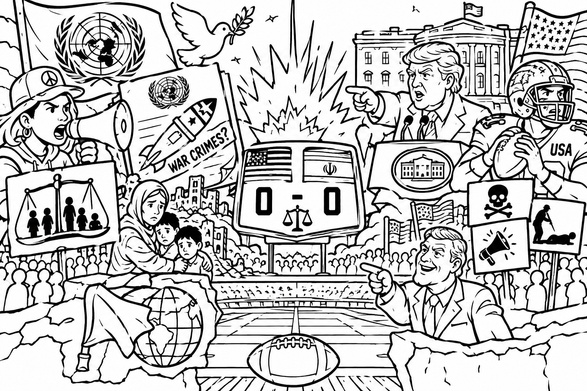
The U.N. report drops a bombshell bigger than any Tomahawk, accusing the U.S. of potential war crimes in Iran. This is like a penalty flag thrown on the field of global justice, demanding accountability for everyone. Civilian losses exceed a hundred, mostly women and children, in strikes in Minab. It's a brutal reminder that the world is less like a fair game and more like an unfair fight. Both the U.S. and Iran must pay reparations; it's time to share the scoreboard of responsibility.
Rightist
Hold onto your seats, folks! The U.N. expert team just tried a Hail Mary against the U.S., claiming war crimes in Iran. But the White House fires back like John Elway in overtime, denying the accusations and pointing fingers at Iran's horrific track record. They've been executing and terrorizing without remorse. In the geopolitical field, the U.S. remains the quarterback, defending democracy while facing flags that seem more about sensationalism than fairness.
 | author: | The Associated Press | institution: | NPR | ¿porque no los dos? |
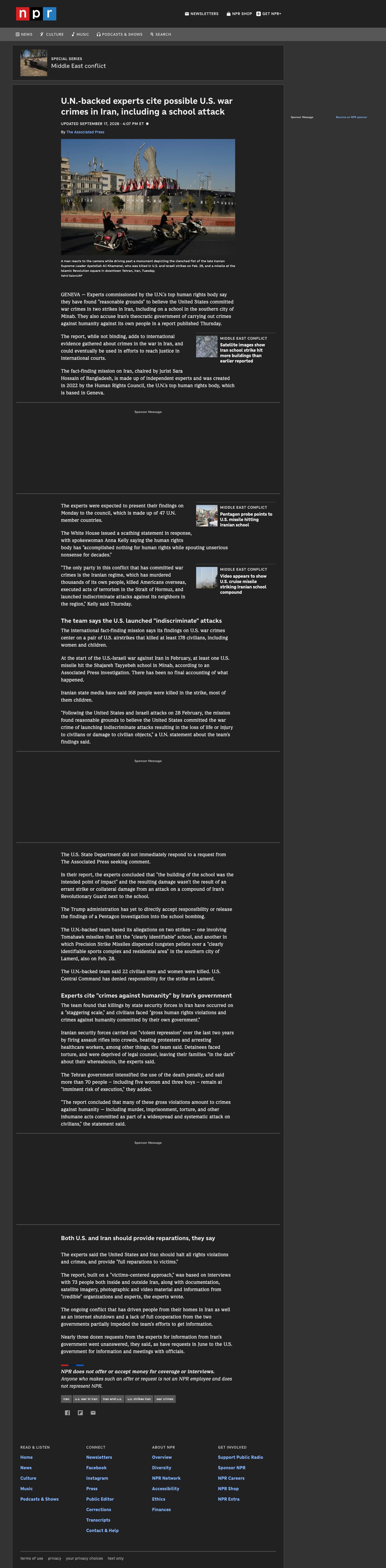
| tl;dr | The article reports that U.N.-commissioned experts found reasonable grounds to suspect U.S. war crimes in two strikes in Iran, including an attack on a school in Minab. The same report accuses Iranian authorities of crimes against humanity through killings, torture and repression. U.S. officials reject the allegations. Experts call for reparations from both governments. Their findings draw on interviews and visual evidence, but information gathering was hindered by conflict, internet restrictions and government noncooperation. The report is not a binding judicial ruling. | ||||
| deeper: | The article emphasizes civilian protection and legal accountability without clearly endorsing a partisan position. It attributes allegations, includes substantial U.S. rebuttals, covers Iranian abuses and explains investigative limitations. Strong wording largely comes from identified sources. Its main weaknesses are reliance on one investigative report, limited explanation of evidence establishing targeting responsibility, and no direct Iranian response. Different casualty figures are attributed but not reconciled. These scores assess the supplied text; the screenshots alone do not authenticate its reporting. | ||||
media: | |||||
| gen: 2026/08/12:01:16 in 32.6 sec (old)bias: 3 (Center) |
| type: newsquality: 82 |
| pts: 0 |
 | author: | Unknown | institution: | Unknown | ¿porque no los dos? |
| tl;dr | The article reports that companies previously linked to Bashar al-Assad’s government continued to secure United Nations procurement contracts even after shifts in Syria’s governing arrangements. It describes concerns from aid organizations and critics about due diligence, the risk of benefiting sanctioned or politically connected actors, and whether UN contracting practices adequately prevent diversion, favoritism, or corruption. It also reflects UN responses about procurement rules, vetting, and operational constraints in delivering aid in Syria. | ||||
| deeper: | The piece is largely evidence-driven: it centers on procurement outcomes, affiliations, and accountability questions, and it presents a critical theme (contracting enabling politically connected firms) while also acknowledging UN rules and constraints. Bias is modest and mainly comes from emphasis on wrongdoing risk and critical sourcing, which can frame the UN as insufficiently rigorous. Quality is strong: it appears investigative, specific, and policy-focused, though readers would want full transparency on methodology (how “tied to Assad” was determined) and the UN’s complete rebuttals. | ||||
media: | |||||
| gen: 2026/08/09:13:32 in 41.3 sec (old)bias: 4 (Center) |
| type: newsquality: 78 |
| pts: 0 |
 | author: | Unknown | institution: | Unknown | ¿porque no los dos? |
| tl;dr | The article investigates how companies previously linked to Syria’s Assad-era power networks continued to win UN contracts even after control shifted to “new rulers” in parts of Syria. It highlights procurement practices, intermediaries, and weak vetting that can route international aid money to politically connected firms. The piece cites contract records and reporting to argue the UN’s safeguards are insufficient, while noting UN explanations/constraints and the difficulty of operating in Syria’s fragmented, high-risk economy. | ||||
| deeper: | The tone is watchdog-oriented and skeptical of UN procurement and compliance claims, framing the UN as insufficiently diligent and too willing to work through tainted commercial networks. That creates mild bias toward a critical interpretation, though it appears grounded in documentary evidence (contracts, company ties) and focuses on accountability rather than ideology. Quality is strong for an investigative piece—clear thesis and specific allegations—though conclusions depend on how well the “ties to Assad” are substantiated and whether UN responses and alternative explanations are fully represented. | ||||
media: | |||||
You made it to the bottom. Now dance!


owned and operated by: RPN Omnigalactic Insitutution as of: 2026/10/15: 07:37 in 0 ms
Enter Code
Login with Account