#war crimes
| gen: 2026/09/18:18:42 in 31.0 secbias: 2 (Center) |
| type: colorquality: 82 |
| pts: 0 |
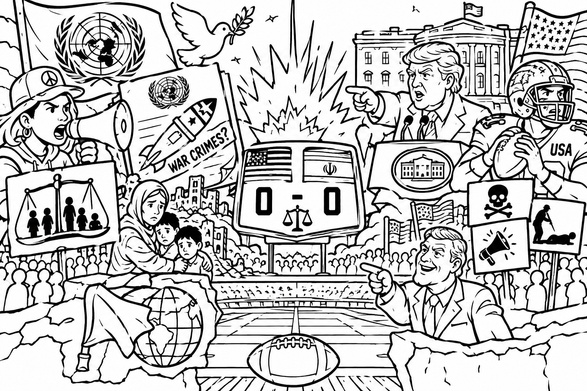
#war crimes#international la#human rights#u.s. politics#iran conflict#iran#united states#united nations#israel#minab#lamerd city stri
Leftist
The U.N. report drops a bombshell bigger than any Tomahawk, accusing the U.S. of potential war crimes in Iran. This is like a penalty flag thrown on the field of global justice, demanding accountability for everyone. Civilian losses exceed a hundred, mostly women and children, in strikes in Minab. It's a brutal reminder that the world is less like a fair game and more like an unfair fight. Both the U.S. and Iran must pay reparations; it's time to share the scoreboard of responsibility.
Rightist
Hold onto your seats, folks! The U.N. expert team just tried a Hail Mary against the U.S., claiming war crimes in Iran. But the White House fires back like John Elway in overtime, denying the accusations and pointing fingers at Iran's horrific track record. They've been executing and terrorizing without remorse. In the geopolitical field, the U.S. remains the quarterback, defending democracy while facing flags that seem more about sensationalism than fairness.
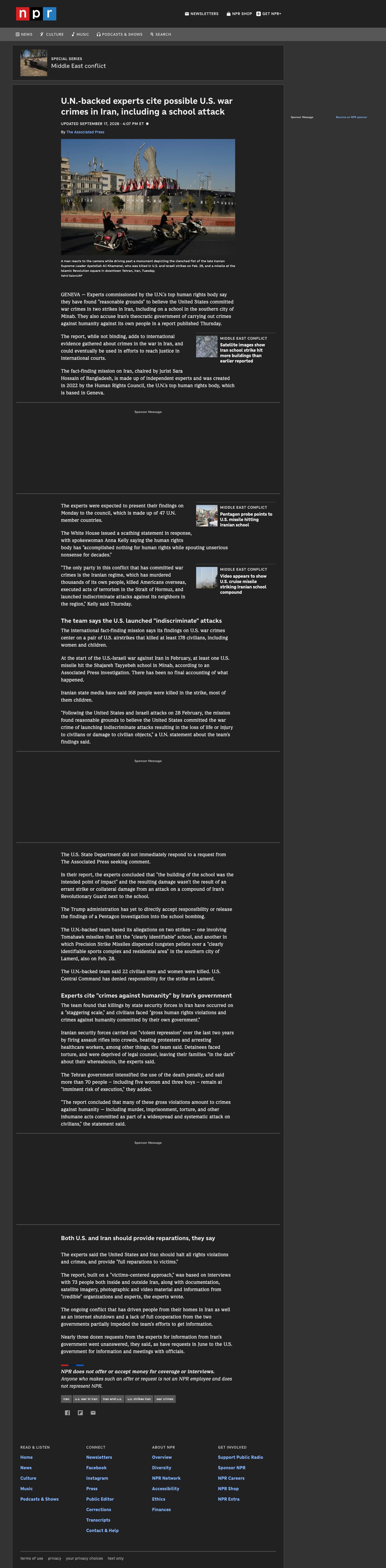 | author: | The Associated Press | institution: | NPR | ¿porque no los dos? |
| tl;dr | The article reports that U.N.-commissioned experts found reasonable grounds to suspect U.S. war crimes in two strikes in Iran, including an attack on a school in Minab. The same report accuses Iranian authorities of crimes against humanity through killings, torture and repression. U.S. officials reject the allegations. Experts call for reparations from both governments. Their findings draw on interviews and visual evidence, but information gathering was hindered by conflict, internet restrictions and government noncooperation. The report is not a binding judicial ruling. | ||||
| deeper: | The article emphasizes civilian protection and legal accountability without clearly endorsing a partisan position. It attributes allegations, includes substantial U.S. rebuttals, covers Iranian abuses and explains investigative limitations. Strong wording largely comes from identified sources. Its main weaknesses are reliance on one investigative report, limited explanation of evidence establishing targeting responsibility, and no direct Iranian response. Different casualty figures are attributed but not reconciled. These scores assess the supplied text; the screenshots alone do not authenticate its reporting. | ||||
media: | |||||
| gen: 2026/09/03:04:14 in 54.3 sec (old)bias: 4 (Center) |
| type: newsquality: 78 |
| pts: 0 |

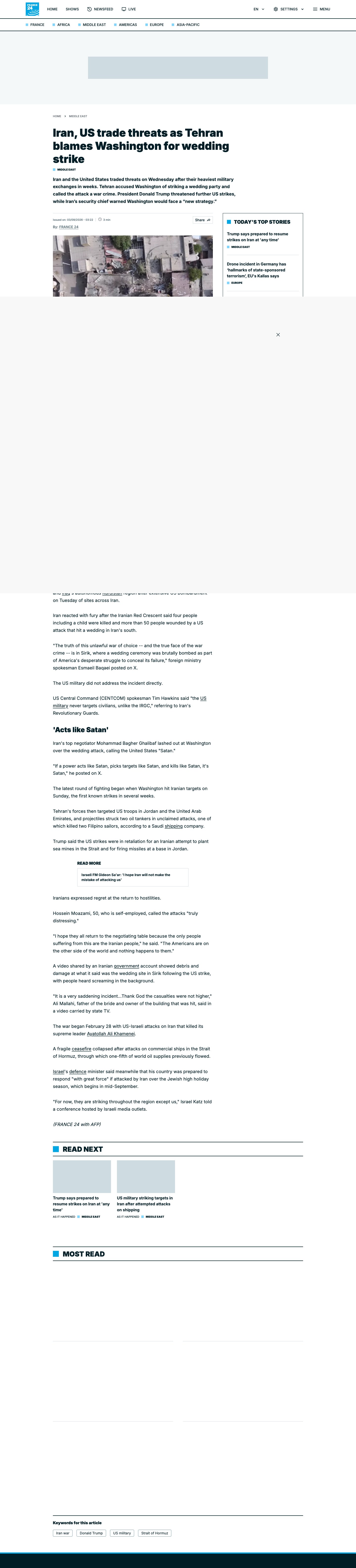 | author: | Unknown | institution: | France 24 (with AFP) | ¿porque no los dos? |
| tl;dr | France 24 (with AFP) reports escalating Iran–US tensions after recent military exchanges. Tehran accuses Washington of striking a wedding in southern Iran (Sirik), calling it a war crime; Iran’s Red Crescent claims four killed (including a child) and 50+ wounded. US Central Command denies targeting civilians and contrasts US conduct with Iran’s IRGC. The piece also notes regional spillover: attacks on US troops in Jordan/UAE, tanker damage in unclaimed attacks, and risks to Strait of Hormuz shipping, alongside Israeli warnings. | ||||
| deeper: | The article is largely straight-wire reporting, presenting claims and counterclaims from Iranian officials, the Iranian Red Crescent, and CENTCOM, plus limited civilian reaction. Bias mainly comes from emphasis on vivid inflammatory quotes (“Satan,” “war crime”) and casualty claims without showing independent verification or forensic detail; it does, however, include the US denial and broader context (shipping, regional strikes, Israeli statements). Quality is solid for a fast update, but thin on corroboration, timelines, and evidence beyond official statements and a government-shared video. | ||||
media: | |||||
| gen: 2026/08/28:05:13 in 26.6 sec (old)bias: 4 (Center) |
| type: newsquality: 52 |
| pts: 0 |

 | author: | Unknown | institution: | Unknown | ¿porque no los dos? |
| tl;dr | The image shows a news article reporting that Ratko Mladić, the former Bosnian Serb military commander convicted of genocide and other war crimes related to the 1992–95 Bosnia war (including Srebrenica), has died at age 84. The piece appears to recap his role in wartime atrocities, his trial and conviction at The Hague, and the broader historical context of the conflict and international justice efforts. | ||||
| deeper: | The language framing (e.g., “warlord,” “oversaw atrocities”) is harsh but broadly consistent with established findings from international courts, so it reads more like moral clarity than partisan spin. The main quality concern is factual reliability: the claim that Mladić died at 84 is a high-stakes assertion that would require clear sourcing and confirmation; as presented in the screenshot, verification cues (named sources, time stamps, corroboration) are not evident. The article otherwise seems structured like a standard wire-style backgrounder. | ||||
media: | |||||
| gen: 2026/08/12:01:15 in 41.3 sec (old)bias: 3 (Center) |
| type: newsquality: 73 |
| pts: 0 |

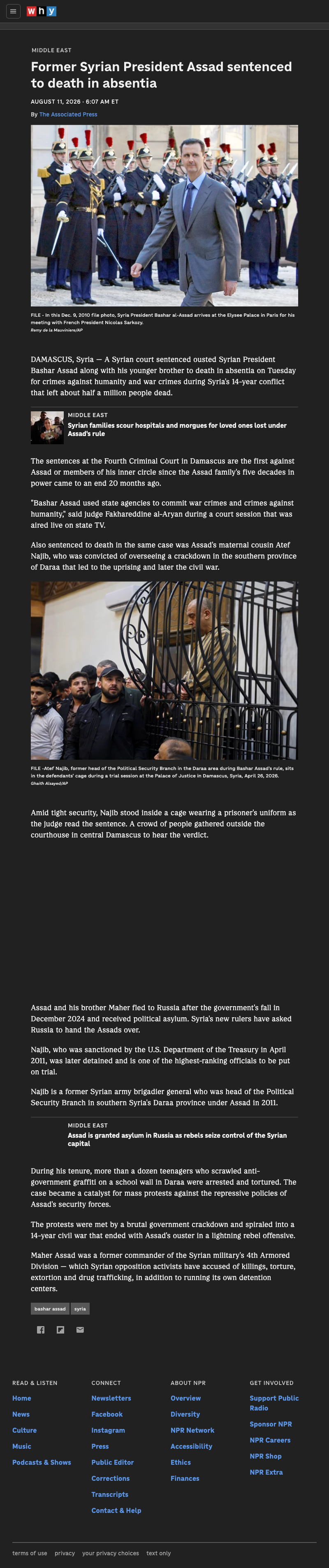 | author: | Associated Press | institution: | NPR (republished from The Associated Press) | ¿porque no los dos? |
| tl;dr | The article reports that a Syrian court in Damascus sentenced ousted President Bashar al-Assad and his brother Maher to death in absentia for alleged crimes against humanity and war crimes tied to Syria’s 14-year conflict. It frames the verdict as the first major court action against Assad-era leaders since the regime’s fall (with Assad reportedly in Russia). It also says Assad’s maternal cousin Atef Najib—linked to the 2011 Daraa crackdown—received a death sentence as well. | ||||
| deeper: | The tone is largely straight, wire-service reporting, but it adopts the court’s framing and widely cited accusations (war crimes/crimes against humanity) with limited detail on evidence presented, defense claims, or the post-Assad judiciary’s credibility and due-process safeguards. The story gives clear context about Daraa and the conflict’s scale, but would be stronger with more attribution granularity (who alleges what), independent verification, and broader reactions (UN, victims’ groups, Russia, international courts). | ||||
media: | |||||
You made it to the bottom. Now dance!


owned and operated by: RPN Omnigalactic Insitutution as of: 2026/10/14: 03:14 in 0 ms
Enter Code
Login with Account