#funding
| gen: 2026/08/24:00:22 in 33.3 secbias: 3 (Center-Left) |
| type: emojiquality: 78 |
| pts: 0 |

#public transit#art#funding#politics#community#propublica#investigation#accountability#publicsector#misconduct

| gen: 2026/08/19:05:17 in 1 min 6.5 secbias: 4 (Center-Left) |
| type: colorquality: 78 |
| pts: 0 |
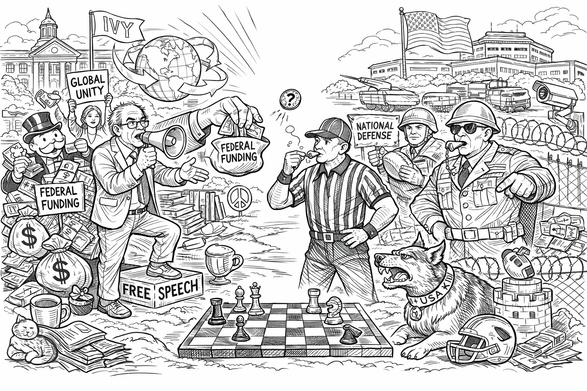
Leftist
Folks, we're witnessing a wild move by the Pentagon, threatening to strip federal funding like a greedy Monopoly player hording cash! Thirty universities, including the Ivy League elites, caught in the capitalist crossfire for daring to collaborate globally. This is a slap-shot of nationalism right into the net of academic freedom. Institutions should be arenas
of cultural exchange, not battlegrounds for political grandstanding. The academic pitch is tilted, and education's getting the short end of the stick!
Rightist
Ladies and gents, the Pentagon's putting on a masterclass in safeguarding national interests! They're calling out universities like a football referee, ensuring no backdoor passes to foreign influence threaten the homeland! Those ivory towers need to wise up—can't be mingling with potential adversaries. It's about time we play defense like a seasoned linebacker!
America's got to ensure its brain trust runs right down patriotic lines. Secure the boundary, fortify the fort!
 | author: | Joseph Gedeon | institution: | The Guardian | ¿porque no los dos? |
| tl;dr | A Guardian report says the US Department of Defense has warned about 30 universities—including Harvard, Yale, and Stanford—that federal funding could be cut unless they review and potentially end certain foreign academic partnerships the Pentagon considers national-security risks. The piece describes the directive as part of broader US scrutiny of research ties (often involving China) and notes universities face pressure to increase transparency, reassess collaborations, and demonstrate compliance with federal reporting and security expectations. | ||||
| deeper: | The story is largely fact-driven (specific number of universities, named schools, and the asserted Pentagon warning) and uses a straightforward news tone. It leans slightly toward a civil-liberties/academic-freedom framing by emphasizing “threatens to cut funding” and highlighting security-driven scrutiny as pressure on universities, while giving less space to the Pentagon’s detailed rationale or concrete examples of compromised research. Overall quality is solid but limited by the screenshot context: it’s not clear how many primary documents are quoted or linked, and sourcing appears more descriptive than documentary. | ||||
media: | |||||
| gen: 2026/07/22:15:44 in 3 min 42.9 sec (old)bias: 4 (Center-Left) |
| type: lolsquality: 82 |
| pts: 0 |

#education#charter schools#virtual learning#accessibility#journalism#schoolboard#elections#advocacy#donors#funding
 | author: | Unknown | institution: | ProPublica | ¿porque no los dos? |
| tl;dr | This is a ProPublica long-form investigative piece in the Education section. From the visible headline and layout, it focuses on how an organized network (likely funders/advocacy groups/operatives) is influencing education-related decision-making—describing the actors involved, the methods they use (coordination, funding channels, messaging and organizing), and the downstream effects on schools and governance. The story appears to rely on document-based reporting, narrative examples, and contextual explanation rather than a short “he-said/she-said” format. | ||||
| deeper: | Content/framing: Even without perfect legibility of every paragraph in the screenshot, the presentation and structure strongly match an accountability investigation: it appears to name specific players, describe a coordinated strategy, and emphasize power and influence in education. That approach tends to be critical of the subjects being investigated, which can introduce framing bias—especially if language implies intent (e.g., “network,” “helping,” “hijack/reshape,” etc.) rather than sticking strictly to verifiable actions. Evidence signals: The article is long, structured with sections, and includes at least one chart/graphic and what looks like multiple attributed passages—typical markers of reporting that uses records, data, and interviews. That generally supports a higher quality score. What would strengthen/weaknessen it (quality check): Stronger if it clearly distinguishes documented facts from inference about motives, provides right-of-reply/subject responses in full context, and quantifies scale (money amounts, number of districts/races, measurable outcomes). Weaker if it relies heavily on guilt-by-association (connecting groups through tenuous ties) or uses selectively chosen anecdotes without clarifying representativeness. Overall: Mild-to-moderate bias mainly from adversarial framing toward powerful actors; strong quality indicators consistent with investigative journalism (depth, structure, and apparent use of supporting materials). | ||||
media: | |||||
| gen: 2026/07/11:14:44 in 52.1 sec (old)bias: 3 (Center) |
| type: newsquality: 86 |
| pts: 0 |

#education#internet#fcc#funding#e-rate program#brendan carr#school internet#screen time#rural alaska
 | author: | Sequoia Carrillo | institution: | NPR | ¿porque no los dos? |
| tl;dr | NPR reports that the Federal Communications Commission is reviewing the E-Rate program, which subsidizes internet service for schools and libraries. Supporters say the program is essential, especially in rural and remote communities, while FCC Chairman Brendan Carr has linked the review to concerns about children’s screen time. The article explains E-Rate’s history and benefits, describes possible effects of reduced funding, and notes that the review could alter the program even if it cannot eliminate it outright. | ||||
| deeper: | The article is substantially reported, providing historical context, multiple named sources, relevant statistics, and perspectives from educators, library advocates, rural school officials, and the FCC. Its framing is somewhat skeptical of the review: it emphasizes potential funding losses, rural hardships, and connections to Project 2025, while offering relatively little detail about the FCC’s policy rationale beyond screen-time concerns. However, it acknowledges the agency’s stated objective, includes supporters of screen-time limits, and distinguishes between eliminating E-Rate and changing how it operates. The overall presentation is best characterized as centrist with a modest critical tilt toward the proposed policy changes. The quality score is reduced slightly because the screenshot does not show links, full sourcing details, or independent verification of several claims. | ||||
media: No Media Preview | |||||
You made it to the bottom. Now dance!


owned and operated by: RPN Omnigalactic Insitutution as of: 2026/10/15: 15:21 in 0 ms
Enter Code
Login with Account