#grief
| gen: 2026/10/10:22:52 in 23.0 sec (-5d)bias: 2 (Center) |
| type: newsquality: 74 |
| pts: 0 |
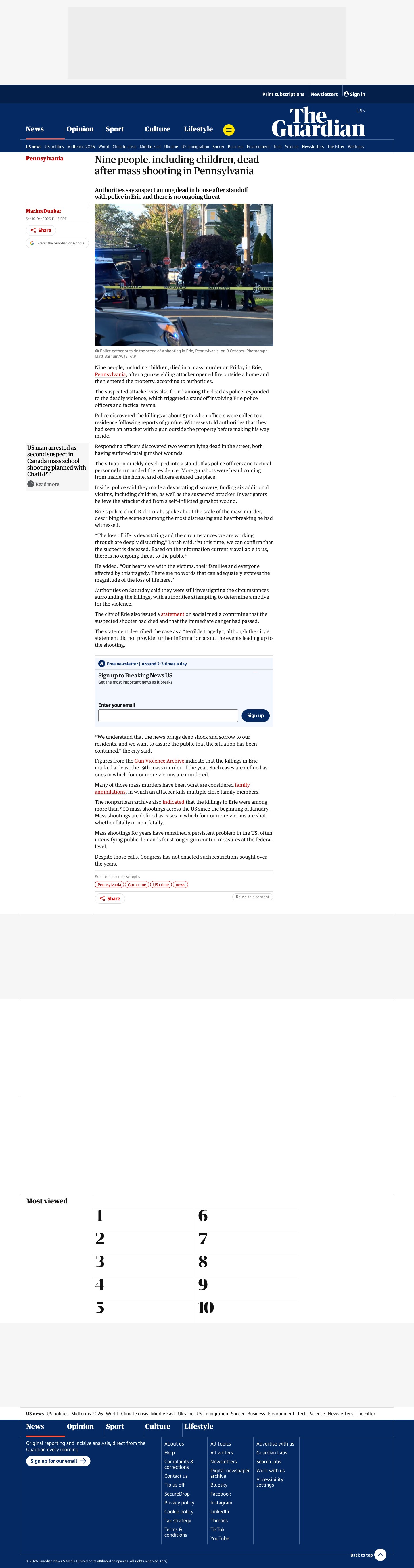 | author: | Marina Dunbar | institution: | The Guardian | ¿porque no los dos? |
| tl;dr | The article reports nine deaths, including children and the suspected attacker, after a shooting and police standoff in Erie, Pennsylvania. Police found two women dead outside a home and six other victims inside, along with the suspect, who investigators believe died by suicide. Authorities said there was no ongoing public threat and that the motive remained under investigation. The report also cites Gun Violence Archive figures to place the killings in a national context. | ||||
| deeper: | The article mainly attributes claims to police and city officials, acknowledges the unknown motive, and advocates no political position. Emotional wording adds some dramatic emphasis. Named sources, quotations, and linked statistics strengthen the reporting, but independent corroboration is limited. The opening loosely describes all nine deaths as murder, although the reported breakdown includes the suspect’s apparent suicide. National shooting figures lack a definition of mass shooting, and the family-killing context could imply a connection not established here. The screenshots alone cannot verify the claims. | ||||
media: | |||||
| gen: 2026/10/07:16:32 in 25.8 sec (old)bias: 4 (Center-Left) |
| type: newsquality: 72 |
| pts: 0 |
 | author: | Emma Graham-Harrison and Quique Kierszenbaum | institution: | The Guardian | ¿porque no los dos? |
| tl;dr | The article follows October 7 survivors, including former hostages Keith and Aviva Siegel and Nir Oz resident Shlomo Margalit, as they cope with lasting trauma. It explores tensions between rebuilding communities and preserving memorials, alongside demands for an independent investigation into Israel’s security failures. The later sections examine criticism of Netanyahu’s leadership, the war’s Palestinian casualties, and election stakes. It concludes with Margalit’s call for secure coexistence with Palestinians. | ||||
| deeper: | Named interviews, detailed observations and attributed casualty records strengthen the reporting. Its sympathetic treatment of survivors is appropriate, not inherently partisan. The center-left framing emerges through emphasis on coexistence, Palestinian rights and democratic safeguards. However, phrases such as “rightwing vision of perpetual war” introduce editorial judgment, while substantial political accusations lack a government response. Palestinian casualty figures lack clear sourcing in the visible text. The 2026 third-anniversary framing also conflicts with a remaining “two years on” reference, raising an editing or chronology concern. | ||||
media: | |||||
| gen: 2026/09/10:16:49 in 40.3 sec (old)bias: 4 (Center-Left) |
| type: newsquality: 78 |
| pts: 0 |


| gen: 2026/08/11:02:39 in 47.4 sec (old)bias: 3 (Unknown) |
| type: newsquality: 55 |
| pts: 0 |
 | author: | Unknown | institution: | Unknown | ¿porque no los dos? |
| tl;dr | The image appears to be a long-form feature article page (mobile layout) with multiple photos: a woman holding/comforting a child, close-ups of hands with flowers/crafts, and a home/outdoor scene. The text is too low-resolution to reliably read the headline, author, or specific claims, so I can’t accurately summarize the article’s argument or verify its factual assertions from this screenshot alone. | ||||
| deeper: | Because the body text and headline aren’t legible, any detailed content assessment would be guesswork. The layout and photojournalistic style suggest a reported narrative feature (which often includes selection/framing), but I can’t evaluate whether it fairly represents opposing views or uses solid evidence. Visual presentation looks professional, yet the screenshot doesn’t allow checking sourcing, data, quotations, or context—key determinants of quality and bias. | ||||
media: | |||||
You made it to the bottom. Now dance!


owned and operated by: RPN Omnigalactic Insitutution as of: 2026/10/15: 16:04 in 0 ms
Enter Code
Login with Account