#economy
| gen: 2026/09/21:17:43 in 26.6 sec (old)bias: 2 (Center) |
| type: newsquality: 65 |
| pts: 0 |

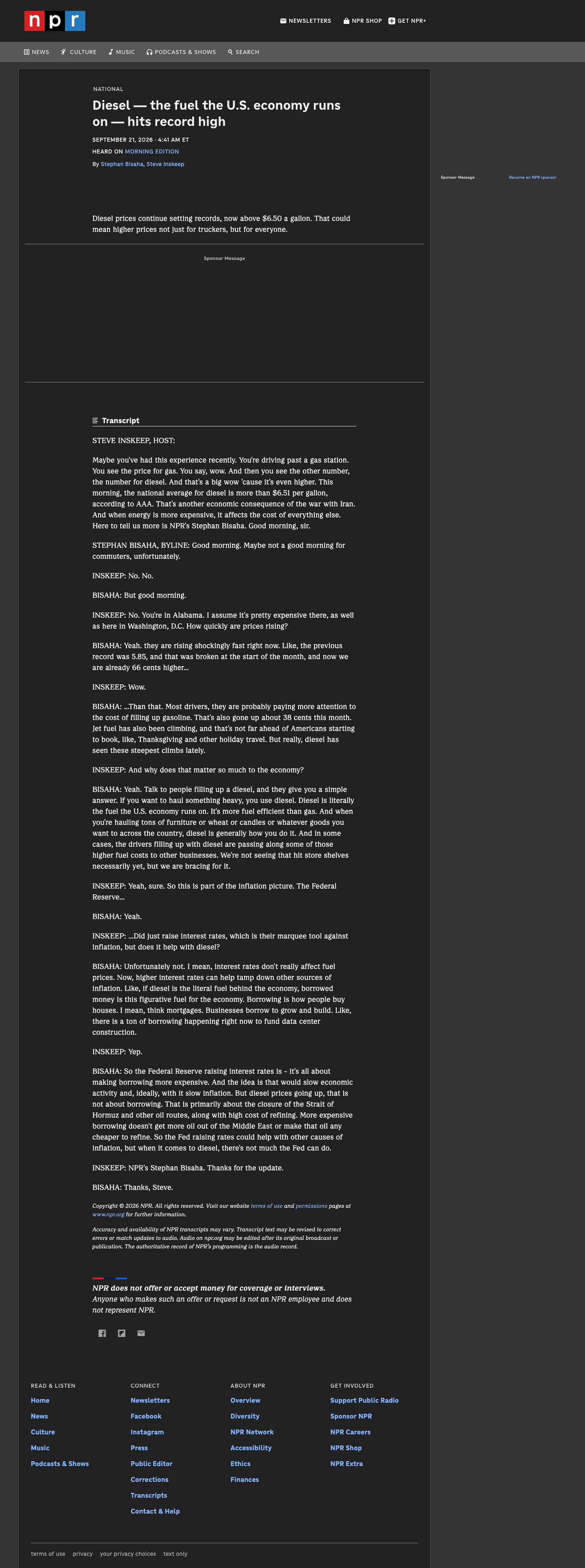 | author: | Stephan Bisaha, Steve Inskeep | institution: | NPR | ¿porque no los dos? |
| tl;dr | The article reports a national average diesel price above $6.51 per gallon, citing AAA. It attributes the increase to war with Iran, disrupted oil routes through the Strait of Hormuz, and refining costs. Because diesel powers much freight transportation, higher prices could spread to consumer goods, though the report says that effect is not yet clearly evident on store shelves. It explains that Federal Reserve interest-rate increases cannot directly resolve these supply disruptions. | ||||
| deeper: | The report emphasizes economic consequences without promoting a political party or ideology. Phrases such as “shockingly fast” add mild alarm, but it distinguishes potential consumer price increases from observed effects. AAA attribution and clear explanations are strengths. However, major claims about the war, shipping disruptions, and refining costs lack supporting sources in the text. Saying interest rates do not affect fuel prices is too categorical: reduced demand can affect them indirectly. The screenshot alone does not independently verify the reported events or figures. | ||||
media: | |||||
| gen: 2026/09/10:16:49 in 40.3 sec (old)bias: 4 (Center-Left) |
| type: newsquality: 78 |
| pts: 0 |


| gen: 2026/09/01:15:51 in 33.8 sec (old)bias: 4 (Center) |
| type: newsquality: 70 |
| pts: 0 |
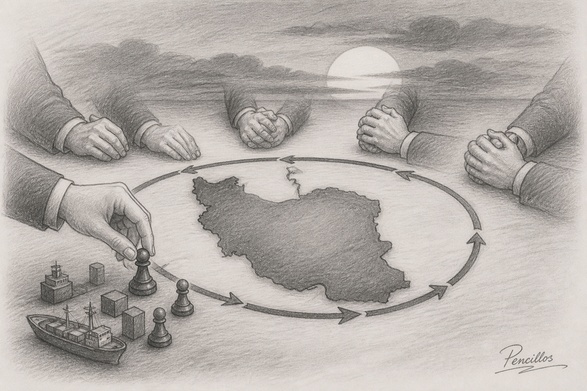
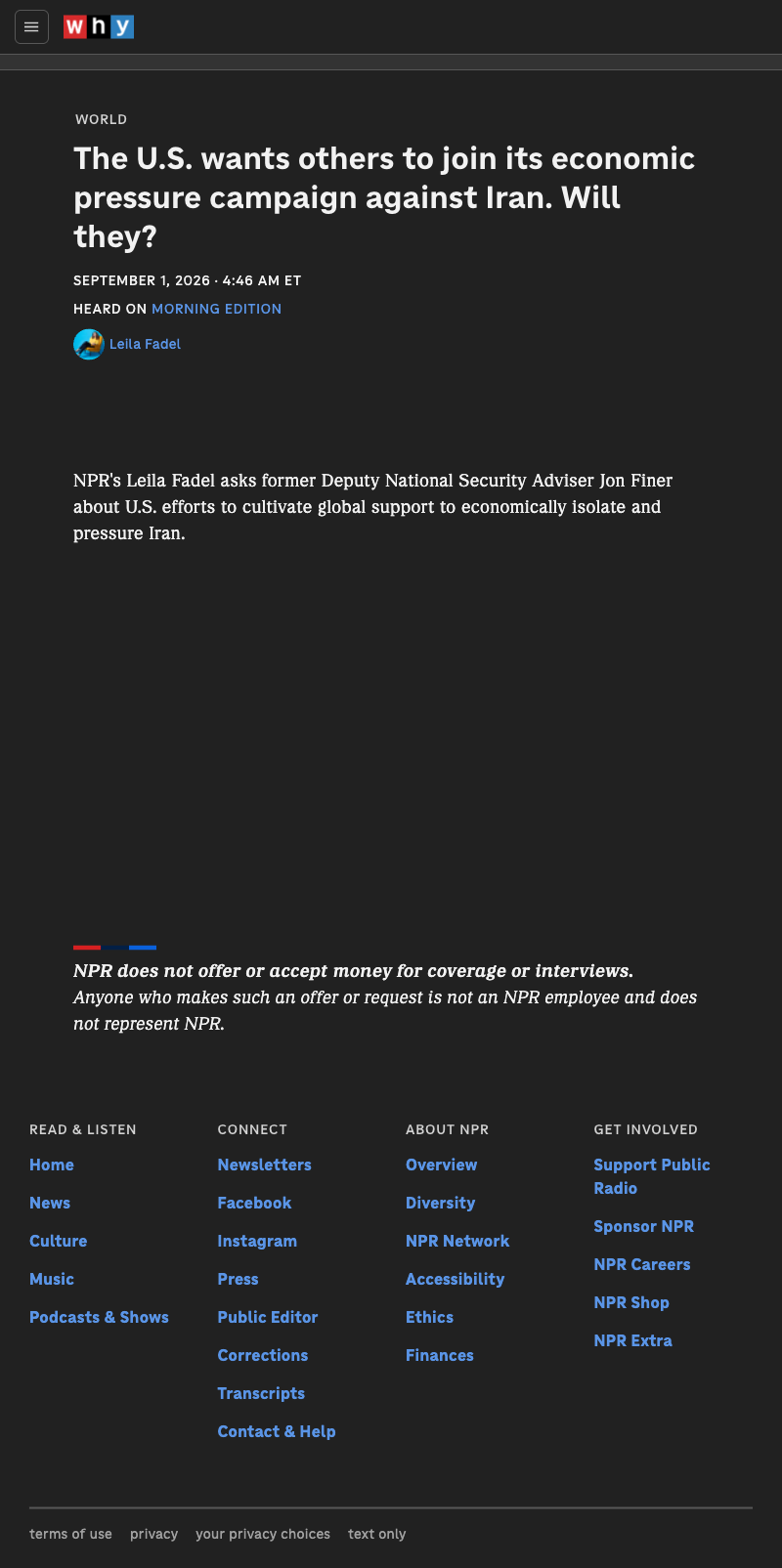 | author: | Leila Fadel | institution: | NPR | ¿porque no los dos? |
| tl;dr | The image shows an NPR World/Morning Edition item titled “The U.S. wants others to join its economic pressure campaign against Iran. Will they?” It’s framed as an interview in which Leila Fadel questions former Deputy National Security Adviser Jon Finer about U.S. efforts to build international support to economically isolate and pressure Iran. The page excerpt indicates the segment focuses on coalition-building and sanctions-style pressure, with the core perspective coming from a senior U.S. official/alumnus rather than multiple stakeholders. | ||||
| deeper: | The framing is largely explanatory and question-driven, but the sourcing shown is narrow: it spotlights a former top U.S. national security official, which tends to privilege Washington’s rationale and language (“pressure campaign,” “isolate”). Without evidence in the screenshot of Iranian, allied, humanitarian, or independent economic perspectives, the segment risks becoming an insider-policy account rather than a fully rounded analysis. Still, NPR’s format and the headline’s interrogative stance suggest an intent to test assumptions rather than simply promote policy. | ||||
media: | |||||
| gen: 2026/08/27:06:16 in 59.4 secbias: 3 (Center) |
| type: eli5quality: 78 |
| pts: 0 |

 | author: | Stephan Bisaha, Michel Martin | institution: | NPR (WHYY) | ¿porque no los dos? |
| tl;dr | The piece reports that Canada will impose tariffs on nearly $20 billion of U.S. goods in response to new U.S. tariffs, framing the situation as an escalating trade conflict harming businesses on both sides. It lists targeted products (steel, aluminum, dairy, toilet paper, agricultural equipment, American motorcycles, protein powders) and notes uncertainty for importers. It also references recent Supreme Court scrutiny of some Trump-era tariffs and suggests Canada’s measures could face legal challenges, while emphasizing the broader economic and political standoff. | ||||
| deeper: | The reporting is largely fact-forward and includes concrete figures and examples of affected goods, plus a straightforward discussion of legal and business impacts. Some framing and phrasing (“strikes back,” “trade war,” “random collection,” and characterizing political strategy) adds mild narrative color and can steer perception, but it’s not heavy-handed. Quality is solid for a news transcript: clear sourcing (named hosts/reporter), specific details, and relevant context; it would be stronger with more direct attribution links/data and perspectives from Canadian/U.S. officials and affected industries. | ||||
media: | |||||
| gen: 2026/08/23:21:39 in 2 min 22.3 sec (old)bias: 3 (Center-Left) |
| type: lolsquality: 78 |
| pts: 0 |

 | author: | Amy Hawkins | institution: | The Guardian | ¿porque no los dos? |
| tl;dr | The Guardian reports that Hui Ka Yan, founder of China’s Evergrande, has been sentenced to life in prison after pleading guilty to fraud. The piece says he and others were accused of inflating company finances and that authorities will confiscate his personal property. It places the case in the wider context of China’s real-estate downturn, heavy developer debt, and Beijing’s regulatory crackdown, noting Evergrande’s outsized role in the sector’s broader crisis and household exposure through pre-sold homes. | ||||
| deeper: | The article is largely straight news with clear attribution and context about the property slump and enforcement actions. Bias is modest: language and framing lean toward skepticism of Evergrande’s conduct and highlight systemic risks and government crackdown, but it does not read as polemical. Quality is strong due to coherent narrative, relevant background, and specific figures; it would be higher with more primary-document detail (court judgment text, defense claims, and fuller sourcing beyond official statements/media reports). | ||||
media: | |||||
| gen: 2026/08/23:17:02 in 55.9 secname: news article webpage screenshot |
| type: thingscientific name: N/A |
| pts: 0confidence level: 99% |
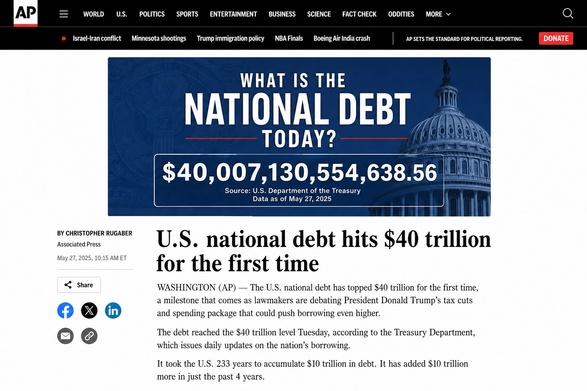

| gen: 2026/08/21:04:19 in 39.0 sec (old)bias: 3 (Center) |
| type: newsquality: 78 |
| pts: 0 |

 | author: | Fatima Hussein | institution: | Associated Press | ¿porque no los dos? |
| tl;dr | The image shows an Associated Press economy story reporting the U.S. national debt surpassing $40 trillion, highlighting a per-capita figure (about $117,339). The framing emphasizes the milestone and points to major contributors such as defense spending, large entitlement programs (Social Security and Medicare), and rising interest costs tied to persistent deficits. It appears to be a straight-news explainer focused on scale and drivers rather than partisan blame, using a striking headline graphic to convey magnitude. | ||||
| deeper: | The content is largely descriptive and numbers-forward, typical of wire-service reporting. Bias is limited but present in framing: the “staggering milestone” language and the per-person breakdown can nudge readers toward alarm, even though per-capita debt is not the same as an individual liability. Quality is fairly strong due to clear attribution (AP, named author) and a concrete figure, but the graphic-forward presentation risks oversimplifying complex fiscal concepts (debt vs. deficit, gross vs. public debt, context like GDP and inflation). | ||||
media: No Media Preview | |||||
| gen: 2026/08/01:04:50 in 48.1 sec (old)bias: 5 (Unknown) |
| type: newsquality: 20 |
| pts: 0 |

 | author: | Unknown | institution: | Unknown | ¿porque no los dos? |
| tl;dr | The provided image appears to be a tall screenshot of a news article page with multiple sections and photos (including a roller-coaster/amusement-park structure and a large outdoor crowd scene). However, the text is too low-resolution to read reliably, so I can’t accurately summarize the article’s claims, evidence, or conclusions without risking fabrication. | ||||
| deeper: | Because the screenshot text is not legible, I can’t evaluate argument framing, source selection, loaded language, or whether counterpoints are addressed—all of which are necessary to score bias and quality. The mid bias score reflects uncertainty rather than a detected slant. The low quality score reflects the input limitation (unverifiable content), not an indictment of the original publisher. | ||||
media: | |||||
| gen: 2026/07/25:14:15 in 53.3 sec (old)bias: 4 (Center) |
| type: newsquality: 72 |
| pts: 0 |

 | author: | Unknown | institution: | Yahoo Finance | ¿porque no los dos? |
| tl;dr | The piece argues that rapid growth in U.S. data centers (driven by cloud computing and especially AI) is a major, underappreciated driver of rising electricity demand and grid strain—more so than geopolitical events like Iran-related oil shocks. It suggests the “energy crisis” is being built domestically through load growth, slow grid build-out, and lagging generation/transmission additions, and it warns consumers may face higher power prices and reliability risks if infrastructure and policy don’t keep pace. | ||||
| deeper: | The headline is provocative (“Not Iran”) and frames the issue as a corrective to a popular narrative, which adds some rhetorical bias. The argument itself is broadly plausible and consistent with current load-growth discussions (AI/data centers, grid congestion, permitting delays), but the screenshot doesn’t show strong quantification transparency, clear sourcing hierarchy, or robust counterarguments (e.g., regional variation, efficiency gains, planned capacity, demand response). Overall: solid explanatory take with some sensational framing. | ||||
media: | |||||
| gen: 2026/07/21:05:46 in 1 min 9.4 sec (old)bias: 7 (Center-Left) |
| type: newsquality: 30 |
| pts: 0 |
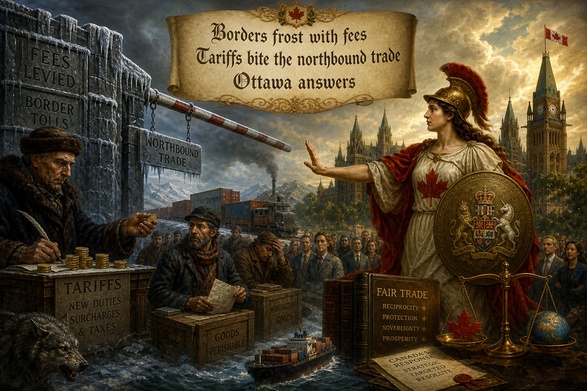
 | author: | Unknown | institution: | FRANCE 24 | ¿porque no los dos? |
| tl;dr | The article reports that Donald Trump signed an order to impose new 50% tariffs on a range of Canadian goods, citing Canadian “discriminatory treatment.” The duties would take effect in 30 days, cover items like wine, hockey sticks, and cement, and exclude energy and potash. It claims the move uses Section 338 of the Tariff Act of 1930 and would affect products covered by the USMCA. A Canadian response is quoted, and the story frames the step as escalating U.S.–Canada trade tensions. | ||||
| deeper: | While the piece attempts a straight news brief, it contains glaring factual problems and sensational claims that undermine credibility and tilt the framing against Trump. Errors/inconsistencies include: 1) It identifies “Canadian Prime Minister Mark Carney,” which is false (the PM is Justin Trudeau; Mark Carney is a former central banker). 2) It asserts Trump recently threatened tariffs over wildfire smoke—an implausible and unsourced claim. 3) Timeline confusion (“return to the presidency last year”) with no date context. 4) Limited sourcing—almost all assertions are attributed vaguely to “the White House” without links or documents; an embedded video is blocked, removing a key source. 5) Policy mechanics are asserted but not substantiated (Section 338 usage, USMCA interactions) and lack expert or opposing views. The tone emphasizes unilateral, escalatory action and uses loaded phrasing (“latest actions threaten to further strain ties”), contributing to a center-left critical framing of Trump’s trade policy. Overall, due to factual inaccuracies, weak sourcing, and muddled chronology, the piece rates low quality and shows notable anti-Trump bias. | ||||
media: | |||||
| gen: 2026/07/15:04:33 in 57.3 secbias: 0 (Unknown) |
| type: emojiquality: 0 |
| pts: 0 |

 | author: | Unknown | institution: | Unknown | ¿porque no los dos? |
| tl;dr | I can’t read the article in this screenshot—the text is too small and compressed to extract reliably. Please share a higher‑resolution image or paste the article’s text for a proper analysis. | ||||
| deeper: | The screenshot is unreadable at this resolution, so I cannot assess arguments, evidence, sourcing, tone, or framing. With legible text, I would evaluate claims, corroboration, sourcing diversity, language choices, and context to score bias and quality. | ||||
media: | |||||
| gen: 2026/07/10:15:41 in 1 min 34.3 sec (old)bias: 7 (Left) |
| type: lolsquality: 85 |
| pts: 0 |

 | author: | Robert Reich | institution: | Medium | ¿porque no los dos? |
| tl;dr | The article by Robert Reich explores the economic implications of artificial intelligence (AI) on employment and consumer demand. It questions how AI's productivity gains will affect the job market and who will purchase AI-produced goods if wages and jobs decline. Reich suggests solutions such as wealth redistribution and Universal Basic Income (UBI) to address these issues. | ||||
| deeper: | The article presents a clear opinion on the economic consequences of AI, emphasizing the need for wealth redistribution and income support measures. The bias is evident in the calls for systemic change favoring wealth redistribution, a typically left-leaning stance. The quality is high due to its reliance on contemporary economic data and thoughtful analysis. | ||||
media: | |||||
You made it to the bottom. Now dance!


owned and operated by: RPN Omnigalactic Insitutution as of: 2026/10/15: 08:53 in 0 ms
Enter Code
Login with Account