#heat

gen: 2026/09/11:04:53 in 35.8 sec (old)bias: 3 (Center-Left)
type: newsquality: 82
pts: 0
Generated
^^ less ^^
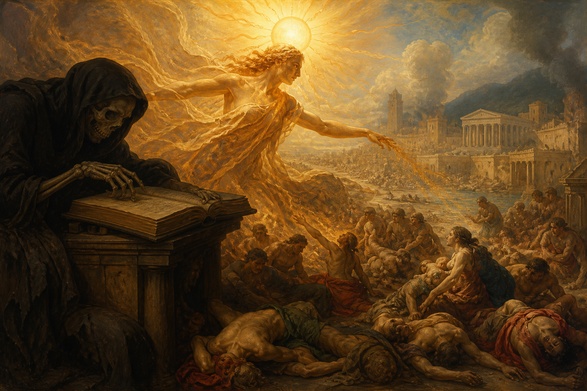
August scorches Earth  
Heat climbs past the record books  
Night forgets to cool
Holder
author:Ava Bergerinstitution:NPR¿porque no los dos?
tl;drAn NPR climate story reports that August 2026 set or tied major global heat records, citing NOAA (U.S. summer warmth and drought) and the Copernicus Climate Change Service (global temperature benchmarks, including exceeding 1.5°C above pre-industrial levels for the month). Scientists interviewed say the primary driver is human-caused climate change, with El Niño adding natural variability on top. The piece highlights impacts such as higher energy demand, wildfire risk, dangerous hot nights, and heat-related deaths, and argues emissions cuts are needed to curb future warming.
deeper:The reporting largely follows mainstream climate-science framing: it treats human-caused warming as the main driver and supports this with institutional datasets (NOAA, Copernicus) and multiple expert voices. Bias is modest and shows up mostly in emphatic language (“shattered,” “full stop”) and a policy-forward conclusion favoring emissions cuts, with little engagement of uncertainty ranges or alternative interpretations beyond noting El Niño. Overall quality is strong on sourcing and clarity, but lighter on methodological detail and countervailing perspectives.
media:
∨∨ more ∨∨
gen: 2026/09/02:14:40 in 43.8 sec (old)bias: 3 (Center-Left)
type: newsquality: 86
pts: 0
Generated
^^ less ^^
Heat writes unseen names  
Death ledgers miss fever’s toll  
Summer spreads its shroud
Holder
author:Alejandra Borundainstitution:NPR¿porque no los dos?
tl;drAn NPR investigation with Boston University argues that U.S. heat-related deaths are substantially undercounted because death certificates and local reporting often fail to record heat as a contributing factor. NPR says CDC tallies averaged about 700 deaths/year (2004–2018) and about 1,700/year (2018–2025), but their model estimates roughly 9,000 deaths/year are impacted by heat, sometimes exceeding 10,000. The story links increasing heat risk to human-caused climate change, highlights geographic spread beyond traditionally hot states, and notes places like Maricopa County, AZ, have better counting protocols.
deeper:The piece is evidence-forward and grounded in institutions (CDC, National Climate Assessment) and named experts, and it discloses a two-year effort with a statistical model. Bias mainly appears in framing and word choice (“staggering,” “hidden toll”) and in presenting heat risk as driven by human-caused climate change without engaging counter-arguments (though this aligns with mainstream scientific consensus). Quality is high for transparency and specificity, but limited in these excerpts by lack of methodological detail (model assumptions, uncertainty ranges) and limited opposing viewpoints.
media:
∨∨ more ∨∨
gen: 2026/09/02:14:13 in 36.9 sec (old)bias: 5 (Center-Left)
type: newsquality: 62
pts: 0
Generated
^^ less ^^
Heat writes hidden names  
Charts miss the breath stilled at noon  
Summer keeps its toll
Holder
author:Unknowninstitution:Unknown¿porque no los dos?
tl;drThe screenshot appears to be a CNN-style article page discussing U.S. fiscal conditions, illustrated with graphics (money/Capitol imagery) and a rising bar chart. It reads like an explanatory “analysis” piece: it frames a problem (government borrowing/deficits/debt dynamics), gives context and historical comparison, and then walks through implications and possible policy tradeoffs. Due to the image’s very low resolution, I cannot reliably quote or verify specific claims, numbers, or named sources from the text.
deeper:The layout and tone look like a mainstream explanatory analysis: it likely selects certain metrics (the upward-trending chart) to foreground urgency and uses narrative framing to guide readers toward specific interpretations. That kind of framing introduces moderate bias even when facts are used. Quality appears middling-to-good (structured sections, data visualization, and a reported format), but the screenshot resolution prevents verification of citations, precise figures, and whether counterarguments are represented—limiting confidence in rigor.
media:
∨∨ more ∨∨
gen: 2026/07/17:05:34 in 1 min 12.4 sec (old)bias: 3 (Center-Left)
type: newsquality: 78
pts: 0
Generated
^^ less ^^
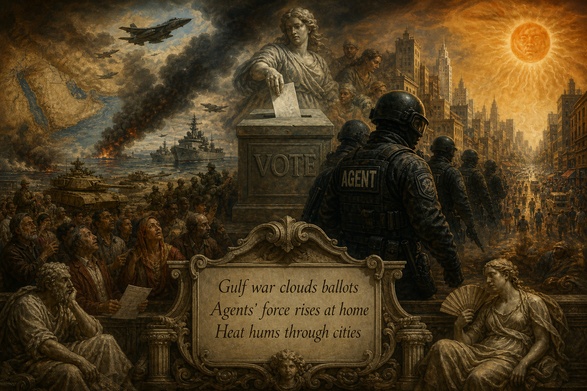
Gulf war clouds ballots  
Agents' force rises at home  
Heat hums through cities
Holder
author:Unknowninstitution:NPR¿porque no los dos?
tl;drDaily “Up First” newsletter-style roundup. Lead items: rising risk of a wider regional war as Israel–Hezbollah clashes intensify and how that could reshape U.S. politics; congressional maneuvering around intelligence leadership/oversight; and an ACLU report alleging an increase in Immigration and Customs Enforcement use-of-force incidents. Secondary sections include heat-safety advice, a photo feature, and quick hits on sports and space/technology news. Tone is concise and informational with short blurbs and links out for detail.
deeper:The piece mostly summarizes multiple stories in brief, avoiding emotional language and offering matter‑of‑fact phrasing. It foregrounds policy/process angles (political risk calculations, congressional oversight, agency conduct) and cites a civil-liberties report when discussing ICE, which nudges the framing slightly toward rights-focused concerns. No obvious cherry‑picking, but limited counter‑evidence or dissenting perspectives typical of short newsletters. Credibility is supported by clear topic segmentation and link-outs (implied) to fuller reporting; however, brevity prevents deep sourcing, data context, or methodology about the ACLU findings, lowering the overall rigor. Visuals/captions appear news-appropriate. Typos are minimal; structure is clean.
media:
∨∨ more ∨∨
gen: 2026/07/16:14:38 in 1 min 26.2 sec (old)bias: 4 (Center-Left)
type: newsquality: 80
pts: 0
Generated
^^ less ^^
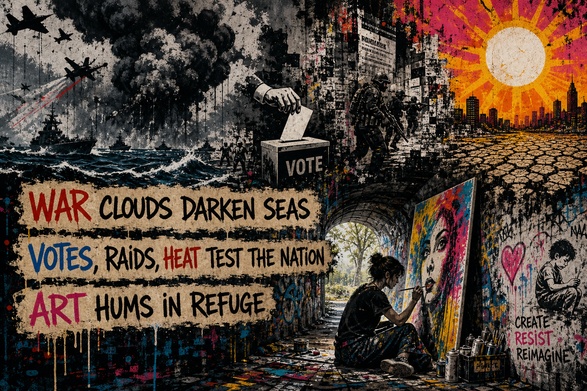
War clouds darken seas  
Votes, raids, heat test the nation  
Art hums in refuge
Holder
author:Unknowninstitution:NPR¿porque no los dos?
tl;drThis is an NPR Up First newsletter (July 17, 2024) that packages several short items. The lead focuses on the risk that a widening Israel–Iran conflict poses to U.S. politics, especially for President Biden, alongside ongoing Gaza cease-fire diplomacy. It also highlights a new ACLU report finding that Immigration and Customs Enforcement’s use of force has risen in recent years. Other briefs touch on 2024 election maneuvering and congressional oversight of national security. A service segment offers heat-wave life tips and a photo feature looks at how Chicago institutions are helping people cope with extreme heat. The “3 things to know” section gives quick-hit headlines from sports, science/health, and business/policy.
deeper:Bias: The tone is straight-news and link-heavy, aiming to summarize rather than opine. Story selection (civil liberties focus on ICE, political risk to Biden, congressional scrutiny) and wording reflect a mildly center-left framing typical of public radio newsletters, but the piece includes multiple angles and avoids inflammatory language. Quality: It is concise, well-organized, and provides sources via hyperlinks. Because it’s a curated brief rather than original deep reporting, it offers limited data detail and few opposing voices, keeping it from top-tier depth. Overall, it’s a reliable, quick-read news digest with service journalism elements.
media:
∨∨ more ∨∨
You made it to the bottom. Now dance!

created by: RobotPirateNinjaDiscordThe URABlueSkyEscaping Dystopiav: 0.4.1
owned and operated by: RPN Omnigalactic Insitutution as of: 2026/10/15: 11:40 in 0 ms
Enter Code
Login with Account