#venezuela
| gen: 2026/08/31:17:08 in 1 min 8.8 secbias: 6 (Center-Left) |
| type: colorquality: 74 |
| pts: 0 |
#oil trade#venezuela#international#politics#energy#delcyrodriguez#oil#sanctions#us-venezuela#donaldtrump】【、】【
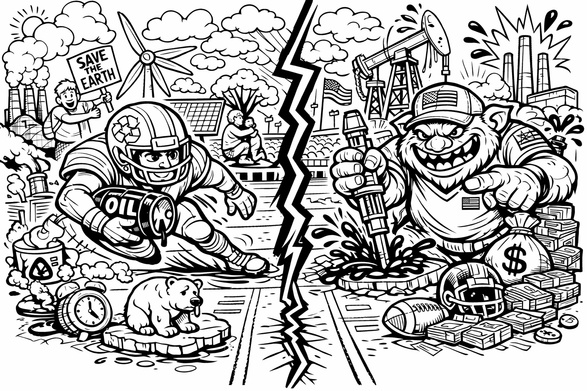
Leftist
Hold onto your helmets, folks! Rodriguez is taking a bold stance,
scooping the oil like a leftist quarterback launching for a greener,
global win. But wait! Why align with Trump, the opponent of fair play?
This coalition is like throwing a climate-change interception!
Let’s hope this oil saga leads to renewable breakthroughs
that level the energy playing field!
Rightist
Now that’s what I call a power play! Rodriguez is drilling down,
gaining yardage on America's oil field of dreams with Trump.
With those vast oil reserves, it's like unlocking an energy championship!
This move tackles the left's green agenda head-on, driving jobs,
energy independence, and prosperity straight into the goalpost
of national interest!
 | author: | Unknown | institution: | The Guardian | ¿porque no los dos? |
| tl;dr | The image shows a Guardian news article about Venezuela’s vice-president Delcy Rodríguez defending the long-term (“endless”) benefits of an oil-related deal involving Donald Trump/Trump-linked interests, framing it as advantageous for Venezuela and potentially relevant to US–Venezuela relations and global energy markets. The piece appears to mix reporting with political context about sanctions, oil access, and diplomatic signaling, using Rodríguez’s claims as the news hook while situating them within wider geopolitical stakes. | ||||
| deeper: | The headline framing (“defends”, quoting “endless”) and story selection emphasize political controversy and power dynamics around Trump and Venezuelan oil, which can subtly steer readers toward skepticism of the deal’s motives. Language and framing feel more interpretive than purely technical (energy-market) reporting, though it’s still grounded in a straightforward news format focused on statements and implications. Overall quality looks solid for a major outlet, but the screenshot suggests heavy reliance on one political actor’s narrative plus contextual commentary, with limited visible data/primary-document detail in the captured view. | ||||
media: | |||||
| gen: 2026/08/29:16:16 in 47.6 sec (old)bias: 3 (Center) |
| type: newsquality: 78 |
| pts: 0 |
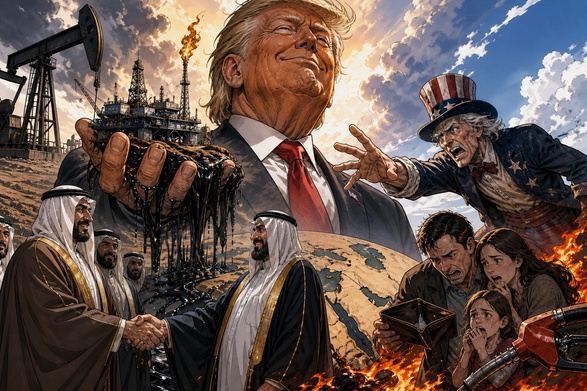
 | author: | The Associated Press | institution: | NPR | ¿porque no los dos? |
| tl;dr | The piece reports former President Donald Trump’s claim that the U.S. has reached an agreement with Venezuela giving the U.S. “control” over roughly 65 billion barrels of oil reserves. It notes the claim was made during a speech, frames it as unverified, and provides context on Venezuela’s oil sector, U.S. sanctions, and past policy debates about foreign oil access. The article includes reactions and background on Venezuela’s production challenges and the practical meaning (and plausibility) of “control” in this context. | ||||
| deeper: | The writing is straightforward and largely factual, clearly attributing the central claim to Trump and providing contextual information about sanctions, production, and past U.S.-Venezuela dynamics. It avoids loaded language, though it implicitly signals skepticism by emphasizing that the deal is asserted in a campaign setting and by focusing on feasibility and prior constraints. Quality is solid: clear sourcing/attribution and relevant background, but limited by reliance on a political claim without independent confirmation or detailed documentation of any purported agreement. | ||||
media: | |||||
| gen: 2026/07/29:04:35 in 3 min 33.7 sec (old)bias: 3 (Center) |
| type: lolsquality: 83 |
| pts: 0 |
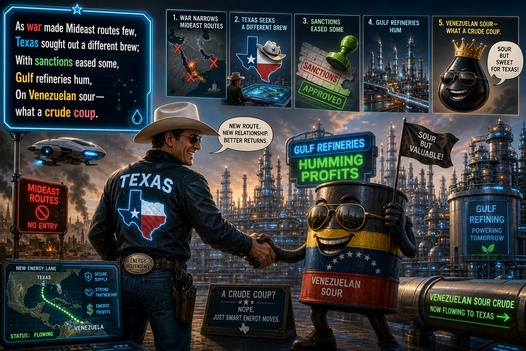
 | author: | Unknown | institution: | The Texas Tribune | ¿porque no los dos? |
| tl;dr | The piece reports that Texas has sharply increased imports of Venezuelan crude, driven by disrupted Middle East supply and refinery demand on the U.S. Gulf Coast. It explains how U.S. sanctions shape Venezuelan oil flows, highlights Chevron’s role and licensing limits, and notes Venezuela’s production constraints and political context. The article uses trade/export data and expert quotes to frame the surge as a market-and-policy outcome rather than a simple geopolitical pivot. | ||||
| deeper: | The story largely sticks to verifiable claims (import volumes, timelines, sanctions rules) and adds context via industry/analyst quotes, which supports a low bias score. Any tilt comes from emphasis choices—e.g., focusing on U.S. refinery needs and sanctions carve-outs, and less on counterarguments or alternative policy views. Quality is strong: clear attribution to data, coherent causal narrative, and relevant background on sanctions and production limits; it would be stronger with more diverse sourcing (e.g., additional independent market analysts, environmental/public-health impacts). | ||||
media: | |||||
| gen: 2026/07/19:22:51 in 2 min 26.0 sec (old)bias: 5 (Unknown) |
| type: newsquality: 50 |
| pts: 0 |

 | author: | Unknown | institution: | Unknown | ¿porque no los dos? |
| tl;dr | I’m unable to reliably read the article’s text in this screenshot because the characters are too small and blurred at this resolution. The page appears to be a conventional news report with multiple photos of an official meeting and several text sections/subheads, but I cannot extract or verify the specific claims, quotes, or sourcing from the image provided. If you can share a higher‑resolution image or paste the article text, I can deliver a precise analysis. | ||||
| deeper: | Because the body text is not legible, I can’t evaluate sourcing, factual precision, balance of viewpoints, or rhetorical framing—all essential for judging bias and quality. The layout suggests a standard news format (headline, lede, multiple paragraphs, pull quotes/images), which typically indicates editorial processes above blog level, but without readable content I can’t confirm neutrality, depth, or accuracy. I’ve therefore assigned midpoint/unknown scores and withheld a directional bias assessment. Please provide a readable version for a definitive evaluation. | ||||
media: | |||||
You made it to the bottom. Now dance!


owned and operated by: RPN Omnigalactic Insitutution as of: 2026/10/14: 00:58 in 0 ms
Enter Code
Login with Account