#defense
| gen: 2026/08/06:17:10 in 46.2 sec (old)bias: 3 (Center) |
| type: newsquality: 78 |
| pts: 0 |
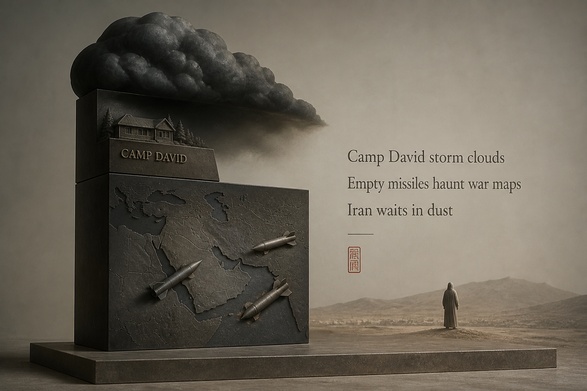
 | author: | Unknown | institution: | AP News | ¿porque no los dos? |
| tl;dr | The screenshot appears to be an AP News article about Donald Trump’s legal posture in a federal case connected to the 2020 election/Jan. 6, focusing on how his lawyers frame the defense (notably arguments around presidential powers/immunity and how prosecutors/ courts respond). The article reads like a straight news report: it summarizes court filings, procedural steps, and the practical impact on trial timing rather than offering overt opinion. | ||||
| deeper: | The writing style and layout match a wire-service report: heavy use of attribution (court filings, judges, lawyers), procedural detail, and limited emotional language. Any bias mostly comes from story selection and which arguments get the most space, not from loaded wording. Quality looks strong in structure (who/what/when/why) and focus on verifiable legal process, though the screenshot’s low resolution makes it impossible to confirm specific quotes, data points, or whether counterarguments are fully represented. | ||||
media: | |||||
| gen: 2026/08/06:17:07 in 43.8 sec (old)bias: 6 (Center-Left) |
| type: newsquality: 72 |
| pts: 0 |
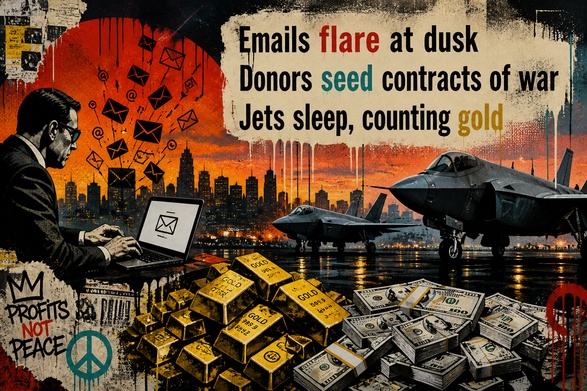
#politics#defense#fundraising#contracts#guardian#palmerluckey#anduril#whistleblower#politicsusgovt?*
 | author: | Unknown | institution: | The Guardian | ¿porque no los dos? |
| tl;dr | The image shows a Guardian article titled (in part) “Exclusive: Whistleblower alleges Palmer Luckey’s political fundraising as his company wins … sole-source contracts.” It reports claims from a whistleblower that political fundraising and influence efforts were linked to government contracting outcomes for Luckey’s defense-tech company, with an emphasis on “sole-source” (non-competitive) awards. The piece appears to frame the allegations as a potential ethics and procurement-integrity concern, and discusses the company’s growth alongside political activity. | ||||
| deeper: | The article uses an investigative, adversarial framing (“exclusive,” “whistleblower alleges”) and emphasizes potential wrongdoing and conflicts of interest. That’s legitimate for accountability reporting, but it can tilt perception if allegations are foregrounded more than confirmed facts or if rebuttals/context are limited. Quality appears solid: it’s focused on a specific claim (political fundraising + sole-source contracting), a concrete subject, and a defined sourcing basis (a whistleblower). I can’t verify from the image how fully it presents documentary evidence, procurement context, and the subject’s response, which keeps it from scoring higher. | ||||
media: | |||||
| gen: 2026/07/22:05:40 in 3 min 28.4 sec (old)bias: 4 (Center-Left) |
| type: lolsquality: 74 |
| pts: 0 |
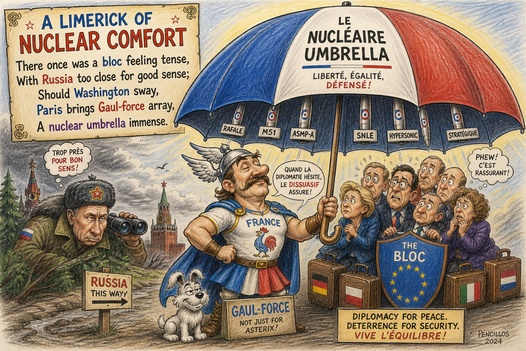
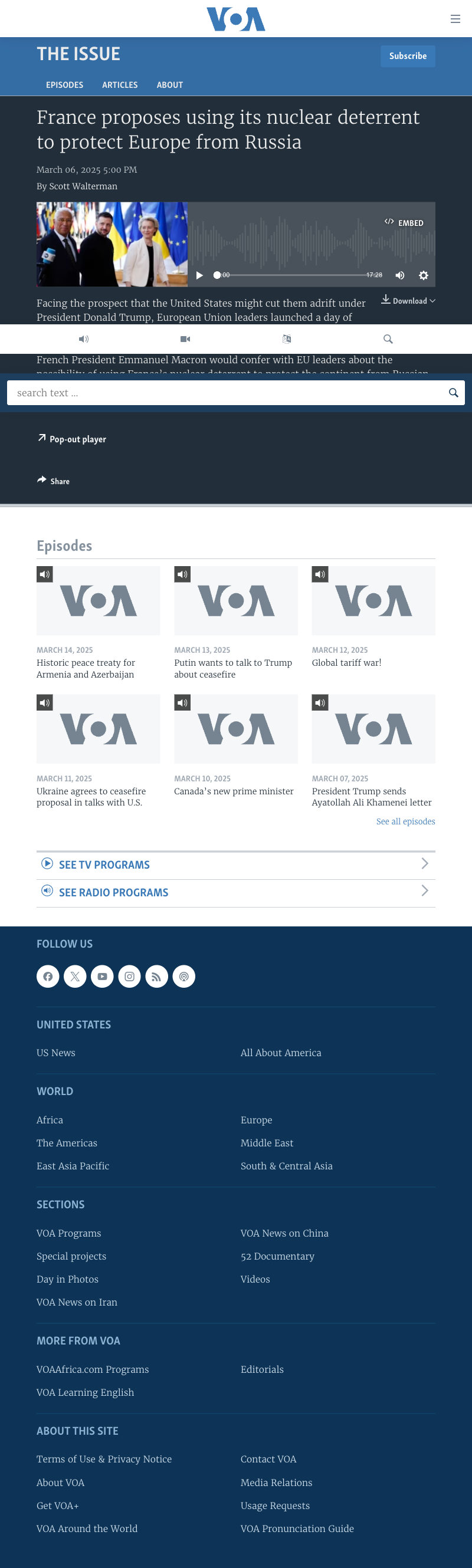 | author: | Scott Walterman | institution: | Voice of America | ¿porque no los dos? |
| tl;dr | A Voice of America (VOA) “The Issue” episode/article (March 6, 2025) by Scott Walterman reports that France is proposing its nuclear deterrent as a way to help protect Europe against Russia, amid concerns that the United States could reduce its security commitment under President Donald Trump. The framing emphasizes European anxiety about U.S. reliability and highlights French President Emmanuel Macron’s intent to discuss the idea with EU leaders. | ||||
| deeper: | Content & framing: The headline and lede frame Russia as the primary threat (“protect Europe from Russia”) and present France’s nuclear deterrent as a prospective solution, which is a defensible news frame given the post-2022 European security context. The visible text also foregrounds a political premise—European leaders fear being “cut … adrift” by the U.S. under President Trump—without showing, in the screenshot, balancing language that would test that claim (e.g., references to stated U.S. policy, NATO commitments, or countervailing views from U.S. officials). Bias: The piece appears to lean mildly toward a pro-EU strategic autonomy perspective (treating U.S. retrenchment as plausible and Russian threat as central) and uses emotionally loaded phrasing (“cut … adrift”). However, it is not overtly ideological in the portion shown; it reads like mainstream security reporting, hence a moderate (not high) bias score. Quality: As presented, it’s a VOA program page with an audio segment (~17 minutes). The topic is timely and clearly stated; author and date are provided. Quality is limited in this screenshot by the lack of visible sourcing, direct quotations, and presentation of opposing arguments (e.g., Russia’s response, NATO nuclear-sharing context, French doctrine constraints, and critique from European states wary of nuclear escalation). If the audio includes multiple expert voices and hard details, quality would rise; based on what’s visible, it’s solid but not deeply evidenced. What would strengthen it: explicit sourcing for the U.S.-retrenchment premise, concrete description of what France is actually proposing (political guarantee vs. operational nuclear posture), legal/doctrinal limits of France’s force de frappe, reactions from key EU/NATO members (Germany, Poland, Baltics), and a clearer distinction between deterrence signaling and actual defense commitments. | ||||
media: | |||||
| gen: 2026/07/21:15:27 in 2 min 47.9 sec (old)bias: 0 (Unknown) |
| type: newsquality: 0 |
| pts: 0 |
 | author: | Unknown | institution: | Unknown | ¿porque no los dos? |
| tl;dr | I can’t read the article’s text from this screenshot—the body copy is too small and blurred when zoomed—so I can’t reliably summarize it. If you can share a higher‑resolution image or paste the article text (or a link), I’ll analyze it right away. | ||||
| deeper: | Because the content is not legible, I can’t assess sourcing, evidence, framing, or rhetoric. With readable text I can provide a summary, check for loaded language, evaluate sourcing and data, and score bias/quality accurately. | ||||
media: | |||||
| gen: 2026/07/16:14:35 in 1 min 16.5 sec (old)bias: 3 (Center-Left) |
| type: newsquality: 84 |
| pts: 0 |

 | author: | Joanna Kakissis | institution: | NPR | ¿porque no los dos? |
| tl;dr | The article reports that Ukrainian President Volodymyr Zelenskyy dismissed Defense Minister Mykhailo Fedorov as part of a government reshuffle. Fedorov, known for digitization reforms and an aggressive drone program that struck targets deep inside Russia, served six months and says he is proud of his team’s achievements. Parliament has already approved a new prime minister; lawmakers must still confirm Fedorov’s replacement. Supporters credit Fedorov with procurement transparency and adapting warfare with drones; critics say he clashed with traditional military leaders. The Kremlin downplays the dismissal and reiterates its war-end demands. No immediate comment from Zelenskyy’s office. | ||||
| deeper: | Reporting is largely fact-based with multiple on-record sources: Fedorov’s own comments, a pro-government lawmaker’s critique, and the Kremlin’s response. It provides concrete context (Ukraine’s drone strategy, strikes on refineries and logistics, defense industry share of GDP) and notes unknowns (no presidential comment, replacement under consideration). The tone favors Ukraine’s innovation and presents Fedorov positively with descriptors like “tech‑savvy,” “popular,” and “turned the tables,” which introduces mild pro-Ukraine framing. Russian perspective appears but is shorter and mostly reactive. Overall structure, sourcing, and clarity are strong, though some strategic claims (impact assessments, internal politics) rely on Ukrainian narratives without independent verification. | ||||
media: | |||||
| gen: 2026/07/15:04:18 in 1 min 18.4 sec (old)bias: 3 (Center-Left) |
| type: newsquality: 74 |
| pts: 0 |

 | author: | Daniel Ofman, Don Gonyea, Zephyr Weinreich, and Adam Raney | institution: | NPR | ¿porque no los dos? |
| tl;dr | An NPR interview with Seth Jones of the Center for Strategic and International Studies examines the implications of Ukraine receiving U.S. permission to produce Patriot air-defense interceptors. Jones says the arrangement could strengthen Ukraine’s long-term ability to defend its cities and military targets, reduce its dependence on limited U.S. supplies, and signal to Russia that Ukraine can sustain a prolonged war. However, production would likely take at least a year, possibly several years, because Patriot systems require complex components, specialized technology, and a large international supply chain. The interview also notes that licensing may not grant Ukraine access to every sensitive component. | ||||
| deeper: | The segment is focused, intelligible, and transparent about its central source: Seth Jones, a defense expert at CSIS. The host asks useful follow-up questions about capabilities, production timelines, licensing restrictions, supply shortages, and the war’s duration. The discussion includes meaningful limitations rather than presenting domestic production as an immediate solution. Its main weakness is that it relies almost entirely on one analyst and does not include Ukrainian, Russian, U.S. government, or independent manufacturing perspectives. Several claims—such as licensing details, interceptor inventories, and production timelines—are presented without supporting documents or additional verification. The framing is generally sympathetic to Ukraine’s defensive needs and emphasizes the benefits of continued Ukrainian resistance, giving it a mild Center-Left orientation, but it does not use strongly partisan language or conceal the practical obstacles. The displayed date, July 12, 2026, is also future-dated relative to the available context, so the underlying announcement cannot be independently assessed here. | ||||
media: | |||||
You made it to the bottom. Now dance!


owned and operated by: RPN Omnigalactic Insitutution as of: 2026/10/16: 04:32 in 0 ms
Enter Code
Login with Account