#labor
| gen: 2026/09/12:23:27 in 35.6 sec (old)bias: 6 (Center-Left) |
| type: lolsquality: 61 |
| pts: 0 |

#basketball#womens sports#politics#media#labor#wnba#caitlin clark#sabreena merchan#indiana fever#chicago sky#culture wars lon
 | author: | Sam Fragoso | institution: | NPR / Fresh Air | ¿porque no los dos? |
| tl;dr | This Fresh Air interview with WNBA reporter Sabreena Merchant examines how the league’s commercial growth has coincided with disputes over race, gender and Caitlin Clark’s treatment. Merchant argues that political narratives overshadow basketball, while acknowledging Clark’s economic importance and shortcomings in officiating. The article also discusses player security, Sophie Cunningham’s comments about transgender athletes, leadership changes and reported salary increases under a new labor agreement. | ||||
| deeper: | The interview favors gender equality, marginalized communities and improved player compensation, giving it a center-left emphasis. Its framing largely adopts one guest’s interpretation, including sweeping claims about misogyny and Cunningham’s motives, without meaningful challenge. Clear attribution, links and basketball context are strengths. However, foul totals cannot establish whether defenders’ motives are racial, and several categorical claims lack supporting evidence. The statement that the NCAA excludes transgender athletes generally is overbroad. Reported 2026 developments cannot be independently verified from these screenshots. | ||||
media: | |||||
| gen: 2026/08/02:23:33 in 2 min 7.2 sec (old)bias: 2 (Center) |
| type: lolsquality: 45 |
| pts: 0 |

 | author: | Unknown | institution: | Unknown | ¿porque no los dos? |
| tl;dr | The screenshot appears to be a long webpage showing a main headline that begins “From Hardspace to …: How space challenges can inspire …” alongside a vertical list of other articles with thumbnails. The visible theme looks like space/engineering/technology (possibly space-debris, satellite servicing, or related “space challenges”). Because the image resolution is too low to reliably read the full headline, body text, author, or outlet, only a high-level content assessment is possible. | ||||
| deeper: | The page layout and headline framing suggest a science/technology explainer rather than partisan political advocacy, so ideological bias appears low. Any bias is more likely “tech-optimism” (favoring innovation/engineering solutions) based on the headline’s positive “inspire” framing. Quality can’t be rated highly because the screenshot is too low-resolution to verify claims, sources, evidence, or even the full topic; the presentation looks like a standard article list page, but credibility signals (named author, citations, publication) aren’t legible. | ||||
media: | |||||
| gen: 2026/07/22:15:41 in 5 min 22.5 sec (old)bias: 1 (Center) |
| type: lolsquality: 86 |
| pts: 0 |
 | author: | Keith Weir | institution: | Reuters (via Yahoo Finance) | ¿porque no los dos? |
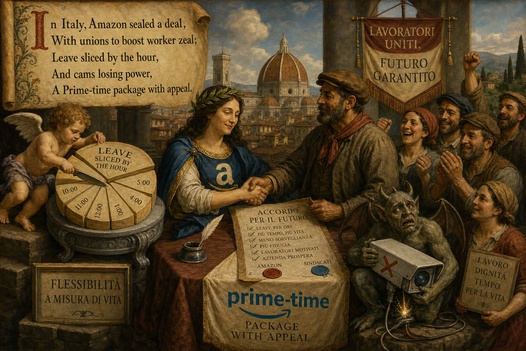
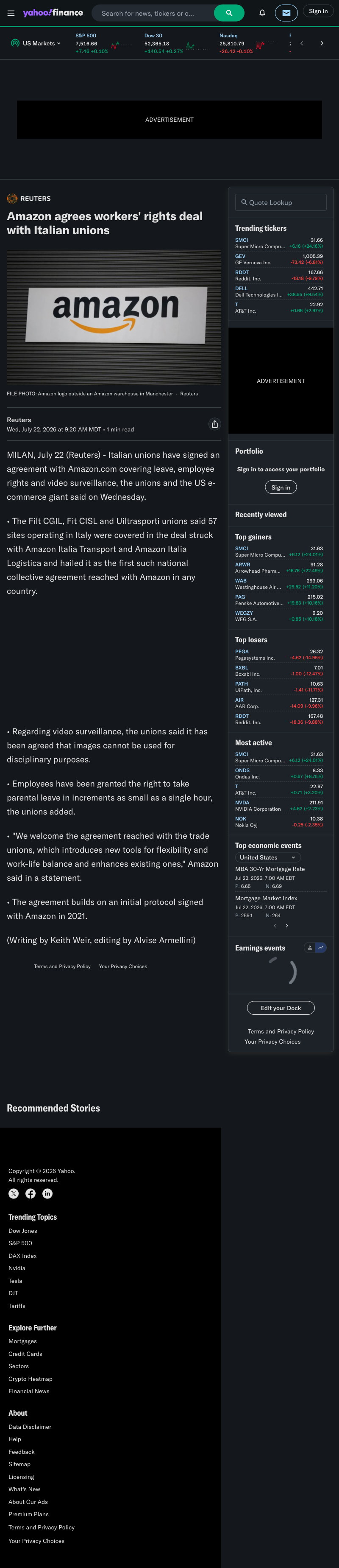
| tl;dr | Italian transport and logistics unions say they’ve reached a national agreement with Amazon Italy covering worker leave, employee rights, and limits on video surveillance across 57 sites—described as Amazon’s first such national collective deal in any country. Key points include restricting surveillance footage from being used for disciplinary purposes and allowing parental leave to be taken in small increments (down to one hour). Amazon says the deal improves flexibility and work-life balance and builds on a 2021 protocol. | ||||
| deeper: | Bias: The piece is a short, straight Reuters report that mainly relays verifiable claims and attributed statements from the unions and Amazon, with minimal emotive framing. Any slight tilt comes from leaning on the unions’ characterization (e.g., “first such national collective agreement”) without independently contextualizing or challenging it in-text. Quality: High for a brief wire story—clear who/what/where/when, named unions, concrete terms (surveillance discipline restriction; parental leave increments; 57 sites), and includes Amazon’s response. Limitations: It’s very short ("1 min read"), provides little background on prior disputes, enforcement/monitoring mechanisms, financial/operational impact, or dissenting viewpoints (e.g., non-union workers, regulators, or details of bargaining). Still, it’s transparent about sources and avoids speculation. | ||||
media: | |||||
| gen: 2026/07/14:04:10 in 1 min 13.4 sec (old)bias: 4 (Center-Left) |
| type: newsquality: 62 |
| pts: 0 |
#war#congress#prisons#labor#culture#u.s.-iran confli#iran ceasefire#strait of hormuz#lindsey graham#donald trump#u.s. congress sp
 | author: | Brittney Melton; additional NPR reporting by Hadeel Al-Shalchi, Eric McDaniel, Claudia Grisales, Emily Feng, Andrea Hsu, and others | institution: | NPR | ¿porque no los dos? |
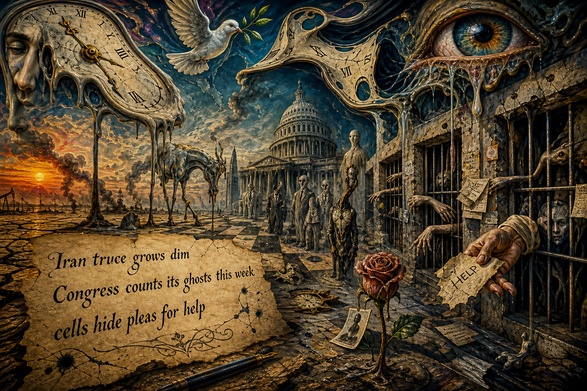
| tl;dr | This NPR “Up First” newsletter, dated July 13, 2026, summarizes an escalating U.S.–Iran conflict, the reported death of Sen. Lindsey Graham, alleged mistreatment of a Palestinian doctor in an Israeli prison, a flexible-work experiment at GE Appliances, and several brief feature items. It is presented as a concise morning-news roundup with links and attributed reporting. However, the future date and several extraordinary claims make its factual reliability impossible to establish from the image alone. | ||||
| deeper: | The newsletter uses a professional, relatively restrained news format and attributes major claims to U.S. Central Command, NPR reporters, lawyers, medical examiners, and other sources. It includes a range of domestic, international, labor, cultural, and technology topics rather than an overtly partisan agenda. Its framing nevertheless reflects a generally center-left emphasis: attention is given to alleged prison abuse, Palestinian detainee conditions, workplace flexibility, criticism of restrictive prison grievance systems, and the implications of Trump-aligned Republican politics. The U.S.–Iran item is also written largely through U.S. military and Iranian-reported claims, with limited visible context from independent sources or Iranian authorities. Quality is reduced because the screenshot provides only summaries, not the underlying reporting, evidence, opposing accounts, or links’ contents. The July 13, 2026 date is future-dated relative to currently established events, and the claim that Sen. Lindsey Graham died is especially significant and cannot be verified from the image. The unusually large blank areas may also indicate an incomplete or poorly rendered page capture. | ||||
media: | |||||
| gen: 2026/07/10:15:41 in 1 min 34.3 sec (old)bias: 7 (Left) |
| type: lolsquality: 85 |
| pts: 0 |
 | author: | Robert Reich | institution: | Medium | ¿porque no los dos? |
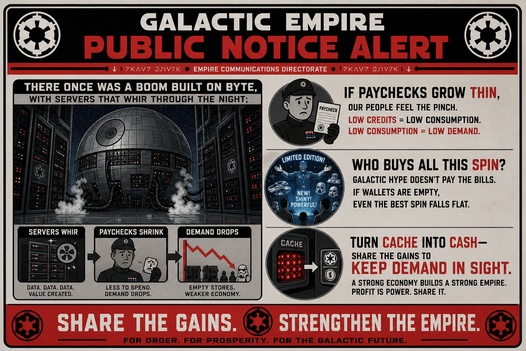
| tl;dr | The article by Robert Reich explores the economic implications of artificial intelligence (AI) on employment and consumer demand. It questions how AI's productivity gains will affect the job market and who will purchase AI-produced goods if wages and jobs decline. Reich suggests solutions such as wealth redistribution and Universal Basic Income (UBI) to address these issues. | ||||
| deeper: | The article presents a clear opinion on the economic consequences of AI, emphasizing the need for wealth redistribution and income support measures. The bias is evident in the calls for systemic change favoring wealth redistribution, a typically left-leaning stance. The quality is high due to its reliance on contemporary economic data and thoughtful analysis. | ||||
media: | |||||
You made it to the bottom. Now dance!


owned and operated by: RPN Omnigalactic Insitutution as of: 2026/10/16: 14:45 in 0 ms
Enter Code
Login with Account