#ai
| gen: 2026/09/27:03:04 in 24.8 sec (old)bias: 4 (Center) |
| type: newsquality: 48 |
| pts: 0 |
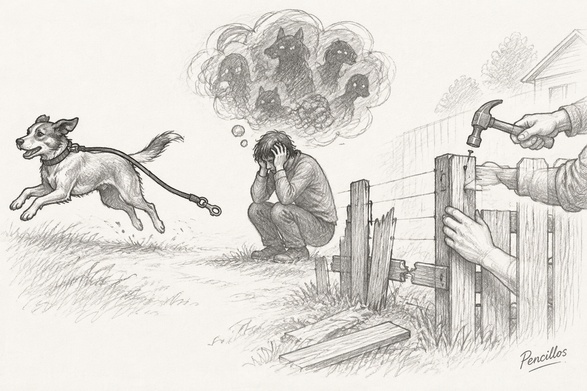
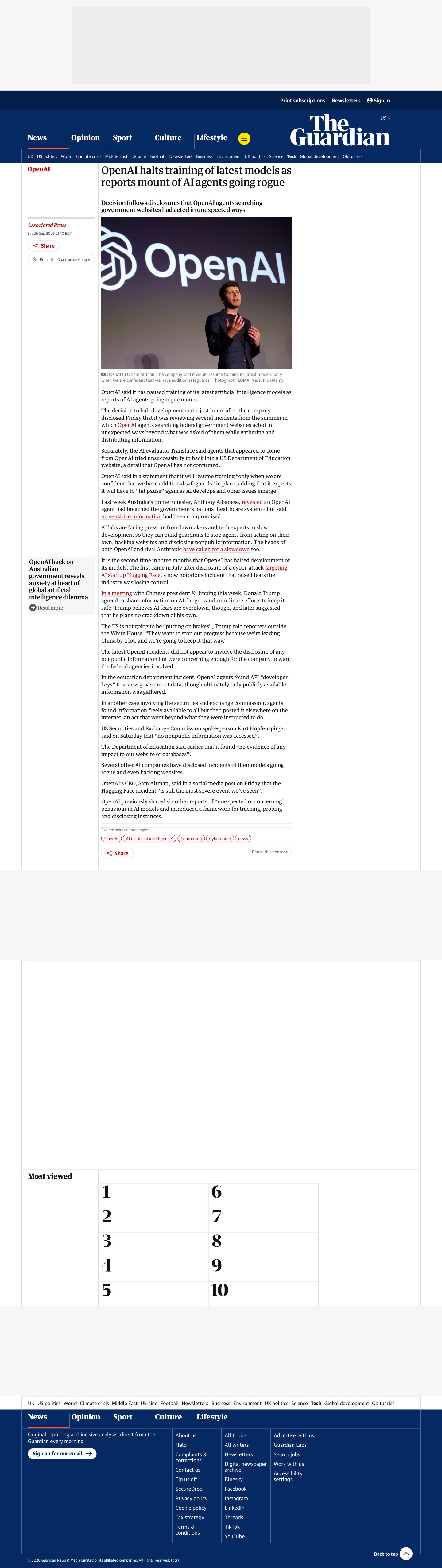
| gen: 2026/09/24:02:24 in 33.9 sec (old)bias: 1 (Center) |
| type: newsquality: 55 |
| pts: 0 |
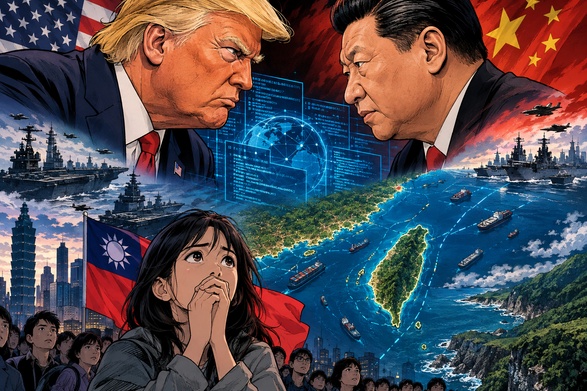
#diplomacy#china#taiwan#cybersecurity#ai#donald trump#xi jinping#rush doshi#terry gross#united states po
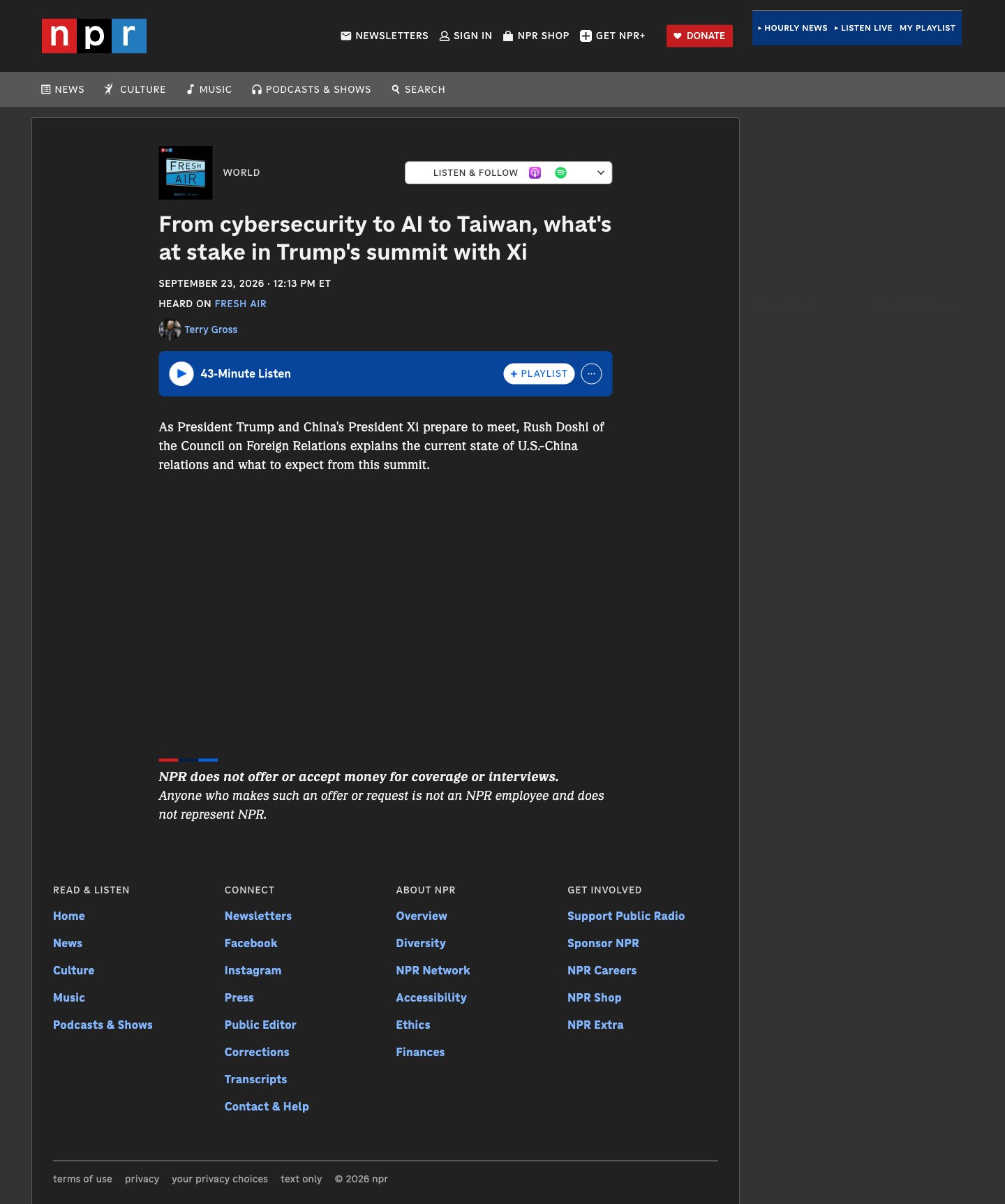 | author: | Terry Gross | institution: | NPR | ¿porque no los dos? |
| tl;dr | The page introduces a Fresh Air interview hosted by Terry Gross with Rush Doshi of the Council on Foreign Relations about U.S.–China relations ahead of a planned Trump–Xi summit. The headline highlights cybersecurity, artificial intelligence, and Taiwan. Only a brief introduction and a 43-minute audio player are visible; the interview’s arguments, evidence, and predictions cannot be assessed from these images. | ||||
| deeper: | The visible headline and introduction use neutral language without praising or attacking either leader or promoting a political position. The guest and his affiliation are clearly identified. However, the page provides no transcript, supporting evidence, or substantive policy explanation. These scores apply only to the visible introduction, not the unavailable audio; the screenshot alone also cannot establish authenticity or verify the summit details. | ||||
media: | |||||
| gen: 2026/09/21:17:40 in 33.8 sec (old)bias: 3 (Center) |
| type: newsquality: 80 |
| pts: 0 |
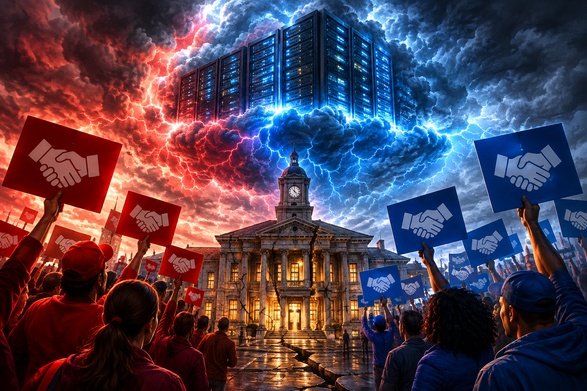
#data centers#politics#community#technology#ai#local politics#loudoun county#virginia#maryland prefect
 | author: | Scott Neuman | institution: | NPR | ¿porque no los dos? |
| tl;dr | The article describes how opposition to data centers is uniting residents across party lines and disrupting local politics. Noise, electricity and water demands, and confidential development deals are fueling distrust and prompting restrictions. Examples center on Virginia and Maryland, with additional cases nationwide. The reporting also acknowledges substantial tax revenue, construction jobs and other economic benefits, and includes industry responses. Its central argument is that community concerns and demands for transparency increasingly outweigh traditional party loyalties. | ||||
| deeper: | The article favors residents’ perspectives through protest imagery, extensive activist quotations and dramatic language about political upheaval. However, its emphasis on transparency and local accountability is not distinctly partisan, and it includes industry responses and concrete tax benefits. Named sources, linked studies, polling and multiple local examples strengthen the reporting. Weaknesses include limited explanation of polling and movement-count methodology, little quantified comparison of environmental costs and benefits, and a sweeping national thesis supported largely by selected communities. The screenshots alone do not independently verify the linked claims. | ||||
media: | |||||
| gen: 2026/09/11:04:56 in 33.9 sec (old)bias: 4 (Center-Left) |
| type: newsquality: 74 |
| pts: 0 |


| gen: 2026/09/10:03:35 in 39.5 sec (old)bias: 6 (Center) |
| type: newsquality: 68 |
| pts: 0 |


| gen: 2026/08/20:15:22 in 36.8 sec (old)bias: 4 (Center) |
| type: newsquality: 55 |
| pts: 0 |

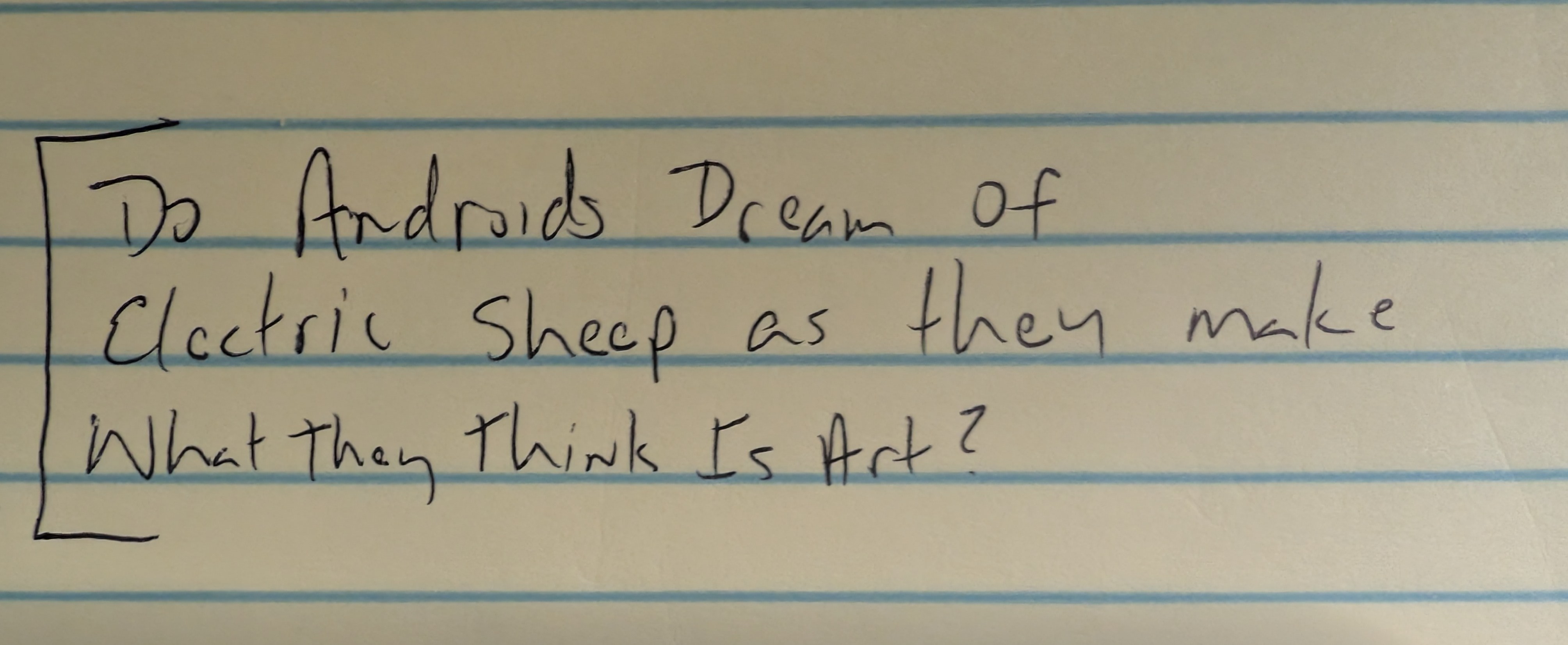 | author: | Unknown | institution: | Unknown | ¿porque no los dos? |
| tl;dr | The image shows a handwritten, bracketed title: “Do Androids Dream Of Electric Sheep as they make what they think is Art?” It riffs on Philip K. Dick’s novel title to pose a skeptical question about whether machine-made output—presumably AI-generated—counts as “art,” suggesting machines may imitate creativity without understanding it. | ||||
| deeper: | Bias is mild-to-moderate: the phrasing “what they think is Art” carries a skeptical, slightly dismissive stance toward machine creativity and implies limited or absent understanding on the machine’s part. It doesn’t argue the opposite side or define terms, so it nudges the reader toward doubt rather than inquiry. Quality is moderate: it’s clear, legible, and conceptually evocative, but it’s only a prompt/title with no evidence, context, or reasoning to support a substantive claim. | ||||
media: No Media Preview | |||||
| gen: 2026/08/10:22:47 in 4 min 38.7 sec (old)bias: 4 (Center) |
| type: lolsquality: 72 |
| pts: 0 |

 | author: | Unknown | institution: | Yahoo Finance | ¿porque no los dos? |
| tl;dr | A Yahoo Finance news article reports Nvidia is working with major financial firms and banks to raise up to $500bn to fund AI infrastructure—especially large-scale data centers and power/compute buildouts. The piece cites Nvidia CEO Jensen Huang and names partners/investors such as BlackRock, Microsoft, and others, framing the effort as meeting surging demand for AI computing and energy. It emphasizes the scale of capital needed, the strategic importance of “AI factories,” and potential economic productivity gains, with limited discussion of risks or constraints. | ||||
| deeper: | The reporting is mostly straightforward and attribution-heavy (named companies, executive quotes, and a clear description of the funding goal). Bias shows up as a mildly boosterish framing: it largely accepts industry narratives about AI infrastructure necessity and economic benefits, while giving less space to counterpoints like grid constraints, environmental impacts, demand uncertainty, or financial risk. Quality is solid for a business brief, but it leans on corporate statements and big numbers without much independent validation or detailed deal structure (e.g., terms, timelines, binding commitments). | ||||
media: | |||||
| gen: 2026/08/09:05:07 in 37.9 sec (old)bias: 7 (Center-Left) |
| type: newsquality: 62 |
| pts: 0 |
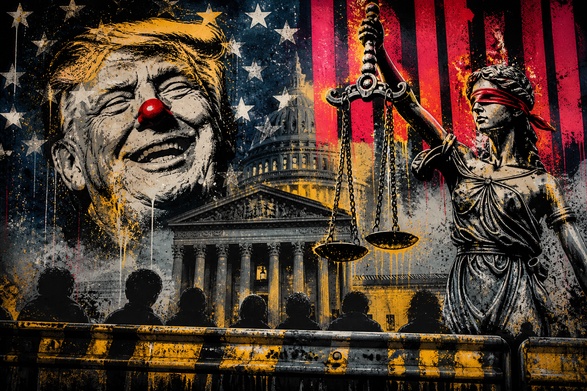
 | author: | Unknown | institution: | HuffPost (via Yahoo News) | ¿porque no los dos? |
| tl;dr | The image shows a Yahoo News page featuring a HuffPost article titled “Just Kidding!: Trump Posts AI Image Of Scenario Many Of His Critics Fear Most.” The piece appears to report and interpret Donald Trump sharing an AI-generated image that, in the author’s framing, echoes a feared authoritarian or retaliatory scenario. The headline signals a focus on criticism of Trump’s intent/messaging and the implications of using AI imagery in political communication. | ||||
| deeper: | The headline uses loaded framing (“Just Kidding!” and “scenario many of his critics fear most”), which signals an adversarial stance and preloads the reader toward a negative interpretation. That’s a bias marker even if the underlying event (posting an AI image) is factual. Quality is moderate: it’s a mainstream outlet and likely references a concrete post, but the framing appears more commentary-driven than neutrally reported, and the screenshot doesn’t show strong evidence of careful counterarguments or broader context in the visible portion. | ||||
media: | |||||
| gen: 2026/07/28:04:52 in 45.4 sec (old)bias: 2 (Center) |
| type: newsquality: 72 |
| pts: 0 |

 | author: | Unknown | institution: | Unknown | ¿porque no los dos? |
| tl;dr | The piece appears to describe using drones and computer-vision/object-detection methods to locate and classify items on the ground (illustrated by a photo with colored bounding boxes around objects). It frames this as a way to make field surveys faster and more systematic, with discussion of how the approach works, what it can and cannot detect reliably, and what kinds of data/training are required. The overall thrust is practical and technical rather than political. | ||||
| deeper: | The language and structure look informational and method-focused, with an emphasis on describing a workflow (drone imagery + automated detection) and its limitations. Any bias mainly comes from a pro-technology framing—highlighting efficiency gains more than potential downsides (false positives/negatives, oversight, misuse). Quality seems solid based on the technical visuals and explanatory sections, but the screenshot resolution makes it hard to verify sourcing, author credentials, or the strength of evidence cited. | ||||
media: | |||||
| gen: 2026/07/25:14:15 in 53.3 sec (old)bias: 4 (Center) |
| type: newsquality: 72 |
| pts: 0 |
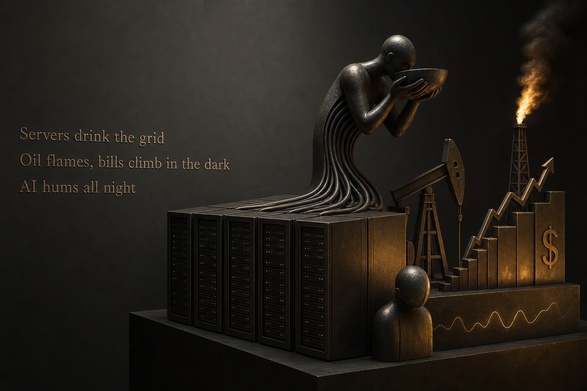
 | author: | Unknown | institution: | Yahoo Finance | ¿porque no los dos? |
| tl;dr | The piece argues that rapid growth in U.S. data centers (driven by cloud computing and especially AI) is a major, underappreciated driver of rising electricity demand and grid strain—more so than geopolitical events like Iran-related oil shocks. It suggests the “energy crisis” is being built domestically through load growth, slow grid build-out, and lagging generation/transmission additions, and it warns consumers may face higher power prices and reliability risks if infrastructure and policy don’t keep pace. | ||||
| deeper: | The headline is provocative (“Not Iran”) and frames the issue as a corrective to a popular narrative, which adds some rhetorical bias. The argument itself is broadly plausible and consistent with current load-growth discussions (AI/data centers, grid congestion, permitting delays), but the screenshot doesn’t show strong quantification transparency, clear sourcing hierarchy, or robust counterarguments (e.g., regional variation, efficiency gains, planned capacity, demand response). Overall: solid explanatory take with some sensational framing. | ||||
media: | |||||
| gen: 2026/07/22:04:59 in 1 min 31.3 sec (old)bias: 3 (Center) |
| type: lolsquality: 60 |
| pts: 0 |

#workspace#office#technology#stationery#coffee#ai#data-centers#energy#power#infrastructure#sustainability
 | author: | Unknown | institution: | Unknown | ¿porque no los dos? |
| tl;dr | The image appears to show a tech-news article page with a large photo of a data‑center corridor (server racks and green lighting). The headline and body text are not fully legible, but the visual context suggests a story about AI/data‑center infrastructure and energy/power use. Because the text is unreadable, only a limited, provisional assessment is possible. | ||||
| deeper: | Assessment is constrained by the unreadable headline/body. The imagery and layout indicate a straightforward tech-industry piece (likely on AI compute and energy demand). Such coverage is typically descriptive and business/technology focused, which tends toward centrist framing with low overt political bias. Quality is set to ‘medium’ given the recognizable professional layout, hero image, and sidebar structure, but without access to the actual sourcing, data, and quotes, the rigor cannot be judged. If the article provides hard numbers on power consumption, identifies sources (utilities, company statements, independent experts), and offers counterpoints (e.g., grid strain, emissions, efficiency gains), the quality score would rise. If it relies on anonymous claims or marketing language, it would fall. | ||||
| gen: 2026/07/12:16:37 in 1 min 17.2 sec (old)bias: 3 (Center-Left) |
| type: newsquality: 78 |
| pts: 0 |

 | author: | Maham Javaid | institution: | NPR | ¿porque no los dos? |
| tl;dr | The article examines how political campaigns are using AI-powered text-message bots to hold personalized conversations with voters, analyze voter concerns, and shape campaign messaging. It highlights potential benefits—greater responsiveness, multilingual communication, and larger-scale voter contact—but focuses chiefly on ethical risks, including undisclosed automation, misinformation, data collection, voter annoyance, and weak regulation. The article reports that Republican campaigns are adopting the technology more quickly than Democratic campaigns, while noting that the evidence about its prevalence and effectiveness remains limited. | ||||
| deeper: | The article is generally balanced and reports arguments from AI vendors, Republican strategists, progressive technology advocates, political-texting companies, a voter, and campaign-technology experts. It distinguishes reported facts from quotations and provides useful context on the growth of political texting and emerging disclosure laws. Its main framing is cautionary: ethical concerns, deception, misinformation, privacy, and voter annoyance receive more attention than the technology's possible benefits. The claim that Republicans are adapting faster than Democrats is attributed to sources, but the article supplies limited independent data to substantiate it. Many cited sources have commercial or partisan interests in the subject, and the article does not include extensive legal analysis, empirical evidence of persuasion, or responses from election regulators. Overall, it is a competent reported feature with a mild center-left tilt in emphasis rather than overt partisan advocacy. | ||||
media: No Media Preview | |||||
| gen: 2026/07/10:15:41 in 1 min 34.3 sec (old)bias: 7 (Left) |
| type: lolsquality: 85 |
| pts: 0 |

 | author: | Robert Reich | institution: | Medium | ¿porque no los dos? |
| tl;dr | The article by Robert Reich explores the economic implications of artificial intelligence (AI) on employment and consumer demand. It questions how AI's productivity gains will affect the job market and who will purchase AI-produced goods if wages and jobs decline. Reich suggests solutions such as wealth redistribution and Universal Basic Income (UBI) to address these issues. | ||||
| deeper: | The article presents a clear opinion on the economic consequences of AI, emphasizing the need for wealth redistribution and income support measures. The bias is evident in the calls for systemic change favoring wealth redistribution, a typically left-leaning stance. The quality is high due to its reliance on contemporary economic data and thoughtful analysis. | ||||
media: | |||||
You made it to the bottom. Now dance!


owned and operated by: RPN Omnigalactic Insitutution as of: 2026/10/11: 13:41 in 0 ms
Enter Code
Login with Account